Rock Cycle Diagram
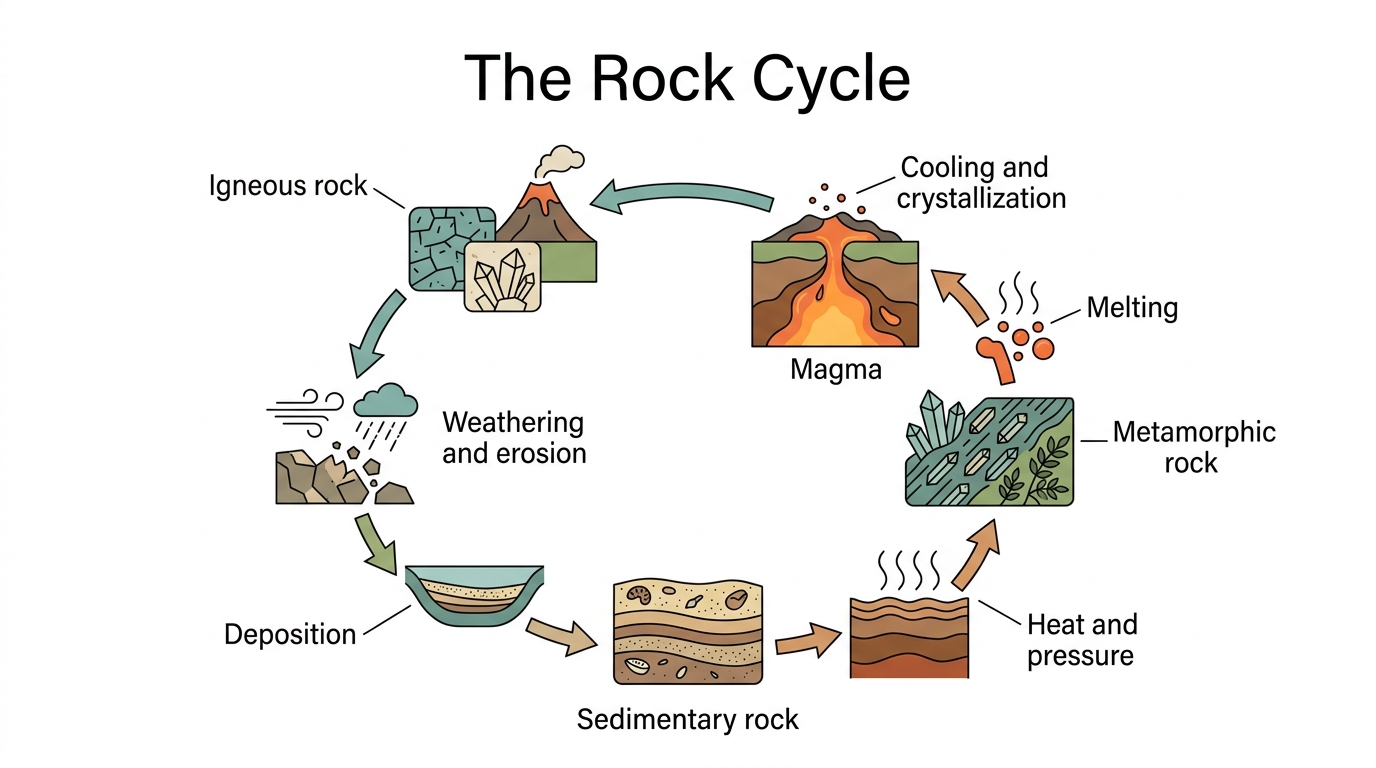
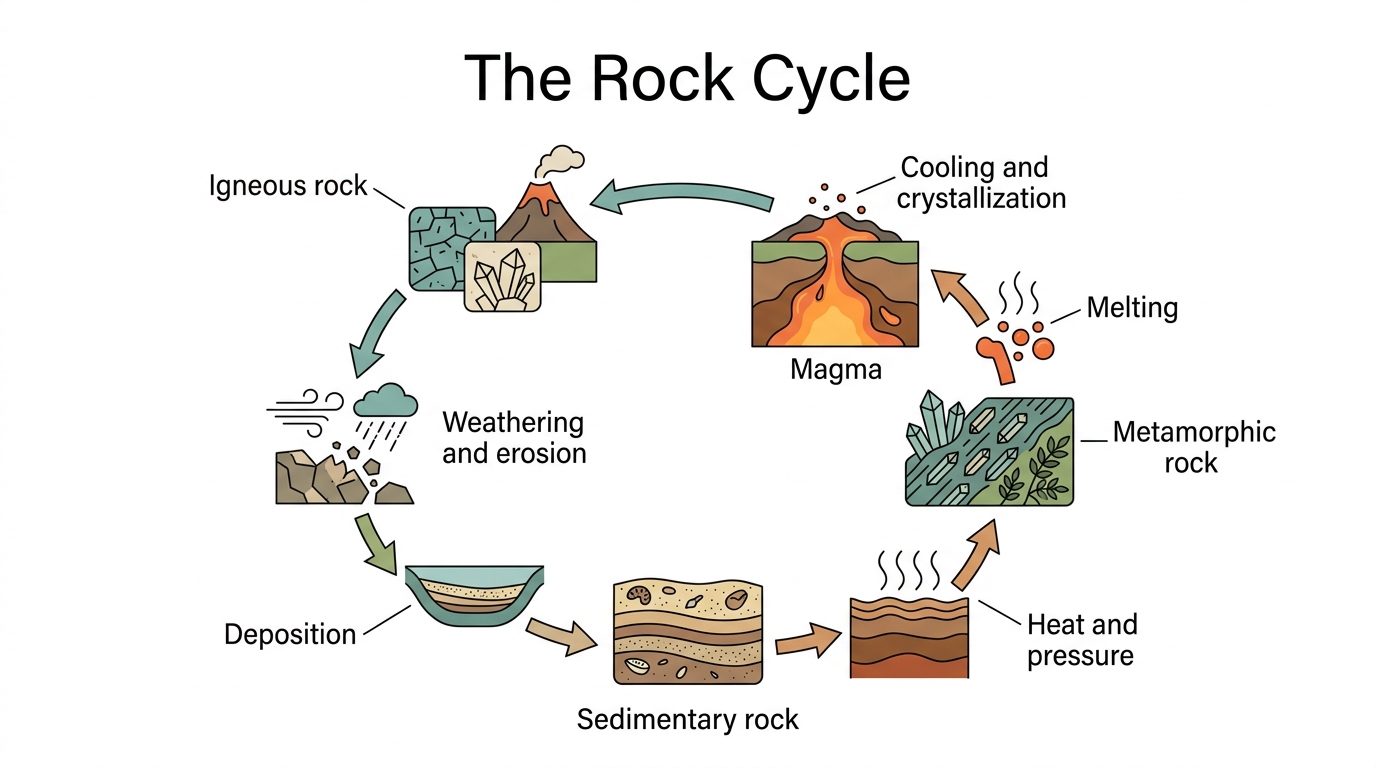
Free printable rock cycle diagram showing igneous, sedimentary and metamorphic rock and the processes that connect them — with labels and flow arrows. Download PDF or PNG for Letter paper.
The rock cycle, step by step
The rock cycle is the slow, never-ending process by which rock changes from one type to another. Here is what happens at each labeled part of the diagram:
| Step | What it does | Why it matters |
|---|---|---|
| Igneous rock | Forms when melted rock (magma or lava) cools and hardens. | Igneous rock is the starting point for the entire cycle — without it, there would be no raw material to weather, erode, or bury. The ocean floor itself is made almost entirely of igneous rock that poured out of underwater volcanoes and hardened. |
| Weathering and erosion | Wind, water and ice break rock into small pieces and carry them away. | This is how mountains slowly disappear: given enough time, even the hardest granite gets ground into grains of sand. The soil your food grows in began as rock that was broken apart by nothing more powerful than rainwater and freezing temperatures. |
| Deposition | The small pieces, called sediment, settle and pile up in layers. | Layers of sediment are nature's filing system — each new layer buries the one before it, preserving fossils, ancient climates, and clues about life that existed long before humans arrived. Without deposition, all that eroded material would just wash into the sea and vanish. |
| Sedimentary rock | Layers of sediment are pressed and cemented together over long periods of time. | Nearly all fossils ever discovered were found inside sedimentary rock, because it forms gently around objects rather than burning or crushing them. Chalk cliffs, sandstone arches, and coal seams are all sedimentary rock — compressed records of ancient environments. |
| Heat and pressure | Buried deep underground, rock is squeezed and heated without melting. | The deeper rock is buried, the more the weight of everything above it squeezes it, and the closer it gets to Earth's hot interior — a slow, invisible force that can completely rewrite a rock's structure without ever melting it. This is the step that turns ordinary limestone into the gleaming marble used in famous sculptures and buildings. |
| Metamorphic rock | Rock that has been changed by heat and pressure into a new form. | Metamorphic rock is proof that solid material can be fundamentally transformed without being destroyed — the original rock is gone, but its atoms have been rearranged into something new and often much harder. Garnet and sapphire gemstones form inside metamorphic rock under exactly these conditions. |
| Melting | Rock gets hot enough to melt back into magma. | Melting is the reset button of the rock cycle: once rock becomes magma, its entire previous history is erased and it can become any type of igneous rock all over again. Without melting, the cycle would have a dead end — material would pile up as metamorphic rock and never return to the surface. |
| Magma | Molten (melted) rock beneath the Earth's surface. | Magma is the source material for all igneous rock on Earth, which means it is ultimately the ancestor of every other rock type in the cycle. It also carries heat from Earth's interior toward the surface, helping drive the movement of tectonic plates that reshapes continents over millions of years. |
| Cooling and crystallization | Magma cools and forms crystals, becoming igneous rock again. | How fast magma cools determines the size of the crystals that form — slow cooling deep underground produces large, visible crystals like those in granite, while lava that chills quickly on the surface forms tiny crystals or glassy obsidian. Those crystal sizes, locked in forever, are like a timestamp that tells geologists exactly where and how the rock formed. |
Companion worksheet
A free fill-in worksheet with an answer key, built from the labels above — students match each step to its description, then answer a couple of short questions. Great for a quick check after using the diagram.
How to print
Choose Download PDF for a ready-to-print file that fits US Letter paper (8.5 × 11") in landscape, or Download PNG for the high-resolution image.
Frequently asked questions
What is the rock cycle?
The rock cycle is the never-ending process by which rocks change from one type to another — igneous, sedimentary and metamorphic — through weathering, deposition, heat, pressure and melting.
What are the three types of rock?
Igneous rock (cooled magma or lava), sedimentary rock (compacted layers of sediment), and metamorphic rock (rock changed by heat and pressure).
What paper size should I print this on?
The diagram is sized for standard US Letter paper (8.5 × 11") in landscape orientation. Use "Download PDF" for a print-ready file that fits the page automatically.