Digestive System Diagram
Free printable digestive system diagram — a labeled illustration showing the mouth, esophagus, stomach, liver, small and large intestine and more. Download a high-resolution PDF or PNG for Letter paper.
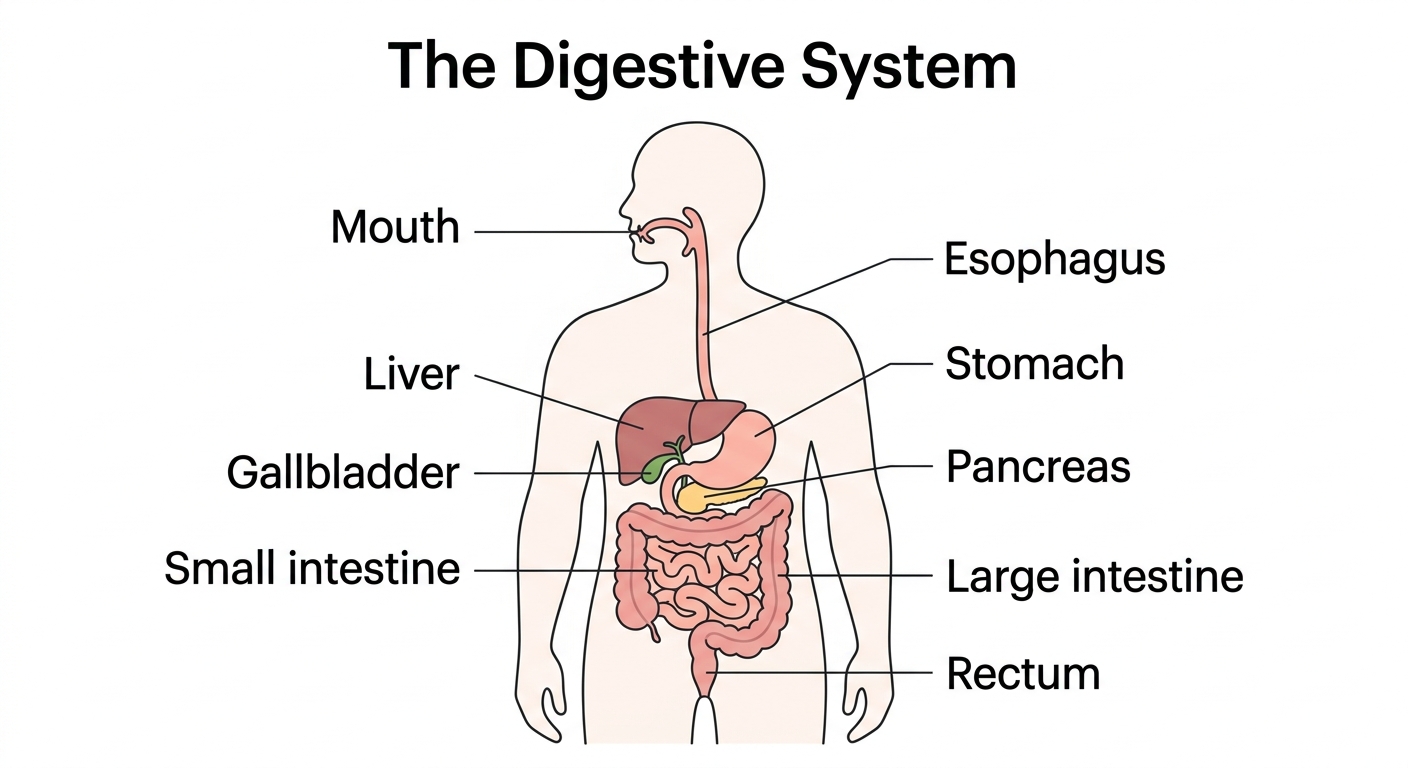
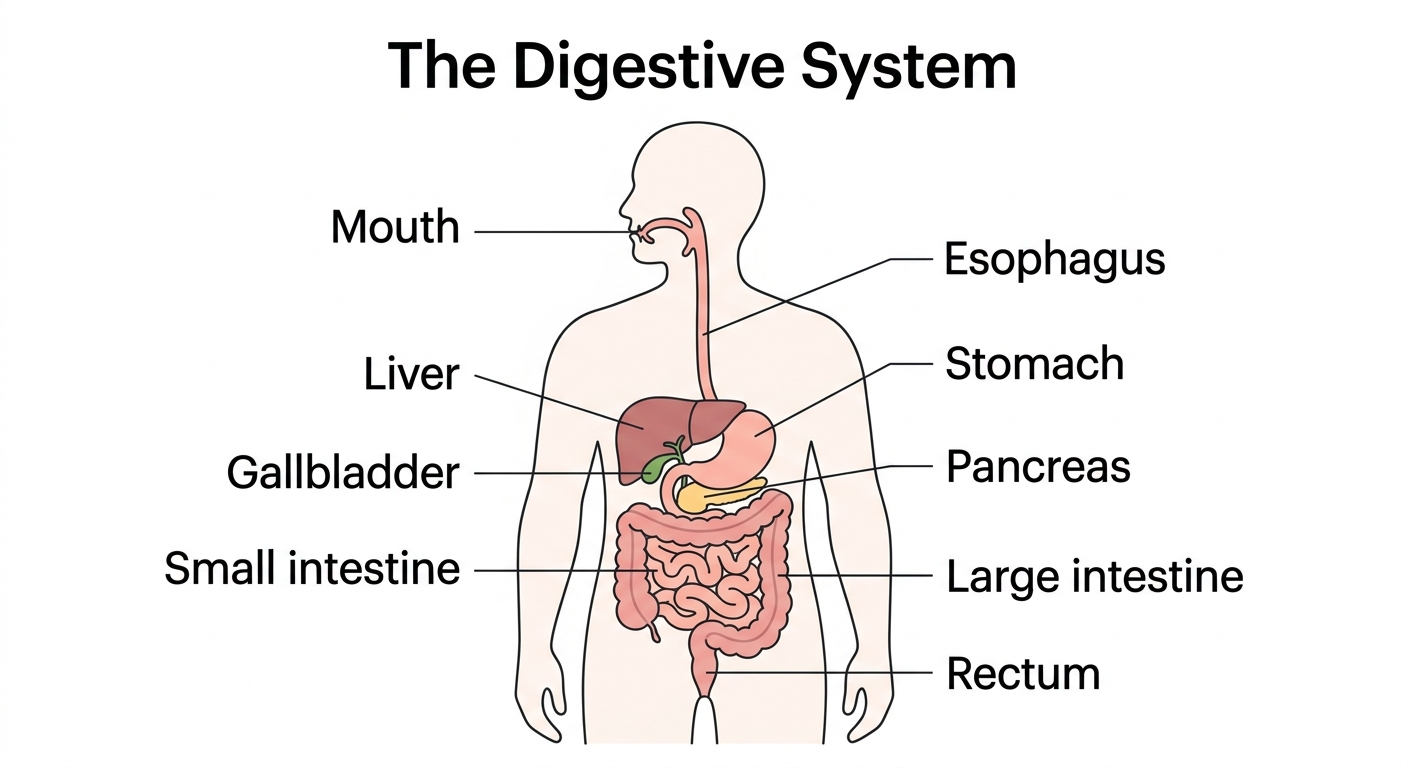
The organs of the digestive system
The digestive system breaks food down into nutrients the body can use, and removes what is left as waste. Here is what happens at each labeled part of the diagram:
| Organ | What it does | Why it matters |
|---|---|---|
| Mouth | Chewing and saliva begin breaking food down. | Skipping this step would make the rest of the system work much harder — the smaller your teeth grind food, the more surface area digestive juices can attack. Saliva also contains an enzyme that starts breaking down starch before food ever reaches the stomach. |
| Esophagus | A muscular tube that pushes food from the mouth down to the stomach. | Gravity isn't actually doing most of the work here — the esophagus uses wave-like muscle contractions called peristalsis, which is why astronauts can swallow normally even in zero gravity. Without it, food would have no reliable path to the stomach. |
| Stomach | Acids and strong muscles churn food into a thick liquid. | The acid inside your stomach is strong enough to dissolve metal, which is why it can break down tough proteins that would survive any other treatment. A special mucus layer protects the stomach walls from digesting themselves — when that layer fails, it causes a painful ulcer. |
| Liver | Makes bile, a fluid that helps digest fats. | Fat doesn't mix with water on its own, so without bile it would clump together and pass through your digestive tract almost completely undigested. The liver is also your body's chemical processing plant, filtering toxins from the blood at the same time. |
| Gallbladder | Stores the bile made by the liver until it is needed. | Rather than trickling bile out continuously, the body stores a concentrated supply and releases a larger burst exactly when a fat-rich meal arrives — a much more efficient system. Gallstones form when bile sits too long and hardens into crystals, which can be intensely painful. |
| Pancreas | Releases juices that help break down food in the small intestine. | Its enzymes are the workhorses of digestion — without them, proteins, fats, and carbohydrates would reach the small intestine only partially broken down and mostly pass through unused. The pancreas also releases insulin, the hormone that tells your cells to absorb sugar from the blood. |
| Small intestine | Where most nutrients are absorbed into the blood. | Stretched out flat, the inner lining of your small intestine would cover a tennis court — all that surface area is what allows nutrients to pass into the blood fast enough to fuel your body. If this step were skipped, you could eat constantly and still slowly starve. |
| Large intestine | Absorbs water from the leftovers and forms solid waste. | Reclaiming water here is critical — your body uses about 9 liters of fluid daily just to run digestion, and most of it gets reabsorbed before waste exits. When something speeds this process up too much (like a stomach bug), you get diarrhea because the water never gets pulled back. |
| Rectum | Stores waste until it leaves the body. | Storage here gives you conscious control over when waste leaves the body, a coordination between muscles and nerves that takes young children years to develop fully. Without this final holding stage, the entire system would have no orderly exit point. |
Companion worksheet
A free fill-in worksheet with an answer key, built from the labels above — students match each organ to its description, then answer a couple of short questions. Great for a quick check after using the diagram.
How to print
Choose Download PDF for a ready-to-print file that fits US Letter paper (8.5 × 11") in landscape, or Download PNG for the high-resolution image.
Frequently asked questions
What are the parts of the digestive system?
The main organs are the mouth, esophagus, stomach, liver, gallbladder, pancreas, small intestine, large intestine and rectum.
What does the digestive system do?
It breaks food into tiny nutrients the body absorbs for energy and growth, and removes the leftover material as waste.
What paper size should I print this on?
The diagram is sized for standard US Letter paper (8.5 × 11") in landscape orientation. Use "Download PDF" for a print-ready file that fits the page automatically.