 Printable Scholar
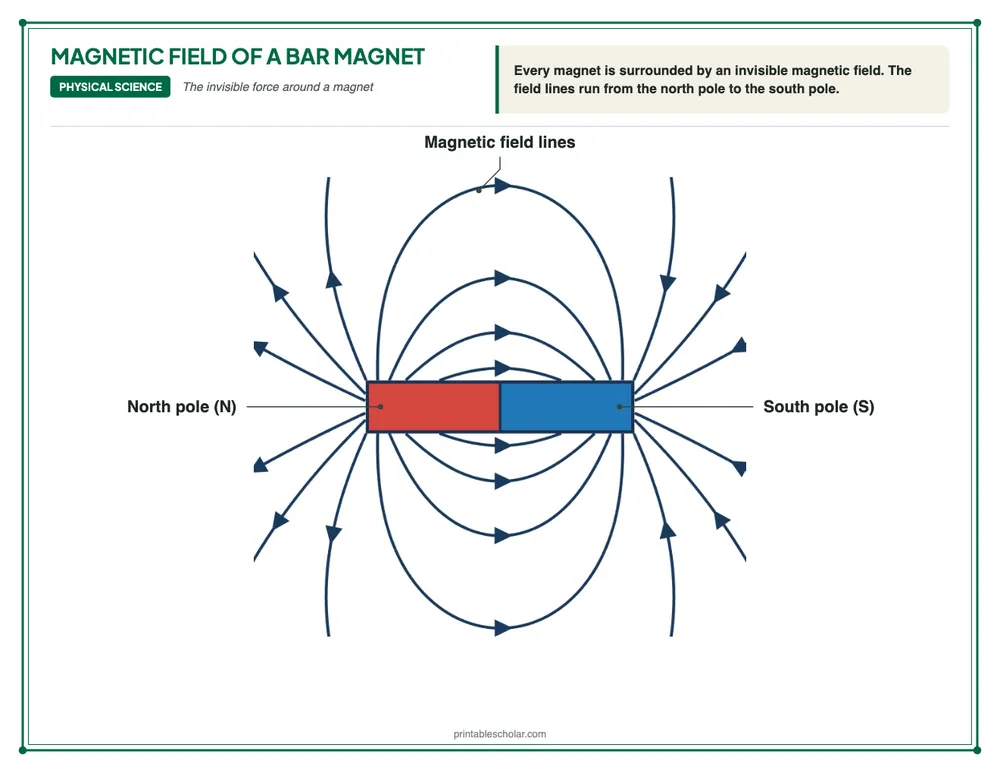
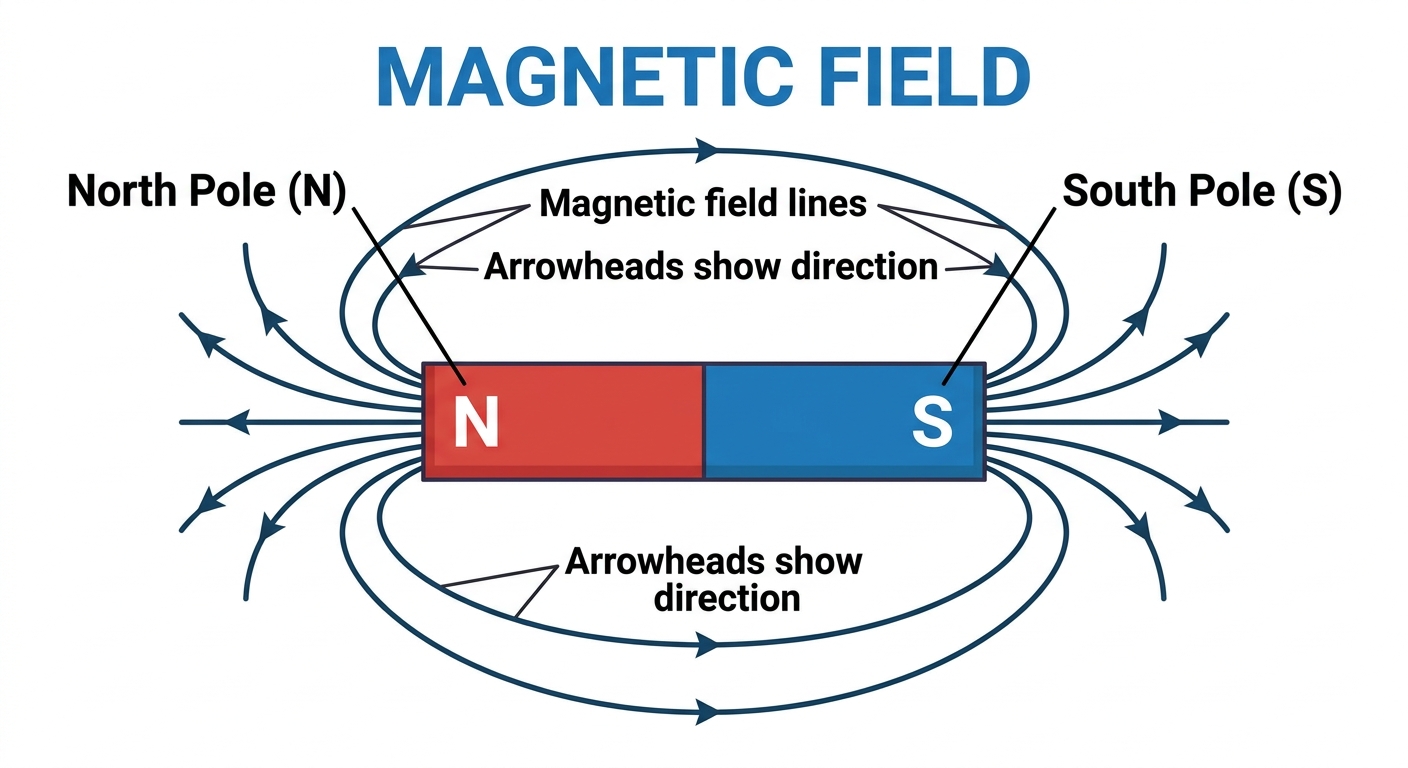
Magnetic Field Diagram
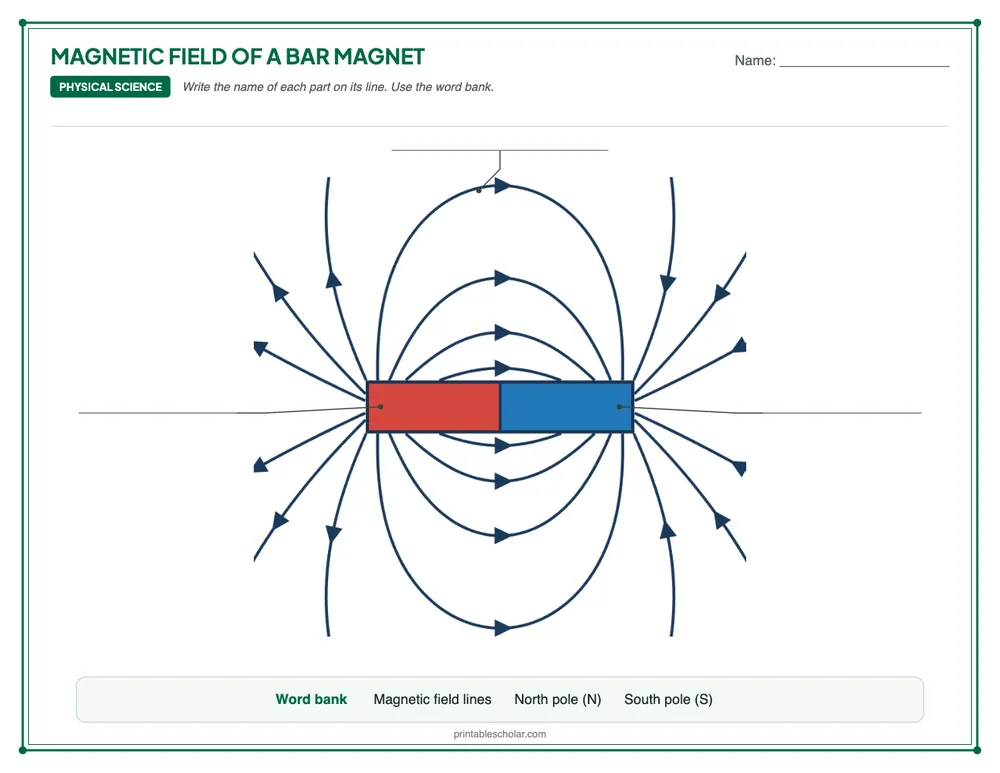
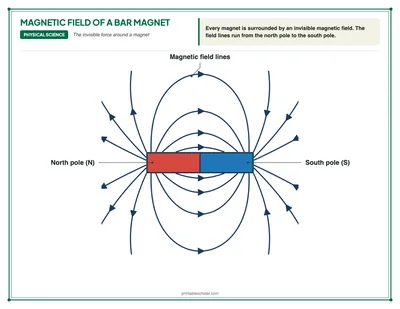
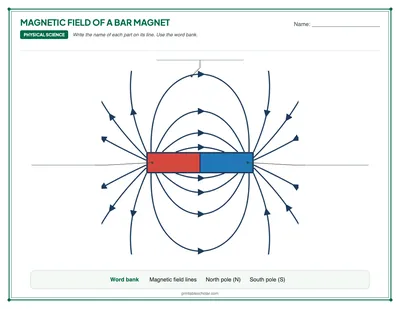
Free printable magnetic field diagram — a bar magnet with its north and south poles and the curved field lines that run between them, with labels and direction arrows. Download PDF or PNG for Letter paper.
Part of the Magnets and Magnetic Fields teaching pack for grades 3 to 5: 25 lesson slides and 8 printables with answer keys. The diagram and the blank one to label are free.
Teaching ideas for Magnets and Magnetic Fields
Pick the ideas that suit your class, then follow the plan or use the sheets in any order.
- Test the room. Give each group a magnet and a few things: a paper clip, a pencil, a plastic spoon, some foil. Students predict first, then test each one.
- Push and pull. Hand out pairs of magnets. Students bring two ends together, then turn one magnet around, and feel the pull change to a push.
- Make a clip chain. Hang a paper clip from a magnet, then hang another clip from the first. Students see how long a chain they can make.
- Pull through paper. Put a paper clip on a sheet of paper and a magnet underneath. Students move the clip around without touching it.
A plan for the week
| Day 1 | Open with one of the ideas above. Teach the lesson with the slides while students fill in the guided notes. Then students label the blank diagram. | Lesson slides (PowerPoint) (in the pack) Magnets and Magnetic Fields Guided Notes (in the pack) Magnetic Field Diagram Blank Magnetic Field |
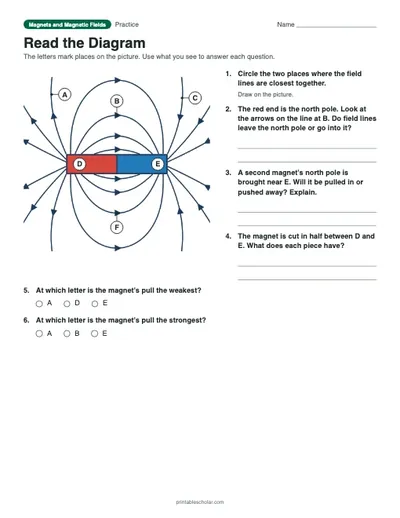
| Day 2 | Students read the field picture on “Read the Diagram”: where the field is strongest, which way the lines run and what a second magnet would do. | Read the Diagram (in the pack) |
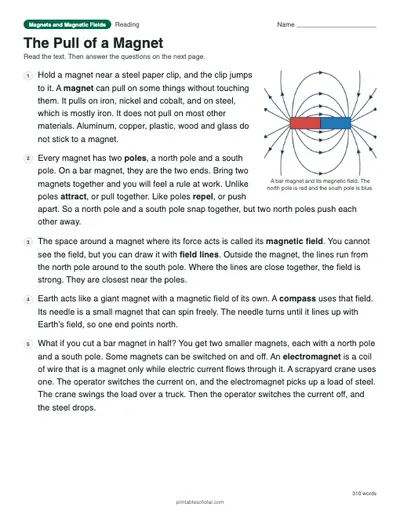
| Day 3 | Read “The Pull of a Magnet” and answer the questions. | The Pull of a Magnet (in the pack) |
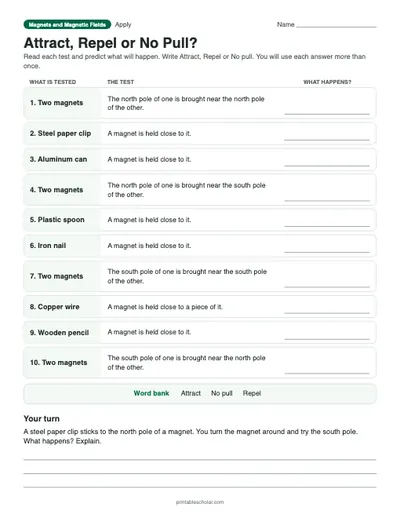
| Day 4 | Students predict what happens in ten magnet tests on “Attract, Repel or No Pull?” Test the ones you can with real magnets. | Attract, Repel or No Pull? (in the pack) |
| Day 5 | Review with the crossword, then give the quiz. | Magnets Crossword (in the pack) Magnets and Magnetic Fields Quiz (in the pack) |
The sheets marked “in the pack” are in the Magnets and Magnetic Fields teaching pack below.
NGSS standards
- Supports 3-PS2-3: Ask questions to determine cause and effect relationships of electric or magnetic interactions between two objects not in contact with each other.
- Supports 3-PS2-4: Define a simple design problem that can be solved by applying scientific ideas about magnets.
Magnets and Magnetic Fields teaching pack
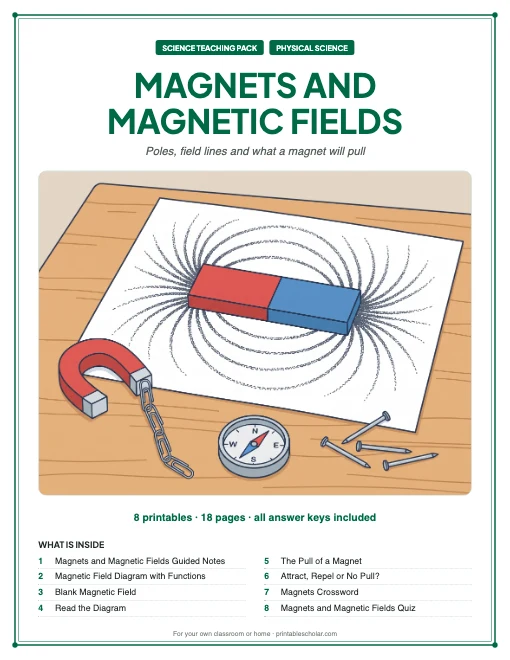
Teaching magnets and magnetic fields? Here is a ready-to-teach lesson. 25 slides and 8 printables that cover the whole topic, from the guided notes to the quiz. Present the slides while students fill in the guided notes, then use the worksheets, crossword and quiz, with every answer key.
Free on this page: the diagram and the blank one to label, marked Download below. The whole pack is $7: 18 pages in one print-ready file, the 25 lesson slides, the practice sheets, the crossword, the quiz and every answer key.
OnlineThe pack also comes as an online lesson for Google Classroom: every part on screen for students, plus a self-grading Google Forms quiz.
One-time purchase. Instant download. Secure checkout by Stripe. Want to see a whole pack first? The Skeletal System pack is free.See all 31 packs in the bundle
- The Microscope
- Photosynthesis
- Parts of a Plant and Flower
- Life Cycle of a Plant
- Life Cycles of a Butterfly and a Frog
- Food Chains and Food Webs
- The Water Cycle
- Human Body Organs
- Skeletal System
- Muscular System
- Digestive System
- Respiratory System
- Heart and Circulation
- Nervous System and Brain
- Eye and Ear
- Parts of a Tooth
- Inside the Earth and Volcanoes
- Rocks and the Rock Cycle
- Layers of the Atmosphere
- Types of Clouds
- Weathering, Erosion and Deposition
- Types of Landforms
- The Solar System
- The Seasons
- Moon Phases and Eclipses
- States of Matter
- Electric Circuits
- Forms of Energy
- Scientific Method
- Simple Machines
- Magnets and Magnetic Fields (this pack)
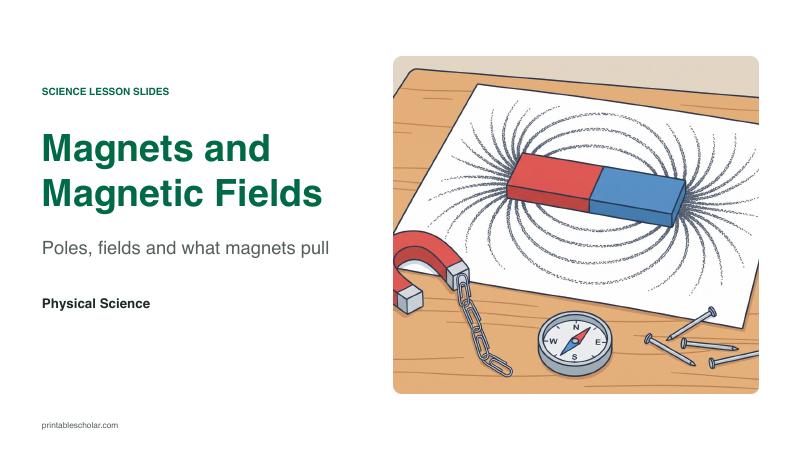
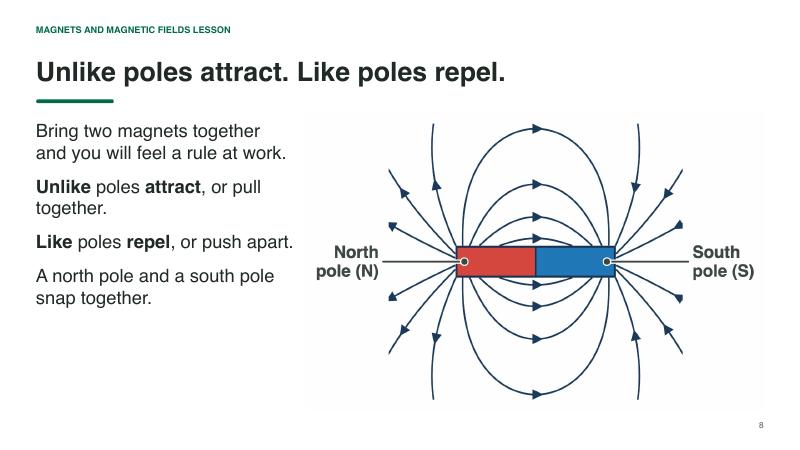
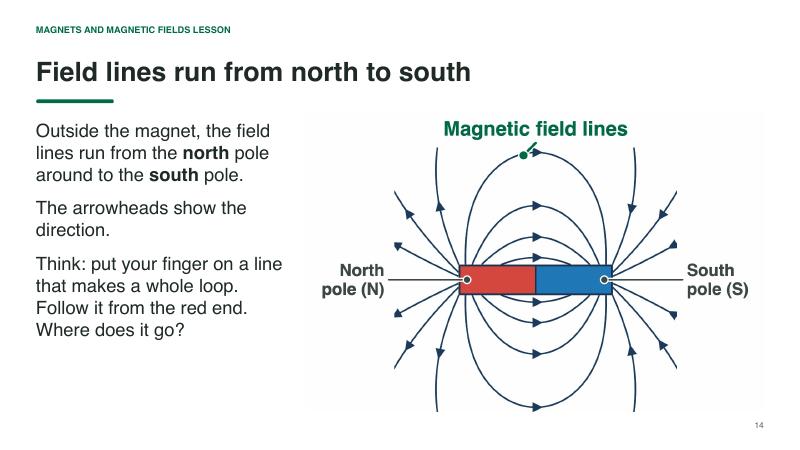
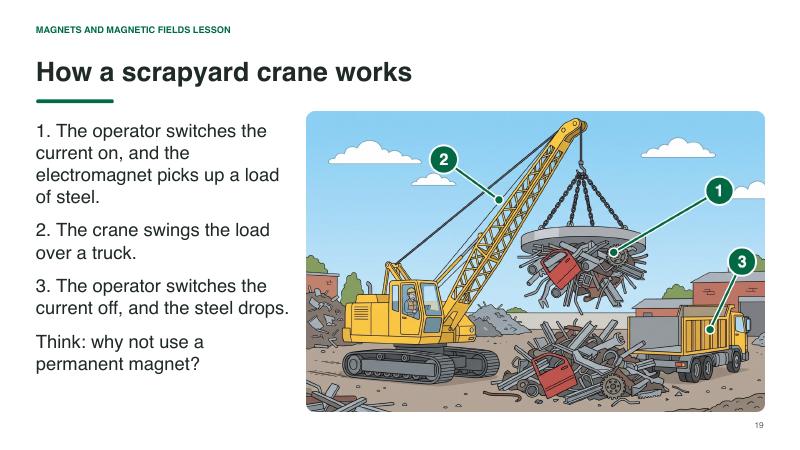
Teach Magnets and Magnetic Fields with 25 ready-made slides
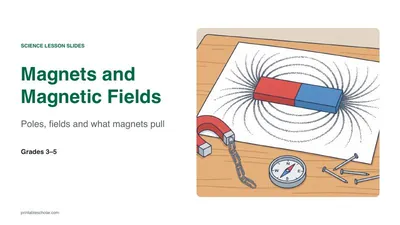
Open the PowerPoint and teach: an opening question, the parts one at a time on the diagram, quick checks and an exit question. Students fill in the guided notes sheet as you go.
Every slide comes with teacher notes: what to say, what to ask, and sample answers.
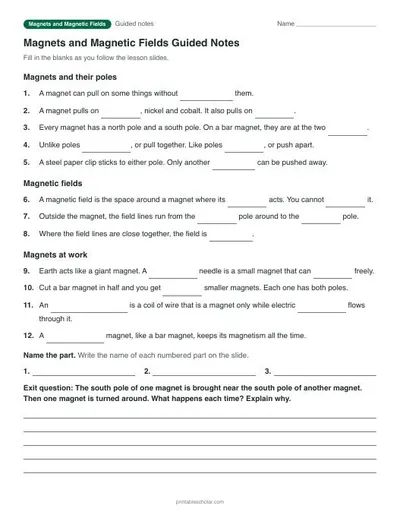
The slides (PowerPoint and a PDF copy) and the guided notes sheet come with the pack.
What is in the pack, in teaching order
 In the pack
1. TeachLesson Slides25 slides to present, with your notes for each one.In the $7 pack
 In the pack
1. TeachMagnets and Magnetic Fields Guided NotesStudents fill in the blanks as you present. With answer key.In the $7 pack
 Free
 Free
 In the pack
3. ReasonRead the DiagramRead the magnet picture: find where the field is strongest and weakest, which way the lines run, and what a second magnet would do.In the $7 pack
 In the pack
4. ReadThe Pull of a MagnetA one-page text on poles, magnetic fields, compasses and electromagnets, with eight questions.In the $7 pack
 In the pack
5. ApplyAttract, Repel or No Pull?Predict what happens in ten magnet tests: attract, repel or no pull.In the $7 pack
 In the pack
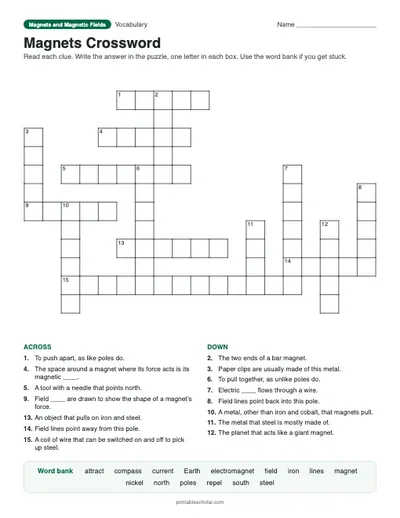
6. ReviewMagnets CrosswordFifteen magnet words with clues and a word bank.In the $7 pack
 In the pack
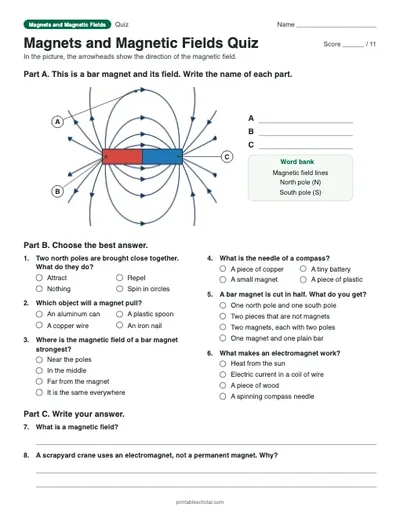
7. CheckMagnets and Magnetic Fields QuizLabel three parts, six multiple choice and two written answers. Scored out of 11.In the $7 pack
Magnets and Magnetic Fields worksheets, crossword and quiz
The Magnets and Magnetic Fields teaching pack is 25 lesson slides (PowerPoint and PDF) and 8 printables with answer keys for grades 3 to 5, in the order you would teach them: the guided notes for the lesson slides, the labeled diagram and the blank one to label, then “Read the Diagram” (a worksheet), “The Pull of a Magnet” (a reading passage), “Attract, Repel or No Pull?” (an attract-or-repel table), a vocabulary crossword and a quiz.
The sheets are in a suggested teaching order: teach the lesson, have students label the blank diagram, then work through the practice sheets and finish with the quiz. Use them all over a week or pick the ones you need. The answer keys are together at the back.
The diagram and the blank one to label are free to download on this page. The other sheets come with the pack ($7), which is also in the Elementary Science bundle (grades 3 to 6).
The magnetic field of a bar magnet
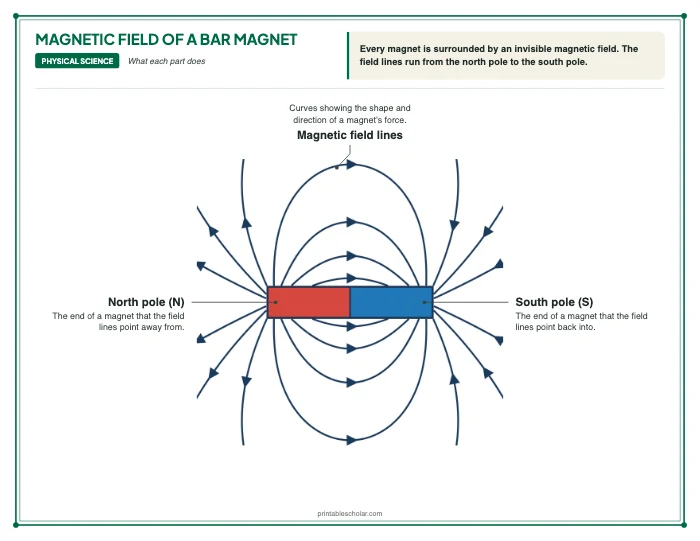
Every magnet is surrounded by an invisible magnetic field. This diagram shows the field of a bar magnet, drawn as curved field lines running from the north pole to the south pole. Here is what happens at each labeled part of the diagram:
| Part | What it does | Why it matters |
|---|---|---|
| North pole (N) | One end of the magnet. Outside the magnet, magnetic field lines point away from the north pole. | Field lines fan outward from the north pole like water spraying from a hose — without a source end to push the field out, there would be no directed force and magnets couldn't attract or repel anything. |
| South pole (S) | The other end of the magnet. Field lines point back into the south pole. | Every field line that leaves the north pole must return somewhere, and that somewhere is the south pole. Slice a bar magnet in half hoping to isolate just one pole and you'll always get two new poles — nature never allows a loose end. |
| Magnetic field lines | Curved lines that show the shape of the field. They are closest together near the poles, where the field is strongest. The arrowheads show its direction: outside the magnet, from the north pole round to the south pole. | Where field lines bunch tightly together, the force is strong enough to lift a paperclip or deflect a compass from across a table; where they spread far apart, the force has faded to nearly nothing. Engineers use this crowding pattern to design speakers, motors, and MRI machines that need precise control over where magnetic force acts. |
How to print
Choose Download PDF for a ready-to-print file that fits US Letter paper (8.5 × 11") in landscape, or Download PNG for the high-resolution image.
Frequently asked questions
Which way do magnetic field lines point?
Outside the magnet, magnetic field lines always point from the north pole to the south pole. Inside the magnet they run from south to north.
Where is a magnetic field strongest?
A magnetic field is strongest near the poles of the magnet, where the field lines are closest together.
What paper size should I print this on?
The diagram is sized for standard US Letter paper (8.5 × 11") in landscape orientation. Use "Download PDF" for a print-ready file that fits the page automatically.
Are there Magnets and Magnetic Fields worksheets to go with the diagram?
Yes. The Magnets and Magnetic Fields teaching pack, for grades 3 to 5, has 25 lesson slides and 8 printables with answer keys: the guided notes for the lesson slides, the labeled diagram and the blank one to label, then “Read the Diagram” (a worksheet), “The Pull of a Magnet” (a reading passage), “Attract, Repel or No Pull?” (an attract-or-repel table), a vocabulary crossword and a quiz. The diagram and the blank one to label are free to download on this page. The other sheets come with the pack ($7), which is also in the Elementary Science bundle (grades 3 to 6).