 Printable Scholar
Atomic Structure Diagram
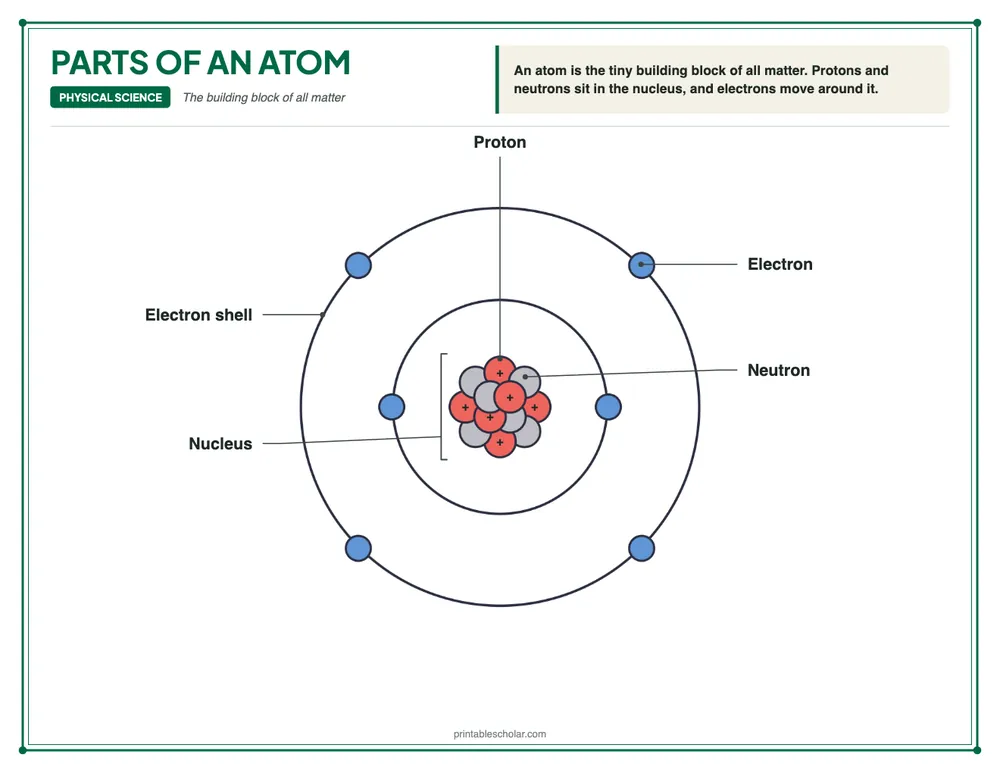
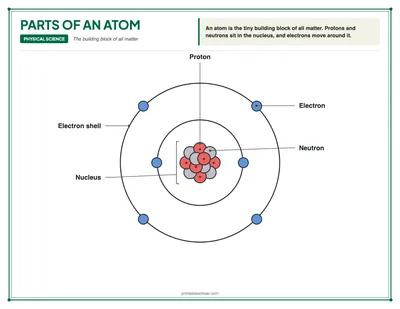
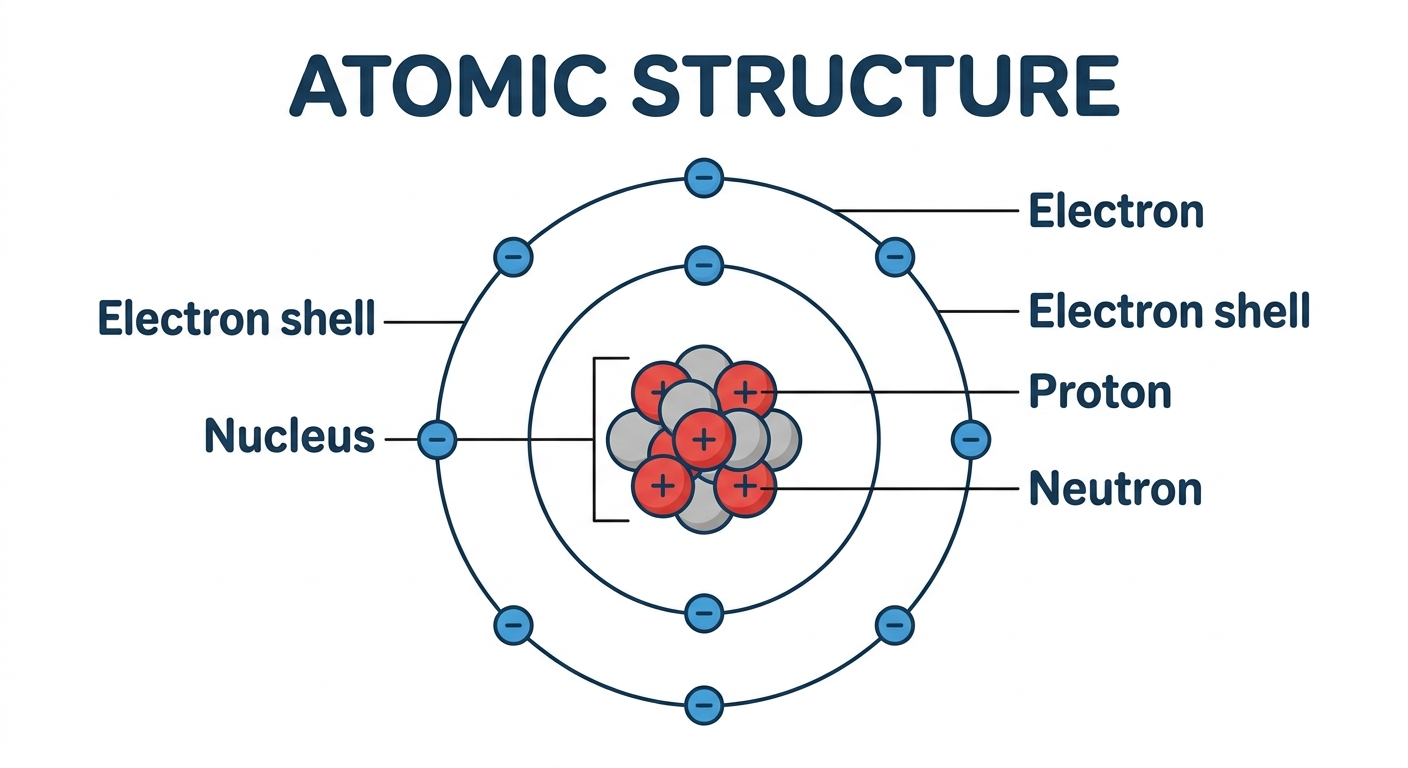
Free printable atomic structure diagram — a labeled Bohr model showing the nucleus with protons and neutrons, and electrons on their shells. Download a high-resolution PDF or PNG for Letter paper.
Part of the free Parts of an Atom teaching pack for grades 6 to 8 (introductory level): 26 lesson slides and 8 printables with answer keys, free by email.
Teaching ideas for Parts of an Atom
Pick the ideas that suit your class, then follow the plan or use the sheets in any order.
- Build a carbon atom. Use clay balls in two colors for the six protons and six neutrons. Draw two rings on paper around them and add six small electrons, two inside and four outside.
- Act out an atom. A few students stand close together as the protons and neutrons in the nucleus. Others walk around them as the electrons.
- Draw a new atom. After “Count the Particles,” students pick an element from the table and draw its nucleus and electrons, with the right number of protons.
A plan for the week
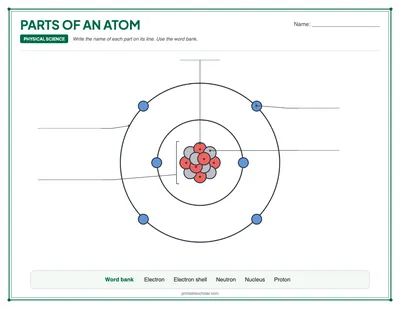
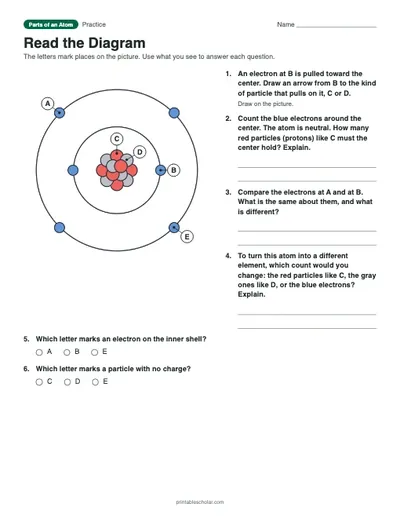
| Day 1 | Open with one of the ideas above. Teach the lesson with the slides while students fill in the guided notes. Then students label the blank diagram. | Lesson slides (PowerPoint) (in the pack) Parts of an Atom Guided Notes (in the pack) Parts of an Atom Diagram Blank Atom |
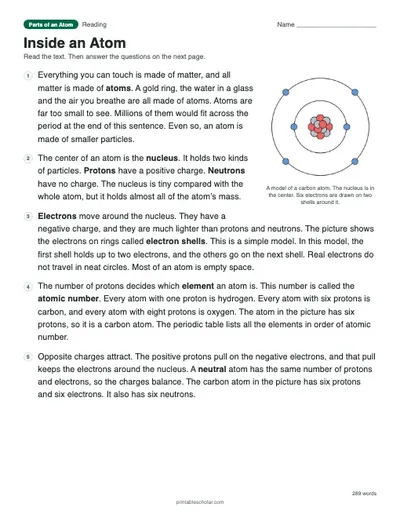
| Day 2 | Students work out what is happening inside the atom on “Read the Diagram”: which particle pulls on an electron, how many protons a neutral atom has and what would change the element. | Read the Diagram (in the pack) |
| Day 3 | Read “Inside an Atom” and answer the questions. | Inside an Atom (in the pack) |
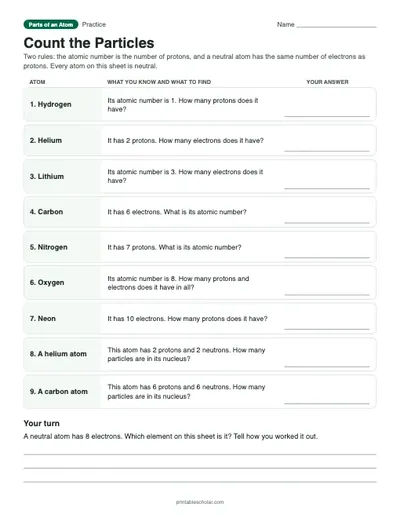
| Day 4 | Students use the atomic number to work out the protons and electrons on “Count the Particles.” | Count the Particles (in the pack) |
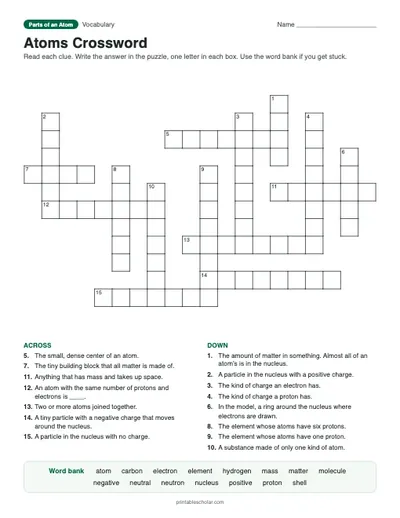
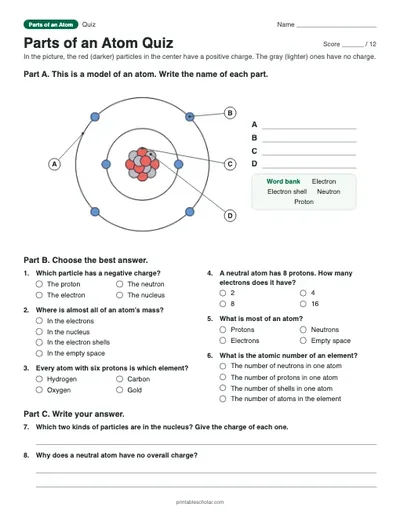
| Day 5 | Review with the crossword, then give the quiz. | Atoms Crossword (in the pack) Parts of an Atom Quiz (in the pack) |
The sheets marked “in the pack” are in the free Parts of an Atom teaching pack below, sent by email.
NGSS standards
- Supports MS-PS1-1: Develop models to describe the atomic composition of simple molecules and extended structures.
Parts of an Atom teaching pack
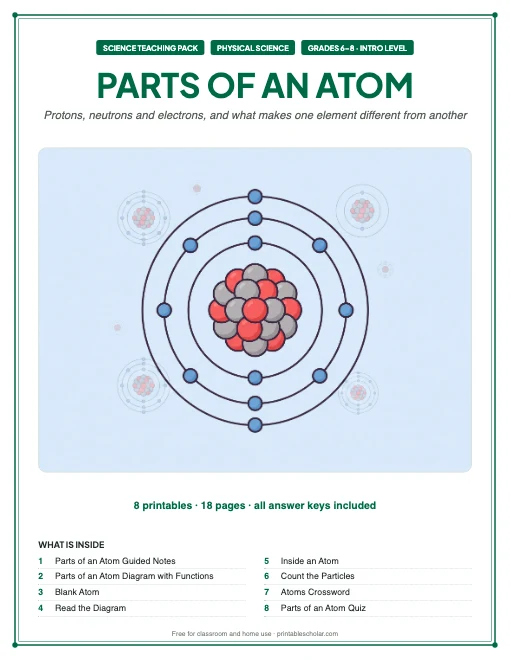
Teaching the parts of an atom? This free pack has ready-made lesson slides and 8 printables that cover the whole topic, in teaching order, with every answer key.
OnlineAlso free as an online lesson for Google Classroom: every part on screen for students, plus a self-grading Google Forms quiz. Try it
GameBuild atoms online with the free Atom Builder: students add protons, neutrons and electrons and see the element, mass number and charge change, and watch unstable atoms decay. Then join them into molecules with the free Molecule Builder and see each one's real 3D shape.
You get the whole pack (PDF, 18 pages), the lesson slides (PowerPoint and PDF) and the guided notes. Now and then we will email you when a new pack is ready. Unsubscribe any time.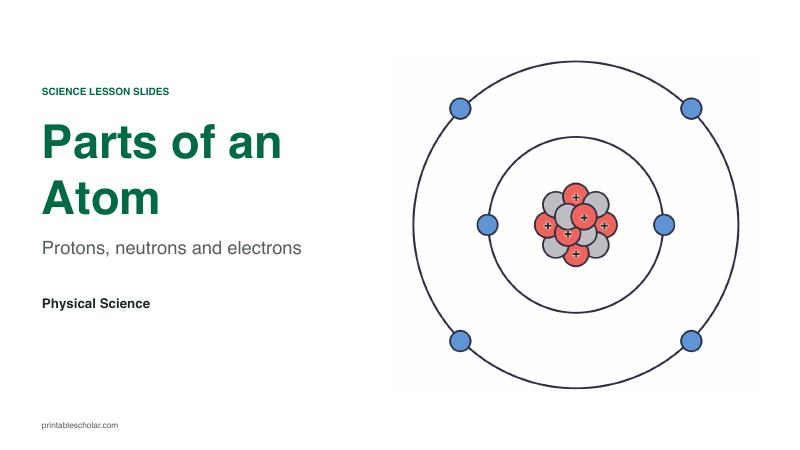
Teach Parts of an Atom with 26 ready-made slides
Open the PowerPoint and teach: an opening question, the parts one at a time on the diagram, quick checks and an exit question. Students fill in the guided notes sheet as you go.
Every slide comes with teacher notes: what to say, what to ask, and sample answers.
The slides (PowerPoint and a PDF copy) and the guided notes sheet come with the free pack, sent by email.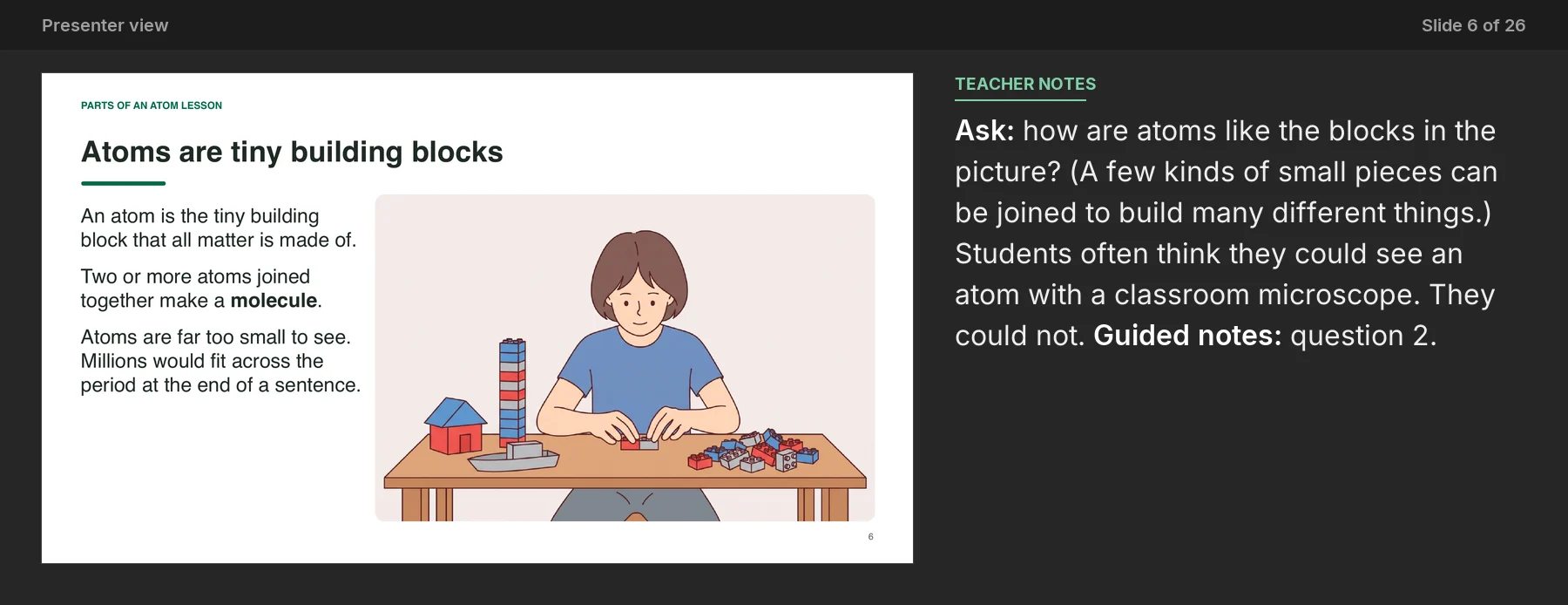
What is in the pack, in teaching order
 Free by email
1. TeachLesson Slides26 slides to present, with your notes for each one.Free by email
 Free by email
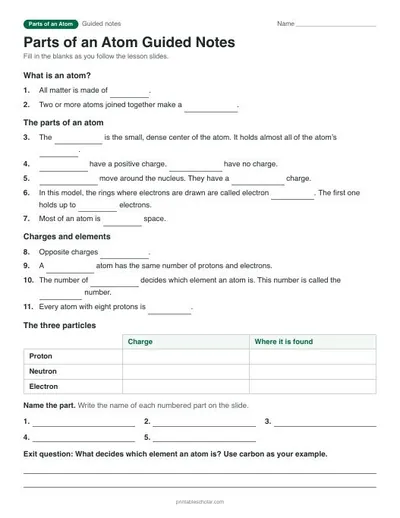
1. TeachParts of an Atom Guided NotesStudents fill in the blanks as you present. With answer key.Free by email
 Free
 Free
 Free by email
3. ReasonRead the DiagramRead the atom picture: count the particles, work out which one pulls on an electron and what would change the element.Free by email
 Free by email
4. ReadInside an AtomA one-page text on what an atom is made of and what makes each element different, with eight questions.Free by email
 Free by email
5. ApplyCount the ParticlesUse the atomic number to work out the protons and electrons in nine atoms, then try one more.Free by email
 Free by email
6. ReviewAtoms CrosswordFifteen atom words with clues and a word bank.Free by email
 Free by email
7. CheckParts of an Atom QuizLabel four parts, six multiple choice and two written answers. Scored out of 12.Free by email
Parts of an Atom worksheets, crossword and quiz
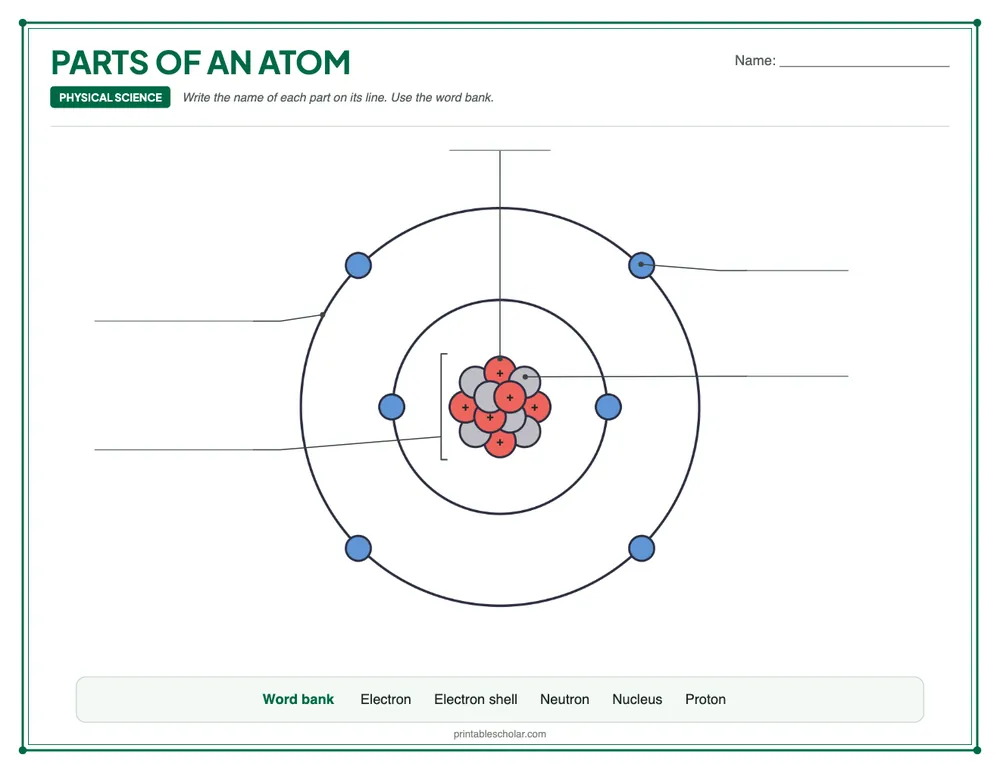
The Parts of an Atom teaching pack is 26 lesson slides (PowerPoint and PDF) and 8 printables with answer keys for grades 6 to 8 (introductory level), in the order you would teach them: the guided notes for the lesson slides, the labeled diagram and the blank one to label, then “Read the Diagram” (a worksheet), “Inside an Atom” (a reading passage), “Count the Particles” (a particle-counting table), a vocabulary crossword and a quiz.
The sheets are in a suggested teaching order: teach the lesson, have students label the blank diagram, then work through the practice sheets and finish with the quiz. Use them all over a week or pick the ones you need. The answer keys are together at the back.
The diagram and the blank one to label download free on this page. The whole pack, with every sheet, the lesson slides and every answer key, is free by email.
The parts of an atom
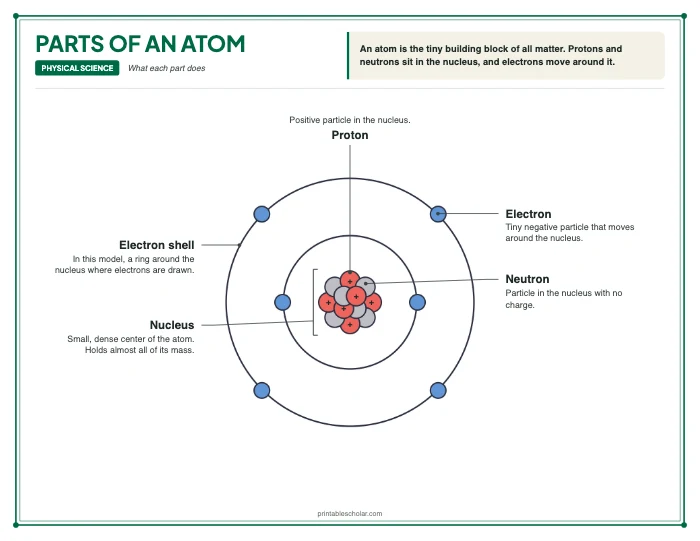
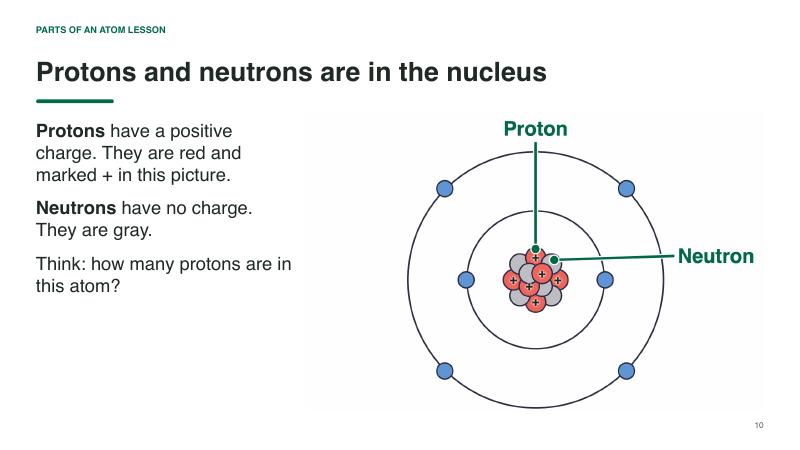
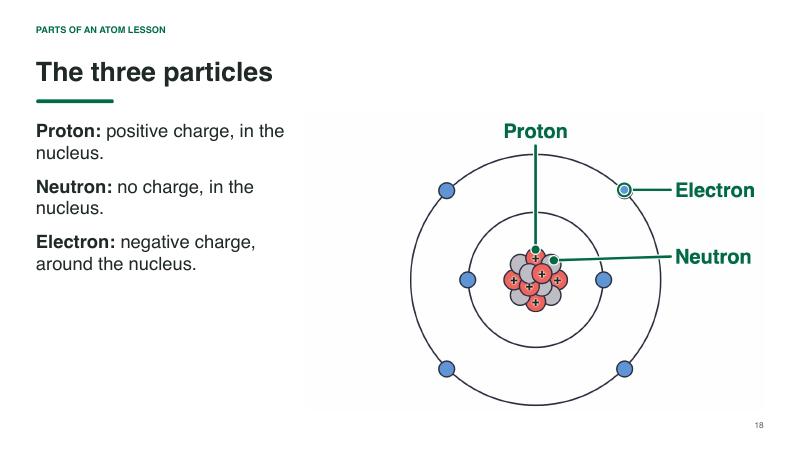
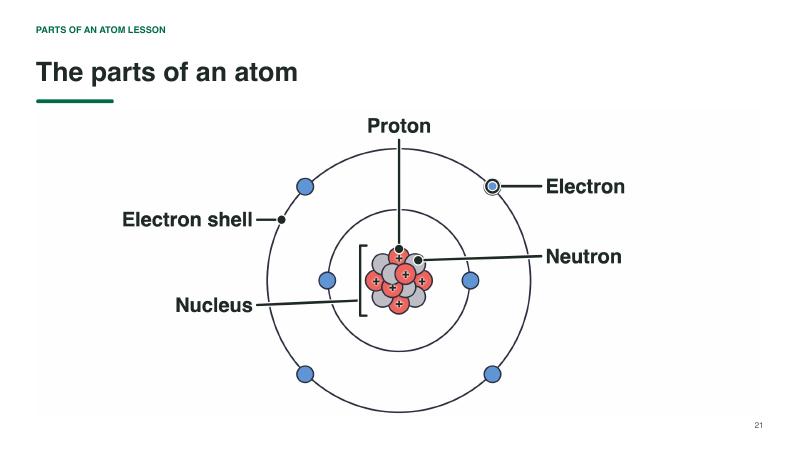
An atom is the tiny building block of all matter. This Bohr model shows its main parts: a central nucleus of protons and neutrons, orbited by electrons on their shells. Here is what happens at each labeled part of the diagram:
| Part | What it does | Why it matters |
|---|---|---|
| Nucleus | The dense center of the atom, made of protons and neutrons; it holds almost all of the atom's mass. | Without a dense, stable center, the atom would have no anchor — electrons would have nothing to orbit and matter as we know it could not hold its shape. Nearly all of the atom's mass lives here, which is why atoms feel solid even though most of their volume is empty space. |
| Proton | A positively charged particle in the nucleus. The number of protons decides which element the atom is. | The number of protons is the atom's identity — change it by even one and you have a completely different element. Add a proton to carbon and you get nitrogen; that single difference is why one is the backbone of all life and the other makes up most of the air you breathe. |
| Neutron | A particle in the nucleus with no electric charge. It adds mass and helps hold the nucleus together. | Protons are all positively charged, and like charges repel each other — so without neutrons acting as a kind of nuclear glue, the nucleus would fly apart instantly. Atoms of the same element can have different numbers of neutrons, creating isotopes, some of which are used in medical imaging and cancer treatment. |
| Electron | A tiny negatively charged particle that moves around the nucleus. | Electrons are what atoms use to interact with the world — when atoms share or transfer electrons, chemical bonds form, which is how water, air, and your DNA are built. Strip the electrons away and a neutral atom becomes a charged ion that behaves in a completely different way. |
| Electron shell | A path, or energy level, around the nucleus where electrons travel. Shells fill from the inside out. | How full or empty an atom's outermost shell is determines whether it eagerly reacts with other atoms or stays completely inert — it is the reason gold doesn't rust but iron does, and why noble gases like helium refuse to bond with almost anything. |
How to print
Choose Download PDF for a ready-to-print file that fits US Letter paper (8.5 × 11") in landscape, or Download PNG for the high-resolution image.
Frequently asked questions
What are the three main parts of an atom?
Protons and neutrons in the central nucleus, and electrons that move around it on electron shells.
What is the Bohr model?
The Bohr model is a simple picture of the atom that shows electrons orbiting the nucleus on fixed shells, like planets around the sun. It is great for learning the basic parts of an atom.
What paper size should I print this on?
The diagram is sized for standard US Letter paper (8.5 × 11") in landscape orientation. Use "Download PDF" for a print-ready file that fits the page automatically.
Are there Parts of an Atom worksheets to go with the diagram?
Yes. The Parts of an Atom teaching pack, for grades 6 to 8 (introductory level), has 26 lesson slides and 8 printables with answer keys: the guided notes for the lesson slides, the labeled diagram and the blank one to label, then “Read the Diagram” (a worksheet), “Inside an Atom” (a reading passage), “Count the Particles” (a particle-counting table), a vocabulary crossword and a quiz. The diagram and the blank one to label download free on this page. The whole pack, with every sheet, the lesson slides and every answer key, is free by email.