 Printable Scholar
States of Matter Worksheets and Diagram
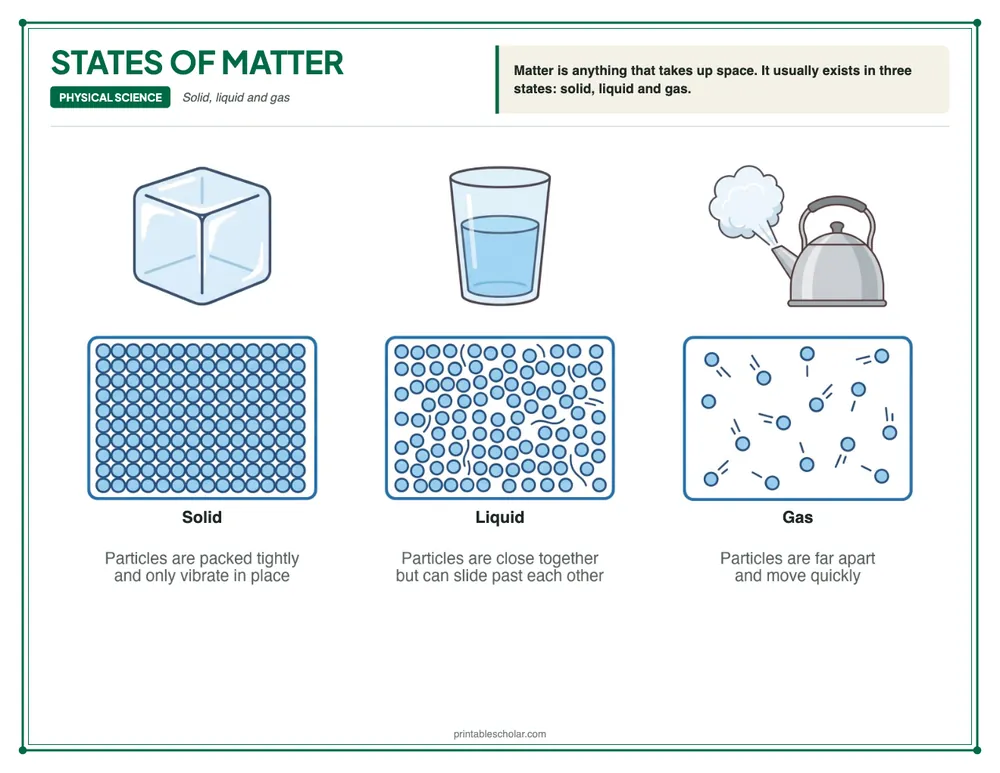
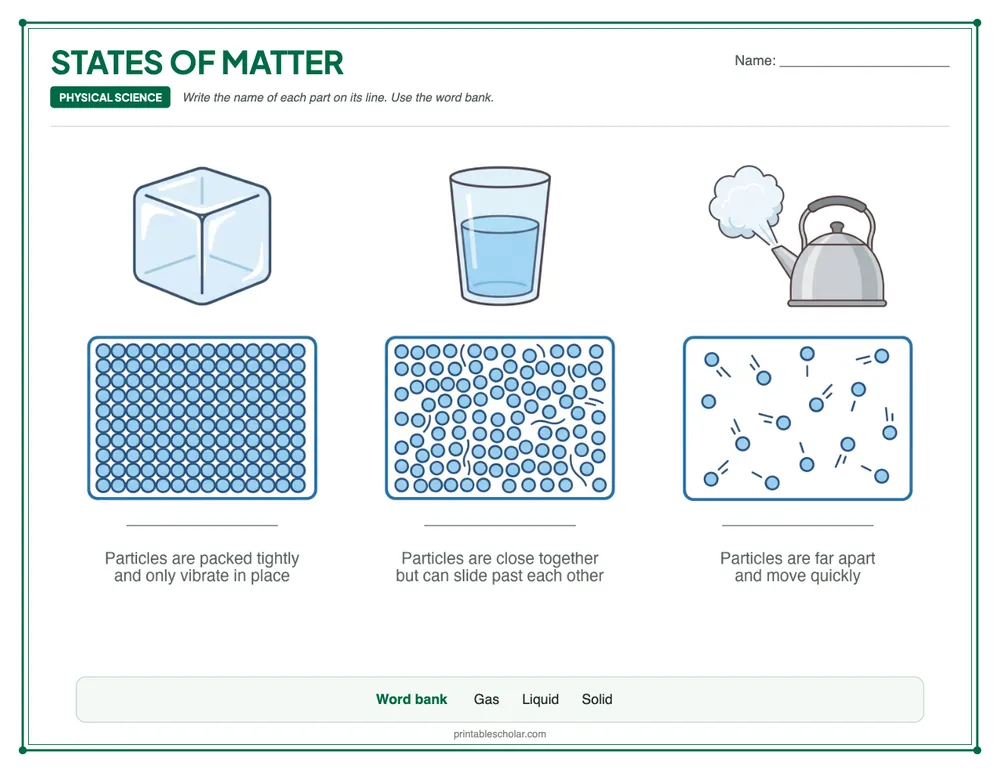
Free states of matter worksheets for grades 4-6: sort solids, liquids and gases, compare solids and liquids on a Venn diagram, and match how the particles move, with answer keys. Plus a labeled states of matter diagram and chart, and a blank one to label. PDF for Letter paper.
Part of the States of Matter teaching pack for grades 4 to 6: 26 lesson slides and 11 printables with answer keys. The diagram and the blank one to label are free, and so are three worksheets: “Solid, Liquid or Gas?”, “Solids and Liquids” and “How Do the Particles Move?”
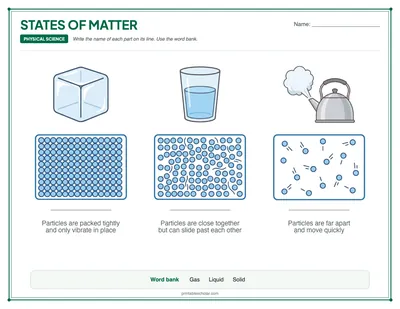
Blank diagram to label
Download blank version + answer key 3 blanks, a word bank, and the answer key on page 2Teaching ideas for States of Matter
Pick the ideas that suit your class, then follow the plan or use the sheets in any order.
- Watch ice melt. Put an ice cube in a dish at the start of class. Students name the change when it melts. Leave the water out for a few days and see the dish dry up.
- Act out the particles. Students stand close and wiggle in place as a solid, slide past each other as a liquid, then spread out across the room as a gas.
- Sort the room. Students list things in the classroom as solid, liquid or gas. A water bottle and a blown up balloon help with the last two.
- Pour it around. Pour the same water into cups and bowls of different shapes. The liquid takes the shape of each one, but there is no more or less of it.
- Wipe and watch. Wipe a wet paper towel across the board. Students watch the streak fade as the water evaporates into the air.
A plan for the week
| Day 1 | Open with one of the ideas above. Teach the lesson with the slides while students fill in the guided notes. Then students label the blank diagram. | Lesson slides (PowerPoint) (in the pack) States of Matter Guided Notes (in the pack) States of Matter Diagram Blank States of Matter |
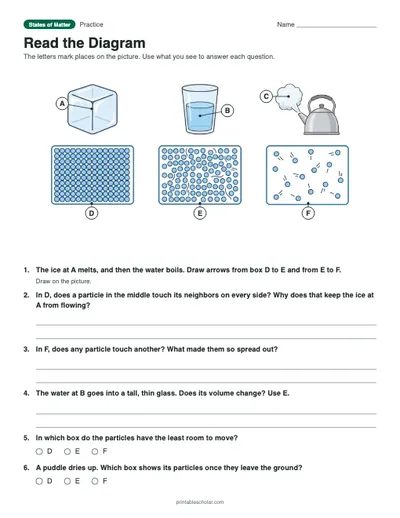
| Day 2 | Students read the particle boxes on “Read the Diagram”: they follow ice as it melts and boils and work out why a solid cannot flow and what heat does to the particles. | Read the Diagram (in the pack) |
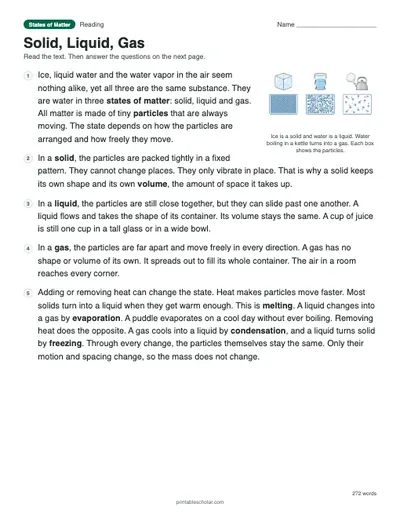
| Day 3 | Read “Solid, Liquid, Gas” and answer the questions. | Solid, Liquid, Gas (in the pack) |
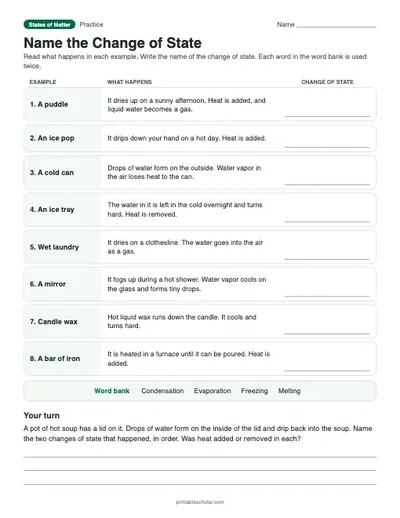
| Day 4 | Students name the change of state in eight everyday examples on “Name the Change of State.” | Name the Change of State (in the pack) |
| Day 5 | Review with the crossword, then give the quiz. | States of Matter Crossword (in the pack) States of Matter Quiz (in the pack) |
The sheets marked “in the pack” are in the States of Matter teaching pack below.
NGSS standards
- Supports 5-PS1-1: Develop a model to describe that matter is made of particles too small to be seen.
- Supports 5-PS1-2: Measure and graph quantities to provide evidence that regardless of the type of change that occurs when heating, cooling, or mixing substances, the total weight of matter is conserved.
- Supports MS-PS1-4: Develop a model that predicts and describes changes in particle motion, temperature, and state of a pure substance when thermal energy is added or removed.
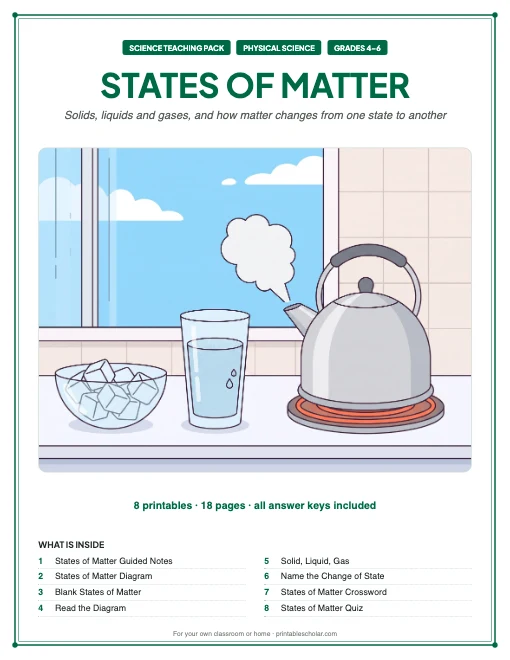
States of Matter teaching pack
Teaching the states of matter? Here is a ready-to-teach lesson. 26 slides and 11 printables that cover the whole topic, from the guided notes to the quiz. Present the slides while students fill in the guided notes, then use the worksheets, crossword and quiz, with every answer key.
Free on this page: 5 of the 11 printables, marked Download below. The whole pack is $7: 24 pages in one print-ready file, the 26 lesson slides, the practice sheets, the crossword, the quiz and every answer key.
OnlineThe pack also comes as an online lesson for Google Classroom: every part on screen for students, plus a self-grading Google Forms quiz.
GameMelt, boil and freeze online with the free States of Matter simulation: students heat and cool a jar of particles, watch them change state and see the heating curve go flat at the melting and boiling points.
One-time purchase. Instant download. Secure checkout by Stripe. Want to see a whole pack first? The Skeletal System pack is free.See all 31 packs in the bundle
- The Microscope
- Photosynthesis
- Parts of a Plant and Flower
- Life Cycle of a Plant
- Life Cycles of a Butterfly and a Frog
- Food Chains and Food Webs
- The Water Cycle
- Human Body Organs
- Skeletal System
- Muscular System
- Digestive System
- Respiratory System
- Heart and Circulation
- Nervous System and Brain
- Eye and Ear
- Parts of a Tooth
- Inside the Earth and Volcanoes
- Rocks and the Rock Cycle
- Layers of the Atmosphere
- Types of Clouds
- Weathering, Erosion and Deposition
- Types of Landforms
- The Solar System
- The Seasons
- Moon Phases and Eclipses
- States of Matter (this pack)
- Electric Circuits
- Forms of Energy
- Scientific Method
- Simple Machines
- Magnets and Magnetic Fields
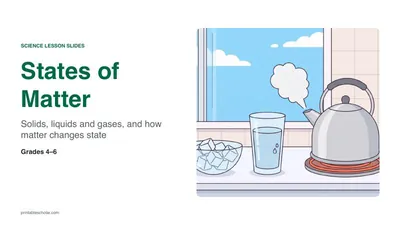
Teach States of Matter with 26 ready-made slides
Open the PowerPoint and teach: an opening question, the parts one at a time on the diagram, quick checks and an exit question. Students fill in the guided notes sheet as you go.
Every slide comes with teacher notes: what to say, what to ask, and sample answers.
The slides (PowerPoint and a PDF copy) and the guided notes sheet come with the pack.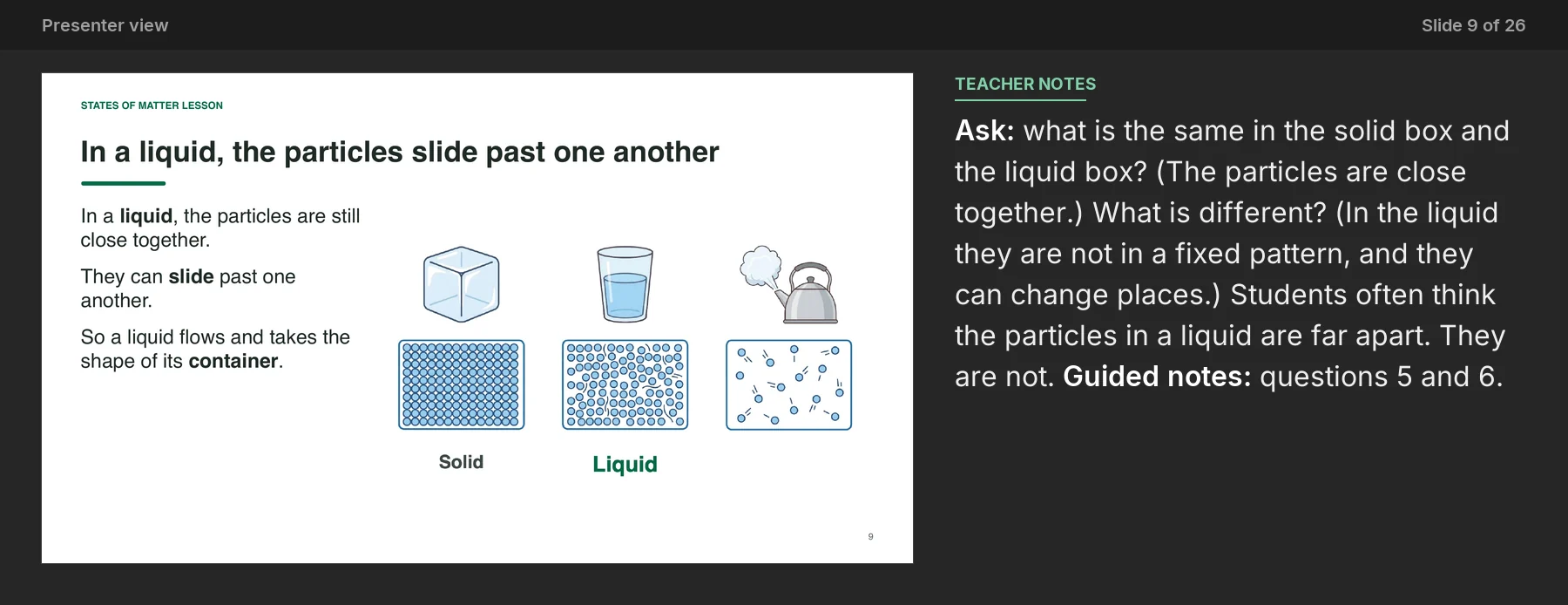
What is in the pack, in teaching order
 In the pack
1. TeachLesson Slides26 slides to present, with your notes for each one.In the $7 pack
 In the pack
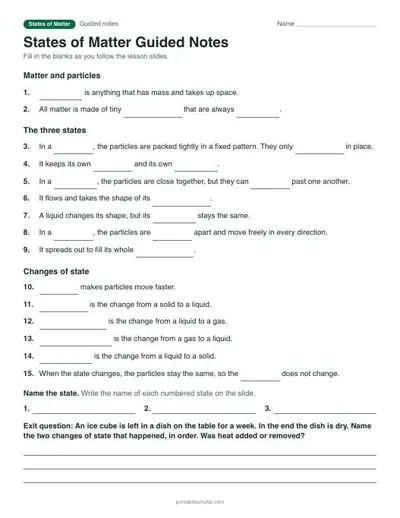
1. TeachStates of Matter Guided NotesStudents fill in the blanks as you present. With answer key.In the $7 pack
 Free
 Free
 In the pack
3. ReasonRead the DiagramRead the particle boxes: follow ice as it melts and boils, and work out why it can or cannot flow, what heat does and where gas particles go.In the $7 pack
 In the pack
4. ReadSolid, Liquid, GasA one-page text on how particles behave in solids, liquids and gases, with eight questions.In the $7 pack
 In the pack
5. ApplyName the Change of StateName the change of state in eight everyday examples, then explain one more.In the $7 pack
 Free
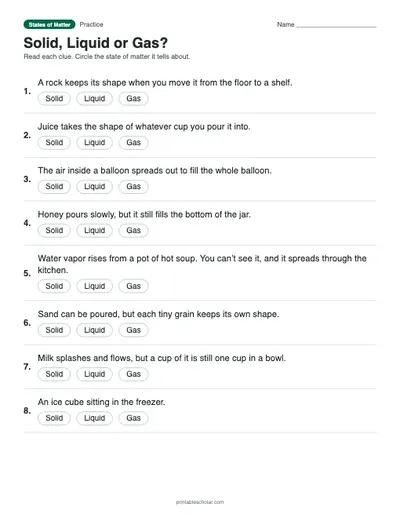
6. PracticeSolid, Liquid or Gas?Eight everyday clues: circle solid, liquid or gas for each.Download free PDF
 Free
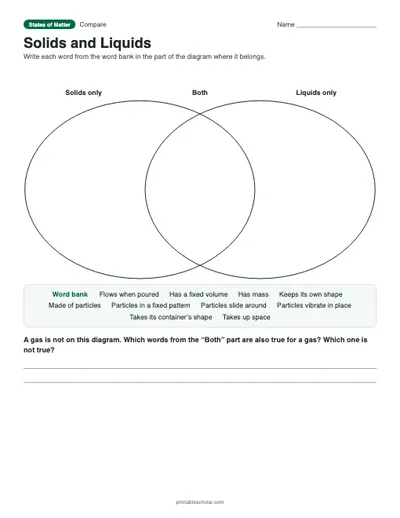
6. PracticeSolids and LiquidsSort ten traits into solids only, liquids only, or both, then think about a gas.Download free PDF
 Free
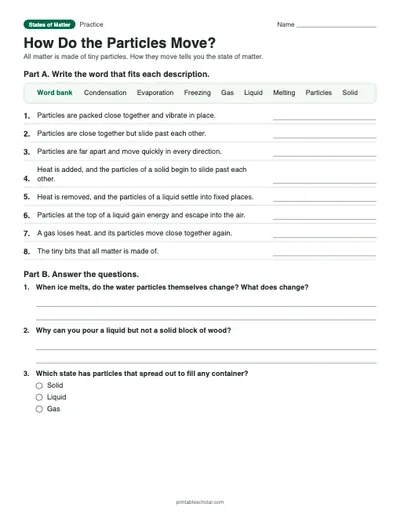
6. PracticeHow Do the Particles Move?Match eight particle descriptions to the word they describe, then answer three questions.Download free PDF
 In the pack
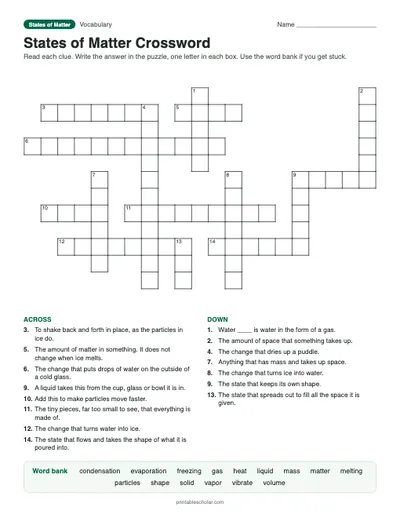
7. ReviewStates of Matter CrosswordFifteen states of matter words with clues and a word bank.In the $7 pack
 In the pack
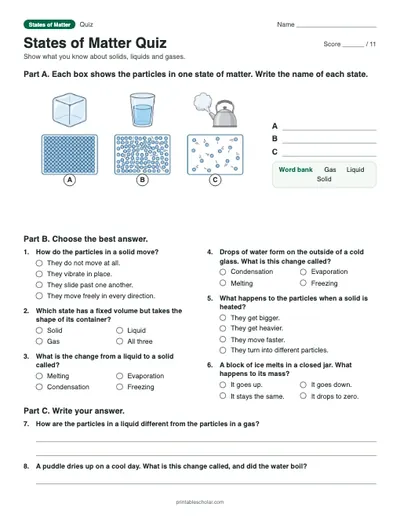
8. CheckStates of Matter QuizLabel three states, six multiple choice and two written answers. Scored out of 11.In the $7 pack
States of Matter worksheets, crossword and quiz
The States of Matter teaching pack is 26 lesson slides (PowerPoint and PDF) and 11 printables with answer keys for grades 4 to 6, in the order you would teach them: the guided notes for the lesson slides, the labeled diagram and the blank one to label, then “Read the Diagram” (a worksheet), “Solid, Liquid, Gas” (a reading passage), “Name the Change of State” (a changes-of-state table), “Solid, Liquid or Gas?” (a circle-the-answer sheet), “Solids and Liquids” (a Venn diagram), “How Do the Particles Move?” (a worksheet), a vocabulary crossword and a quiz.
The sheets are in a suggested teaching order: teach the lesson, have students label the blank diagram, then work through the practice sheets and finish with the quiz. Use them all over a week or pick the ones you need. The answer keys are together at the back.
The diagram and the blank one to label are free to download on this page, and so are three worksheets: “Solid, Liquid or Gas?”, “Solids and Liquids” and “How Do the Particles Move?” The other sheets come with the pack ($7), which is also in the Elementary Science bundle (grades 3 to 6).
The three states of matter
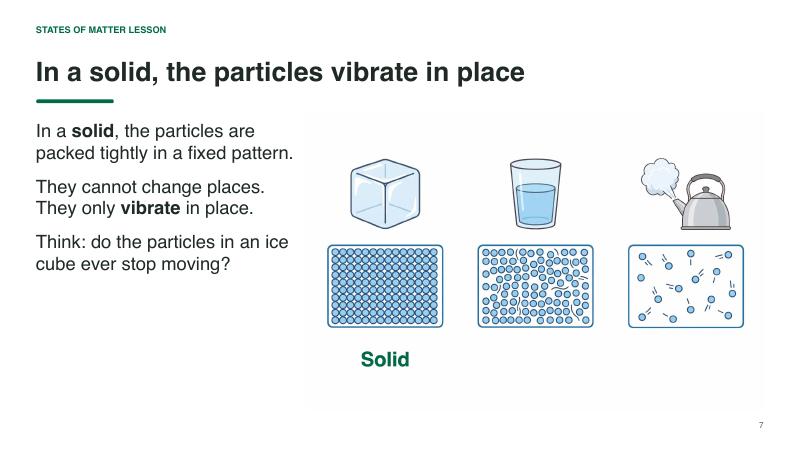
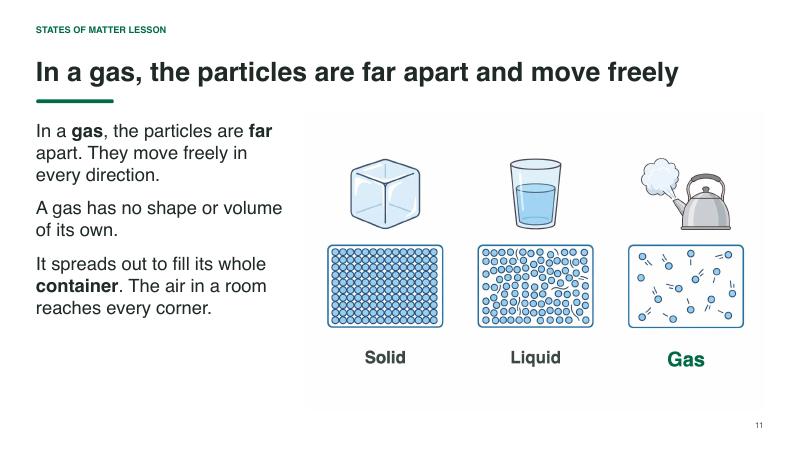
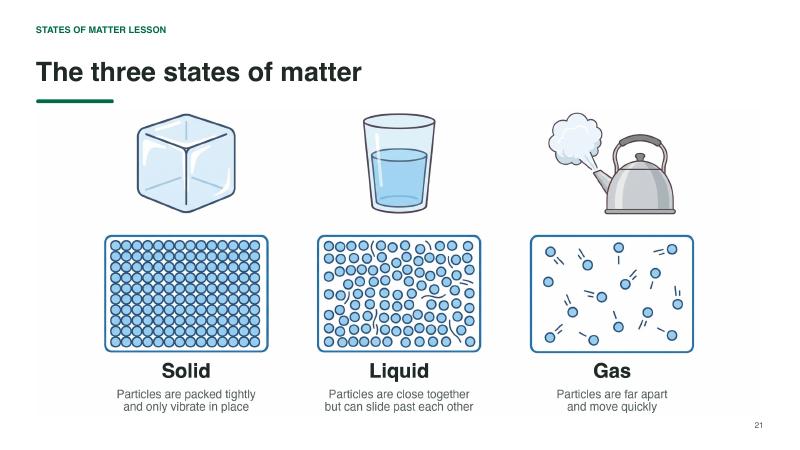
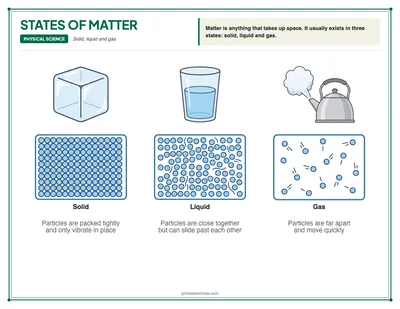
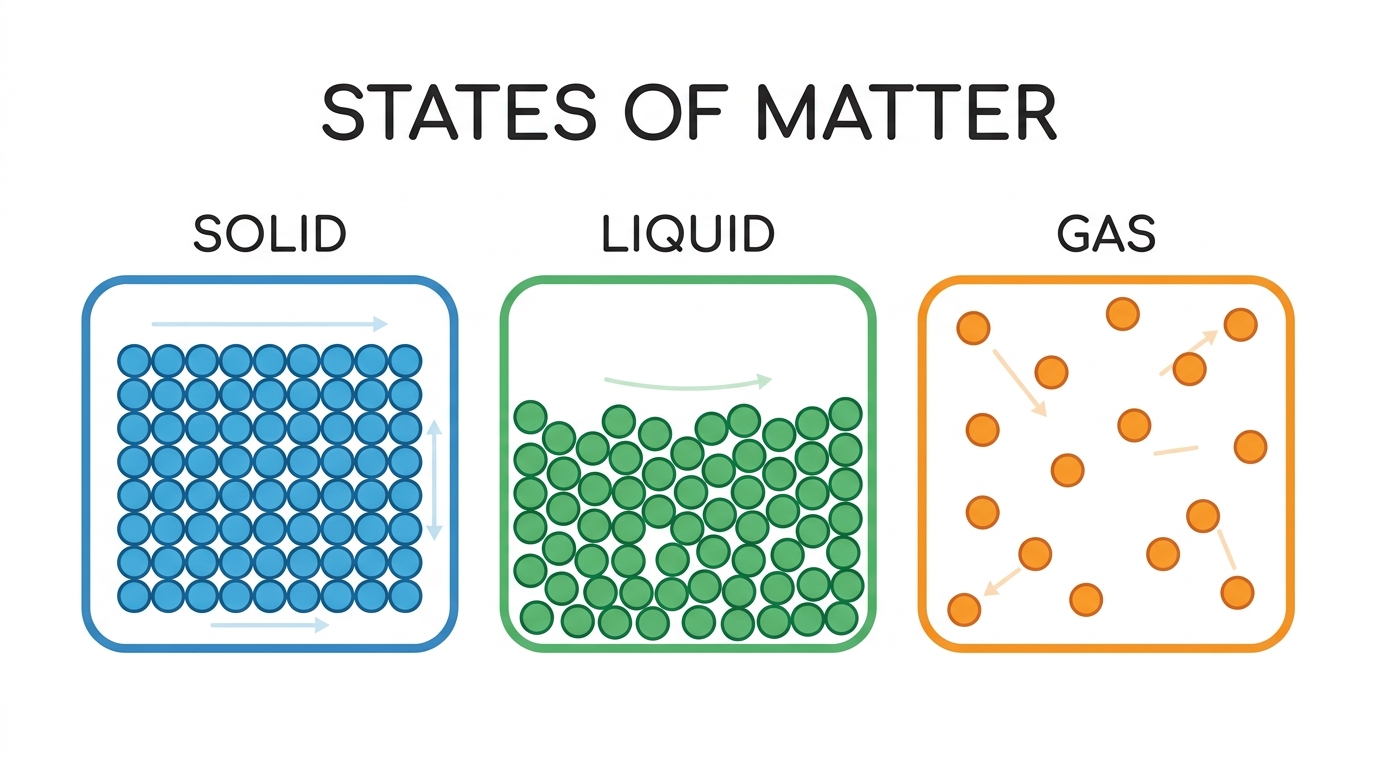
Matter is anything that takes up space, and it usually exists in three states: solid, liquid and gas. Here is what happens at each labeled part of the diagram:
| State | What it does | Why it matters |
|---|---|---|
| Solid | The particles are packed tightly in a fixed pattern, so a solid keeps its own shape. | Because its particles lock into a fixed pattern, a solid holds its shape without a container — which is why your chair doesn't puddle on the floor when you sit on it. If solids couldn't maintain their structure, nothing we build or touch would stay in one piece. |
| Liquid | The particles are close but can slide past each other, so a liquid flows and takes the shape of its container. | The sliding, flowing behavior of liquid particles is exactly what lets blood carry oxygen through your veins and lets rivers carve canyons over thousands of years. Take away liquids, and there would be no way to transport nutrients, dissolve chemicals, or fill any container we pour into. |
| Gas | The particles are far apart and move freely, so a gas spreads out to fill any space. | Freely moving gas particles spread out to fill every corner of a space, which is why the oxygen you breathe reaches every part of your lungs — not just the spot right in front of your mouth. Without gases behaving this way, Earth's atmosphere couldn't wrap evenly around the planet and protect us from space. |
How to print
Choose Download PDF for a ready-to-print file that fits US Letter paper (8.5 × 11") in landscape, or Download PNG for the high-resolution image.
Frequently asked questions
What are the three states of matter?
The three common states of matter are solid, liquid and gas.
Why does a solid keep its shape but a gas does not?
In a solid the particles are locked tightly together, so it holds its shape. In a gas the particles are far apart and move freely, so the gas spreads out to fill whatever space it is in.
What paper size should I print this on?
The diagram is sized for standard US Letter paper (8.5 × 11") in landscape orientation. Use "Download PDF" for a print-ready file that fits the page automatically.
Are there States of Matter worksheets to go with the diagram?
Yes. The States of Matter teaching pack, for grades 4 to 6, has 26 lesson slides and 11 printables with answer keys: the guided notes for the lesson slides, the labeled diagram and the blank one to label, then “Read the Diagram” (a worksheet), “Solid, Liquid, Gas” (a reading passage), “Name the Change of State” (a changes-of-state table), “Solid, Liquid or Gas?” (a circle-the-answer sheet), “Solids and Liquids” (a Venn diagram), “How Do the Particles Move?” (a worksheet), a vocabulary crossword and a quiz. The diagram and the blank one to label are free to download on this page, and so are three worksheets: “Solid, Liquid or Gas?”, “Solids and Liquids” and “How Do the Particles Move?” The other sheets come with the pack ($7), which is also in the Elementary Science bundle (grades 3 to 6).