 Printable Scholar
Human Body Organs Diagram
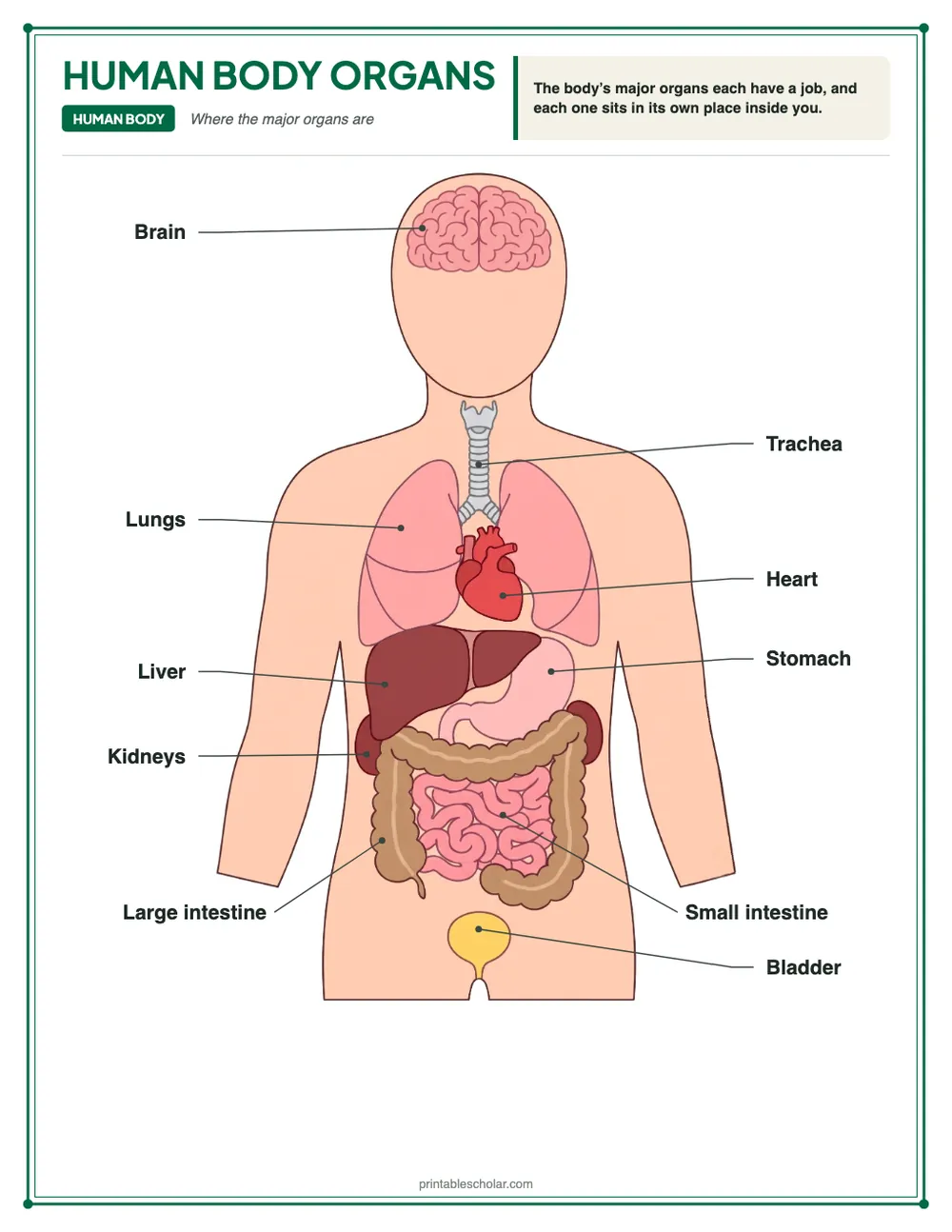
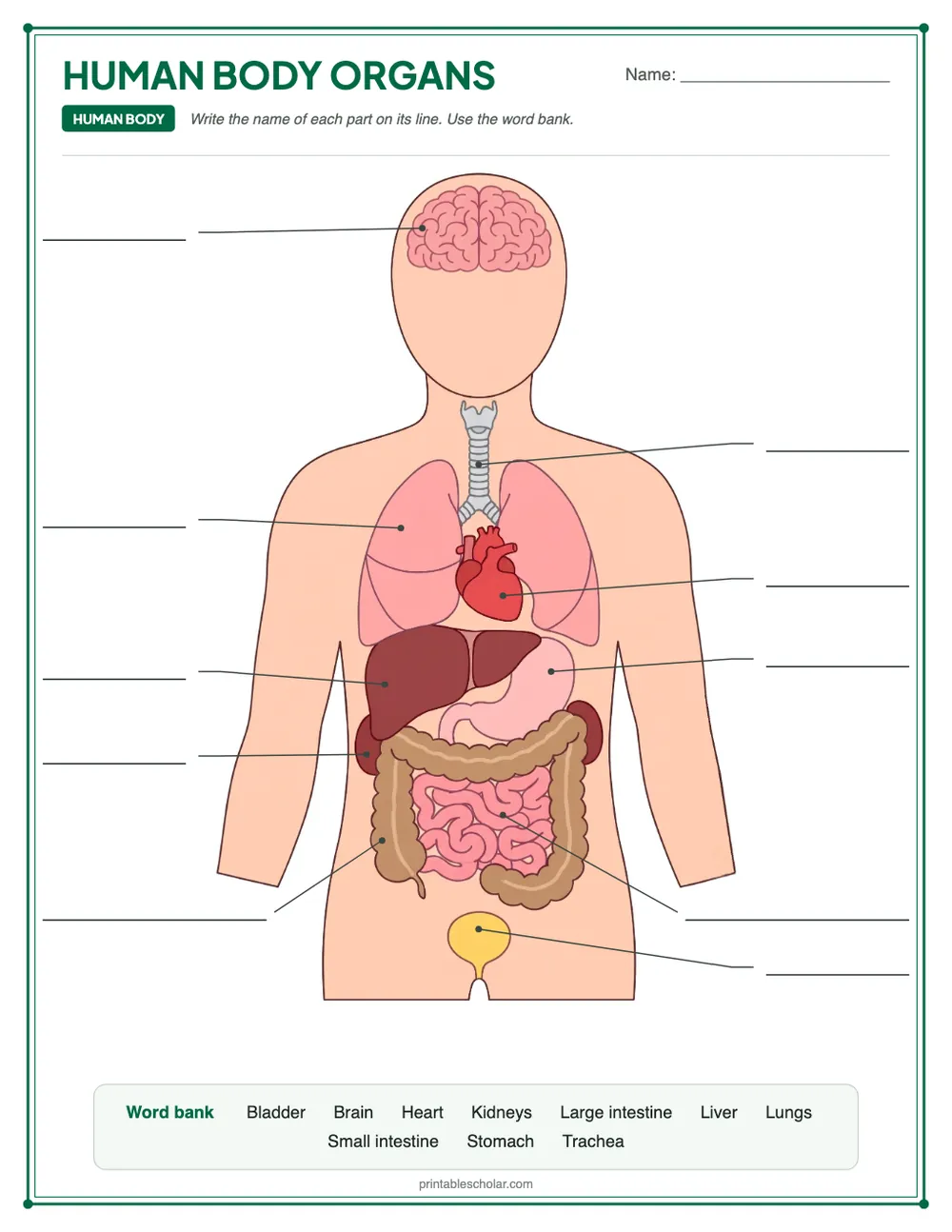
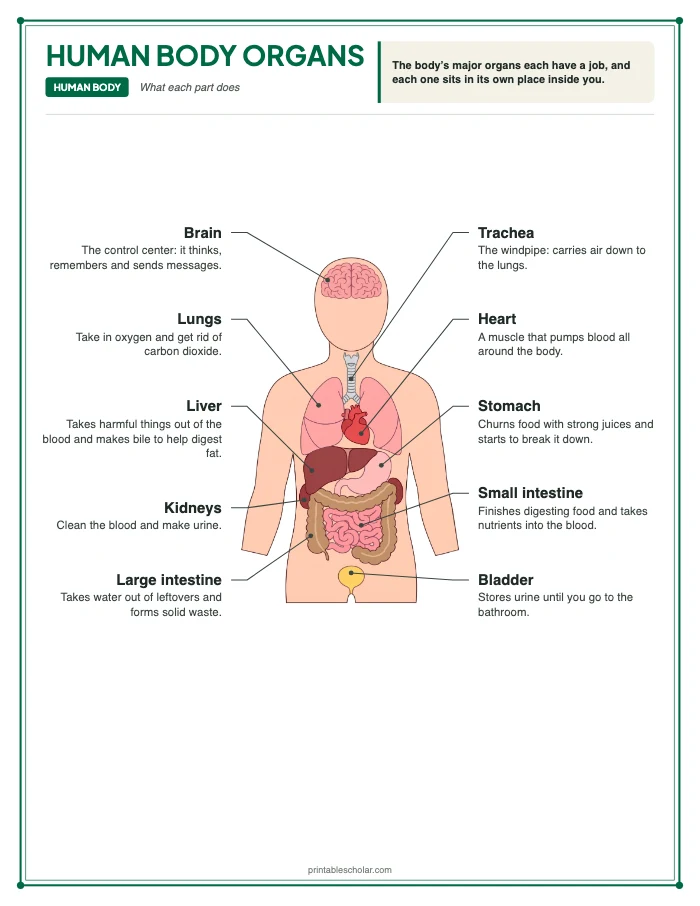
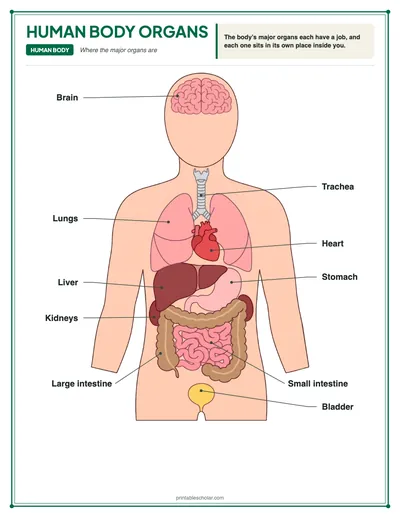
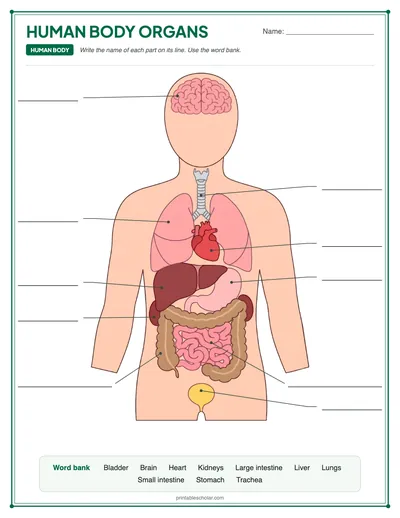
Free printable human body organs diagram for grades 3-5: a labeled body showing where the brain, lungs, heart, liver, stomach, intestines, kidneys and bladder are and what each one does, plus a blank diagram to label. PDF or PNG for Letter paper.
Part of the Human Body Organs teaching pack for grades 3 to 5: 22 lesson slides and 8 printables with answer keys. The diagram and the blank one to label are free.
Teaching ideas for Human Body Organs
Pick the ideas that suit your class, then follow the plan or use the sheets in any order.
- Organs in place. Draw a large body outline on butcher paper. Groups cut the ten organs out of colored paper and tape each one in its place, using the labeled diagram.
- Feel your heartbeat. Students rest a hand flat on the chest, a little left of the middle, and feel the heart beating. Then they press gently along the ribs that guard it.
- Left or right?. Stand facing the class and raise your right hand. Students see it on their left. That is why the liver is on the left of the diagram.
- Sort the team. Write each organ on a card. Groups sort the cards into body systems, then tell how two of the systems help each other.
A plan for the week
| Day 1 | Open with one of the ideas above. Teach the lesson with the slides while students fill in the guided notes. Then students label the blank diagram. | Lesson slides (PowerPoint) (in the pack) Human Body Organs Guided Notes (in the pack) Human Body Organs Diagram Blank Human Body Organs |
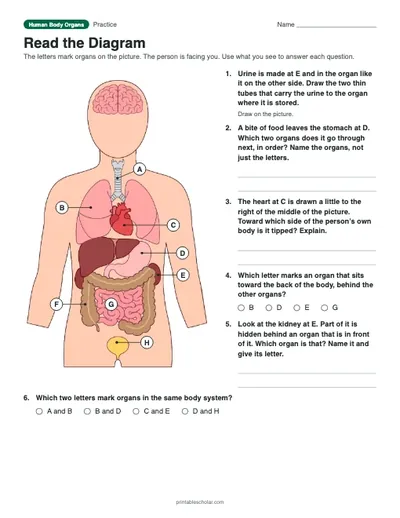
| Day 2 | Students work out what is happening on the picture on “Read the Diagram”: where urine goes, which way food travels, which side the heart tips toward and which organ hides part of a kidney. | Read the Diagram (in the pack) |
| Day 3 | Read “Your Body’s Team of Organs” and answer the questions. | Your Body’s Team of Organs (in the pack) |
| Day 4 | Students read what ten body parts do on “Sort the Body Systems” and sort each one into its system. | Sort the Body Systems (in the pack) |
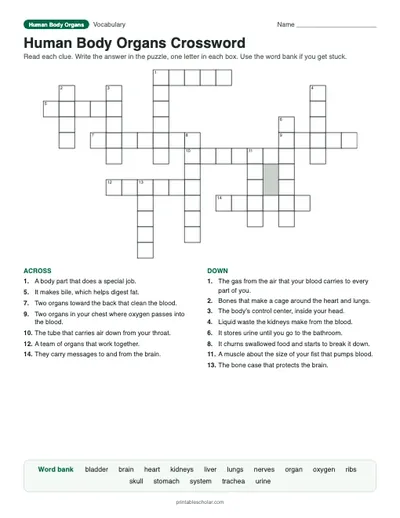
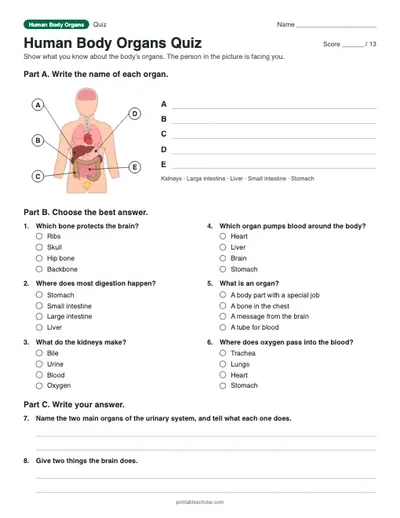
| Day 5 | Review with the crossword, then give the quiz. | Human Body Organs Crossword (in the pack) Human Body Organs Quiz (in the pack) |
The sheets marked “in the pack” are in the Human Body Organs teaching pack below.
NGSS standards
- Supports 4-LS1-1: Construct an argument that plants and animals have internal and external structures that function to support survival, growth, behavior, and reproduction.
- Supports MS-LS1-3: Use argument supported by evidence for how the body is a system of interacting subsystems composed of groups of cells.
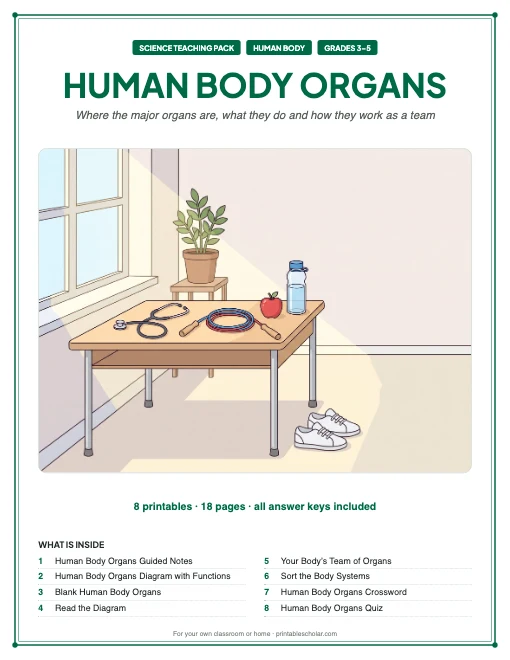
Human Body Organs teaching pack
Teaching the organs of the human body? Here is a ready-to-teach lesson. 22 slides and 8 printables that cover where the major organs are, what each one does and how they work together in body systems, from the guided notes to the quiz. Present the slides while students fill in the guided notes, then use the worksheets, crossword and quiz, with every answer key.
Free on this page: the diagram and the blank one to label, marked Download below. The whole pack is $7: 18 pages in one print-ready file, the 22 lesson slides, the practice sheets, the crossword, the quiz and every answer key.
OnlineThe pack also comes as an online lesson for Google Classroom: every part on screen for students, plus a self-grading Google Forms quiz.
One-time purchase. Instant download. Secure checkout by Stripe. Want to see a whole pack first? The Skeletal System pack is free.See all 29 packs in the bundle
- The Microscope
- Photosynthesis
- Parts of a Plant and Flower
- Life Cycle of a Plant
- Life Cycles of a Butterfly and a Frog
- Food Chains and Food Webs
- The Water Cycle
- Human Body Organs (this pack)
- Skeletal System
- Muscular System
- Digestive System
- Respiratory System
- Heart and Circulation
- Nervous System and Brain
- Eye and Ear
- Parts of a Tooth
- Inside the Earth and Volcanoes
- Rocks and the Rock Cycle
- Layers of the Atmosphere
- Types of Clouds
- Weathering, Erosion and Deposition
- Types of Landforms
- The Solar System
- The Seasons
- Moon Phases and Eclipses
- States of Matter
- Forms of Energy
- Simple Machines
- Magnets and Magnetic Fields
Teach Human Body Organs with 22 ready-made slides
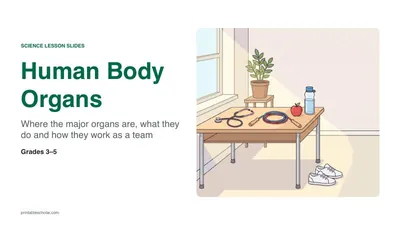
Open the PowerPoint and teach: an opening question, the parts one at a time on the diagram, quick checks and an exit question. Your notes for each slide are in the speaker notes. Students fill in the guided notes sheet as you go.
The slides (PowerPoint and a PDF copy) and the guided notes sheet come with the pack.What is in the pack, in teaching order
 In the pack
1. TeachLesson Slides22 slides to present, with your notes for each one.In the $7 pack
 In the pack
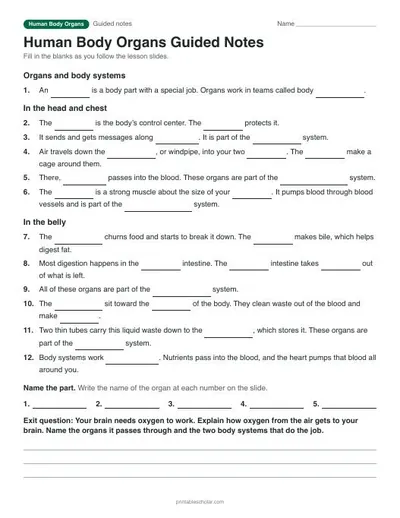
1. TeachHuman Body Organs Guided NotesStudents fill in the blanks as you present. With answer key.In the $7 pack
 Free
 Free
 In the pack
3. ReasonRead the DiagramRead the body organs picture: draw how urine reaches the bladder, follow food after the stomach, work out which side the heart tips toward and which organ hides part of a kidney.In the $7 pack
 In the pack
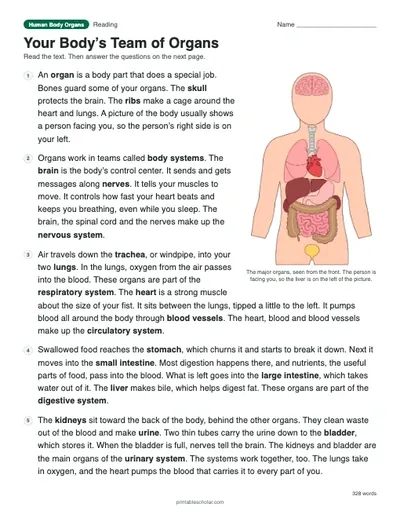
4. ReadYour Body’s Team of OrgansA one-page text on where the major organs are, what each one does and how organs work together in body systems, with eight questions.In the $7 pack
 In the pack
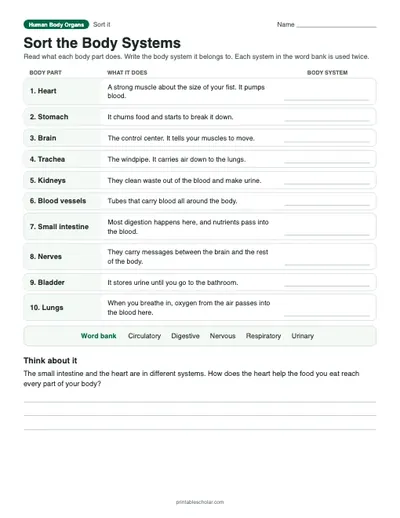
5. SortSort the Body SystemsRead what ten body parts do and sort each one into its body system.In the $7 pack
 In the pack
6. ReviewHuman Body Organs CrosswordFifteen body organ and body system words with clues and a word bank.In the $7 pack
 In the pack
7. CheckHuman Body Organs QuizLabel five organs, six multiple choice and two written answers. Scored out of 13.In the $7 pack
Human Body Organs worksheets, crossword and quiz
The Human Body Organs teaching pack is 22 lesson slides (PowerPoint and PDF) and 8 printables with answer keys for grades 3 to 5, in the order you would teach them: the guided notes for the lesson slides, the labeled diagram and the blank one to label, then “Read the Diagram” (a worksheet), “Your Body’s Team of Organs” (a reading passage), “Sort the Body Systems” (a sorting table), a vocabulary crossword and a quiz.
The sheets are in a suggested teaching order: teach the lesson, have students label the blank diagram, then work through the practice sheets and finish with the quiz. Use them all over a week or pick the ones you need. The answer keys are together at the back.
The diagram and the blank one to label are free to download on this page. The other sheets come with the pack ($7), which is also in the Elementary Science bundle (grades 3 to 6).
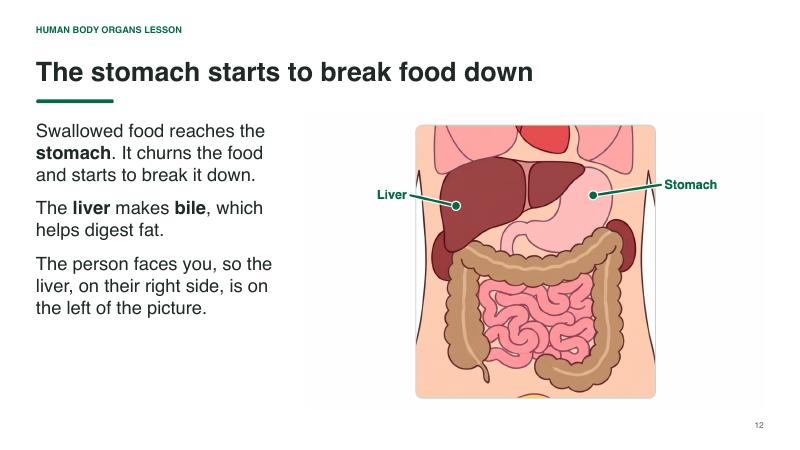
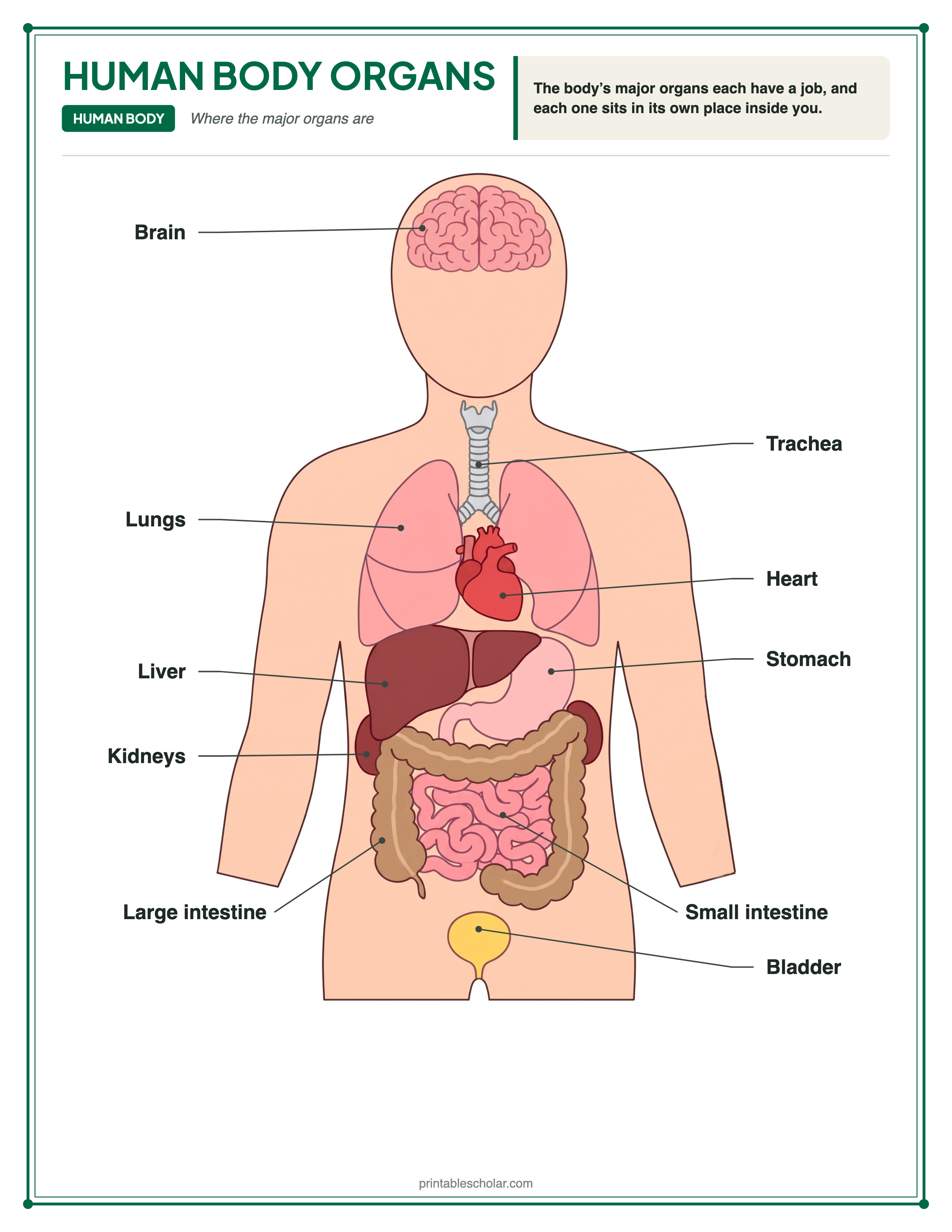
An organ is a body part made of different kinds of tissue that work together to do one main job. The brain controls the body. In the chest, the lungs bring in air and the heart pumps blood. In the belly, the stomach and intestines break down food and take in the nutrients, with help from bile made by the liver, while the kidneys clean the blood and the bladder stores the urine they make. Organs also work in teams called body systems: the stomach and intestines are part of the digestive system, and the lungs and trachea are part of the respiratory system. The diagram shows the body from the front, as if the person is facing you, so the person’s right side is on your left. That is why the liver, which is on the right side of the body, is drawn on the left of the picture. The kidneys really sit toward the back of the body, behind the other organs; diagrams like this one show them so you can see where they are.
The major organs and their jobs
Your body has organs that each do a special job. This human body organs diagram shows where the major organs sit inside you, from the brain in your head to the bladder low in your belly. Here is what happens at each labeled part of the diagram:
| Organ | What it does | Why it matters |
|---|---|---|
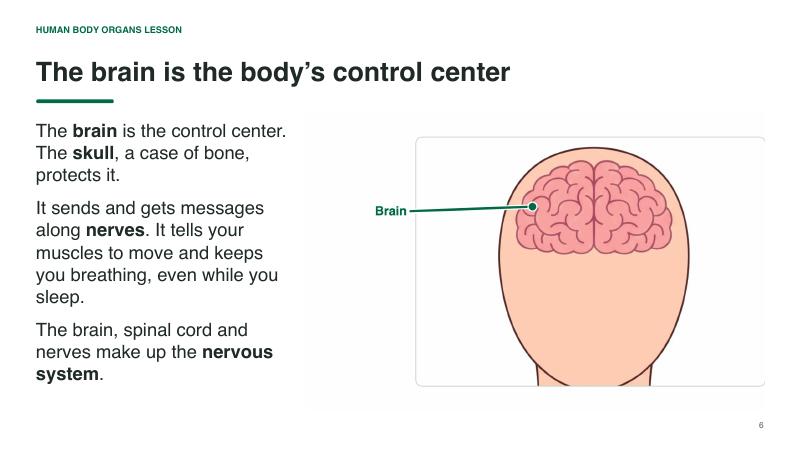
| Brain | The control center of the body. It thinks, remembers and sends messages to every part of you. | The brain sits inside the skull, which protects it. It sends and receives messages along nerves, so it can tell your muscles to move and feel what your skin touches. It also runs jobs you never think about, like breathing and how fast your heart beats, even while you sleep. |
| Trachea | The windpipe: a tube that carries air from your throat down to your lungs. | Stiff rings of cartilage hold the trachea open so air can always get through. You can feel the ridges of these rings at the front of your neck. At the bottom, the trachea splits into two branches, one going into each lung. |
| Lungs | Two spongy organs in the chest that take in oxygen when you breathe in and get rid of carbon dioxide when you breathe out. | Inside, the lungs are filled with millions of tiny air sacs. Oxygen passes from the air in the sacs into the blood, and carbon dioxide, a waste gas, passes out of the blood to be breathed out. The left lung is a little smaller than the right one, to make room for the heart. |
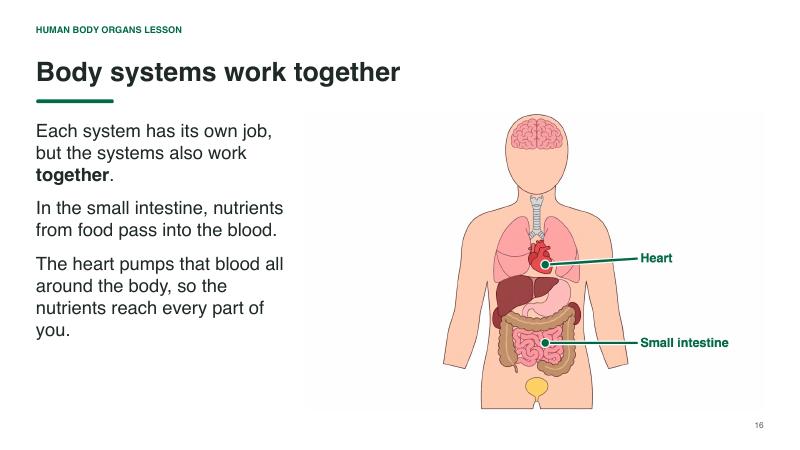
| Heart | A strong muscle that pumps blood all around the body. | The heart sits in the middle of the chest, between the lungs and tipped a little to the left. It is about the size of your fist. In a resting child it beats about 70 to 110 times a minute, pushing blood through blood vessels that carry oxygen and nutrients to every part of the body. |
| Liver | The largest organ inside the body. It takes harmful things out of the blood and makes bile, a juice that helps digest fat. | The liver sits in the upper right part of the belly, tucked under the ribs. It does hundreds of jobs. It takes harmful things out of the blood, stores sugar and vitamins for later, and makes bile, which helps the small intestine break down fat. |
| Stomach | A stretchy bag that mixes food with strong juices and starts to break it down. | Food reaches the stomach through a tube from the mouth called the esophagus. The stomach sits in the upper left part of the belly. Its muscles squeeze and churn the food, and its juices, which include a strong acid, turn it into a thick, soupy mix. Food stays in the stomach for a few hours before it moves on. |
| Small intestine | A long, coiled tube where food is broken down the rest of the way and taken into the blood. | It is called “small” because it is narrow, not because it is short. In a living adult it is about 3 meters (10 feet) long, folded up to fit in the middle of the belly. Its inside wall is covered in tiny finger-like bumps that soak up the nutrients from food. |
| Large intestine | A wide tube that takes water out of leftover food and turns it into solid waste. | The large intestine is wider than the small intestine but only about half as long, about 1.5 meters (5 feet). It goes up one side of the belly, across the top and down the other side, like a frame around the small intestine. As leftover food moves through it, water is taken back into the body and the waste becomes solid. |
| Kidneys | Two bean-shaped organs that clean the blood and make urine out of waste and extra water. | Each kidney is about the size of a fist. They sit toward the back of the body, one on each side of the spine, just below the ribs. Blood flows through them all day long, and they filter out waste and extra water. This makes urine, which flows down two thin tubes to the bladder. |
| Bladder | A stretchy bag low in the belly that stores urine until you go to the bathroom. | The bladder sits low in the belly, between the hip bones. Its walls stretch as it fills, like a balloon. When it starts to get full, nerves send a message to your brain that it is time to go to the bathroom. |
How to print
Choose Download PDF for a ready-to-print file that fits US Letter paper (8.5 × 11") in portrait, or Download PNG for the high-resolution image.
Frequently asked questions
What are the major organs of the human body?
The major organs include the brain, lungs, heart, liver, stomach, small intestine, large intestine, kidneys and bladder. The skin is an organ too: it covers the outside of the body and is the body’s largest organ.
Which side of the body is the heart on?
The heart is in the middle of the chest, between the lungs, tipped slightly to the left side of the body.
Why is the liver on the left side of the diagram?
The diagram shows a person facing you, as if they are standing face to face with you. The person’s right side is on your left, so the liver, which is on the right side of the body, appears on the left of the picture.
What is the largest organ inside the body?
The liver is the largest organ inside the body. The skin, on the outside, is the largest organ of all.
What paper size should I print this on?
The diagram is sized for standard US Letter paper (8.5 × 11") in portrait orientation. Use "Download PDF" for a print-ready file that fits the page automatically.
Are there Human Body Organs worksheets to go with the diagram?
Yes. The Human Body Organs teaching pack, for grades 3 to 5, has 22 lesson slides and 8 printables with answer keys: the guided notes for the lesson slides, the labeled diagram and the blank one to label, then “Read the Diagram” (a worksheet), “Your Body’s Team of Organs” (a reading passage), “Sort the Body Systems” (a sorting table), a vocabulary crossword and a quiz. The diagram and the blank one to label are free to download on this page. The other sheets come with the pack ($7), which is also in the Elementary Science bundle (grades 3 to 6).
Related: Take a closer look at single body systems with our digestive system, respiratory system, heart and excretory system diagrams.