 Printable Scholar
Human Heart Diagram
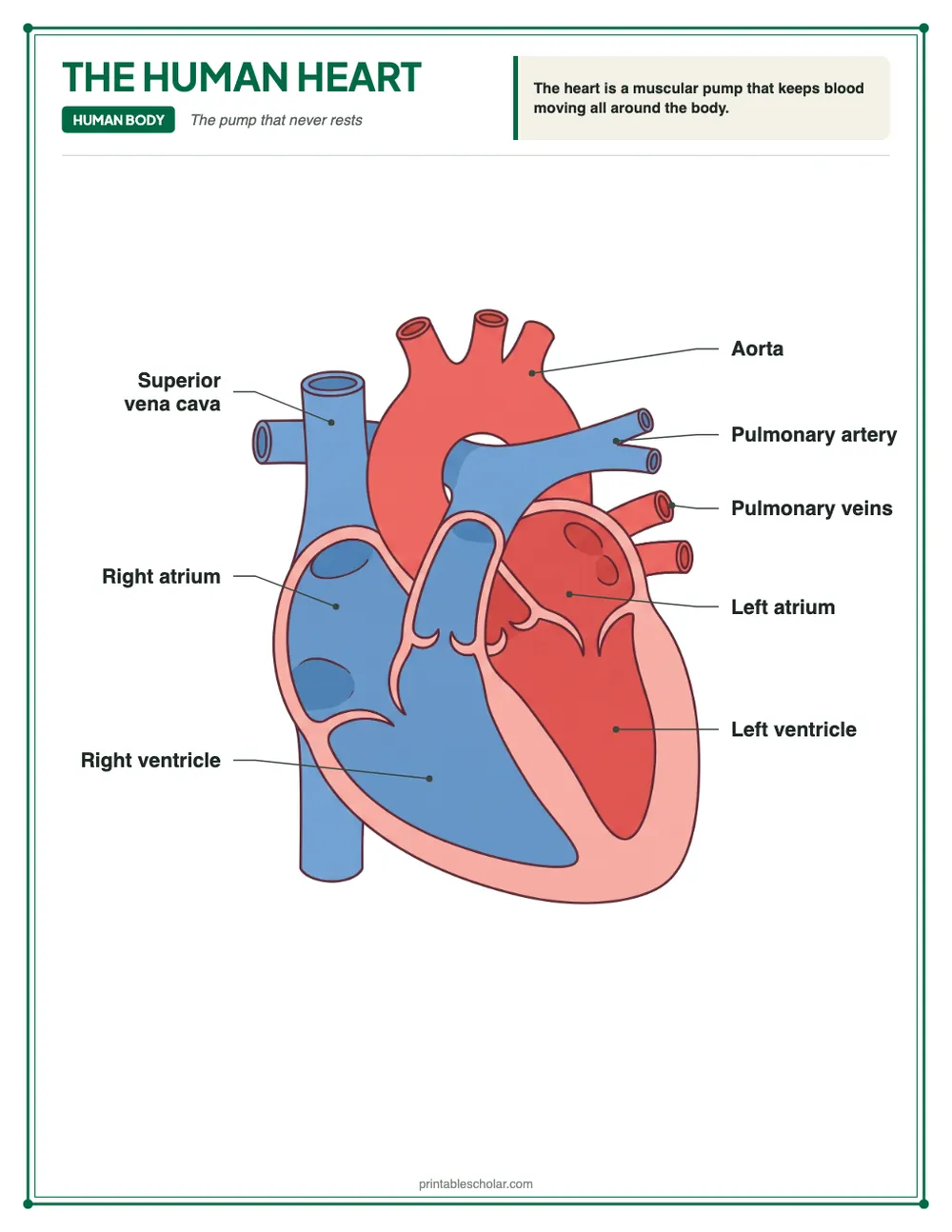
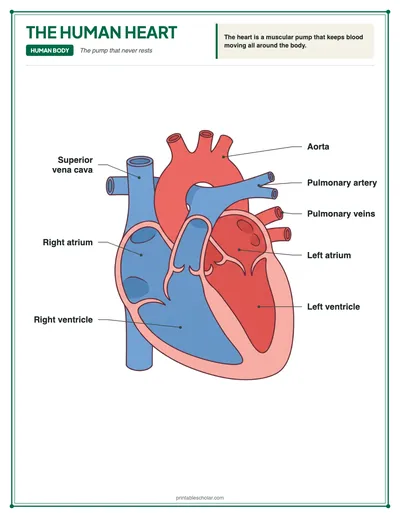
Free printable human heart diagram — a labeled cross-section showing the four chambers, the aorta, pulmonary artery, pulmonary veins and vena cava. Download a high-resolution PDF or PNG for Letter paper.
Part of the Heart and Circulation teaching pack for grades 4 to 6: 26 lesson slides and 11 printables with answer keys. The diagrams are free.
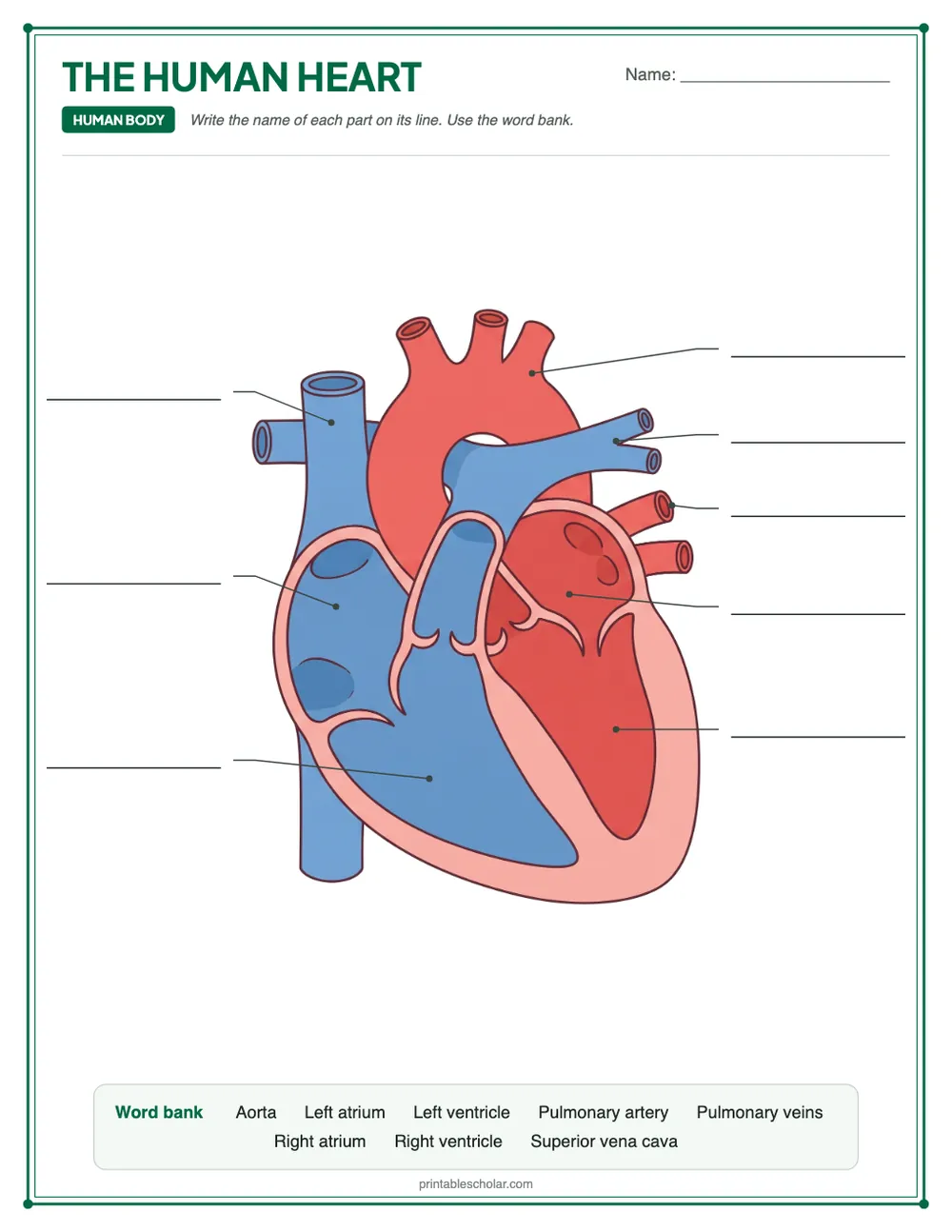
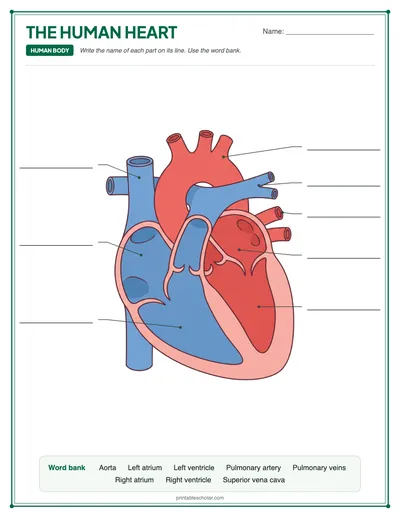
Blank diagram to label
Download blank version + answer key 8 blanks, a word bank, and the answer key on page 2Teaching ideas for Heart and Circulation
Pick the ideas that suit your class, then follow the plan or use the sheets in any order.
- Find your pulse. Students rest two fingers on the inside of the wrist and feel the beat. Try again after jogging in place and talk about why it is faster.
- Squeeze a ball. Students squeeze a tennis ball over and over, like a heartbeat, until the hand gets tired. The heart does this work all day and all night.
- Walk the path. Mark the four chambers of the heart, the lungs and the body on the floor with tape or chalk. Students walk the path of the blood and name each part.
A plan for the week
| Day 1 | Open with one of the ideas above. Teach the lesson with the slides while students fill in the guided notes. Then students label the blank diagram. | Lesson slides (PowerPoint) (in the pack) Heart and Circulation Guided Notes (in the pack) Heart Diagram Blank Heart |
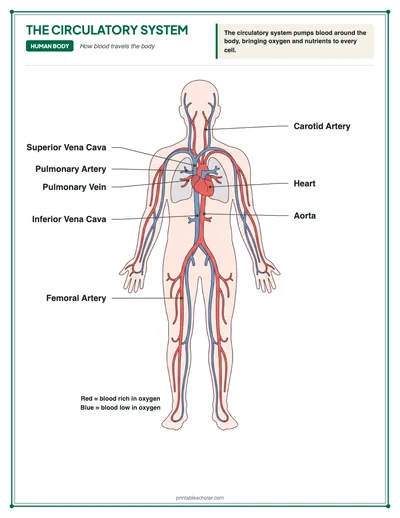
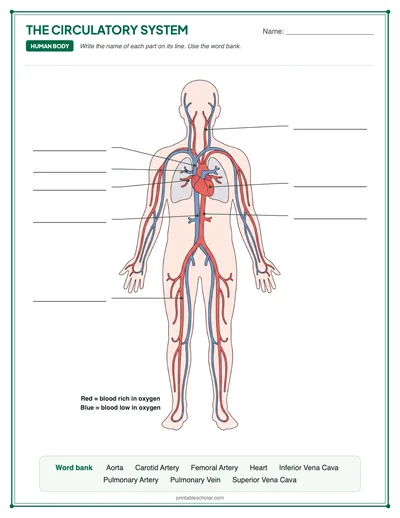
| Day 2 | Teach the circulatory system from the labeled diagram. Students label the blank one. | Circulatory System Diagram Blank Circulatory System |
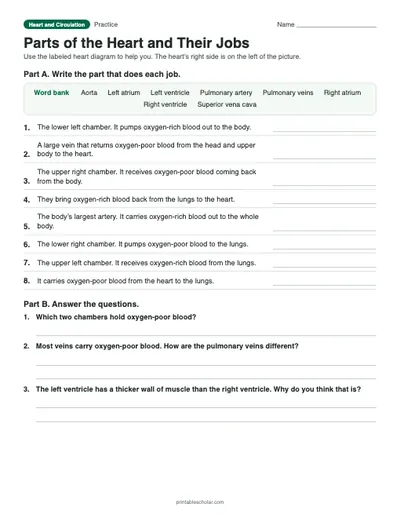
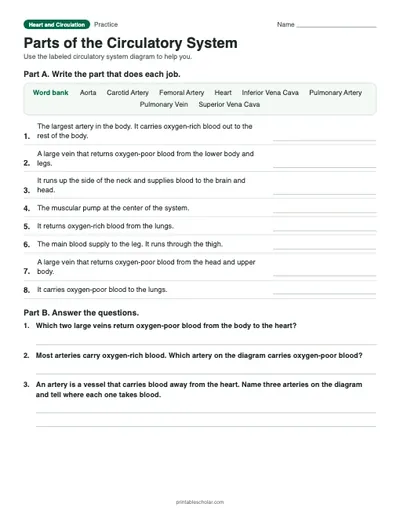
| Day 3 | Match the parts of the heart to their jobs. Then do the same for the parts of the circulatory system. | Parts of the Heart and Their Jobs (in the pack) Parts of the Circulatory System (in the pack) |
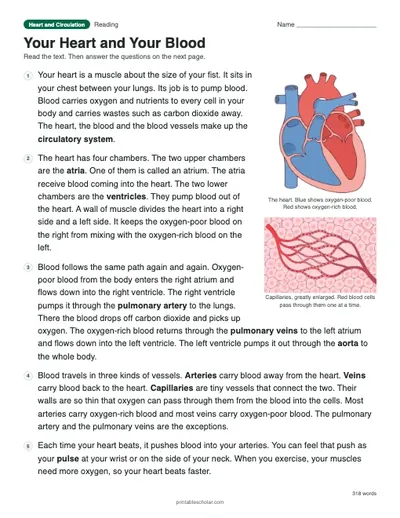
| Day 4 | Read “Your Heart and Your Blood” and answer the questions. Then put the steps of “The Path of Blood Through the Heart” in order. | Your Heart and Your Blood (in the pack) The Path of Blood Through the Heart (in the pack) |
| Day 5 | Review with the crossword, then give the quiz. | Heart and Circulation Crossword (in the pack) Heart and Circulation Quiz (in the pack) |
The sheets marked “in the pack” are in the Heart and Circulation teaching pack below.
NGSS standards
- Supports 4-LS1-1: Construct an argument that plants and animals have internal and external structures that function to support survival, growth, behavior, and reproduction.
- Supports MS-LS1-3: Use argument supported by evidence for how the body is a system of interacting subsystems composed of groups of cells.
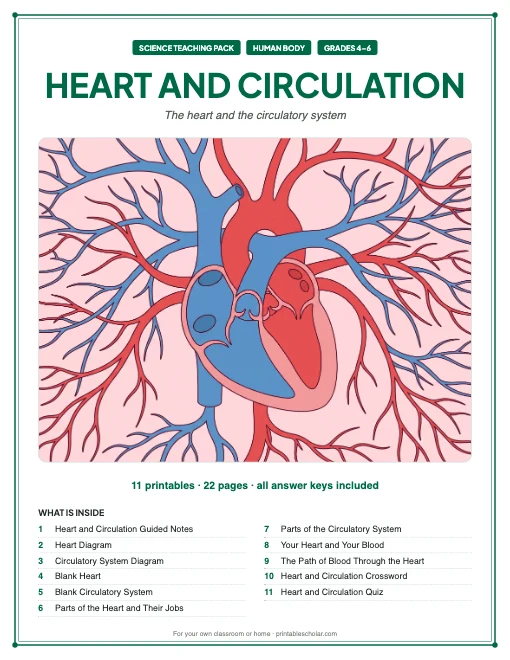
Heart and Circulation teaching pack
Teaching the heart and the circulatory system? This pack has ready-made lesson slides and 11 printables that cover the whole topic, in teaching order, with every answer key.
Free on this page: 4 of the 12 printables, marked Download below. The whole pack is $7: 22 pages in one print-ready file, the 26 lesson slides, the practice sheets, the crossword, the quiz and every answer key.
One-time purchase. Instant download. Secure checkout by Stripe. Want to see a whole pack first? The Skeletal System pack is free.See all 28 packs in the bundle
- The Microscope
- Photosynthesis
- Parts of a Plant and Flower
- Life Cycle of a Plant
- Life Cycles of a Butterfly and a Frog
- Food Chains and Food Webs
- The Water Cycle
- Skeletal System
- Muscular System
- Digestive System
- Respiratory System
- Heart and Circulation (this pack)
- Nervous System and Brain
- Eye and Ear
- Parts of a Tooth
- Inside the Earth and Volcanoes
- Rocks and the Rock Cycle
- Layers of the Atmosphere
- Types of Clouds
- Weathering, Erosion and Deposition
- Types of Landforms
- The Solar System
- The Seasons
- Moon Phases and Eclipses
- States of Matter
- Forms of Energy
- Simple Machines
- Magnets and Magnetic Fields
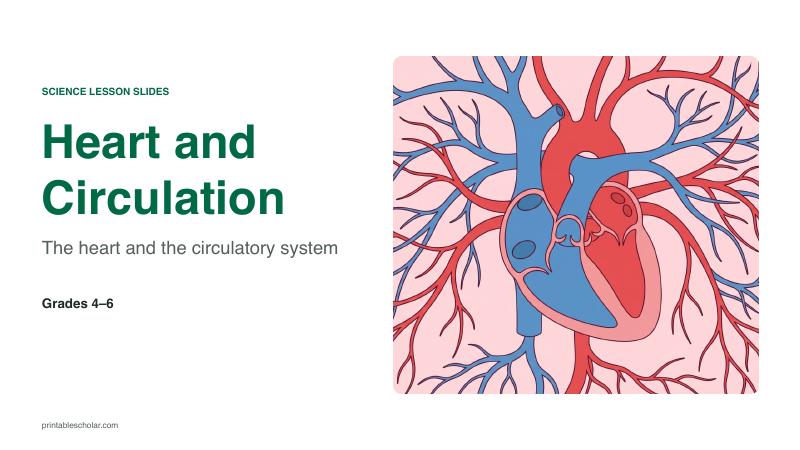
Teach Heart and Circulation with 26 ready-made slides
Open the PowerPoint and teach: an opening question, the parts one at a time on the diagram, quick checks and an exit question. Your notes for each slide are in the speaker notes. Students fill in the guided notes sheet as you go.
The slides (PowerPoint and a PDF copy) and the guided notes sheet come with the pack.What is in the pack, in teaching order
 In the pack
1. TeachLesson Slides26 slides to present, with your notes for each one.In the $7 pack
 In the pack
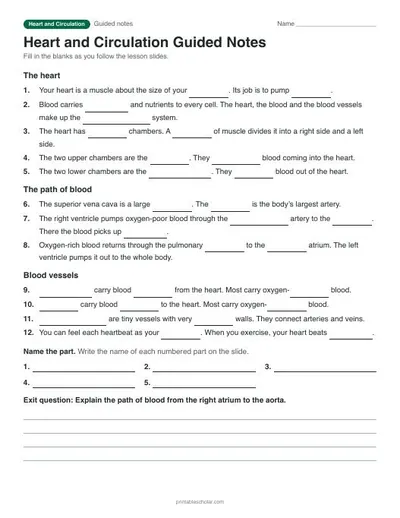
1. TeachHeart and Circulation Guided NotesStudents fill in the blanks as you present. With answer key.In the $7 pack
 Free
 Free
 Free
 Free

 In the pack
3. MatchParts of the Heart and Their JobsMatch 8 parts of the heart to their jobs, then answer three questions.In the $7 pack
 In the pack
3. MatchParts of the Circulatory SystemMatch 8 parts of the circulatory system to their jobs, then answer three questions.In the $7 pack
 In the pack
4. ReadYour Heart and Your BloodA one-page text on how the heart pumps blood around the body, with eight questions.In the $7 pack
 In the pack
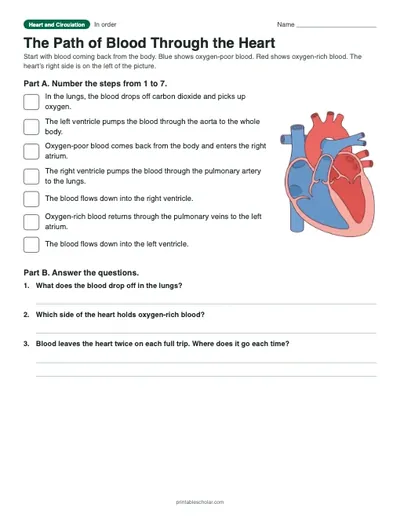
5. OrderThe Path of Blood Through the HeartPut seven steps in order to trace blood through the heart and lungs, then answer three questions.In the $7 pack
 In the pack
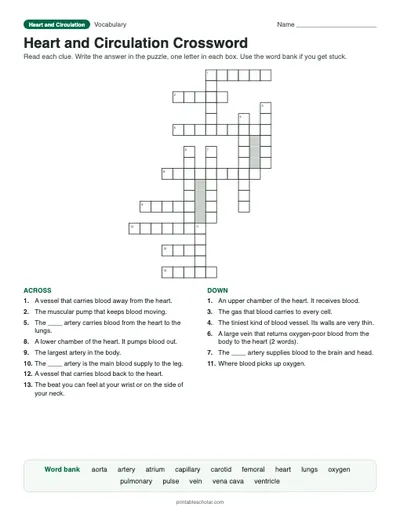
6. ReviewHeart and Circulation CrosswordFourteen heart and blood vessel words with clues and a word bank.In the $7 pack
 In the pack
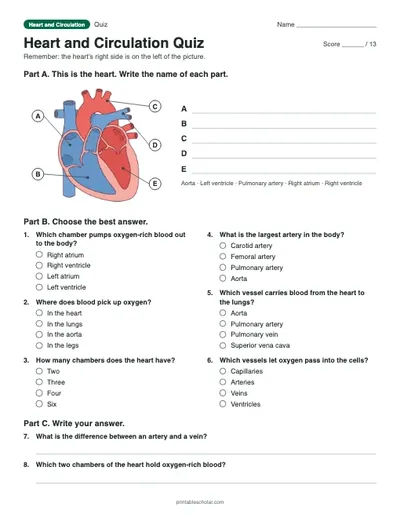
7. CheckHeart and Circulation QuizLabel five parts, six multiple choice and two written answers. Scored out of 13.In the $7 pack
Heart and Circulation worksheets, crossword and quiz
The Heart and Circulation teaching pack is 26 lesson slides (PowerPoint and PDF) and 11 printables with answer keys for grades 4 to 6, in the order you would teach them: the guided notes for the lesson slides, 4 diagram sheets, then “Parts of the Heart and Their Jobs” (a worksheet), “Parts of the Circulatory System” (a worksheet), “Your Heart and Your Blood” (a reading passage), “The Path of Blood Through the Heart” (an ordering worksheet), a vocabulary crossword and a quiz.
The sheets are in a suggested teaching order: teach the lesson, have students label the blank diagrams, then work through the practice sheets and finish with the quiz. Use them all over a week or pick the ones you need. The answer keys are together at the back.
The diagrams are free to download on this page. The other sheets come with the pack ($7), which is also in the Elementary Science bundle (grades 3 to 6).
The parts of the heart
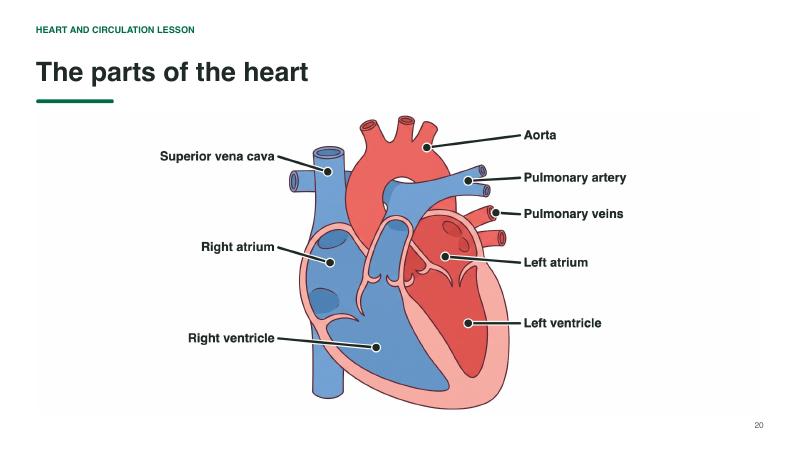
The heart is a muscular pump that keeps blood moving all around the body. Here is what happens at each labeled part of the diagram:
| Part | What it does | Why it matters |
|---|---|---|
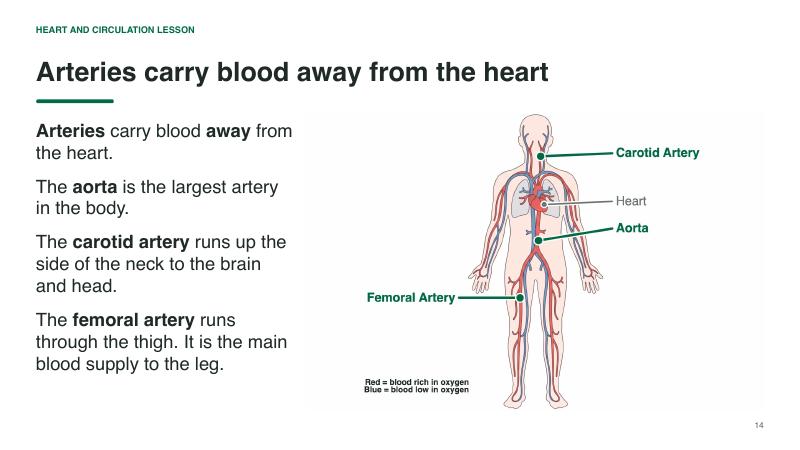
| Aorta | The body's largest artery; it carries oxygen-rich blood out to the whole body. | |
| Superior vena cava | A large vein that returns oxygen-poor blood from the upper body to the heart. | Every cell in your head, neck, and arms produces carbon-dioxide-laden blood that has to return somewhere — this is the highway it travels. Without it, that used blood would have no route back to get refreshed. |
| Pulmonary artery | Carries oxygen-poor blood from the heart to the lungs to pick up oxygen. | Unusually for an artery, this one carries oxygen-poor blood — a fact that surprises most people who learn that arteries carry blood away from the heart, not that they always carry fresh blood. Without this connection, your lungs would have nothing to oxygenate and the whole system would grind to a halt. |
| Pulmonary veins | Bring oxygen-rich blood back from the lungs into the heart. | These four vessels are the only veins in the body that carry oxygen-rich blood, which is another rule-breaker worth remembering. Cut this link and the left side of your heart would have no fuel to pump out to the body. |
| Right atrium | The upper right chamber that receives oxygen-poor blood returning from the body. | Think of it as the heart's waiting room — blood from your entire upper and lower body files in here before being sent onward. Without it, the return flow from the body would have nowhere to land and the circuit would back up. |
| Left atrium | The upper left chamber that receives oxygen-rich blood from the lungs. | Fresh from the lungs and loaded with oxygen, blood pools here just long enough to be passed down into the left ventricle for the big push. A problem in this chamber — like an irregular heartbeat — can allow blood to clot and raise the risk of a stroke. |
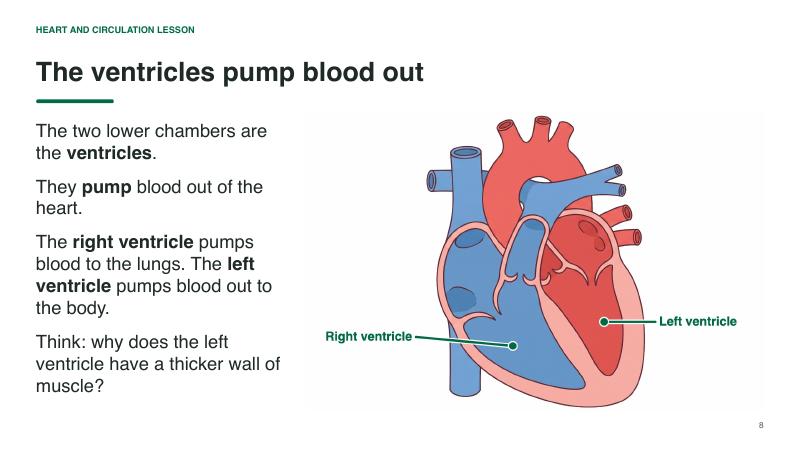
| Right ventricle | The lower right chamber that pumps blood out to the lungs. | It only needs to push blood as far as your lungs, which are right next door, so its walls are thinner than the left ventricle's — a neat example of the heart being built exactly as strong as it needs to be. If this chamber fails, fluid can back up into the lungs, making it hard to breathe. |
| Left ventricle | The lower left chamber that pumps oxygen-rich blood out to the body. | This is the hardest-working chamber in the heart, with thick muscular walls built to generate enough pressure to push blood all the way to your toes. When doctors measure your blood pressure, they are essentially measuring the force this chamber produces with every squeeze. |
How to print
Choose Download PDF for a ready-to-print file that fits US Letter paper (8.5 × 11") in portrait, or Download PNG for the high-resolution image.
Frequently asked questions
What does the heart do?
The heart is a muscular pump that pushes blood around the body, delivering oxygen and nutrients and carrying away waste.
How many chambers does the heart have?
The heart has four chambers: two upper chambers called atria and two lower chambers called ventricles.
What paper size should I print this on?
The diagram is sized for standard US Letter paper (8.5 × 11") in portrait orientation. Use "Download PDF" for a print-ready file that fits the page automatically.
Are there Heart and Circulation worksheets to go with the diagram?
Yes. The Heart and Circulation teaching pack, for grades 4 to 6, has 26 lesson slides and 11 printables with answer keys: the guided notes for the lesson slides, 4 diagram sheets, then “Parts of the Heart and Their Jobs” (a worksheet), “Parts of the Circulatory System” (a worksheet), “Your Heart and Your Blood” (a reading passage), “The Path of Blood Through the Heart” (an ordering worksheet), a vocabulary crossword and a quiz. The diagrams are free to download on this page. The other sheets come with the pack ($7), which is also in the Elementary Science bundle (grades 3 to 6).