Immune System Diagram
Free printable immune system diagram — a labeled illustration of the lymphatic organs, lymph nodes, bone marrow, and key immune cells. Download a high-resolution PDF or PNG for Letter paper.
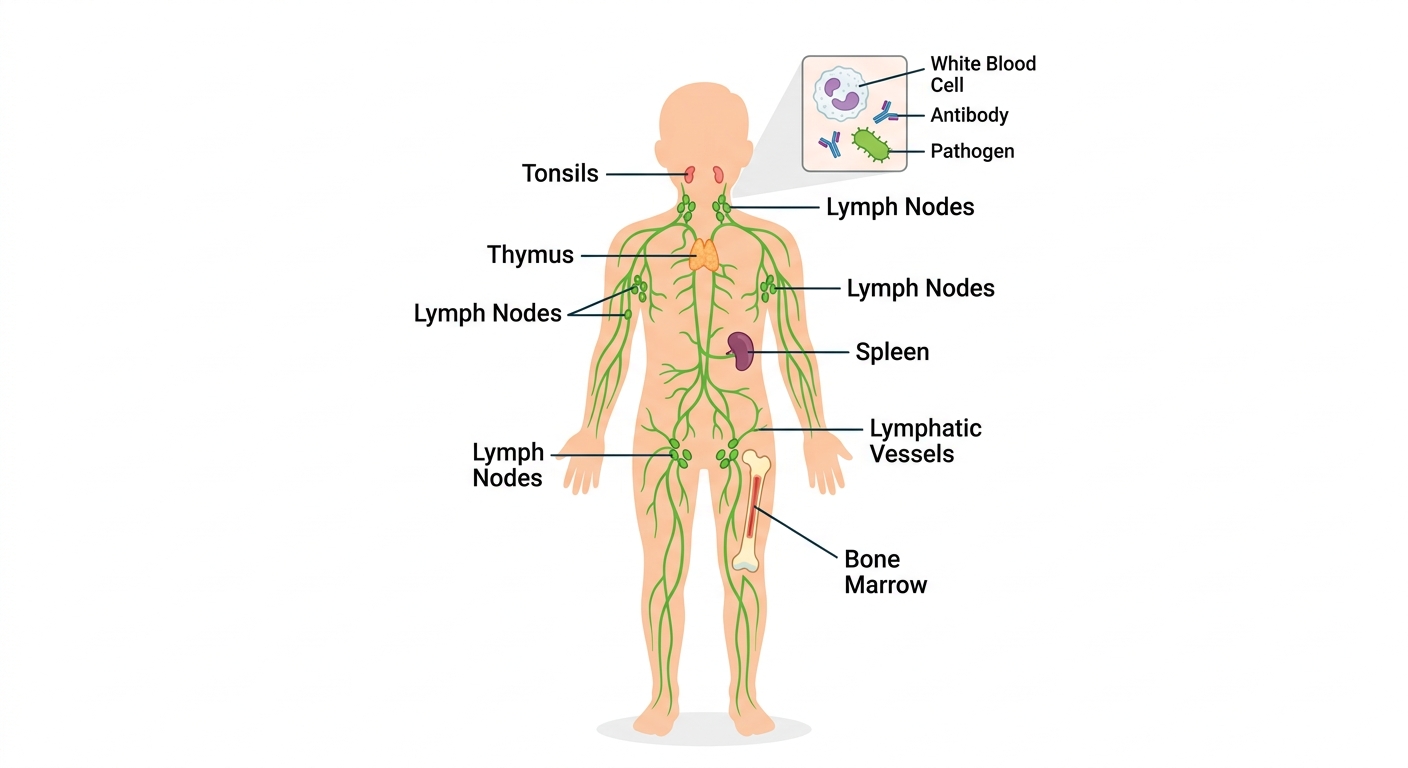

The parts of the immune system
The immune system is the body's defence network, identifying and destroying bacteria, viruses, and other threats before they can make you seriously ill. Here is what happens at each labeled part of the diagram:
| Part | What it does | Why it matters |
|---|---|---|
| Bone Marrow | The soft tissue inside bones where all blood cells — including immune cells — are produced. | Every immune cell in your body was born in the bone marrow, which produces around 500 billion new blood cells every day to replace those that wear out or are used up fighting infection. Stem cells in the marrow can become any type of blood cell — red cells for oxygen transport, platelets for clotting, or the various white blood cells that make up the immune system. This is why bone marrow transplants can rebuild an immune system that has been destroyed by disease or cancer treatment. |
| Thymus | Matures a type of immune cell called T-lymphocytes (T-cells), which directly attack infected cells. | T-cells are made in the bone marrow but must graduate from the thymus before they are fit for duty. During their time in the thymus, immature T-cells are tested: those that react to the body's own cells are eliminated (preventing autoimmune attacks), while those that can recognise foreign threats are released into the bloodstream. The thymus does most of this work in childhood; by adulthood it has shrunken but the trained T-cells it released continue circulating for decades. |
| Spleen | Filters the blood, removes old red blood cells, and stores a reserve of immune cells. | The spleen acts as a blood filter and an immune staging ground at the same time. Blood passes through its tissue continuously, where old or damaged red blood cells are broken down and recycled, and where immune cells stand ready to ambush pathogens that make it into the bloodstream. After a severe infection the spleen can enlarge noticeably as it ramps up its immune response — one reason doctors feel for an enlarged spleen during a physical examination after symptoms like fever and fatigue. |
| Lymph Nodes | Small glands that filter lymph fluid and trap pathogens for immune cells to destroy. | Hundreds of lymph nodes are scattered throughout the body — behind the knees, in the groin, under the arms, along the neck — connected by the lymphatic vessels. When an infection is nearby, the local lymph nodes swell as they fill with immune cells and trapped pathogens. Swollen lymph nodes ("swollen glands") under the jaw during a throat infection are the body's immune response working at full speed exactly where the threat is. |
| Lymphatic Vessels | A network of tubes that collects fluid from body tissues and drains it through lymph nodes before returning it to the bloodstream. | The lymphatic system is a one-way drainage network running parallel to the blood vessels. It collects the fluid that leaks out of blood capillaries into surrounding tissues and returns it to the blood, preventing tissue swelling. Along the way, this fluid (called lymph) passes through lymph nodes where it is screened for pathogens. Unlike the circulatory system, the lymphatic system has no pump — it moves lymph through the squeezing action of surrounding muscles during normal movement. |
| Tonsils | Clusters of immune tissue at the back of the throat that trap pathogens entering through the mouth and nose. | The tonsils are the immune system's first checkpoint for everything you breathe and swallow. They are packed with white blood cells that sample passing microbes and mount an immune response before an infection can travel deeper into the body. This is why they often become inflamed and sore during throat infections — they are literally fighting the pathogen at the door. Removing tonsils (tonsillectomy) does not severely impair immunity because the rest of the lymphatic system compensates. |
| White Blood Cells | The immune system's active fighters — they identify, attack, and remember pathogens. | There are many types of white blood cells, each with a different role: neutrophils rush to infections and engulf bacteria; B-cells produce antibodies; T-cells directly kill infected cells or coordinate the overall response; memory cells linger for years so a second encounter with the same pathogen is defeated before you even feel ill. A single drop of blood contains thousands of white blood cells, all on constant patrol. |
| Antibodies | Y-shaped proteins made by B-cells that bind to specific pathogens and mark them for destruction. | Each antibody is precisely shaped to lock onto one specific target — like a key cut for one lock. Once attached to a pathogen, the antibody neutralises it directly or flags it for other immune cells to come and destroy. Vaccines work by exposing the immune system to a harmless piece of a pathogen so that B-cells produce antibodies and memory cells — meaning if the real pathogen ever arrives, the immune response is already primed and waiting. |
Companion worksheet
A free fill-in worksheet with an answer key, built from the labels above — students match each part to its description, then answer a couple of short questions. Great for a quick check after using the diagram.
How to print
Choose Download PDF for a ready-to-print file that fits US Letter paper (8.5 × 11") in landscape, or Download PNG for the high-resolution image.
Frequently asked questions
What does the immune system do?
It defends the body against bacteria, viruses, fungi, and other pathogens — identifying threats, attacking them, and remembering them so future infections are fought off faster.
What is the difference between the immune system and the lymphatic system?
The lymphatic system is a network of vessels and organs (nodes, spleen, thymus) that drains fluid and filters pathogens. The immune system refers to all the cells and processes that fight infection — much of which happens within the lymphatic system.
What paper size should I print this on?
The diagram is sized for standard US Letter paper (8.5 × 11") in landscape orientation. Use "Download PDF" for a print-ready file that fits the page automatically.