Plant Cell Diagram
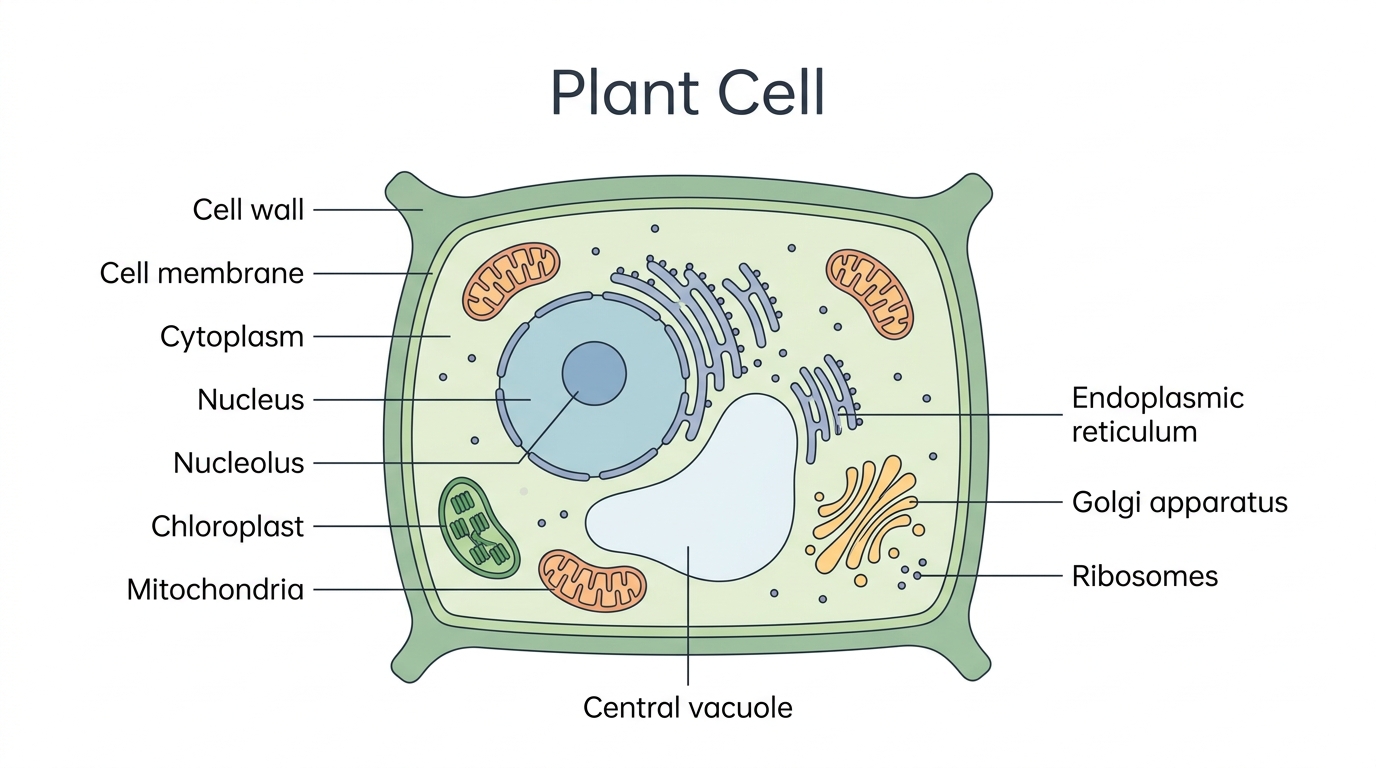
Free printable plant cell diagram — a labeled plant cell showing the cell wall, chloroplasts, central vacuole, nucleus, mitochondria and more. Download a high-resolution PDF or PNG for Letter paper.
Plant cells are the original solar panels — they capture energy from sunlight and convert it into food that powers nearly every living thing on Earth. Two structures make them unique: chloroplasts, which run photosynthesis, and a rigid cell wall, which gives plants the strength to stand upright without muscles or a skeleton. Everything else in the cell supports those two jobs.
The parts of a plant cell
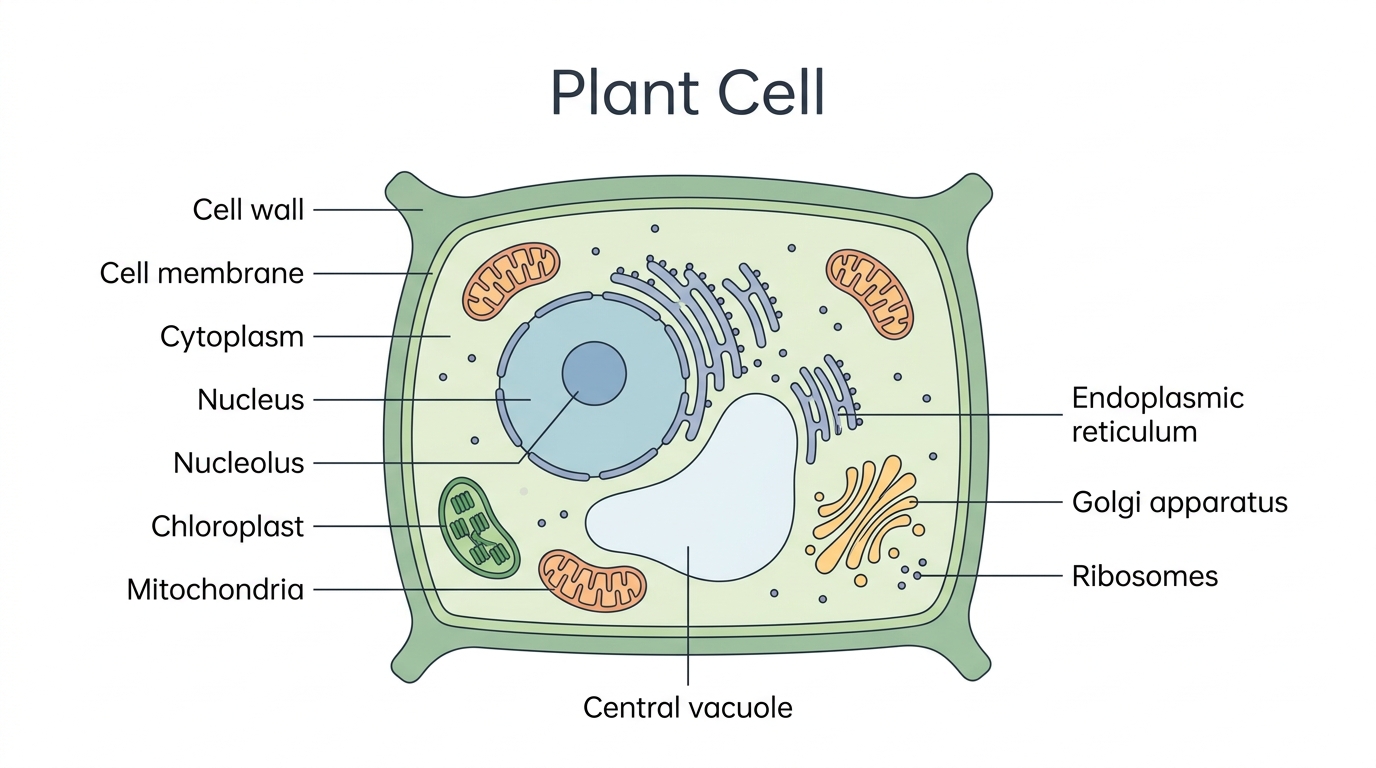
A plant cell is the basic building block of plants. It shares many parts with an animal cell but has three key structures animals don't: a cell wall, chloroplasts, and a large central vacuole. Here is what happens at each labeled part of the diagram:
| Organelle | What it does | Why it matters |
|---|---|---|
| Cell wall | A rigid outer layer surrounding the cell membrane that gives the plant cell its shape and support. | The cell wall is why plants can stand upright without muscles or a skeleton — it provides structural strength that makes trees, stems, and leaves physically possible. Animal cells have no equivalent. |
| Cell membrane | A thin layer inside the cell wall that controls what enters and leaves the cell. | Even though the cell wall provides structure, the membrane does all the selective filtering — deciding exactly which molecules get in and out to keep the cell's chemistry in balance. |
| Cytoplasm | The jelly-like fluid that fills the cell and holds all the organelles. | The medium through which nutrients, proteins, and signals travel between organelles — without it, the cell's parts couldn't communicate. |
| Nucleus | The control center that holds the DNA and directs the cell's activities. | Contains the full DNA blueprint for the plant — including the instructions for building the proteins that run photosynthesis in the chloroplasts. |
| Nucleolus | A small body inside the nucleus that makes ribosomes. | Ribosomes are the cell's protein-building machines — the nucleolus is where those machines are manufactured before they start work. |
| Chloroplast | The organelle that captures sunlight and uses it to make food through photosynthesis. | The defining feature of plant cells. Without chloroplasts, plants couldn't make their own food — and since nearly every food chain starts with plants, chloroplasts ultimately power almost all life on Earth. |
| Mitochondria | Releases energy from food for the cell to use. | Even though chloroplasts make food, mitochondria release that energy in a form the cell can actually spend. Plants need both — chloroplasts to capture energy, mitochondria to use it. |
| Large central vacuole | A giant water-filled storage sac that takes up most of the cell's volume. | When full of water, the vacuole pushes outward against the cell wall, keeping the plant firm and upright. When a plant wilts, the vacuoles have lost water — watering it refills them and the plant stands up again. |
| Endoplasmic reticulum | A network of membranes that makes and moves proteins and fats around the cell. | The cell's internal highway — carrying newly-made proteins from where they're built to where they're needed. |
| Golgi apparatus | Packages and ships proteins to where they are needed inside or outside the cell. | The cell's post office: sorts and labels proteins, then sends them to the right destination — other organelles, the cell wall, or neighboring cells. |
| Ribosomes | Tiny structures that build proteins. | Every protein in the plant — including the enzymes that run photosynthesis — is built by ribosomes. They're found in all living cells because proteins are universal to life. |
Companion worksheet
A free fill-in worksheet with an answer key, built from the labels above — students match each organelle to its description, then answer a couple of short questions. Great for a quick check after using the diagram.
How to print
Choose Download PDF for a ready-to-print file that fits US Letter paper (8.5 × 11") in landscape, or Download PNG for the high-resolution image.
Frequently asked questions
What are the main parts of a plant cell?
A plant cell has a cell wall, cell membrane, cytoplasm, nucleus, nucleolus, chloroplasts, mitochondria, a large central vacuole, endoplasmic reticulum, Golgi apparatus and ribosomes.
What is the difference between a plant cell and an animal cell?
Plant cells have three structures animal cells lack: a rigid cell wall (for support), chloroplasts (for photosynthesis), and a large central vacuole (for water storage). Animal cells have lysosomes and centrioles instead.
What paper size should I print this on?
The diagram is sized for standard US Letter paper (8.5 × 11") in landscape orientation. Use "Download PDF" for a print-ready file that fits the page automatically.