Mitosis Diagram
Free printable mitosis diagram — a labeled cell cycle showing all six stages of mitosis: interphase, prophase, metaphase, anaphase, telophase, and cytokinesis. Download a high-resolution PDF or PNG for Letter paper.
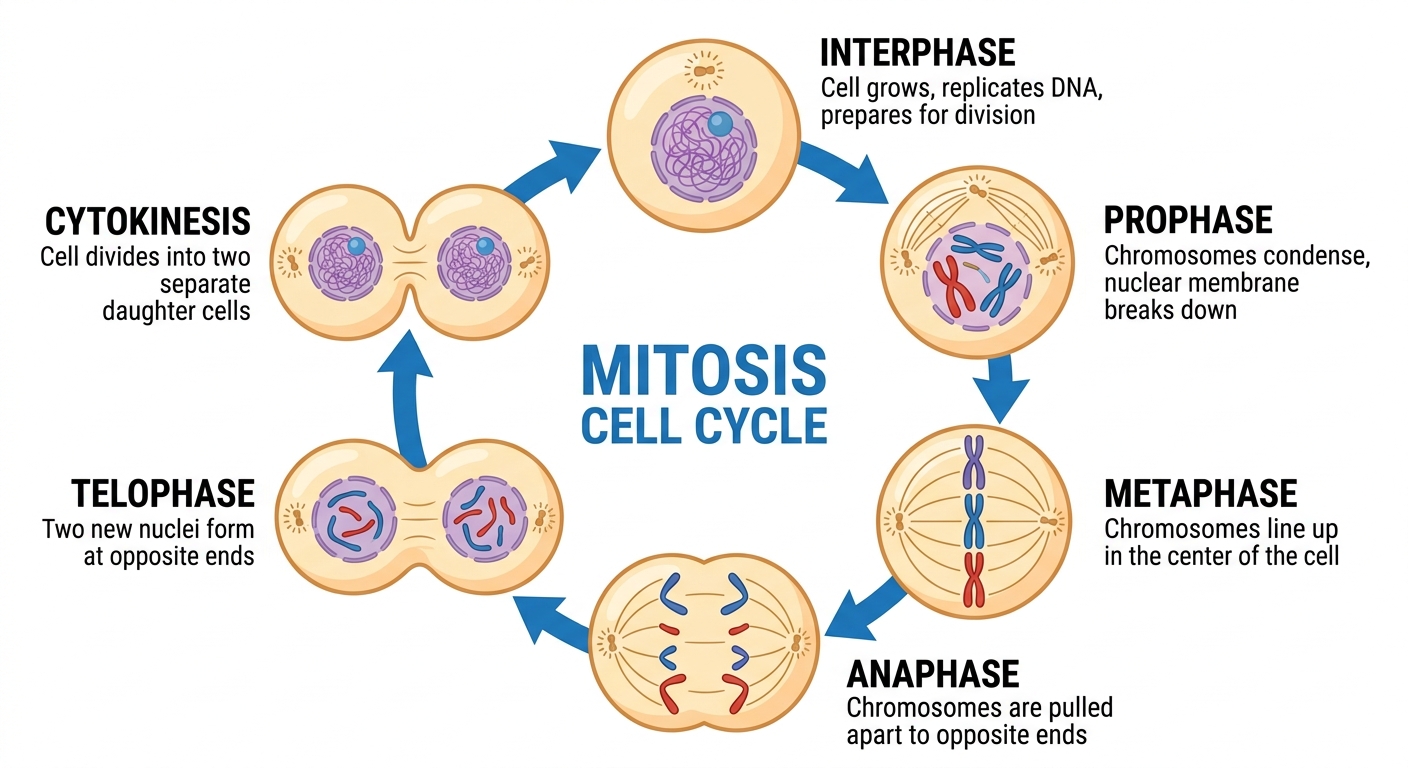

The stages of mitosis
Mitosis is the process by which one cell divides into two identical daughter cells — the way all living things grow, repair tissue, and replace worn-out cells. Here is what happens at each labeled part of the diagram:
| Stage | What it does | Why it matters |
|---|---|---|
| Interphase | The cell grows and copies its DNA in preparation for division. | Interphase is not a stage of mitosis itself — it is the long period of normal cell activity that comes before division begins. During this time the cell doubles in size, replicates all of its DNA so each daughter cell will get a complete copy, and produces the proteins and organelles it will need. A typical human cell spends about 90 percent of its life in interphase; the actual division that follows takes only one to two hours. |
| Prophase | The chromosomes condense and become visible; the nuclear envelope breaks down. | At the start of prophase the cell's loosely wound DNA (chromatin) coils tightly into the compact X-shaped chromosomes visible under a microscope. At the same time the nuclear envelope — the membrane surrounding the nucleus — dissolves, and spindle fibres begin to form from the cell's centrioles. Prophase is the cell's equivalent of assembling and loading the machinery that will physically pull the chromosomes apart. |
| Metaphase | The chromosomes line up along the middle of the cell. | Spindle fibres from opposite ends of the cell attach to the centre of each chromosome and tug them into a precise line across the cell's equator. This alignment is not random — it is the cell's quality-control step, ensuring that every chromosome has a spindle fibre from each side so that when they separate, one copy goes to each new cell. If a chromosome is not correctly attached, the cell pauses and will not continue. |
| Anaphase | The chromosome pairs are pulled apart to opposite ends of the cell. | The spindle fibres shorten rapidly, physically dragging the duplicated chromosomes toward opposite poles of the cell. What was one pair of identical chromosomes becomes two separate single chromosomes moving in opposite directions. Anaphase is the fastest stage of mitosis — the chromosomes can travel the full length of the cell in just a few minutes — and it is the most visually dramatic, creating the familiar "star" shape seen in textbook photographs. |
| Telophase | A new nuclear envelope forms around each set of chromosomes. | As the chromosomes arrive at their respective poles, the spindle fibres disappear and a new nuclear envelope assembles around each group. The chromosomes begin to uncoil back into loose chromatin. By the end of telophase the cell has two separate nuclei — one at each end — each containing a complete and identical set of genetic information. The cell itself has not yet divided; that happens next. |
| Cytokinesis | The cell splits into two identical daughter cells. | Cytokinesis begins while telophase is still finishing and completes cell division by physically splitting the cytoplasm in two. In animal cells a ring of protein filaments pinches the cell inward like a drawstring bag until it separates into two cells. In plant cells a new cell wall is built down the middle of the cell instead, since the rigid outer wall prevents pinching. The result in both cases is two genetically identical daughter cells, each ready to begin interphase again. |
Companion worksheet
A free fill-in worksheet with an answer key, built from the labels above — students match each stage to its description, then answer a couple of short questions. Great for a quick check after using the diagram.
How to print
Choose Download PDF for a ready-to-print file that fits US Letter paper (8.5 × 11") in landscape, or Download PNG for the high-resolution image.
Frequently asked questions
What is mitosis?
Mitosis is the process by which a cell divides its nucleus to produce two daughter cells with identical DNA. It is used for growth, tissue repair, and asexual reproduction.
What is the difference between mitosis and meiosis?
Mitosis produces two identical diploid cells (same number of chromosomes as the parent) and is used for growth and repair. Meiosis produces four genetically unique haploid cells (half the chromosomes) and is used to make sex cells (eggs and sperm).
What paper size should I print this on?
The diagram is sized for standard US Letter paper (8.5 × 11") in landscape orientation. Use "Download PDF" for a print-ready file that fits the page automatically.