 Printable Scholar
Punnett Square Worksheet and Diagram
Free printable Punnett square diagram and practice worksheet for grades 6-8: Mendel’s pea flower monohybrid cross (Pp × Pp) with dominant and recessive alleles, homozygous and heterozygous genotypes, phenotypes and the 3 : 1 ratio, plus a blank diagram to label. PDF for Letter paper.
Part of the Heredity and Punnett Squares teaching pack for grades 6 to 8: 33 lesson slides and 10 printables with answer keys. The diagram and the blank one to label are free.
Teaching ideas for Heredity and Punnett Squares
Pick the ideas that suit your class, then follow the plan or use the sheets in any order.
- Coin toss offspring. Two students each flip a coin for a Pp parent: heads is P, tails is p. They write the offspring’s genotype. Pool the whole class’s tosses and compare with the Punnett square.
- A plant with babies. Bring in a spider plant with small plants hanging from it, or a strawberry plant with a runner. Each small plant came from one parent alone.
- Sort trait cards. Write genotypes and descriptions on cards, like “Tt” or “black fur.” Groups sort them into homozygous, heterozygous and phenotype piles.
A plan for the week
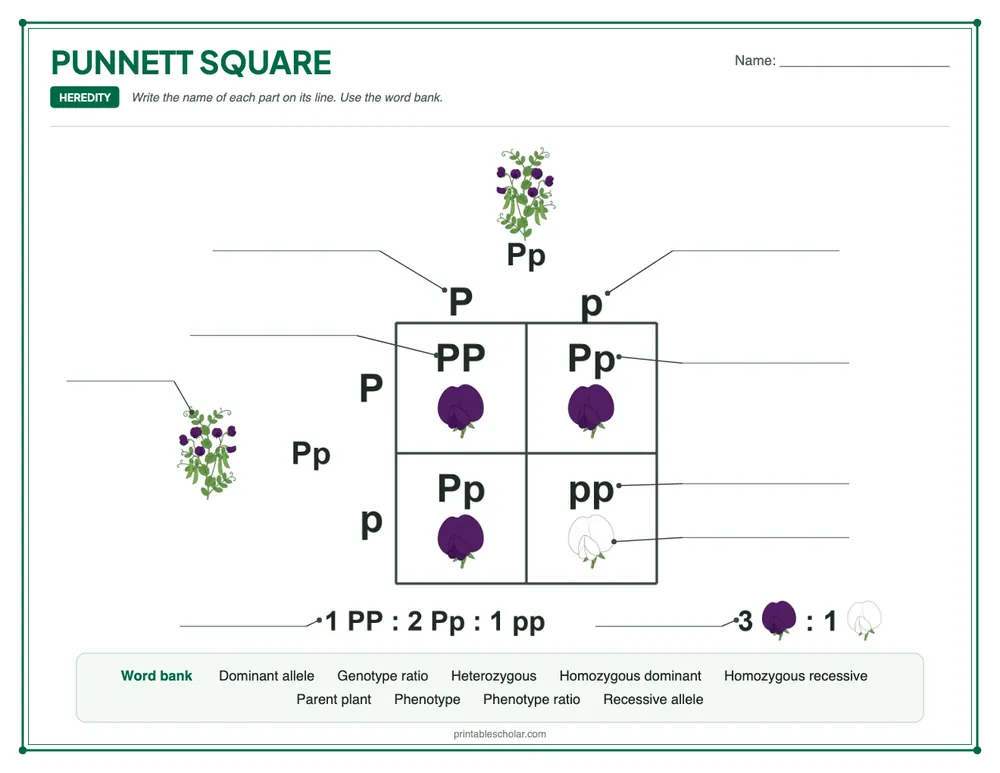
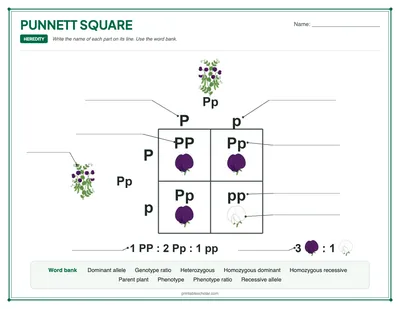
| Day 1 | Open with one of the ideas above. Teach the lesson with the slides while students fill in the guided notes. Teach the parts of a Punnett square from the labeled diagram, then students label the blank one. | Lesson slides (PowerPoint) (in the pack) Heredity and Punnett Squares Guided Notes (in the pack) Punnett Square Diagram Blank Punnett Square Diagram |
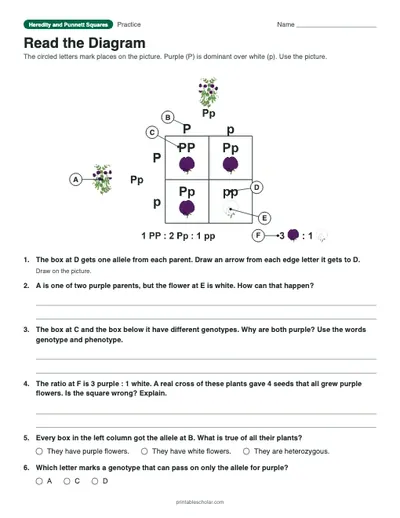
| Day 2 | Students work out what the picture shows on “Read the Diagram”: where each box gets its letters, how two purple parents can have a white-flowered offspring and what the ratio really means. | Read the Diagram (in the pack) |
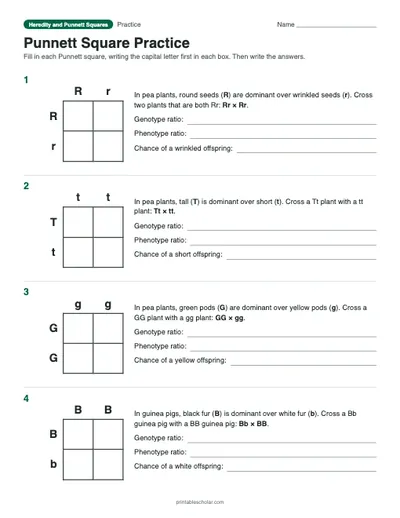
| Day 3 | Read “How Traits Are Passed On” and answer the questions. Then students fill in four squares on “Punnett Square Practice.” | How Traits Are Passed On (in the pack) Punnett Square Practice |
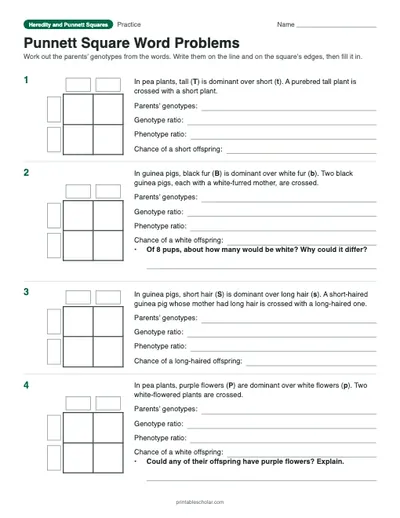
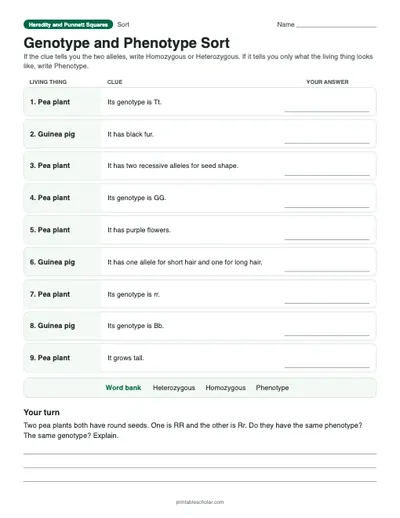
| Day 4 | Students work out the parents’ genotypes from the words on “Punnett Square Word Problems,” then sort genotypes and traits on “Genotype and Phenotype Sort.” | Punnett Square Word Problems (in the pack) Genotype and Phenotype Sort (in the pack) |
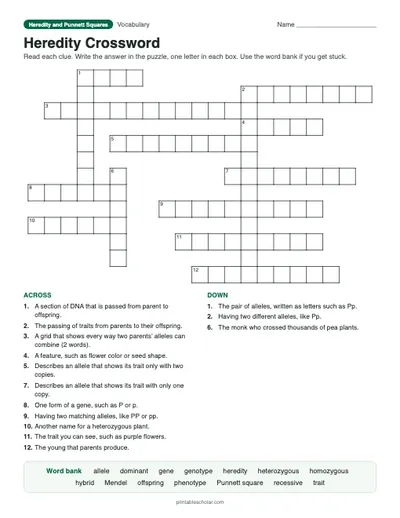
| Day 5 | Review with the crossword, then give the quiz. | Heredity Crossword (in the pack) Heredity Quiz (in the pack) |
The sheets marked “in the pack” are in the Heredity and Punnett Squares teaching pack below.
NGSS standards
- Supports MS-LS3-2: Develop and use a model to describe why asexual reproduction results in offspring with identical genetic information and sexual reproduction results in offspring with genetic variation.
Heredity and Punnett Squares teaching pack
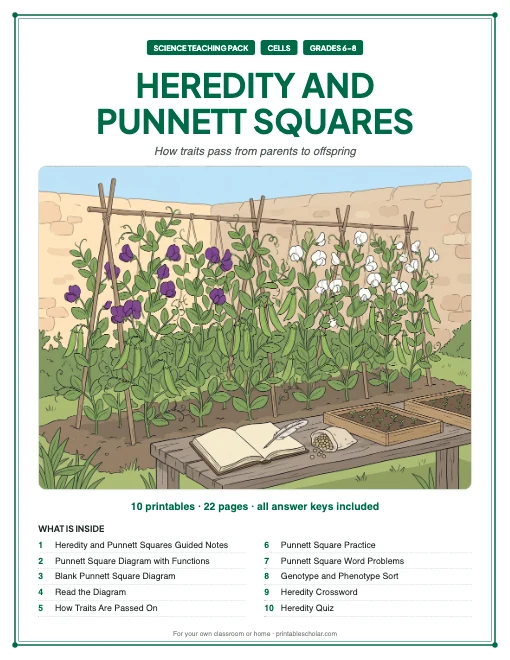
A ready-to-teach lesson: 33 slides and 10 printables. Present the slides while students fill in the guided notes, then use the worksheets, crossword and quiz, with every answer key.
Teaching heredity and Punnett squares? This pack has ready-made lesson slides and 9 printables that take students from traits and alleles to filling in Punnett squares and solving word problems, in teaching order, with every answer key.
Free on this page: 3 of the 10 printables, marked Download below. The whole pack is $7: 22 pages in one print-ready file, the 33 lesson slides, the practice sheets, the crossword, the quiz and every answer key.
OnlineThe pack also comes as an online lesson for Google Classroom: every part on screen for students, plus a self-grading Google Forms quiz.
One-time purchase. Instant download. Secure checkout by Stripe. Want to see a whole pack first? The Cells pack is free.See all 16 packs in the bundle
- Cells
- Mitosis
- DNA
- Heredity and Punnett Squares (this pack)
- Carbon Cycle and Greenhouse Effect
- The Nitrogen Cycle
- Excretory System
- Endocrine System
- Immune System
- Layers of the Skin
- Plate Tectonics and Earthquakes
- Life Cycle of a Star
- Parts of an Atom
- The Periodic Table
- Waves and the Electromagnetic Spectrum
- Acids, Bases and the pH Scale
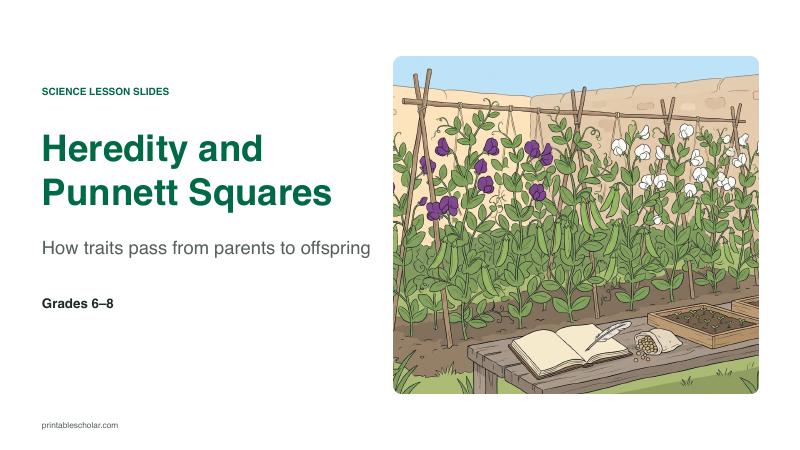
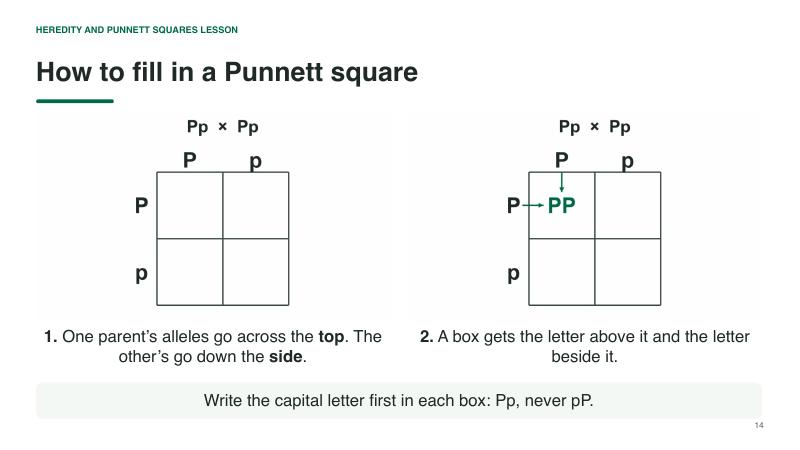
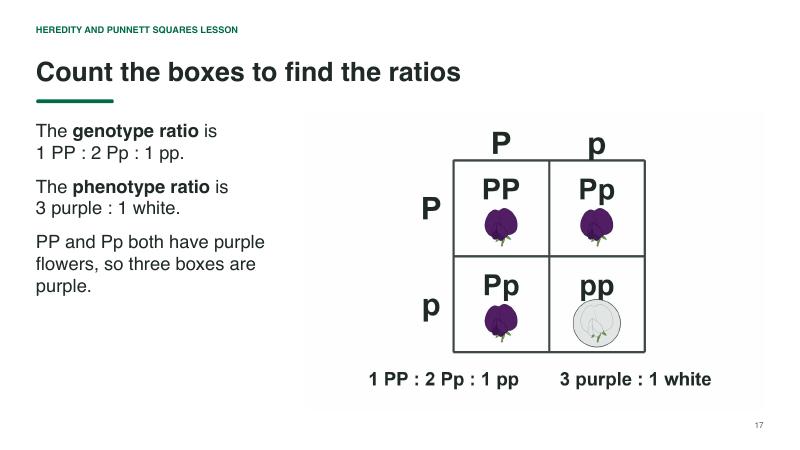
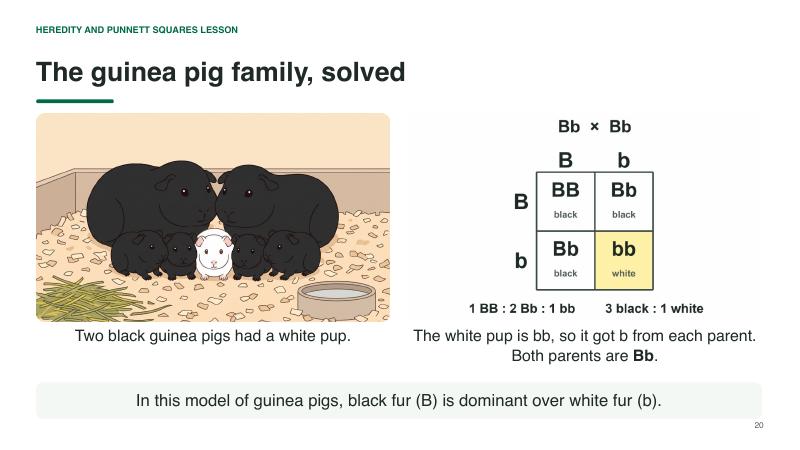
Teach Heredity and Punnett Squares with 33 ready-made slides
Open the PowerPoint and teach: an opening question, the parts one at a time on the diagram, quick checks and an exit question. Students fill in the guided notes sheet as you go.
Every slide comes with teacher notes: what to say, what to ask, and sample answers.
The slides (PowerPoint and a PDF copy) and the guided notes sheet come with the pack.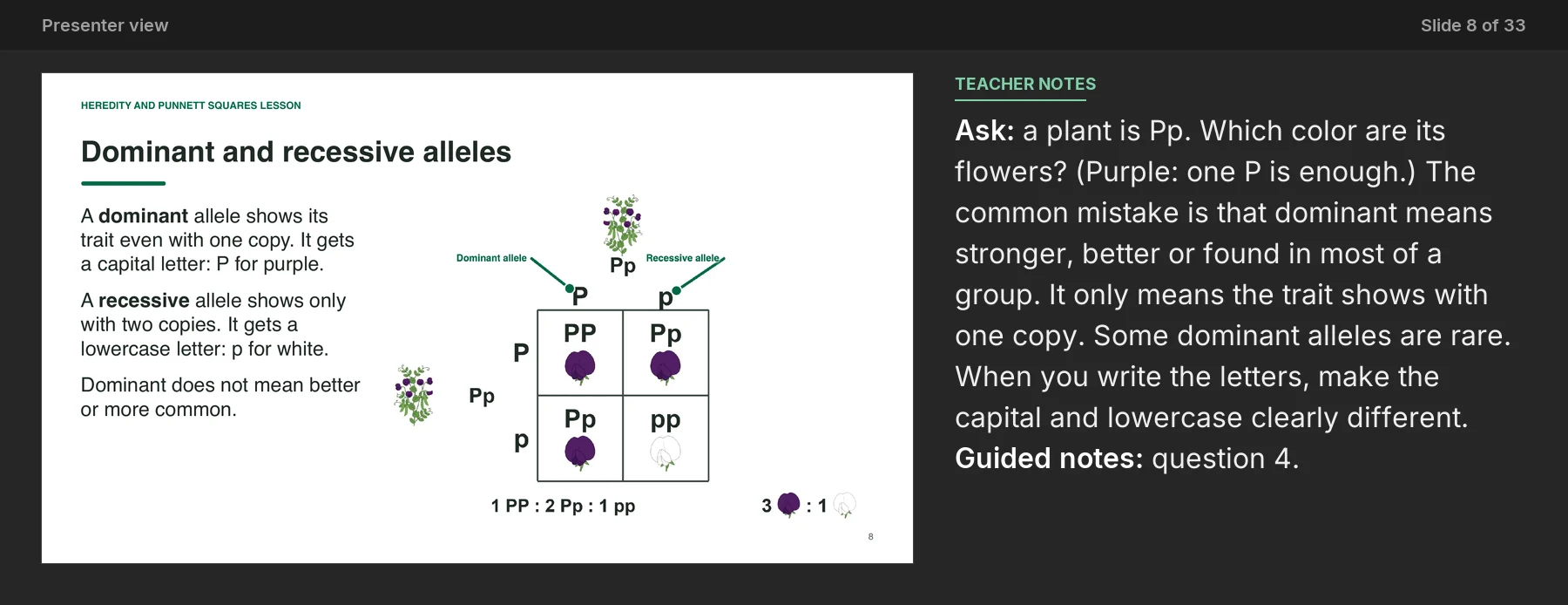
What is in the pack, in teaching order
 In the pack
1. TeachLesson Slides33 slides to present, with your notes for each one.In the $7 pack
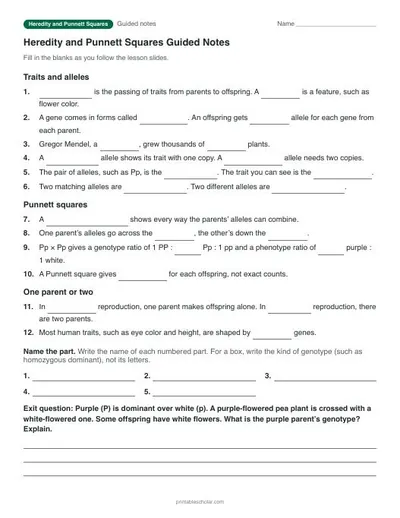 In the pack
1. TeachHeredity and Punnett Squares Guided NotesStudents fill in the blanks as you present. With answer key.In the $7 pack
 Free
 Free
 In the pack
3. ReasonRead the DiagramRead the Punnett square picture: draw where a box gets its letters, explain how two purple parents can have a white-flowered offspring and what the 3 : 1 ratio means.In the $7 pack
 In the pack
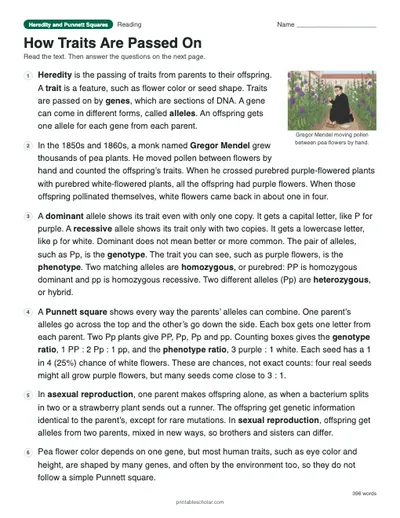
4. ReadHow Traits Are Passed OnA one-page text on traits, alleles, Mendel’s peas, dominant and recessive alleles, genotype and phenotype, and how a Punnett square works, with eight questions.In the $7 pack
 Free
5. PracticePunnett Square PracticeFour Punnett squares with the parents’ letters given: fill in each grid, then write the genotype ratio, the phenotype ratio and the chance of the recessive trait.Download free PDF
 In the pack
6. ApplyPunnett Square Word ProblemsFour Punnett square word problems: work out the parents’ genotypes from the words, fill in the grid and predict the offspring.In the $7 pack
 In the pack
7. SortGenotype and Phenotype SortDecide whether each clue tells a homozygous genotype, a heterozygous genotype or only a phenotype, then compare two round-seeded plants.In the $7 pack
 In the pack
8. ReviewHeredity CrosswordFourteen heredity words with clues and a word bank.In the $7 pack
 In the pack
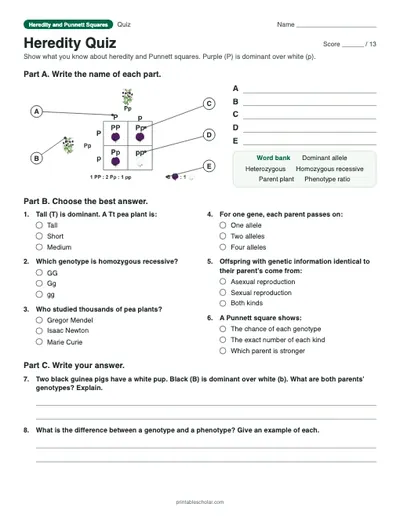
9. CheckHeredity QuizName five parts of a Punnett square, six multiple choice and two written answers. Scored out of 13.In the $7 pack
Heredity and Punnett Squares worksheets, crossword and quiz
The Heredity and Punnett Squares teaching pack is 33 lesson slides (PowerPoint and PDF) and 10 printables with answer keys for grades 6 to 8, in the order you would teach them: the guided notes for the lesson slides, the labeled diagram and the blank one to label, then “Read the Diagram” (a worksheet), “How Traits Are Passed On” (a reading passage), “Punnett Square Practice” (a worksheet), “Punnett Square Word Problems” (a worksheet), “Genotype and Phenotype Sort” (a sorting table), a vocabulary crossword and a quiz.
The sheets are in a suggested teaching order: teach the lesson, have students label the blank diagram, then work through the practice sheets and finish with the quiz. Use them all over a week or pick the ones you need. The answer keys are together at the back.
The diagram and the blank one to label are free to download on this page. The other sheets come with the pack ($7), which is also in the Middle School Science bundle (grades 5 to 8).
Heredity is the passing of traits from parents to their offspring. Each parent passes on one of its two alleles for a gene, so the offspring gets one allele from each parent. A Punnett square, named after the British scientist Reginald Punnett, shows every combination at once: one parent’s alleles go across the top, the other’s down the side, and each box gets one letter from each. In Mendel’s peas, the allele for purple flowers (P) is dominant and the allele for white flowers (p) is recessive, so only a plant with two p alleles has white flowers. When two Pp plants are crossed, each offspring has a 3 in 4 chance of purple flowers and a 1 in 4 chance of white. The square gives chances, not exact counts: four real seeds may not grow into three purple-flowered plants and one white-flowered plant, but many seeds come close. School crosses use single-gene traits like these on purpose. Most human traits, such as eye color and height, are shaped by many genes, and often by the environment too, so they do not follow a simple Punnett square.
The parts of a Punnett square
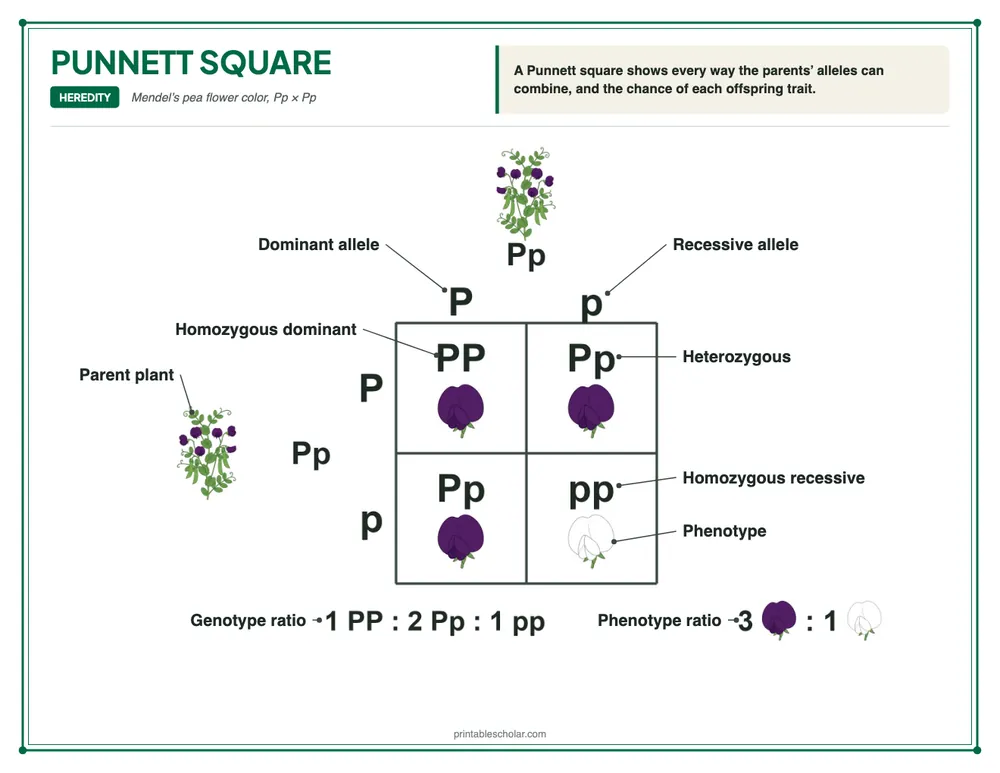
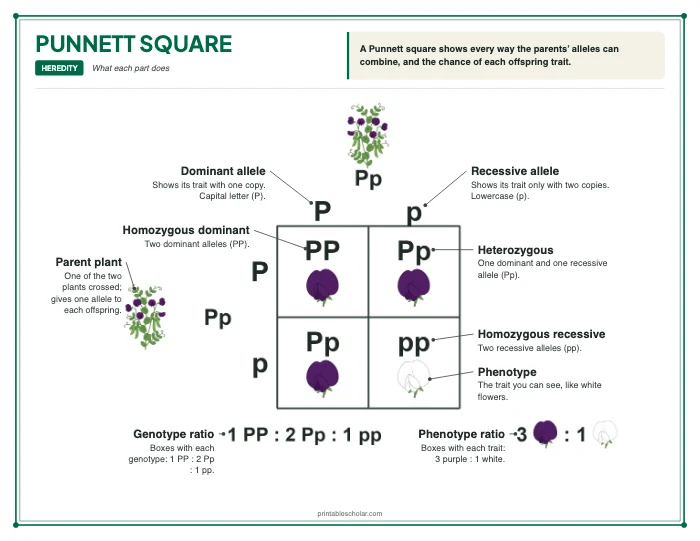
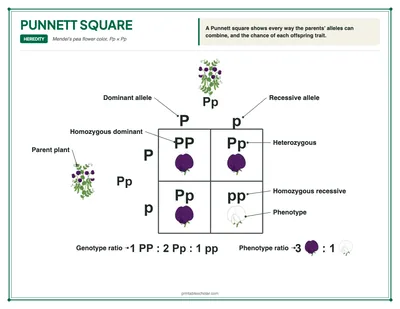
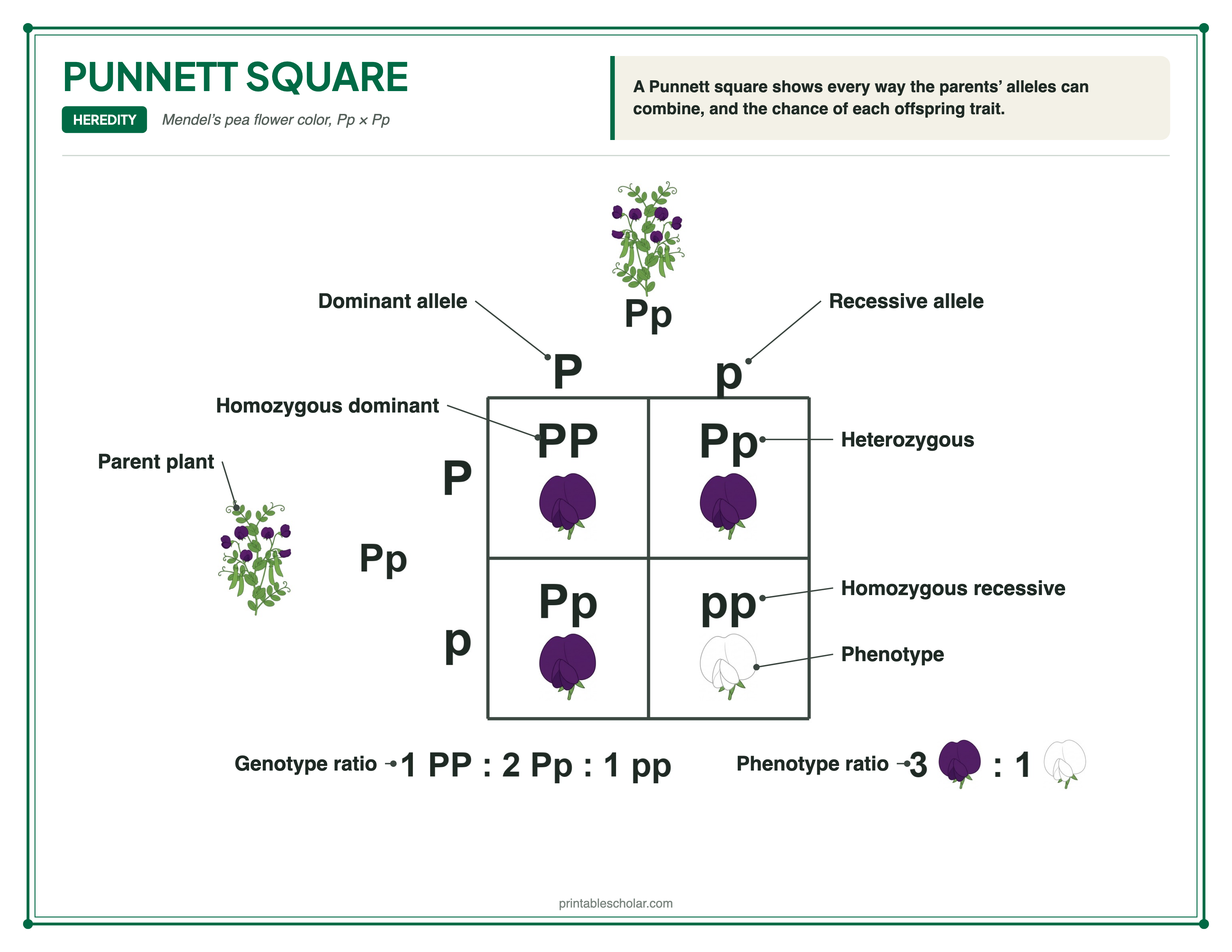
A Punnett square is a grid that shows every way two parents’ alleles can combine in their offspring. This diagram follows Gregor Mendel’s pea plants: two purple-flowered parents that each carry a hidden allele for white flowers. Here is what happens at each labeled part of the diagram:
| Part | What it does | Why it matters |
|---|---|---|
| Parent plant | One of the two plants being crossed. Each parent gives one allele for the trait to each offspring. | Both parents here have purple flowers and the genotype Pp: one allele for purple and one for white. Mendel crossed pea plants by moving pollen from the flower of one plant to the flower of another by hand, so he knew exactly which two plants were the parents. |
| Dominant allele | The allele that shows its trait even when only one copy is present. Written with a capital letter (P). | P, the allele for purple flowers, is dominant: a plant with PP or Pp has purple flowers. Dominant does not mean better or more common. It only means that one copy is enough to show the trait. |
| Recessive allele | The allele that shows its trait only when there are two copies. Written with a lowercase letter (p). | p, the allele for white flowers, is recessive. A Pp plant carries it but does not show it, so two purple parents can have a white-flowered offspring when each passes on its p. |
| Homozygous dominant | A genotype with two dominant alleles, like PP. | “Homo” means same: both alleles are the same. A PP plant has purple flowers and can only pass on P. Plants that always give offspring like themselves are called “purebred” (true-breeding). |
| Heterozygous | A genotype with one dominant and one recessive allele, like Pp. | “Hetero” means different. A Pp plant shows the dominant trait (purple) but carries the recessive allele, which it passes on to about half of its offspring. A heterozygous plant is sometimes called a hybrid. |
| Homozygous recessive | A genotype with two recessive alleles, like pp. | This is the only genotype that shows the recessive trait. In this cross one box in four is pp, so each offspring has a 1 in 4 chance of white flowers. |
| Phenotype | The trait you can see or measure, like purple or white flowers. | The genotype is the pair of letters; the phenotype is what the plant looks like. PP and Pp are different genotypes with the same phenotype: purple flowers. In the picture each box shows its genotype with the flower it gives. |
| Genotype ratio | How many boxes have each genotype, written as a ratio: 1 PP : 2 Pp : 1 pp. | Count the boxes: one PP, two Pp and one pp. Write the genotype with the dominant letter first (Pp, never pP). |
| Phenotype ratio | How many boxes have each trait: 3 purple : 1 white. | Three boxes (PP, Pp and Pp) give purple flowers and one (pp) gives white, so the phenotype ratio is 3 : 1. Mendel counted thousands of pea plants and found close to 3 : 1 again and again: 705 purple-flowered plants to 224 white-flowered ones in his flower color cross. |
How to print
Choose Download PDF for a ready-to-print file that fits US Letter paper (8.5 × 11") in landscape, or Download PNG for the high-resolution image.
Frequently asked questions
How do you fill in a Punnett square?
Write one parent’s two alleles across the top and the other parent’s two alleles down the left side. In each box, write the letter from the top of its column and the letter from the start of its row, with the capital letter first. Then count the boxes to get the genotype and phenotype ratios.
What is the difference between genotype and phenotype?
The genotype is the pair of alleles an organism has, written as letters such as PP, Pp or pp. The phenotype is the trait you can see or measure, such as purple or white flowers. Different genotypes can give the same phenotype: PP and Pp pea plants both have purple flowers.
What are dominant and recessive alleles?
A dominant allele shows its trait when there is one copy or two; it is written with a capital letter. A recessive allele shows its trait only when there are two copies; it is written with the same letter in lowercase. Dominant does not mean stronger, better or more common.
What is the difference between homozygous and heterozygous?
Homozygous means the two alleles are the same (PP or pp). Heterozygous means they are different (Pp). A heterozygous organism shows the dominant trait but can pass on the recessive allele.
Who was Gregor Mendel?
Gregor Mendel (1822-1884) was a monk and scientist in Brno, in what is now the Czech Republic. He crossed thousands of pea plants and counted their traits, and found the patterns of dominant and recessive inheritance. His work, published in 1866, was mostly overlooked until 1900, and he is now called the father of genetics.
Is eye color controlled by one gene?
No. Eye color is shaped by several genes working together. That is why eye colors come in so many shades, and why two blue-eyed parents can, rarely, have a brown-eyed child, which a simple one-gene model says cannot happen. Height, skin color and most other human traits also depend on many genes, and often on the environment too. Classes use single-gene traits, like Mendel’s pea flower color, because they follow a Punnett square cleanly.
What paper size should I print this on?
The diagram is sized for standard US Letter paper (8.5 × 11") in landscape orientation. Use "Download PDF" for a print-ready file that fits the page automatically.
Are there Heredity and Punnett Squares worksheets to go with the diagram?
Yes. The Heredity and Punnett Squares teaching pack, for grades 6 to 8, has 33 lesson slides and 10 printables with answer keys: the guided notes for the lesson slides, the labeled diagram and the blank one to label, then “Read the Diagram” (a worksheet), “How Traits Are Passed On” (a reading passage), “Punnett Square Practice” (a worksheet), “Punnett Square Word Problems” (a worksheet), “Genotype and Phenotype Sort” (a sorting table), a vocabulary crossword and a quiz. The diagram and the blank one to label are free to download on this page. The other sheets come with the pack ($7), which is also in the Middle School Science bundle (grades 5 to 8).
Related: Genes are made of DNA: see the DNA structure diagram, and how cells copy themselves in the mitosis diagram.