 Printable Scholar
Bacterial Cell Diagram
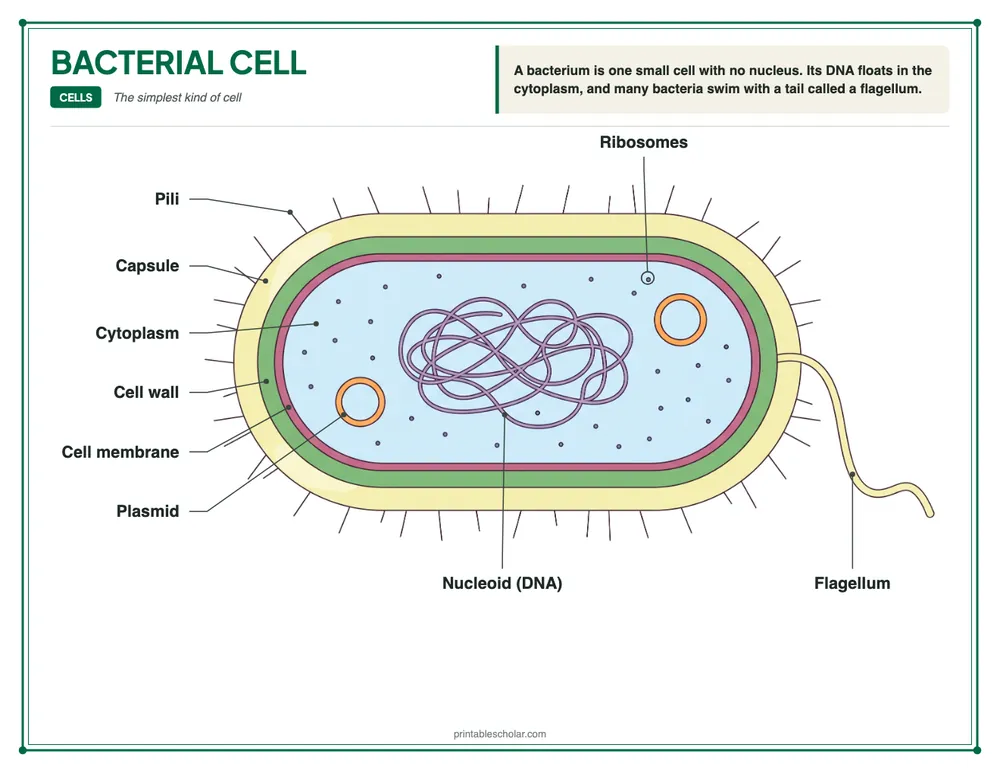
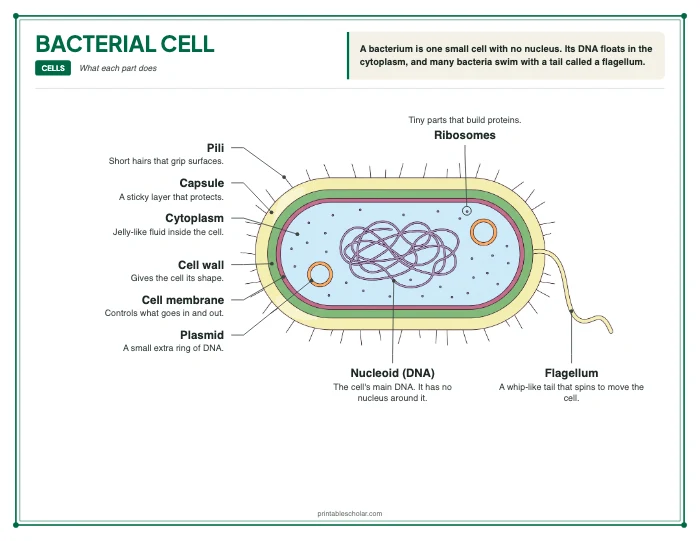
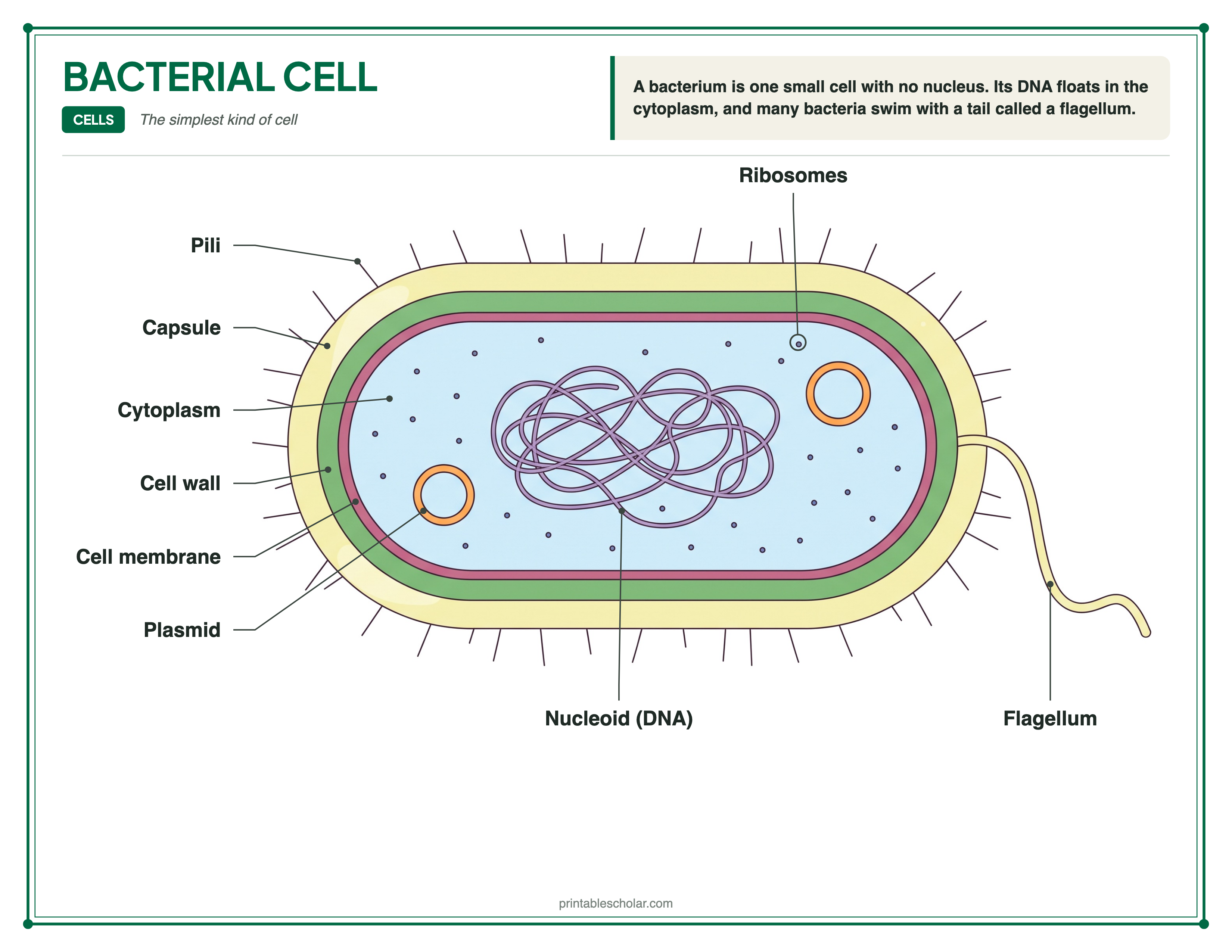
Free printable bacterial cell diagram — a labeled prokaryotic cell showing the cell wall, cell membrane, nucleoid DNA, plasmid, ribosomes, flagellum, pili and capsule. Labeled and blank PDFs with an answer key.
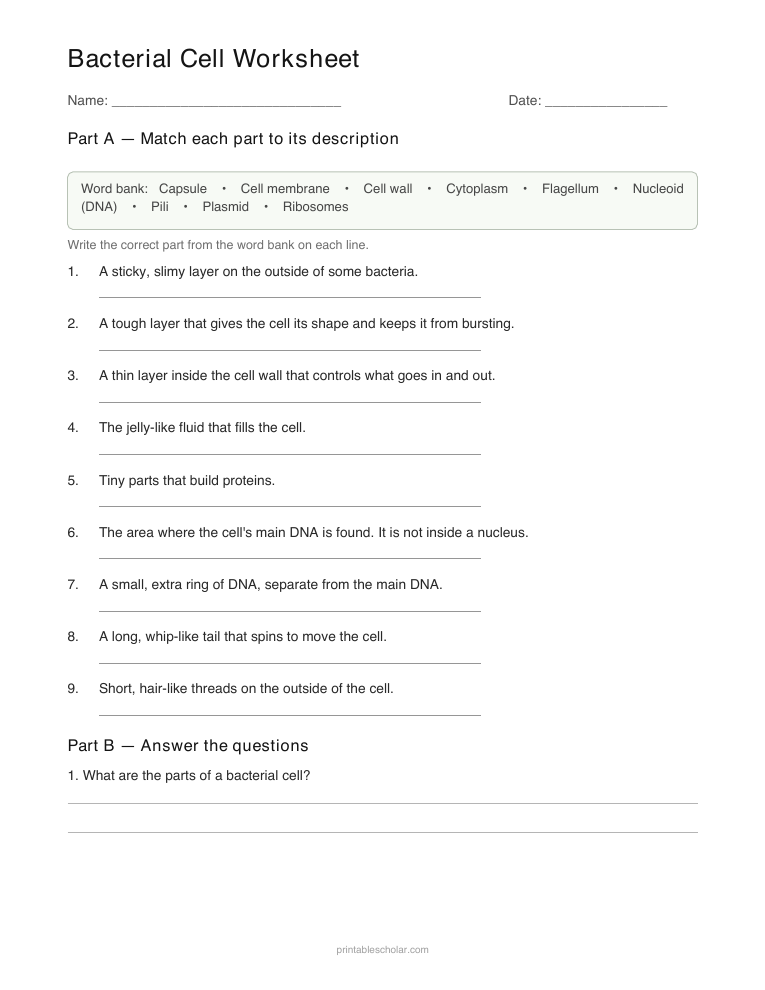
Companion worksheet
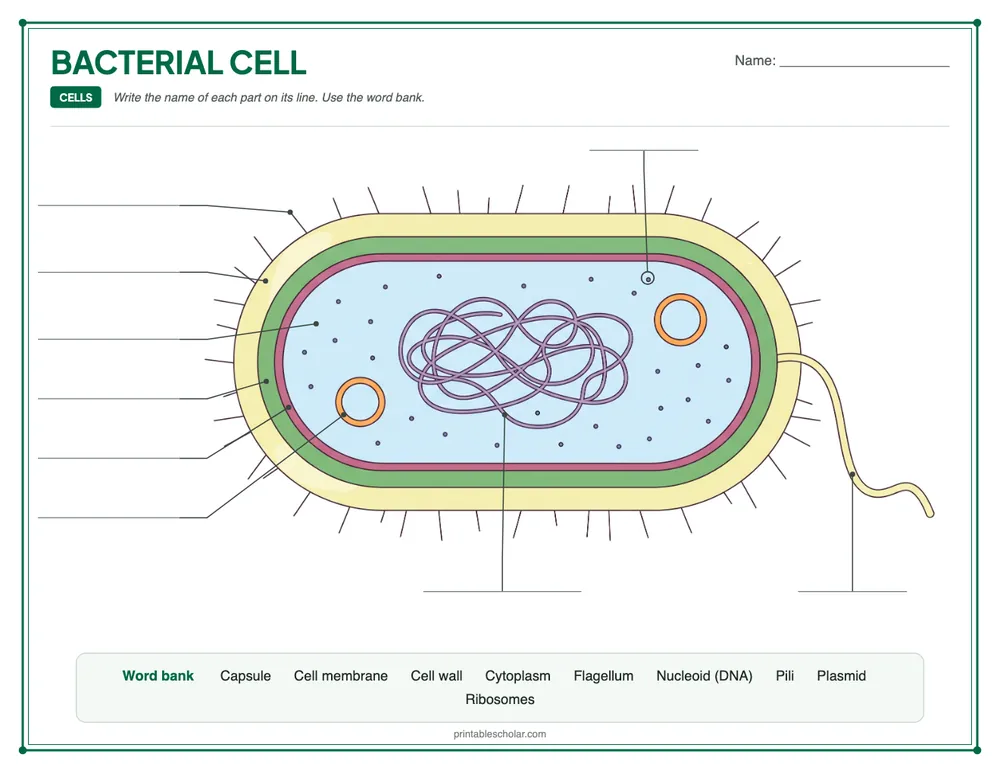
A fill-in worksheet built from the labels: students match each part to its description, then answer a few short questions. The answer key is included.
Download worksheet + answer key (PDF)Bacteria are the simplest and oldest kind of cell, and they live almost everywhere: in soil, in water, on your skin and in your gut. Each one is a single cell only a few thousandths of a millimeter long, far too small to see without a microscope. Scientists call bacterial cells prokaryotic, which means "before a nucleus": unlike an animal or plant cell, a bacterium keeps its DNA loose in the cytoplasm instead of wrapped in a nucleus, and it has no mitochondria or other membrane-covered organelles. The diagrams on this page show the parts most classes learn, with what each one does.
The parts of a bacterial cell
A bacterium is a living thing made of just one small cell. It is a prokaryotic cell: it has no nucleus, and its DNA floats in the cytoplasm. Here is what happens at each labeled part of the diagram:
| Part | What it does | Why it matters |
|---|---|---|
| Capsule | A sticky, slimy layer on the outside of some bacteria. | The capsule helps a bacterium stick to surfaces such as teeth, and keeps it from drying out. It can also help a bacterium hide from the white blood cells that would destroy it, so many disease-causing bacteria have one. Not every bacterium has a capsule. |
| Cell wall | A tough layer that gives the cell its shape and keeps it from bursting. | Plant cells have a cell wall too, but a bacterial cell wall is made of a different material called peptidoglycan. The antibiotic penicillin works by stopping bacteria from building their cell walls. |
| Cell membrane | A thin layer inside the cell wall that controls what goes in and out. | Every living cell has a cell membrane. In a bacterium it also does jobs that mitochondria do in our cells, such as releasing energy from food. |
| Cytoplasm | The jelly-like fluid that fills the cell. | The cell's chemical reactions happen in the cytoplasm. The DNA, plasmids and ribosomes all float in it. |
| Ribosomes | Tiny parts that build proteins. | Bacterial ribosomes are smaller than the ribosomes in human cells. Some antibiotics work by blocking bacterial ribosomes while leaving ours alone. |
| Nucleoid (DNA) | The area where the cell's main DNA is found. It is not inside a nucleus. | A bacterium's main DNA is usually one long loop, folded up tightly in the middle of the cell. It holds the instructions for everything the cell does. Having no nucleus is what makes a bacterium a prokaryote. |
| Plasmid | A small, extra ring of DNA, separate from the main DNA. | Plasmids carry a few extra genes, such as genes that help a bacterium survive an antibiotic. Bacteria can pass plasmids to each other, which is one way antibiotic resistance spreads. |
| Flagellum | A long, whip-like tail that spins to move the cell. | The flagellum turns like a propeller and pushes the bacterium through water. Some bacteria have one flagellum, some have many, and some have none. The plural is flagella. |
| Pili | Short, hair-like threads on the outside of the cell. | Pili help a bacterium hold on to surfaces and to other cells. Some bacteria use a special pilus to pass DNA, such as a plasmid, to another bacterium. One of them is called a pilus. |
How to print
Choose Download PDF for a ready-to-print file that fits US Letter paper (8.5 × 11") in landscape, or Download PNG for the high-resolution image.
Frequently asked questions
What are the parts of a bacterial cell?
A bacterial cell has a cell wall, a cell membrane, cytoplasm, ribosomes and a nucleoid where its DNA is found. Many bacteria also have plasmids, a flagellum, pili and a capsule.
What is the difference between a bacterial cell and an animal or plant cell?
A bacterial cell is a prokaryotic cell: it has no nucleus, and its DNA sits in the cytoplasm. It also has no mitochondria, chloroplasts, endoplasmic reticulum or Golgi apparatus. Animal and plant cells are eukaryotic cells: their DNA is inside a nucleus, and they are usually much bigger.
Do all bacteria look like this?
No. This diagram shows a rod-shaped bacterium with every common part. Bacteria can also be round or spiral, and many have no flagellum, pili or capsule. Every bacterium has a cell membrane, cytoplasm, ribosomes and DNA, and almost all have a cell wall.
What paper size should I print this on?
The diagram is sized for standard US Letter paper (8.5 × 11") in landscape orientation. Use "Download PDF" for a print-ready file that fits the page automatically.