 Printable Scholar
A Food Web
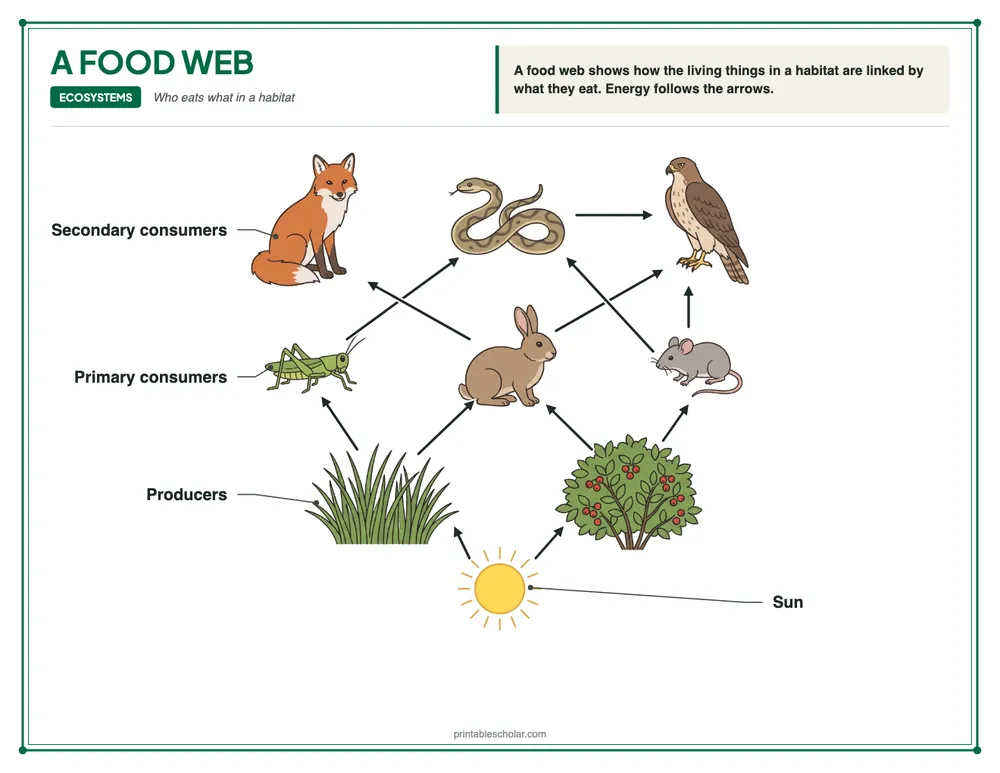
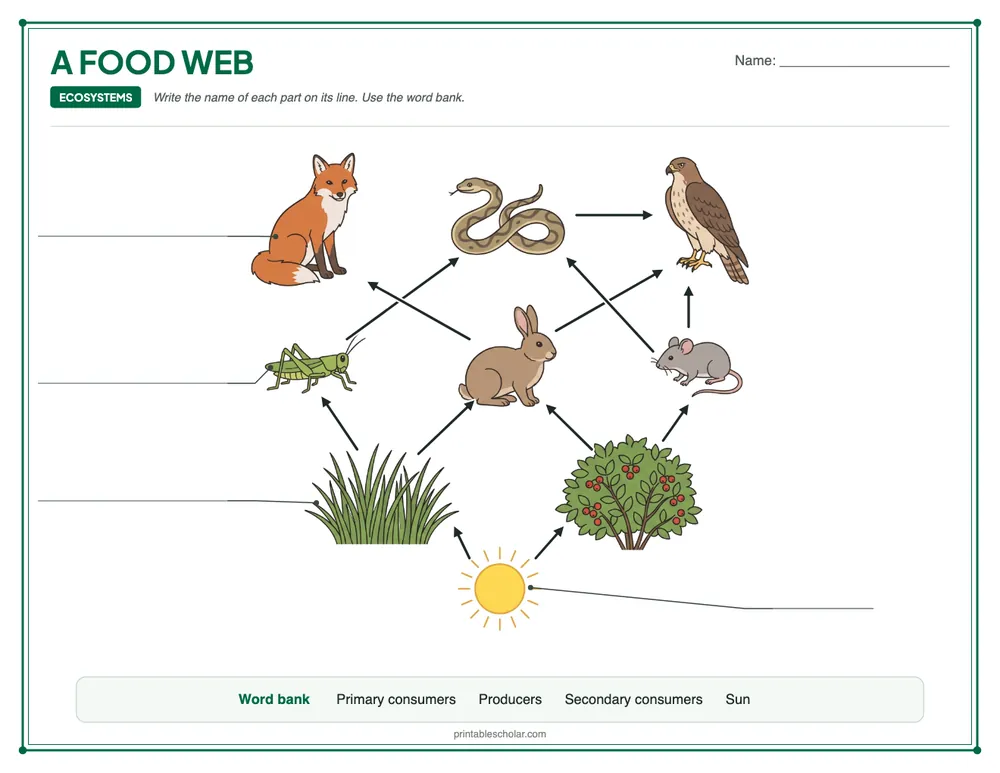
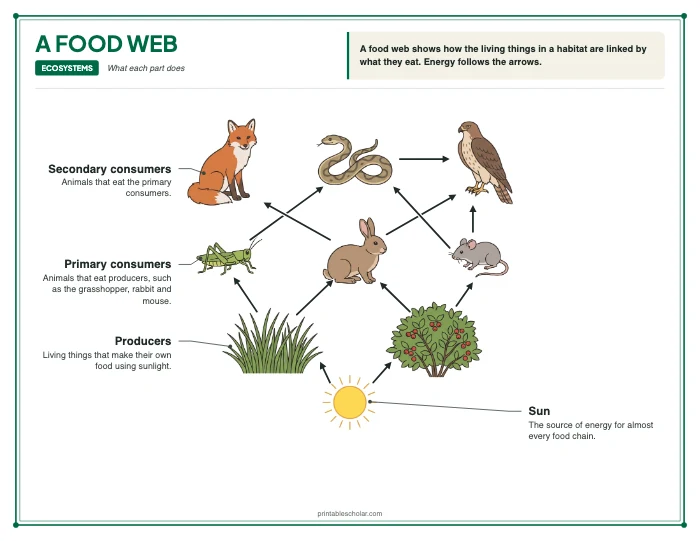
Free printable food web diagram — a woodland food web showing how plants and animals are connected, with arrows showing how energy flows. Download a high-resolution PDF or PNG for Letter paper.
Part of the Food Chains and Food Webs teaching pack for grades 4 to 6: 26 lesson slides and 10 printables with answer keys. The diagrams are free.
Teaching ideas for Food Chains and Food Webs
Pick the ideas that suit your class, then follow the plan or use the sheets in any order.
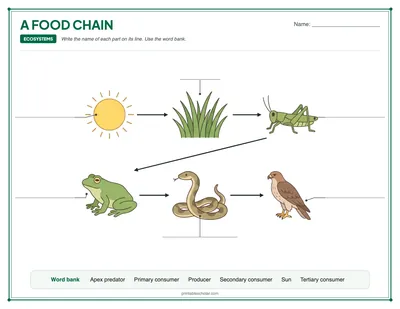
- Line up the chain. Six students hold cards for the sun, grass, a grasshopper, a frog, a snake and a hawk. The class puts them in order and names each level.
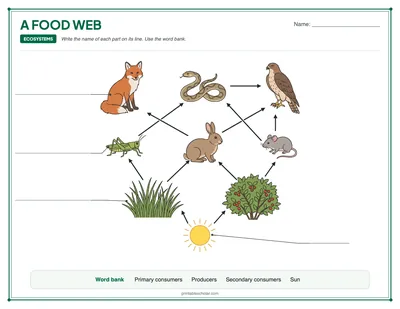
- Weave a web. Students in a circle hold cards for the living things in the food web. Pass a ball of string from each one to something that eats it.
- Look outside. Take the class outside. Students look for a producer, a consumer and a decomposer, such as grass, a bird and a mushroom on a dead log.
- Sort by diet. Hand out animal picture cards. Students sort them into three groups: herbivore, carnivore and omnivore.
A plan for the week
| Day 1 | Open with one of the ideas above. Teach the lesson with the slides while students fill in the guided notes. Then students label the blank diagrams. | Lesson slides (PowerPoint) (in the pack) Food Chains and Food Webs Guided Notes (in the pack) Food Chain Diagram Food Web Diagram Blank Food Chain Blank Food Web |
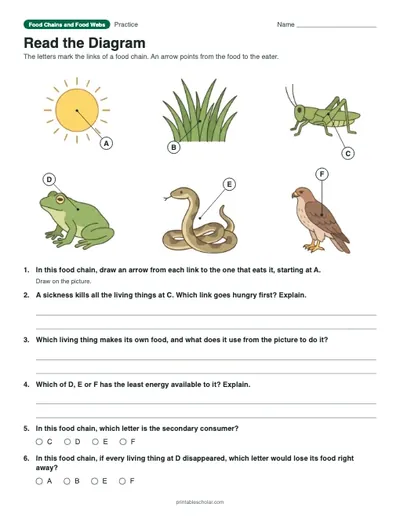
| Day 2 | Students trace the energy along the food chain on “Read the Diagram” and work out what happens when one link goes missing. | Read the Diagram (in the pack) |
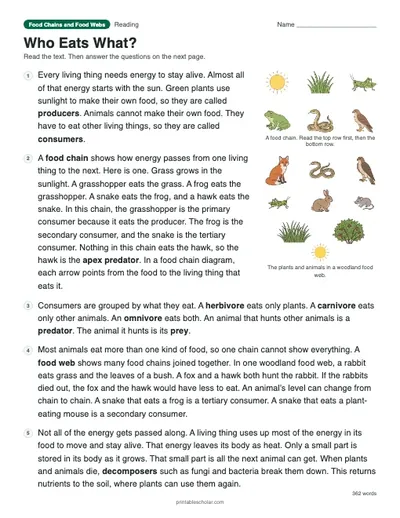
| Day 3 | Read “Who Eats What?” and answer the questions. | Who Eats What? (in the pack) |
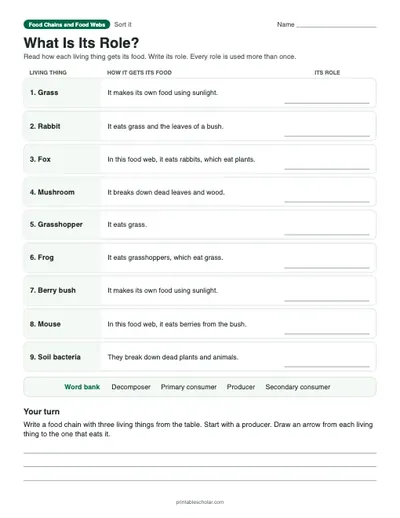
| Day 4 | Students read how nine living things get their food on “What Is Its Role?” and write the role of each one. | What Is Its Role? (in the pack) |
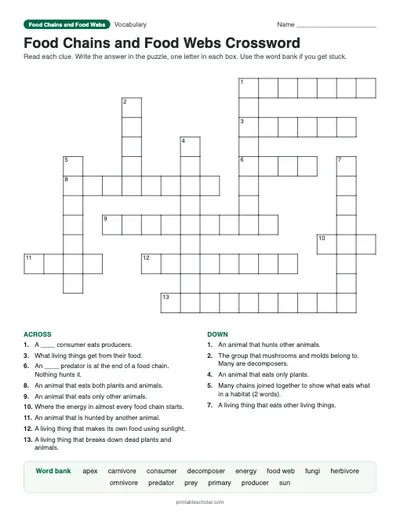
| Day 5 | Review with the crossword, then give the quiz. | Food Chains and Food Webs Crossword (in the pack) Food Chains and Food Webs Quiz (in the pack) |
The sheets marked “in the pack” are in the Food Chains and Food Webs teaching pack below.
NGSS standards
- Aligned to 5-PS3-1: Use models to describe that energy in animals' food (used for body repair, growth, and motion and to maintain body warmth) was once energy from the sun.
- Supports 5-LS2-1: Develop a model to describe the movement of matter among plants, animals, decomposers, and the environment.
- Supports MS-LS2-3: Develop a model to describe the cycling of matter and flow of energy among living and nonliving parts of an ecosystem.
Food Chains and Food Webs teaching pack
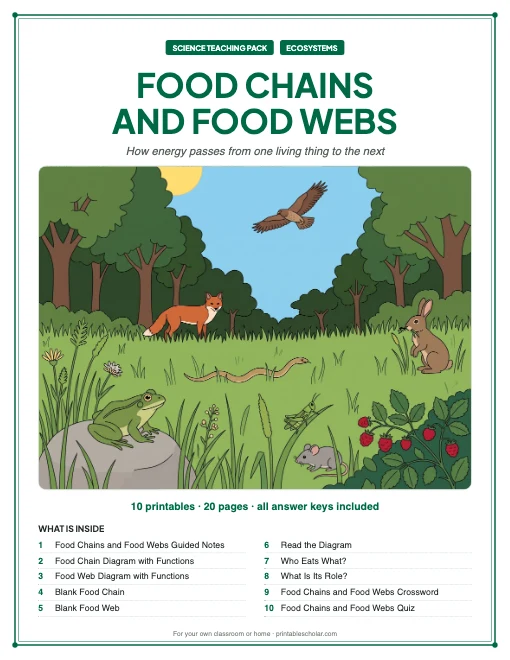
Teaching food chains and food webs? Here is a ready-to-teach lesson. 26 slides and 10 printables that cover the whole topic, from the guided notes to the quiz. Present the slides while students fill in the guided notes, then use the worksheets, crossword and quiz, with every answer key.
Free on this page: 4 of the 10 printables, marked Download below. The whole pack is $7: 20 pages in one print-ready file, the 26 lesson slides, the practice sheets, the crossword, the quiz and every answer key.
OnlineThe pack also comes as an online lesson for Google Classroom: every part on screen for students, plus a self-grading Google Forms quiz.
GameBuild a living food web with the free Food Web Builder: students take one plant or animal out of a woodland and watch the change ripple through the web, then work to keep the woodland thriving.
One-time purchase. Instant download. Secure checkout by Stripe. Want to see a whole pack first? The Skeletal System pack is free.See all 31 packs in the bundle
- The Microscope
- Photosynthesis
- Parts of a Plant and Flower
- Life Cycle of a Plant
- Life Cycles of a Butterfly and a Frog
- Food Chains and Food Webs (this pack)
- The Water Cycle
- Human Body Organs
- Skeletal System
- Muscular System
- Digestive System
- Respiratory System
- Heart and Circulation
- Nervous System and Brain
- Eye and Ear
- Parts of a Tooth
- Inside the Earth and Volcanoes
- Rocks and the Rock Cycle
- Layers of the Atmosphere
- Types of Clouds
- Weathering, Erosion and Deposition
- Types of Landforms
- The Solar System
- The Seasons
- Moon Phases and Eclipses
- States of Matter
- Electric Circuits
- Forms of Energy
- Scientific Method
- Simple Machines
- Magnets and Magnetic Fields
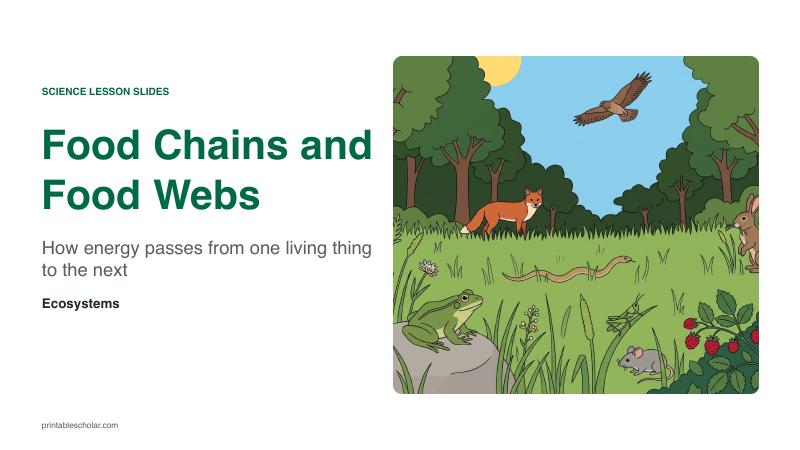
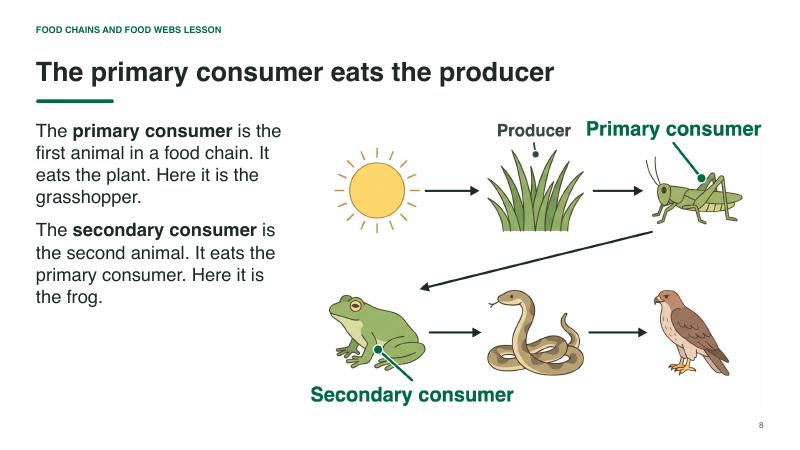
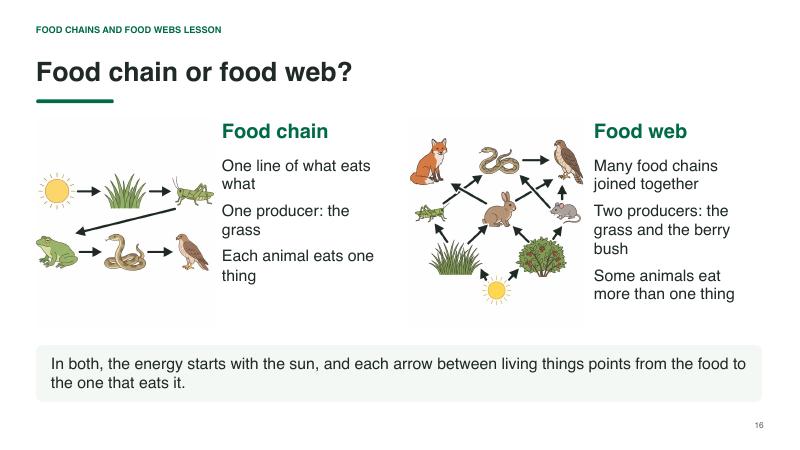
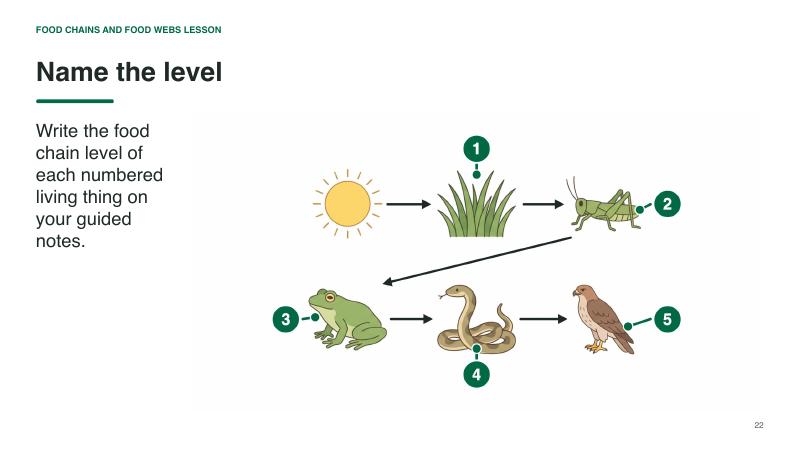
Teach Food Chains and Food Webs with 26 ready-made slides
Open the PowerPoint and teach: an opening question, the parts one at a time on the diagram, quick checks and an exit question. Students fill in the guided notes sheet as you go.
Every slide comes with teacher notes: what to say, what to ask, and sample answers.
The slides (PowerPoint and a PDF copy) and the guided notes sheet come with the pack.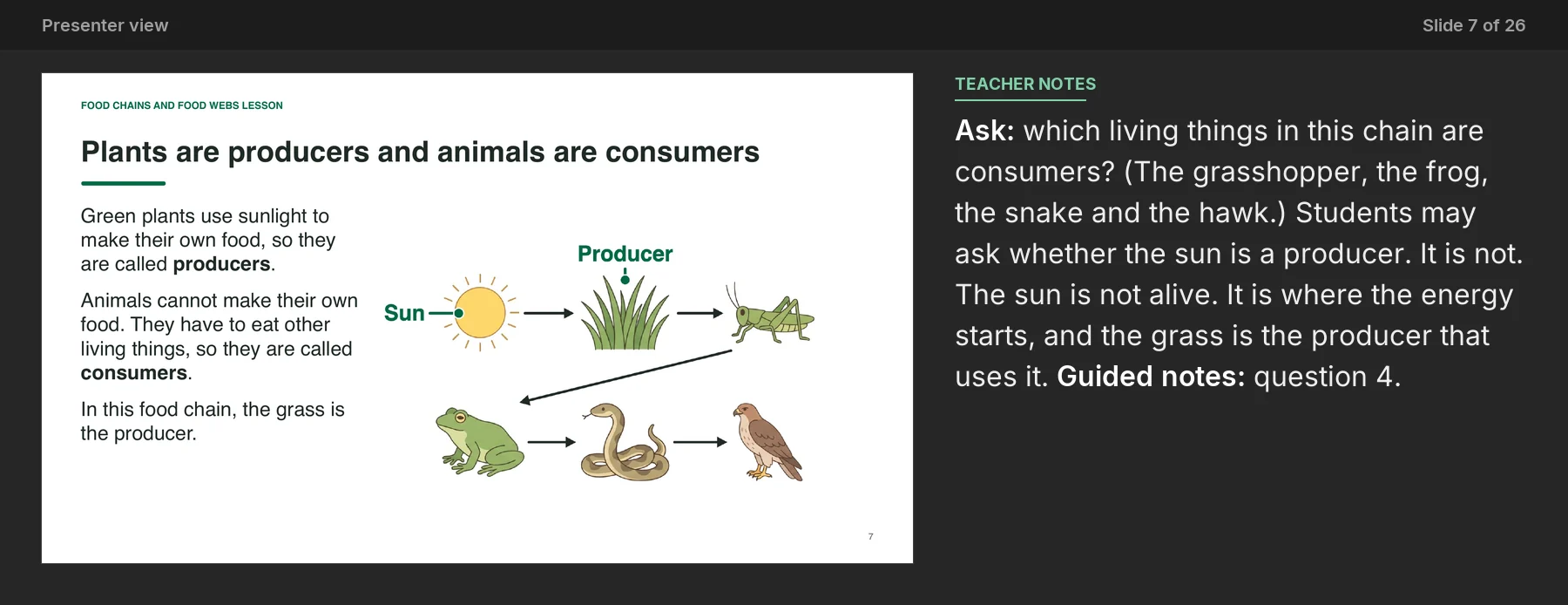
What is in the pack, in teaching order
 In the pack
1. TeachLesson Slides26 slides to present, with your notes for each one.In the $7 pack
 In the pack
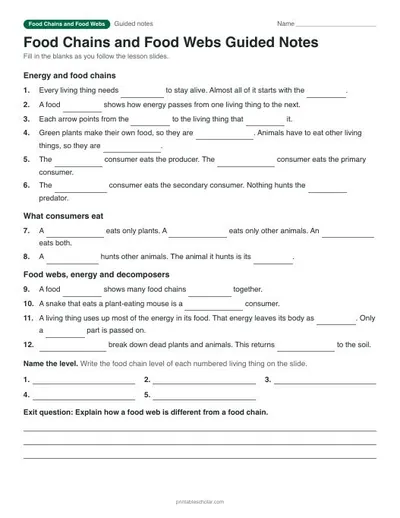
1. TeachFood Chains and Food Webs Guided NotesStudents fill in the blanks as you present. With answer key.In the $7 pack
 Free
 Free
 Free
 Free
 In the pack
3. ReasonRead the DiagramRead the food chain picture: draw how energy moves from the Sun to the hawk, then work out what happens when one link goes missing and why the last link gets the least energy.In the $7 pack
 In the pack
4. ReadWho Eats What?A one-page text on how energy passes along food chains and food webs, with eight questions.In the $7 pack
 In the pack
5. SortWhat Is Its Role?Read how nine living things get their food and write the role each one plays.In the $7 pack
 In the pack
6. ReviewFood Chains and Food Webs CrosswordFourteen food chain and food web words with clues and a word bank.In the $7 pack
 In the pack
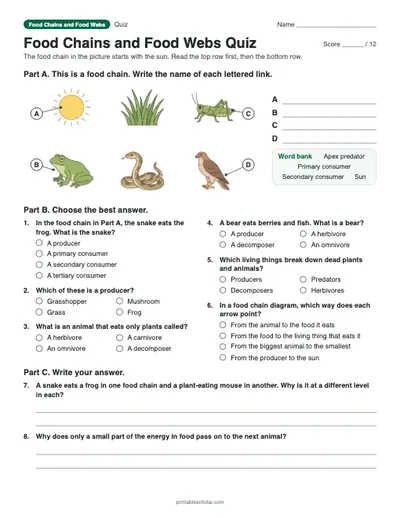
7. CheckFood Chains and Food Webs QuizLabel four links in a food chain, six multiple choice and two written answers. Scored out of 12.In the $7 pack
Food Chains and Food Webs worksheets, crossword and quiz
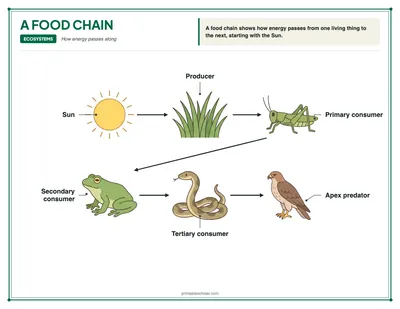
The Food Chains and Food Webs teaching pack is 26 lesson slides (PowerPoint and PDF) and 10 printables with answer keys for grades 4 to 6, in the order you would teach them: the guided notes for the lesson slides, 4 diagram sheets, then “Read the Diagram” (a worksheet), “Who Eats What?” (a reading passage), “What Is Its Role?” (a sorting table), a vocabulary crossword and a quiz.
The sheets are in a suggested teaching order: teach the lesson, have students label the blank diagrams, then work through the practice sheets and finish with the quiz. Use them all over a week or pick the ones you need. The answer keys are together at the back.
The diagrams are free to download on this page. The other sheets come with the pack ($7), which is also in the Elementary Science bundle (grades 3 to 6).
How a food web is built
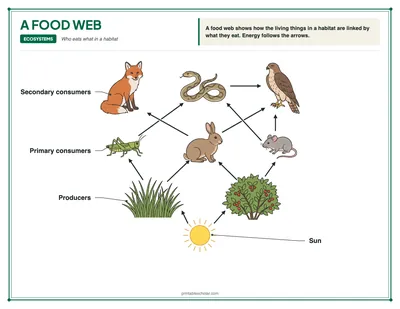
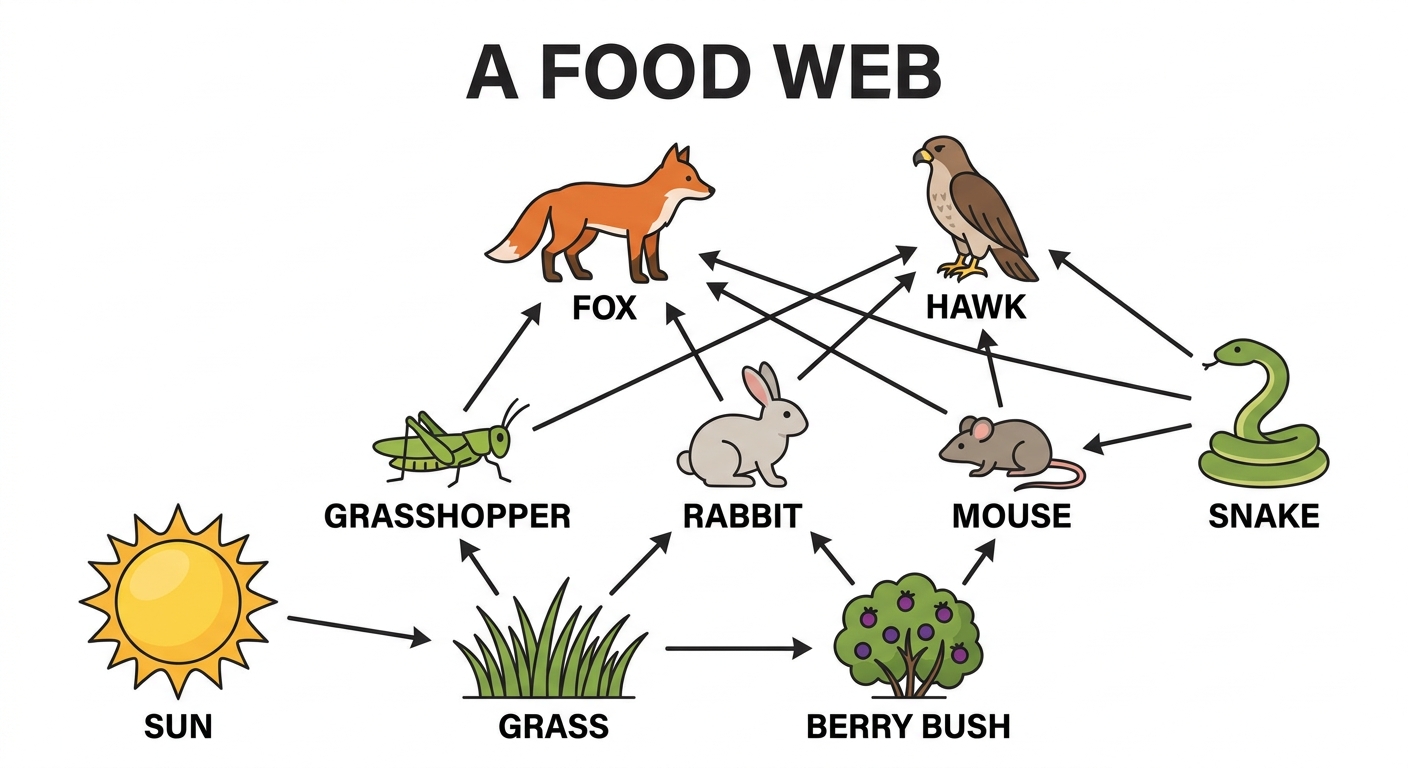
A food web shows how the living things in a habitat are connected by what they eat. Energy passes from one organism to the next, following the arrows. Here is what happens at each labeled part of the diagram:
| Role | What it does | Why it matters |
|---|---|---|
| Sun | The source of energy for the whole web. Producers use sunlight to make their food. | Every arrow in a food web traces back to the sun. Plants capture a small share of its light, and that captured energy is all the fox, the snake and the hawk ever get to live on — passed along one meal at a time. |
| Producers | Plants like grass and bushes that make their own food from sunlight. They are the base of the web. | If producers disappeared, every other living thing in the web would eventually starve — there would be no new energy entering the system at all. They do something no animal can: they manufacture food out of thin air and sunlight. |
| Primary consumers | Plant-eaters (herbivores) such as the grasshopper, rabbit and mouse. | Without herbivores, plants would go uneaten and the energy locked inside them could never move up the web to feed larger animals. They are the critical bridge that transfers plant energy into animal bodies. |
| Secondary consumers | Animals that eat the plant-eaters, such as the fox, snake and hawk. The hawk eats the snake too. | Predators like foxes and hawks keep herbivore populations from exploding — without them, plant-eaters would multiply unchecked and strip a habitat bare. Remove a secondary consumer and the whole web can collapse in a chain reaction ecologists call a trophic cascade. |
How to print
Choose Download PDF for a ready-to-print file that fits US Letter paper (8.5 × 11") in landscape, or Download PNG for the high-resolution image.
Frequently asked questions
What is a food web?
A food web is a diagram that shows how the food chains in a habitat connect. It shows what eats what, with arrows pointing from each food source to the animal that eats it.
What is the difference between a food chain and a food web?
A food chain shows a single line of who-eats-whom, while a food web connects many food chains to show all the feeding relationships in a habitat.
What paper size should I print this on?
The diagram is sized for standard US Letter paper (8.5 × 11") in landscape orientation. Use "Download PDF" for a print-ready file that fits the page automatically.
Are there Food Chains and Food Webs worksheets to go with the diagram?
Yes. The Food Chains and Food Webs teaching pack, for grades 4 to 6, has 26 lesson slides and 10 printables with answer keys: the guided notes for the lesson slides, 4 diagram sheets, then “Read the Diagram” (a worksheet), “Who Eats What?” (a reading passage), “What Is Its Role?” (a sorting table), a vocabulary crossword and a quiz. The diagrams are free to download on this page. The other sheets come with the pack ($7), which is also in the Elementary Science bundle (grades 3 to 6).