 Printable Scholar
Photosynthesis Diagram
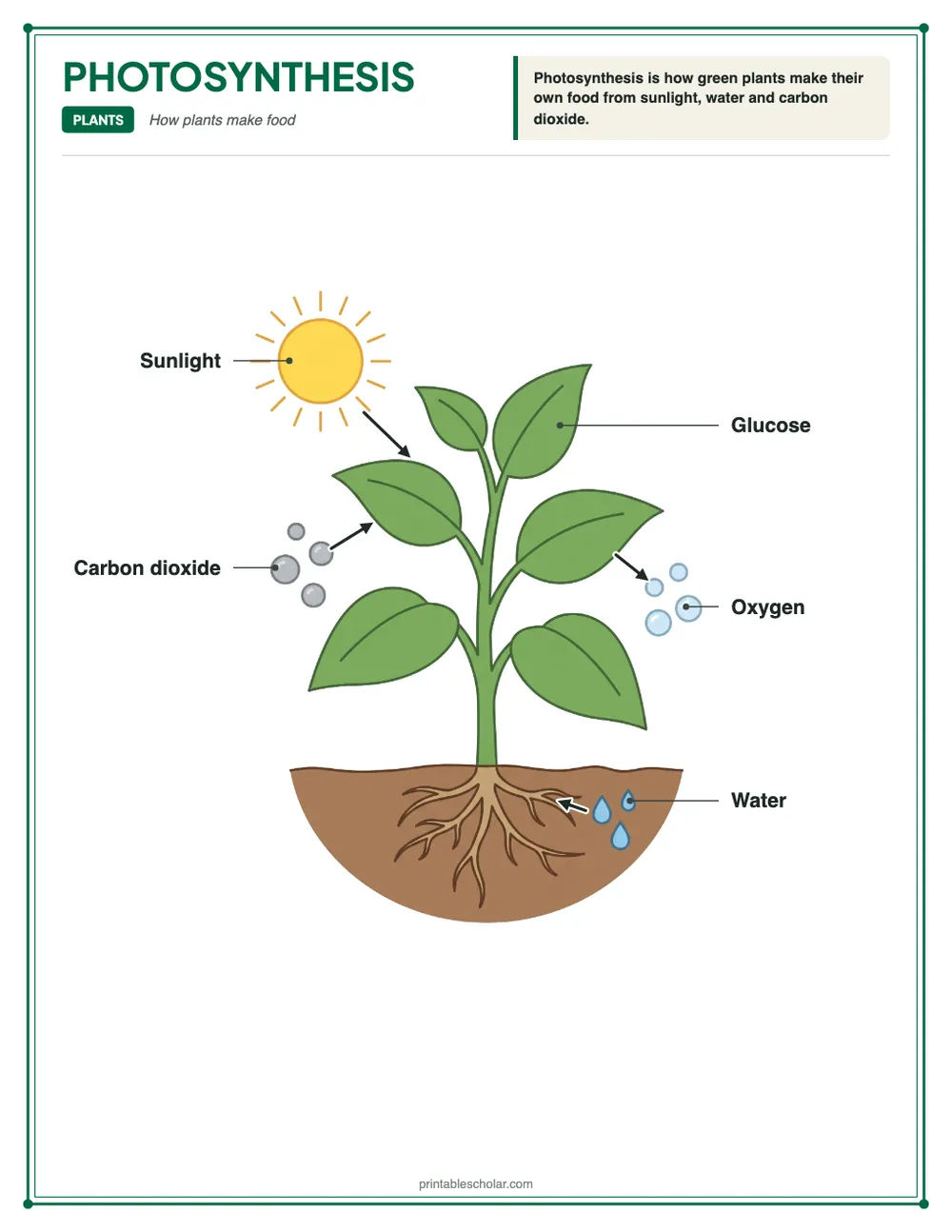
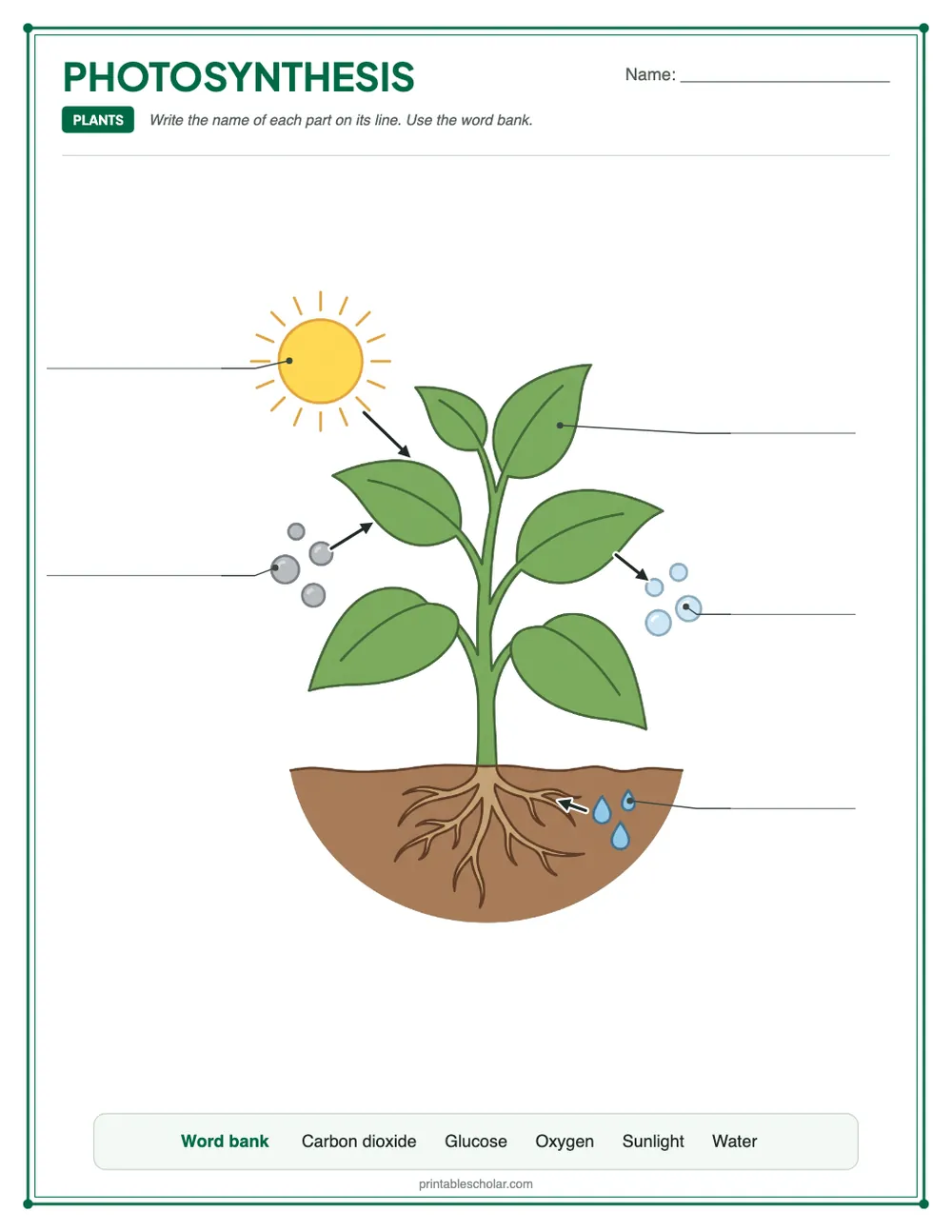
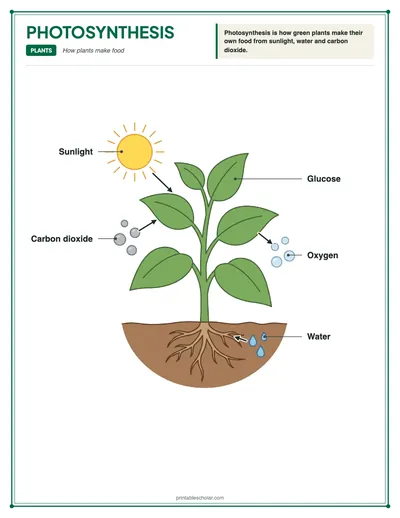
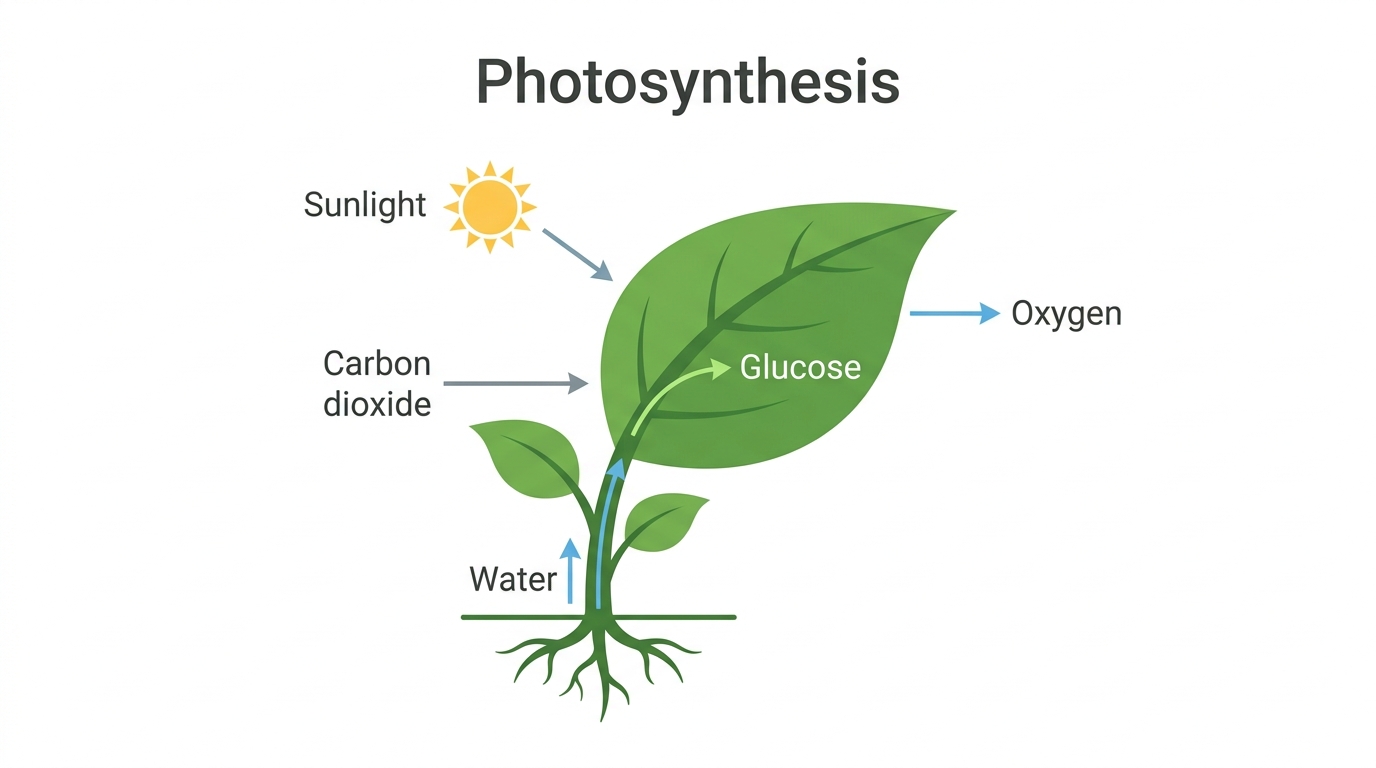
Free printable photosynthesis diagram — a labeled illustration showing how a plant uses sunlight, water and carbon dioxide to make glucose and release oxygen. Download PDF or PNG for Letter paper.
Part of the Photosynthesis teaching pack for grades 4 to 6: 24 lesson slides and 8 printables with answer keys. The diagram and the blank one to label are free.
Teaching ideas for Photosynthesis
Pick the ideas that suit your class, then follow the plan or use the sheets in any order.
- Light and dark. Put one small potted plant in a sunny window and one like it in a dark closet. Water both. Students compare them after a week or two.
- Lift a board. Leave a board or a mat on a patch of grass for a week or so, then lift it. The grass underneath has turned pale because it had no sunlight.
- Turn a plant. Find a windowsill plant that leans toward the window. Turn it around and look again in a few days to see its leaves facing the light again.
- Act it out. Mark a big leaf on the floor. Students carry in cards for sunlight, water and carbon dioxide, then carry out cards for glucose and oxygen.
A plan for the week
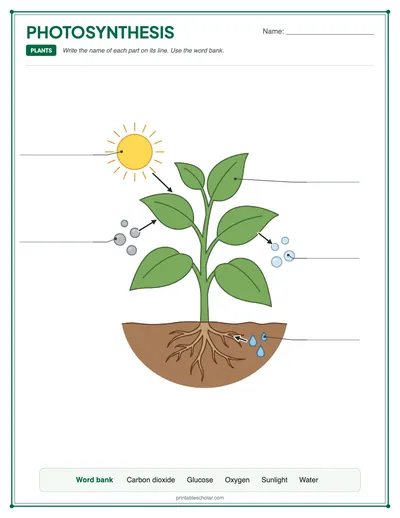
| Day 1 | Open with one of the ideas above. Teach the lesson with the slides while students fill in the guided notes. Then students label the blank diagram. | Lesson slides (PowerPoint) (in the pack) Photosynthesis Guided Notes (in the pack) Photosynthesis Diagram Blank Photosynthesis Diagram |
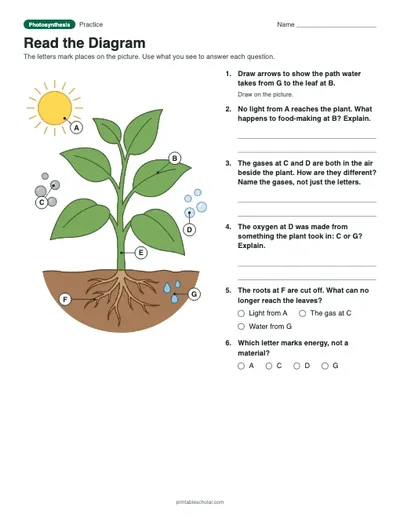
| Day 2 | Students work out what is happening on the picture on “Read the Diagram”: the path water takes, what happens in the dark and where the oxygen comes from. | Read the Diagram (in the pack) |
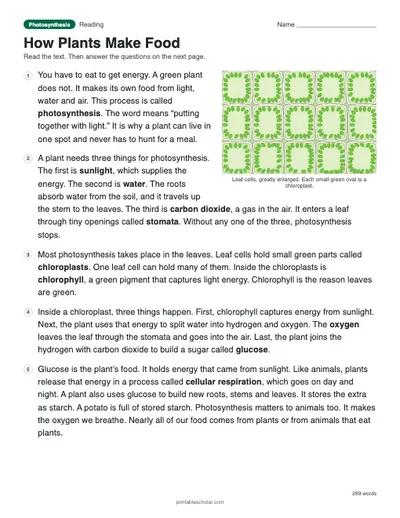
| Day 3 | Read “How Plants Make Food” and answer the questions. | How Plants Make Food (in the pack) |
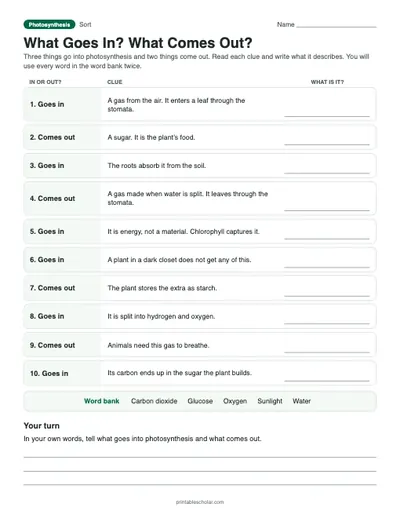
| Day 4 | Students read the clues on “What Goes In? What Comes Out?” and name each thing. | What Goes In? What Comes Out? (in the pack) |
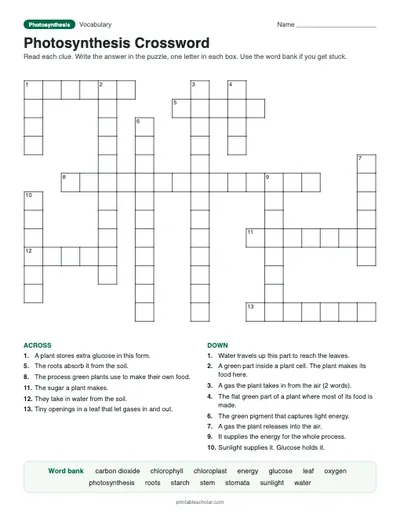
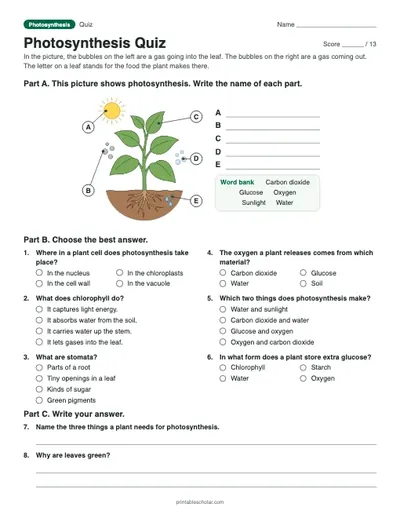
| Day 5 | Review with the crossword, then give the quiz. | Photosynthesis Crossword (in the pack) Photosynthesis Quiz (in the pack) |
The sheets marked “in the pack” are in the Photosynthesis teaching pack below.
NGSS standards
- Aligned to 5-LS1-1: Support an argument that plants get the materials they need for growth chiefly from air and water.
- Supports MS-LS1-6: Construct a scientific explanation based on evidence for the role of photosynthesis in the cycling of matter and flow of energy into and out of organisms.
Photosynthesis teaching pack
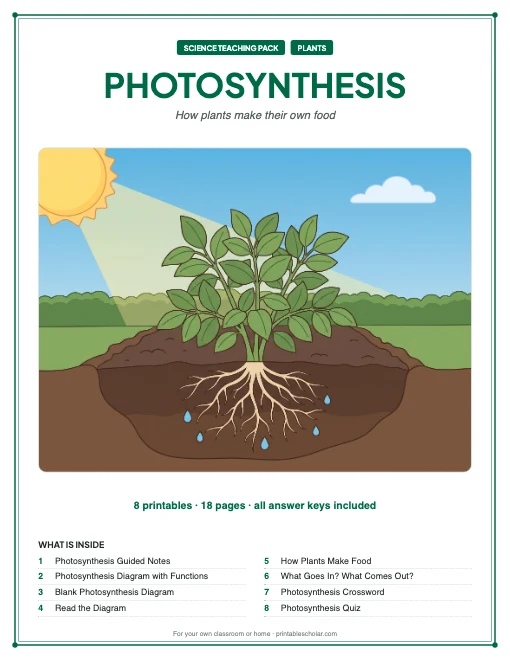
Teaching photosynthesis? Here is a ready-to-teach lesson. 24 slides and 8 printables that cover the whole topic, from the guided notes to the quiz. Present the slides while students fill in the guided notes, then use the worksheets, crossword and quiz, with every answer key.
Free on this page: the diagram and the blank one to label, marked Download below. The whole pack is $7: 18 pages in one print-ready file, the 24 lesson slides, the practice sheets, the crossword, the quiz and every answer key.
OnlineThe pack also comes as an online lesson for Google Classroom: every part on screen for students, plus a self-grading Google Forms quiz.
One-time purchase. Instant download. Secure checkout by Stripe. Want to see a whole pack first? The Skeletal System pack is free.See all 31 packs in the bundle
- The Microscope
- Photosynthesis (this pack)
- Parts of a Plant and Flower
- Life Cycle of a Plant
- Life Cycles of a Butterfly and a Frog
- Food Chains and Food Webs
- The Water Cycle
- Human Body Organs
- Skeletal System
- Muscular System
- Digestive System
- Respiratory System
- Heart and Circulation
- Nervous System and Brain
- Eye and Ear
- Parts of a Tooth
- Inside the Earth and Volcanoes
- Rocks and the Rock Cycle
- Layers of the Atmosphere
- Types of Clouds
- Weathering, Erosion and Deposition
- Types of Landforms
- The Solar System
- The Seasons
- Moon Phases and Eclipses
- States of Matter
- Electric Circuits
- Forms of Energy
- Scientific Method
- Simple Machines
- Magnets and Magnetic Fields
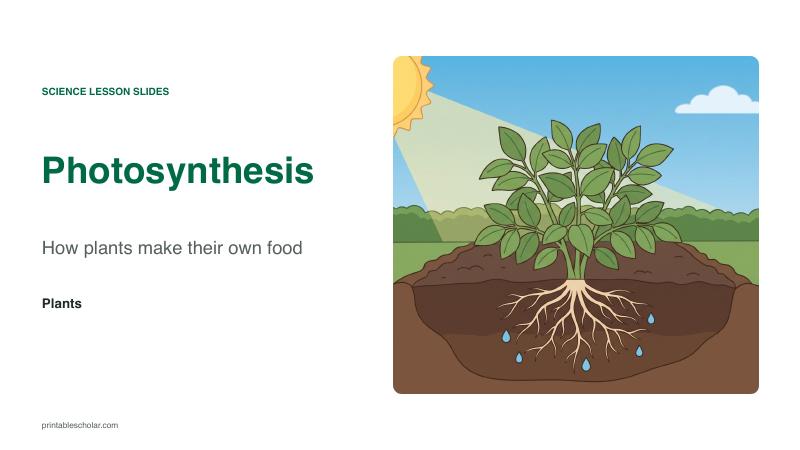
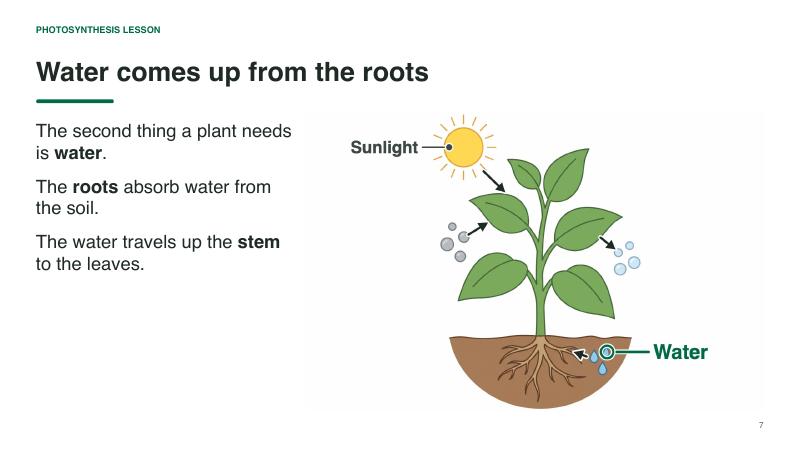
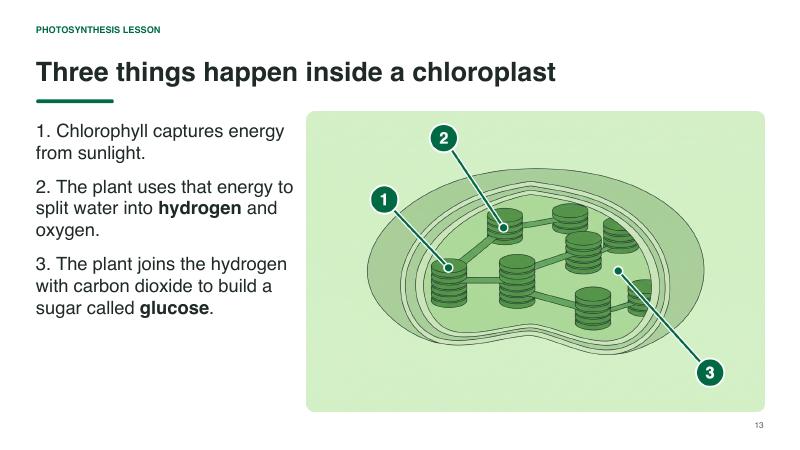
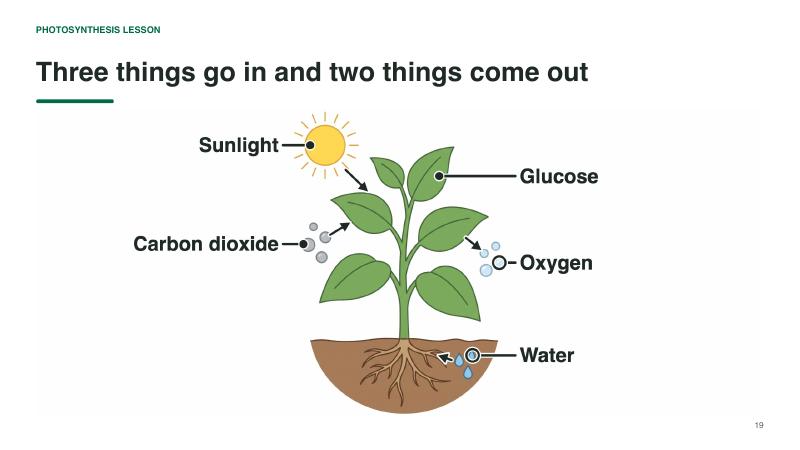
Teach Photosynthesis with 24 ready-made slides
Open the PowerPoint and teach: an opening question, the parts one at a time on the diagram, quick checks and an exit question. Students fill in the guided notes sheet as you go.
Every slide comes with teacher notes: what to say, what to ask, and sample answers.
The slides (PowerPoint and a PDF copy) and the guided notes sheet come with the pack.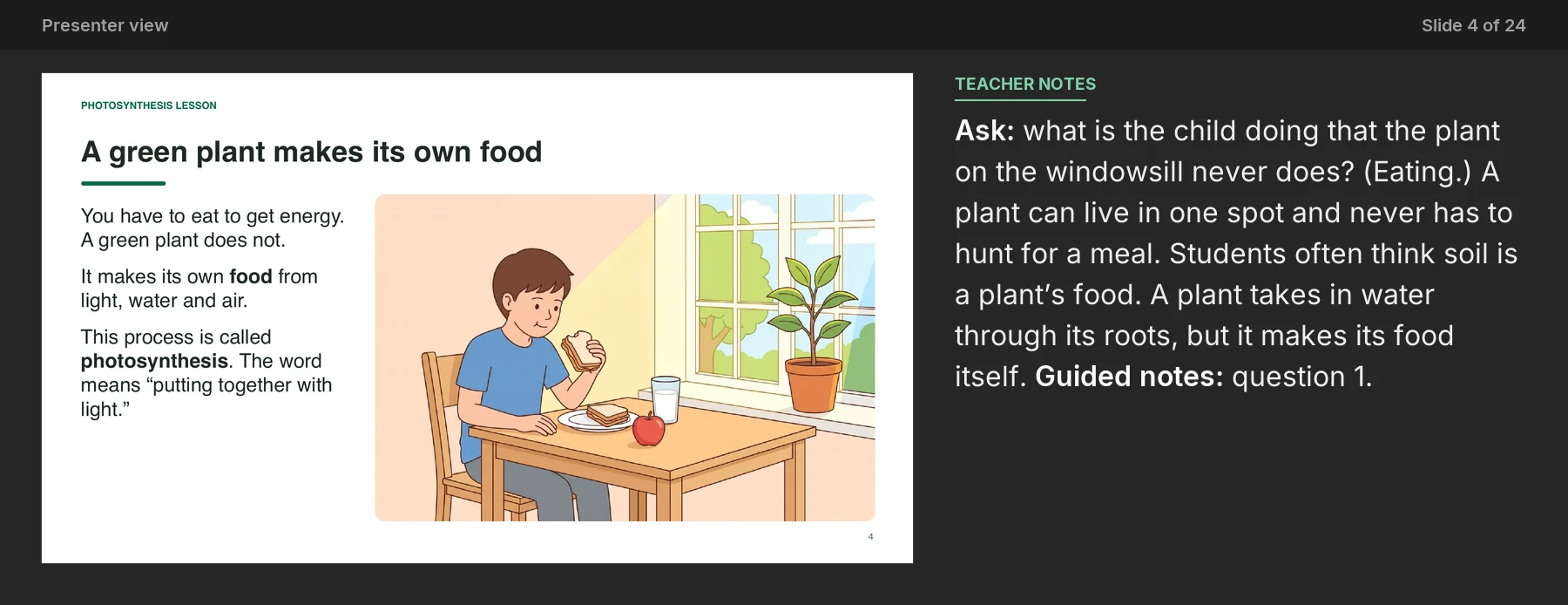
What is in the pack, in teaching order
 In the pack
1. TeachLesson Slides24 slides to present, with your notes for each one.In the $7 pack
 In the pack
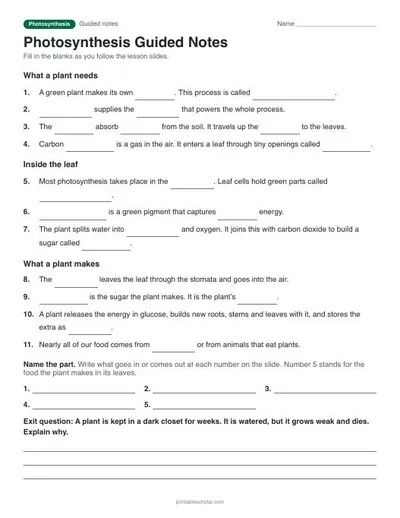
1. TeachPhotosynthesis Guided NotesStudents fill in the blanks as you present. With answer key.In the $7 pack
 Free
 Free
 In the pack
3. ReasonRead the DiagramRead the photosynthesis picture: trace the path water takes, work out what happens in the dark and where the oxygen comes from.In the $7 pack
 In the pack
4. ReadHow Plants Make FoodA one-page text on how a plant makes its own food, with eight questions.In the $7 pack
 In the pack
5. SortWhat Goes In? What Comes Out?Read ten clues about what goes into photosynthesis and what comes out, and name each one.In the $7 pack
 In the pack
6. ReviewPhotosynthesis CrosswordFourteen photosynthesis words with clues and a word bank.In the $7 pack
 In the pack
7. CheckPhotosynthesis QuizLabel five parts, six multiple choice and two written answers. Scored out of 13.In the $7 pack
Photosynthesis worksheets, crossword and quiz
The Photosynthesis teaching pack is 24 lesson slides (PowerPoint and PDF) and 8 printables with answer keys for grades 4 to 6, in the order you would teach them: the guided notes for the lesson slides, the labeled diagram and the blank one to label, then “Read the Diagram” (a worksheet), “How Plants Make Food” (a reading passage), “What Goes In? What Comes Out?” (an in-and-out table), a vocabulary crossword and a quiz.
The sheets are in a suggested teaching order: teach the lesson, have students label the blank diagram, then work through the practice sheets and finish with the quiz. Use them all over a week or pick the ones you need. The answer keys are together at the back.
The diagram and the blank one to label are free to download on this page. The other sheets come with the pack ($7), which is also in the Elementary Science bundle (grades 3 to 6).
The ingredients and products of photosynthesis
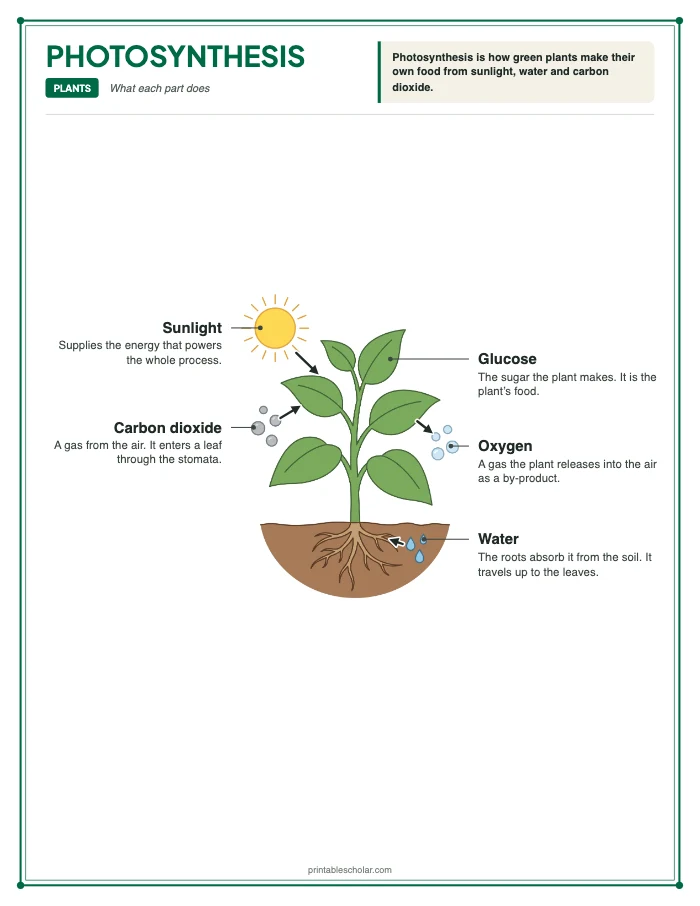
Photosynthesis is how green plants make their own food, using sunlight, water and carbon dioxide. Here is what happens at each labeled part of the diagram:
| Part | What it does | Why it matters |
|---|---|---|
| Sunlight | The energy the leaf captures to power photosynthesis. | Light is the original power source for the whole reaction — without it, the plant has no energy to convert air and water into food. On a cloudy winter day, plants slow down dramatically, which is why houseplants near dim windows grow so much more slowly than ones on a bright sill. |
| Carbon dioxide | A gas the plant takes in from the air. | Every sugar molecule a plant builds contains carbon atoms that came straight from the air, making plants literal living filters of the atmosphere. If plants stopped absorbing carbon dioxide, the gas would continue to build up from burning fuel and breathing, warming the planet even faster than it does today. |
| Water | Absorbed by the roots and carried up to the leaves. | A plant can lose its leaves and regrow them, but if its roots dry out completely, it dies — because without water, photosynthesis simply stops. The hydrogen atoms locked inside each water molecule end up woven into the glucose the plant produces, so every bite of fruit or vegetable you eat contains atoms that were once water in the soil. |
| Glucose | The sugar (food) the plant makes and uses for energy and growth. | Glucose is the finished product — the sugar that fuels every cell in the plant's body, from growing new roots to producing flowers and seeds. When you eat a potato, a carrot, or a grain of rice, you are consuming stored glucose that a plant built from sunlight, water, and air. |
| Oxygen | A gas the plant releases into the air as a by-product. | Released as a by-product the plant doesn't even need, oxygen is essentially waste — yet it is the gas that all animals, including humans, depend on to breathe. Scientists believe that almost all of the oxygen in Earth's atmosphere was put there by billions of years of photosynthesis, meaning every breath you have ever taken was a gift from a plant. |
How to print
Choose Download PDF for a ready-to-print file that fits US Letter paper (8.5 × 11") in portrait, or Download PNG for the high-resolution image.
Frequently asked questions
What is photosynthesis?
Photosynthesis is the process green plants use to turn sunlight, water and carbon dioxide into glucose (their food), releasing oxygen as a by-product.
What does a plant need for photosynthesis?
A plant needs sunlight, water and carbon dioxide. It uses these to make glucose and gives off oxygen.
What paper size should I print this on?
The diagram is sized for standard US Letter paper (8.5 × 11") in portrait orientation. Use "Download PDF" for a print-ready file that fits the page automatically.
Are there Photosynthesis worksheets to go with the diagram?
Yes. The Photosynthesis teaching pack, for grades 4 to 6, has 24 lesson slides and 8 printables with answer keys: the guided notes for the lesson slides, the labeled diagram and the blank one to label, then “Read the Diagram” (a worksheet), “How Plants Make Food” (a reading passage), “What Goes In? What Comes Out?” (an in-and-out table), a vocabulary crossword and a quiz. The diagram and the blank one to label are free to download on this page. The other sheets come with the pack ($7), which is also in the Elementary Science bundle (grades 3 to 6).