The Life Cycle of a Star
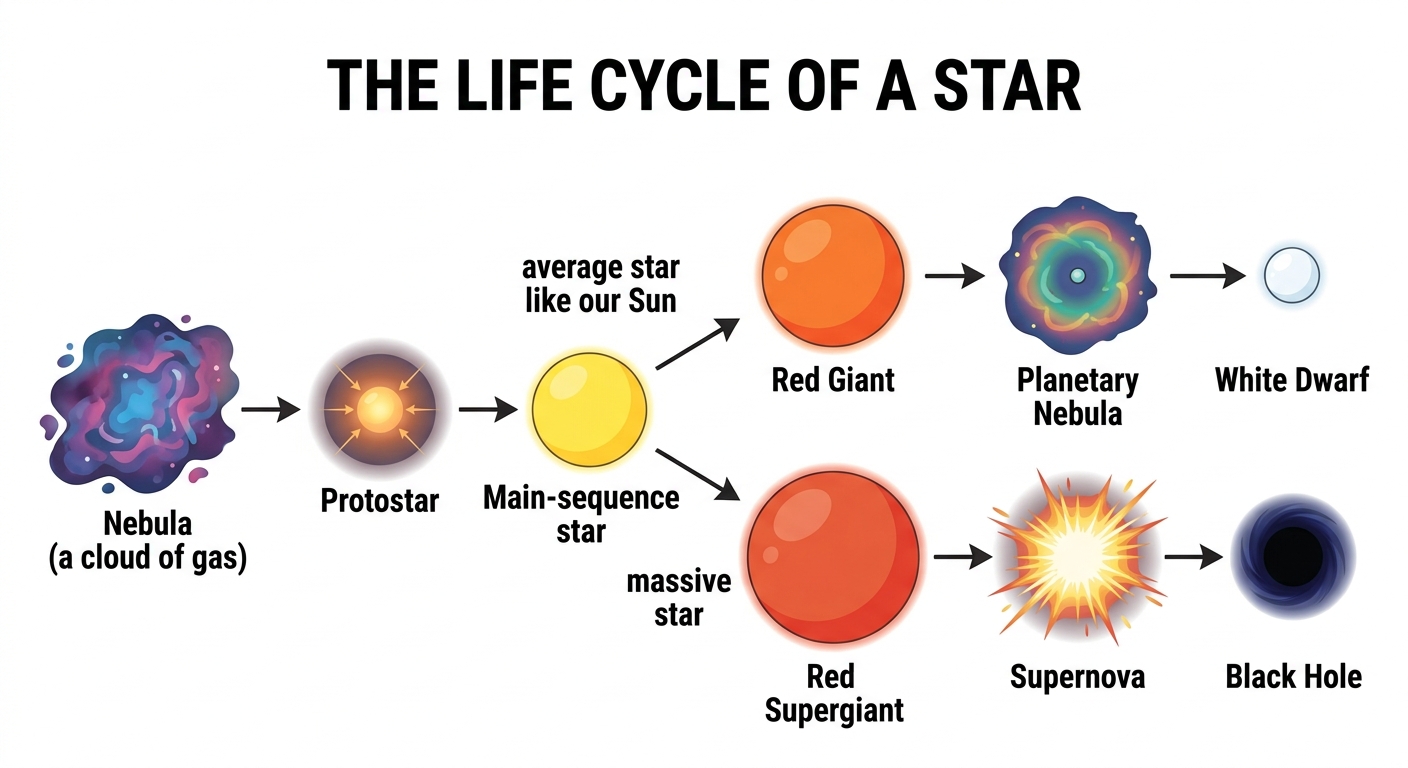
Free printable life cycle of a star diagram — from a nebula to a main-sequence star, and the two paths for average and massive stars. Download a high-resolution PDF or PNG for Letter paper.
Stars run on fuel — specifically, hydrogen gas that gets crushed together under enormous gravity until it fuses into helium and releases light and heat. Just like a campfire burns through wood and eventually goes out, a star burns through its hydrogen and must change when that fuel runs low. Our own Sun is a star roughly halfway through its life, which means it has already been shining for about 5 billion years and has another 5 billion left to go. Whether a star ends its life quietly or in a colossal explosion comes down to one thing: how much mass it started with.
The stages in a star's life
Stars are born, live for millions or billions of years, and then die. How a star ends its life depends on how big it is. Here is what happens at each labeled part of the diagram:
| Stage | What it does | Why it matters |
|---|---|---|
| Nebula | A giant cloud of gas and dust in space where stars are born. | Without these vast nurseries of gas and dust, no new stars — and no solar systems like ours — could ever form. The atoms in your body were once scattered through a nebula before a star collected them and forged them into heavier elements. |
| Protostar | The gas and dust pull together and heat up, forming a young star. | This is the moment gravity wins: the cloud stops floating apart and starts becoming something. If a protostar can gather enough mass to ignite hydrogen fusion at its core, a true star is born — if not, it fizzles out as a cold, dark object called a brown dwarf. |
| Main-sequence star | A stable, shining star — like our Sun — that burns for billions of years. | The Sun has been in this stable phase for 4.6 billion years, giving Earth a steady source of energy long enough for life to evolve and thrive. Stability is the key word — the inward pull of gravity and the outward push of fusion energy are perfectly balanced, like a tug-of-war that never moves. |
| Red giant or supergiant | As it runs out of fuel the star swells up: average stars become red giants, massive stars become red supergiants. | When our Sun eventually swells into a red giant, it will expand far enough to swallow Mercury and Venus — a reminder that even familiar, steady things change dramatically when their fuel runs out. Massive supergiants burn so hot and bright they can outshine entire galaxies, yet they race through their fuel in just a few million years rather than billions. |
| Planetary nebula → white dwarf | An average star gently sheds its outer layers, leaving behind a small, dense white dwarf. | The glowing shells of a planetary nebula seed the galaxy with carbon, oxygen, and nitrogen — the very atoms that make up living things. Left behind, the white dwarf is about the size of Earth but as massive as the Sun, meaning a teaspoon of its material would weigh roughly five tons. |
| Supernova → black hole | A massive star explodes in a supernova, and its core can collapse into a black hole. | A supernova briefly outshines its entire galaxy and blasts heavy elements like iron and gold across space — without these explosions, the universe would have almost none of the heavier atoms that planets and life are built from. The black hole left behind has gravity so intense that not even light can escape, making it one of the strangest objects the universe produces. |
Companion worksheet
A free fill-in worksheet with an answer key, built from the labels above — students match each stage to its description, then answer a couple of short questions. Great for a quick check after using the diagram.
How to print
Choose Download PDF for a ready-to-print file that fits US Letter paper (8.5 × 11") in landscape, or Download PNG for the high-resolution image.
Frequently asked questions
What is the life cycle of a star?
A star begins in a nebula, becomes a protostar, then a main-sequence star. An average star later becomes a red giant, then a planetary nebula and a white dwarf. A massive star becomes a red supergiant, explodes as a supernova, and may form a black hole.
What will happen to our Sun?
The Sun is an average star. In billions of years it will become a red giant, then shed its layers as a planetary nebula, leaving behind a white dwarf.
What paper size should I print this on?
The diagram is sized for standard US Letter paper (8.5 × 11") in landscape orientation. Use "Download PDF" for a print-ready file that fits the page automatically.