Excretory System Diagram
Free printable excretory system diagram — a labeled illustration showing the kidneys, ureters, bladder, urethra, liver, lungs, and skin and how each removes waste from the body. Download a high-resolution PDF or PNG for Letter paper.
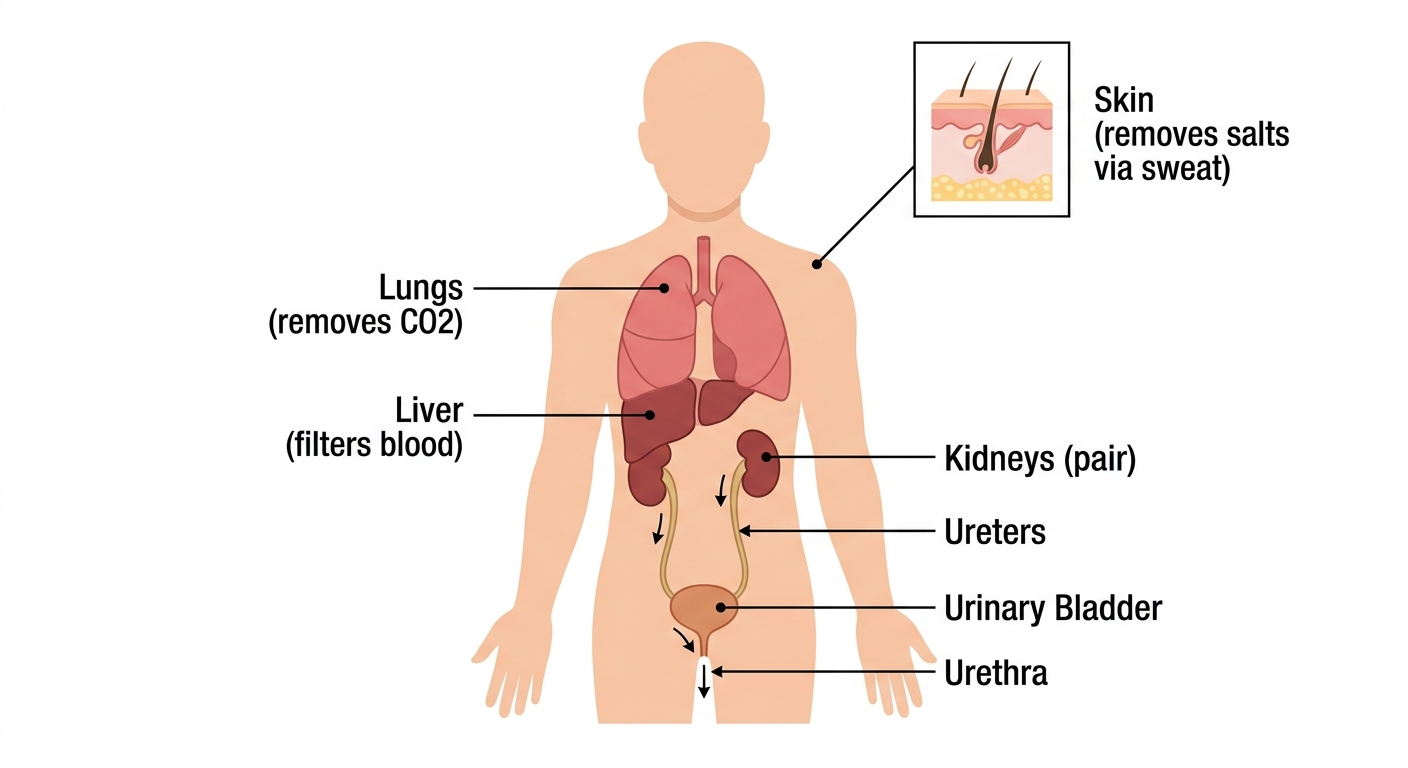

The organs of the excretory system
The excretory system removes waste products that build up as the body burns fuel and carries out its daily work. Here is what happens at each labeled part of the diagram:
| Part | What it does | Why it matters |
|---|---|---|
| Kidneys | A pair of bean-shaped organs that filter waste and excess water from the blood to make urine. | Each kidney contains about a million tiny filtering units called nephrons, which together filter all of your blood roughly 30 times every day — about 180 litres of fluid processed to produce just 1-2 litres of urine. Beyond making urine, the kidneys also regulate blood pressure, control the balance of salts and minerals in the blood, and produce a hormone that tells bone marrow to make more red blood cells. |
| Ureters | Two tubes that carry urine from the kidneys down to the bladder. | The ureters do not rely on gravity — muscular walls squeeze in waves (peristalsis) to push urine downward regardless of body position. Each ureter enters the bladder at an angle that acts as a one-way valve, preventing urine from flowing back toward the kidneys when the bladder contracts during urination. |
| Urinary Bladder | A muscular bag that stores urine until it can be released. | The bladder wall is made of smooth muscle arranged in layers that allow it to stretch as it fills — a healthy adult bladder holds about 400-600 ml before the urge to urinate becomes urgent. Stretch receptors in the wall send signals to the brain when the bladder is about two-thirds full, giving you time to find a toilet rather than forcing an immediate response. |
| Urethra | The tube that carries urine from the bladder out of the body. | Two sphincter muscles — one involuntary (controlled automatically) and one voluntary (consciously controlled) — encircle the urethra. The voluntary sphincter is what you consciously contract to "hold it" and relax when urination is appropriate. Toilet training is essentially the process of learning to control that voluntary sphincter. |
| Lungs | Remove carbon dioxide — a waste gas produced by every cell — from the bloodstream through exhalation. | Carbon dioxide is the waste product of cellular respiration, the process cells use to extract energy from glucose. It diffuses from cells into the blood, travels to the lungs, and crosses into the air sacs (alveoli) to be breathed out. With every breath you exhale, you are expelling the carbon dioxide waste of millions of simultaneous chemical reactions happening throughout your body. |
| Liver | Processes chemical waste from the blood, converting it into forms the kidneys and intestines can remove. | The liver performs over 500 functions, but its excretory role is breaking down toxic substances — from alcohol to the breakdown products of dead red blood cells — into less harmful chemicals. The yellow-green bile it produces carries some of these waste products into the intestine to be eliminated in faeces; the rest are processed into water-soluble forms the kidneys can filter out. |
| Skin | Releases water, salts, and small amounts of urea through sweat. | Sweating is primarily a cooling mechanism, but sweat also removes small amounts of waste — sodium, chloride, urea, and traces of other metabolic products — making the skin a minor but real excretory organ. During intense exercise or fever, sweat glands can produce more than a litre of fluid per hour, removing significant quantities of salt and pushing the kidneys to compensate by conserving more water in the urine. |
Companion worksheet
A free fill-in worksheet with an answer key, built from the labels above — students match each part to its description, then answer a couple of short questions. Great for a quick check after using the diagram.
How to print
Choose Download PDF for a ready-to-print file that fits US Letter paper (8.5 × 11") in landscape, or Download PNG for the high-resolution image.
Frequently asked questions
What is the main job of the excretory system?
To remove the waste products that build up in the body — including carbon dioxide from respiration, urea from protein breakdown, excess salts and water, and bile pigments from old red blood cells.
What is the difference between excretion and elimination?
Excretion removes waste produced by the body's own chemical reactions (like urea or CO2). Elimination removes undigested food that was never absorbed — it is a digestive process, not an excretory one.
What paper size should I print this on?
The diagram is sized for standard US Letter paper (8.5 × 11") in landscape orientation. Use "Download PDF" for a print-ready file that fits the page automatically.