Nervous System Diagram
Free printable nervous system diagram — a labeled illustration showing the brain, spinal cord, and major nerves of the peripheral nervous system, color-coded CNS and PNS. Download a high-resolution PDF or PNG for Letter paper.
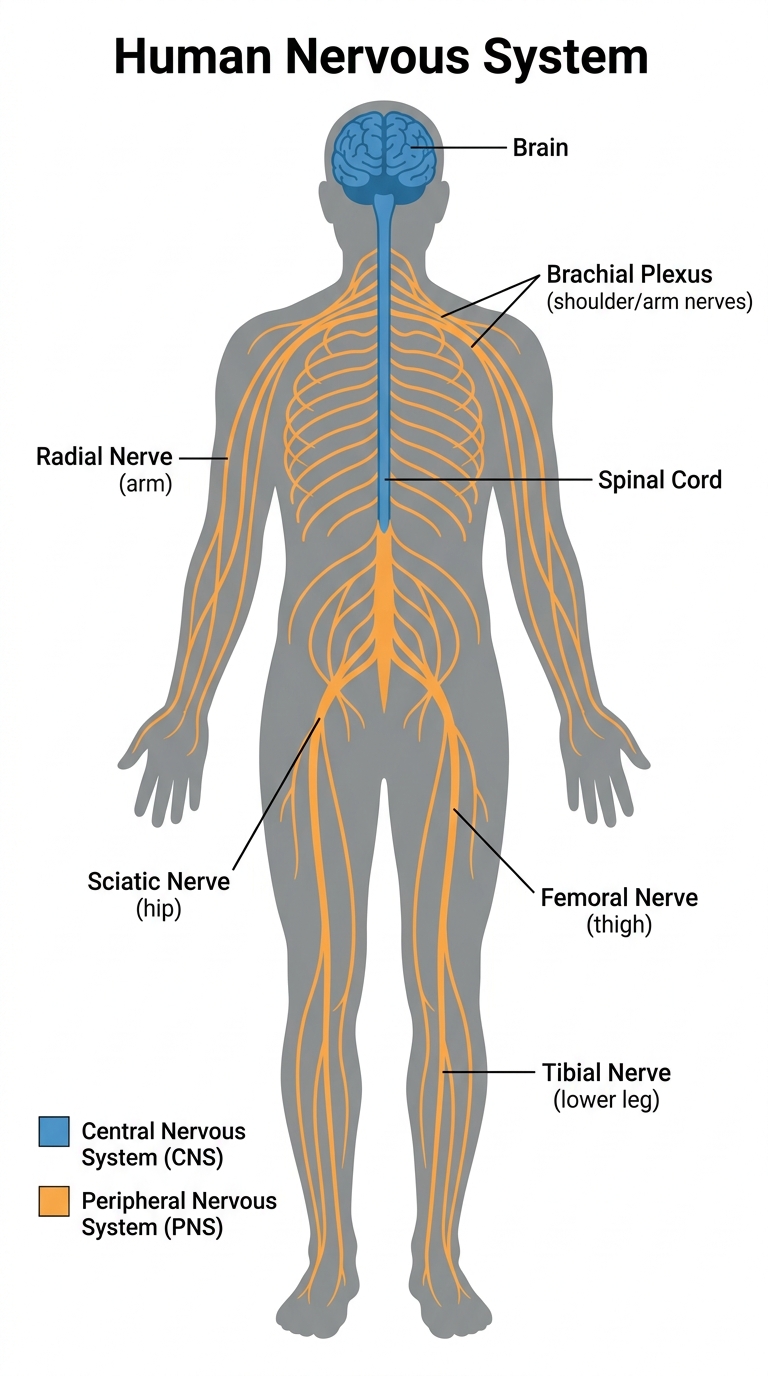

The parts of the nervous system
The nervous system is the body's communication and control network, sending signals between the brain and every part of the body at lightning speed. Here is what happens at each labeled part of the diagram:
| Part | What it does | Why it matters |
|---|---|---|
| Brain | The command centre of the nervous system — it receives, processes, and sends all signals. | Everything you think, feel, see, hear, and decide passes through roughly 86 billion neurons packed into an organ that weighs about 1.4 kilograms. Despite using only about 20 percent of the body's energy, the brain never fully switches off — it keeps processing, consolidating memories, and regulating your heartbeat and breathing even while you sleep. |
| Spinal Cord | The main nerve highway running down the centre of the spine, connecting the brain to the rest of the body. | The spinal cord is about the thickness of a finger and runs from the base of the brain to the lower back, protected inside the bony tunnel of the vertebrae. It carries signals from the brain down to the muscles and carries sensory signals — pain, temperature, touch — back up to the brain. Crucially, it also handles reflex responses locally: when you touch a hot pan and snatch your hand back before you consciously feel the pain, that loop happened entirely in the spinal cord. |
| Brachial Plexus | A network of nerves at the shoulder that controls the arm and hand. | Five nerve roots leaving the spinal cord in the neck merge and branch into the brachial plexus, then fan out to become the specific nerves controlling every muscle from the shoulder to the fingertips. Sports injuries that stretch the neck sideways — common in contact sports — can damage this plexus, causing a burning or stinging sensation down the arm that athletes call a "stinger." |
| Radial Nerve | Runs down the arm to control the muscles that extend the wrist and fingers. | The radial nerve winds around the back of the upper arm bone (humerus) so closely that a fracture there often injures the nerve too, producing "wrist drop" — the inability to lift the wrist. Sleeping with your arm draped over a hard edge can compress the same nerve and cause the same temporary numbness, though it recovers as soon as the pressure is released. |
| Sciatic Nerve | The longest nerve in the body, running from the lower back through the hip and down the leg. | At its widest point the sciatic nerve is about as thick as your thumb, making it the largest peripheral nerve in the body. It exits the spine in the lower back and travels through the buttock and down each leg, controlling the hamstrings and most of the muscles below the knee. When a herniated disc in the lower back presses on the sciatic nerve roots it can cause searing pain all the way from the lower back to the foot — the condition known as sciatica. |
| Femoral Nerve | Controls the quadriceps and carries sensation from the front of the thigh. | Emerging from the lumbar spine and passing through the groin into the thigh, the femoral nerve is what lets you straighten your knee and feel the front of your leg. It is the nerve at risk during hip surgery and is sometimes deliberately blocked with local anaesthetic to numb the thigh during knee operations — a technique called a femoral nerve block. |
| Tibial Nerve | Runs down the back of the leg to control the calf muscles and the sole of the foot. | The tibial nerve branches from the sciatic nerve behind the knee and continues down the calf to supply the muscles that point the foot downward and curl the toes — the muscles used in every step and every jump. It curves around the inside of the ankle (through the tarsal tunnel) to reach the sole, which is why compression there, called tarsal tunnel syndrome, causes numbness and tingling in the bottom of the foot similar to carpal tunnel in the hand. |
Companion worksheet
A free fill-in worksheet with an answer key, built from the labels above — students match each part to its description, then answer a couple of short questions. Great for a quick check after using the diagram.
How to print
Choose Download PDF for a ready-to-print file that fits US Letter paper (8.5 × 11") in portrait, or Download PNG for the high-resolution image.
Frequently asked questions
What are the two main parts of the nervous system?
The central nervous system (CNS) — the brain and spinal cord — and the peripheral nervous system (PNS) — all the nerves branching out to the rest of the body.
What does the nervous system do?
It controls everything the body does — voluntary actions like walking, involuntary functions like heartbeat and breathing, and your senses, thoughts, and emotions.
What paper size should I print this on?
The diagram is sized for standard US Letter paper (8.5 × 11") in portrait orientation. Use "Download PDF" for a print-ready file that fits the page automatically.