 Printable Scholar
Electric Circuits
Free printable electric circuit diagram for grades 4-6: the parts of a simple circuit (battery, wire, switch, light bulb), open and closed circuits, and series and parallel circuits, with a blank diagram to label. PDF for Letter paper.
Part of the Electric Circuits teaching pack for grades 4 to 6: 30 lesson slides and 10 printables with answer keys. The diagram and the blank one to label are free.
Teaching ideas for Electric Circuits
Pick the ideas that suit your class, then follow the plan or use the sheets in any order.
- Light the bulb. Give each group a D battery in a holder, a flashlight bulb in a holder and two insulated wires with clips. Can they make the bulb light? Then unclip one wire. Remind them never to clip a wire straight from one end of the battery to the other: it gets hot.
- Conductor tester. Leave a gap in the circuit and touch the two loose clips to a paper clip, a craft stick, foil and a rubber band. The bulb shows which are conductors.
- Series, then parallel. Wire two bulbs in one loop, then each on its own branch. Unclip one bulb holder each time and watch what the other bulb does.
- Inside a flashlight. Open an old-style flashlight that runs on AA or D batteries and has a small bulb (newer LED ones hide the parts). Find the batteries, the switch, the bulb and the metal strips that close the loop.
A plan for the week
| Day 1 | Open with one of the ideas above. Teach the lesson with the slides while students fill in the guided notes. Then students label the blank diagram. | Lesson slides (PowerPoint) (in the pack) Electric Circuits Guided Notes (in the pack) Electric Circuits Diagram Blank Electric Circuits Diagram |
| Day 2 | On “Read the Diagram,” students trace a complete loop, explain why the open circuit’s bulb is dark and predict what happens when a bulb is taken out. Then read “Around and Back Again” and answer the questions. | Read the Diagram (in the pack) Around and Back Again (in the pack) |
| Day 3 | Students predict which of six bulbs will light on “Will the Bulb Light?” Then they sort fourteen everyday objects on “Conductor or Insulator?” | Will the Bulb Light? (in the pack) Conductor or Insulator? (in the pack) |
| Day 4 | On “Circuit Symbols,” students read three circuit diagrams and draw their own. | Circuit Symbols (in the pack) |
| Day 5 | Review with the crossword, then give the quiz. | Electric Circuits Crossword (in the pack) Electric Circuits Quiz (in the pack) |
The sheets marked “in the pack” are in the Electric Circuits teaching pack below.
NGSS standards
- Supports 4-PS3-2: Make observations to provide evidence that energy can be transferred from place to place by sound, light, heat, and electric currents.
- Supports 4-PS3-4: Apply scientific ideas to design, test, and refine a device that converts energy from one form to another.
Electric Circuits teaching pack
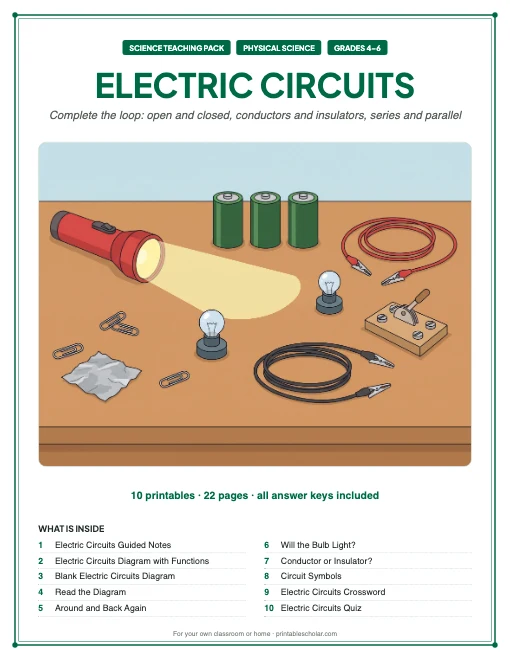
A ready-to-teach lesson: 30 slides and 10 printables. Present the slides while students fill in the guided notes, then use the worksheets, crossword and quiz, with every answer key.
Teaching electric circuits? This pack has ready-made lesson slides and 9 printables that take students from “complete the loop” to open and closed circuits, conductors and insulators, series and parallel circuits and circuit symbols, in teaching order, with every answer key.
Free on this page: the diagram and the blank one to label, marked Download below. The whole pack is $7: 22 pages in one print-ready file, the 30 lesson slides, the practice sheets, the crossword, the quiz and every answer key.
OnlineThe pack also comes as an online lesson for Google Classroom: every part on screen for students, plus a self-grading Google Forms quiz.
GameBuild circuits online with the free Circuit Builder: students snap batteries, switches, bulbs and fans onto a pegboard and see series vs parallel, conductors and short circuits for themselves.
One-time purchase. Instant download. Secure checkout by Stripe. Want to see a whole pack first? The Skeletal System pack is free.See all 31 packs in the bundle
- The Microscope
- Photosynthesis
- Parts of a Plant and Flower
- Life Cycle of a Plant
- Life Cycles of a Butterfly and a Frog
- Food Chains and Food Webs
- The Water Cycle
- Human Body Organs
- Skeletal System
- Muscular System
- Digestive System
- Respiratory System
- Heart and Circulation
- Nervous System and Brain
- Eye and Ear
- Parts of a Tooth
- Inside the Earth and Volcanoes
- Rocks and the Rock Cycle
- Layers of the Atmosphere
- Types of Clouds
- Weathering, Erosion and Deposition
- Types of Landforms
- The Solar System
- The Seasons
- Moon Phases and Eclipses
- States of Matter
- Electric Circuits (this pack)
- Forms of Energy
- Scientific Method
- Simple Machines
- Magnets and Magnetic Fields
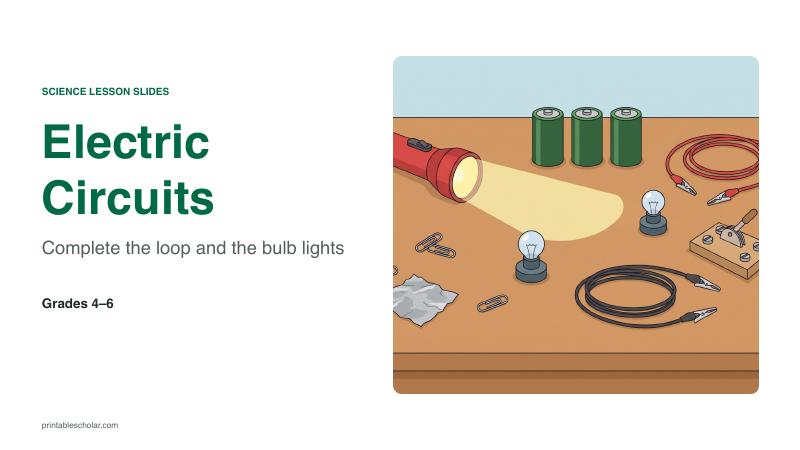
Teach Electric Circuits with 30 ready-made slides
Open the PowerPoint and teach: an opening question, the parts one at a time on the diagram, quick checks and an exit question. Students fill in the guided notes sheet as you go.
Every slide comes with teacher notes: what to say, what to ask, and sample answers.
The slides (PowerPoint and a PDF copy) and the guided notes sheet come with the pack.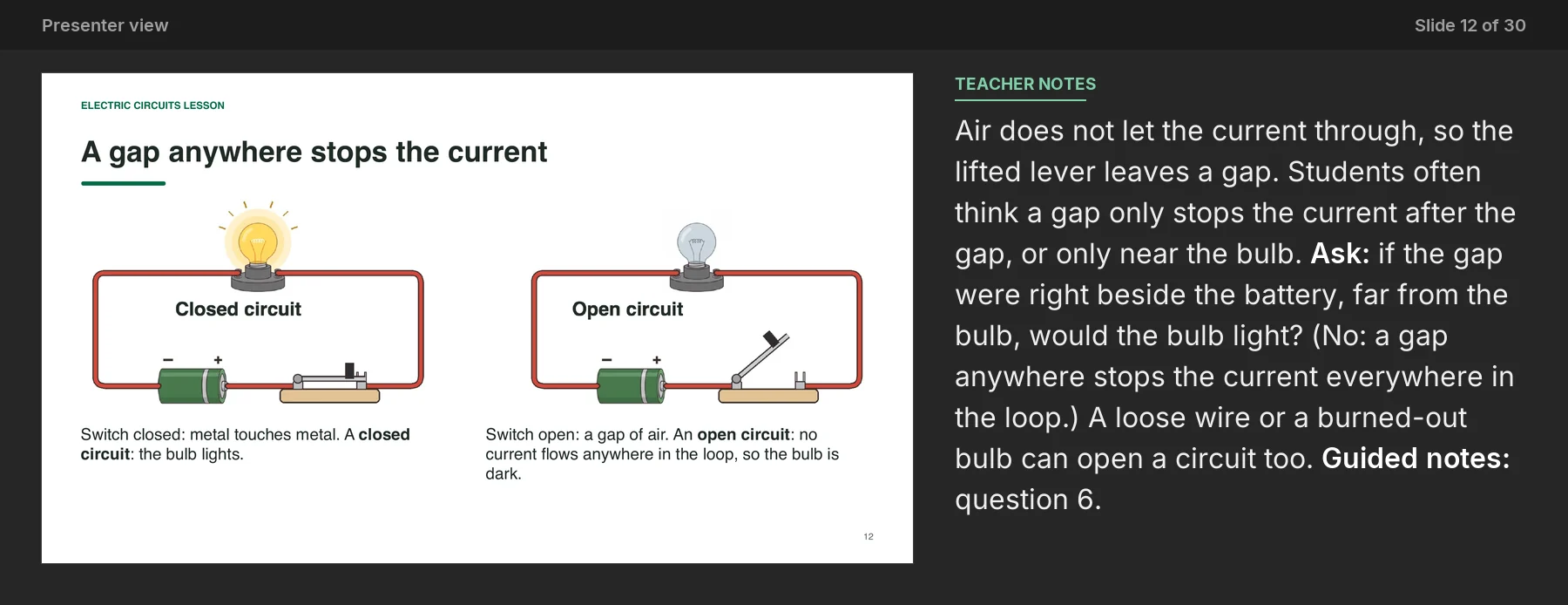
What is in the pack, in teaching order
 In the pack
1. TeachLesson Slides30 slides to present, with your notes for each one.In the $7 pack
 In the pack
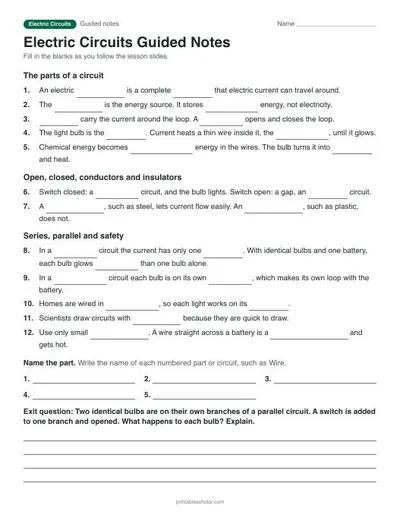
1. TeachElectric Circuits Guided NotesStudents fill in the blanks as you present. With answer key.In the $7 pack
 Free
 Free
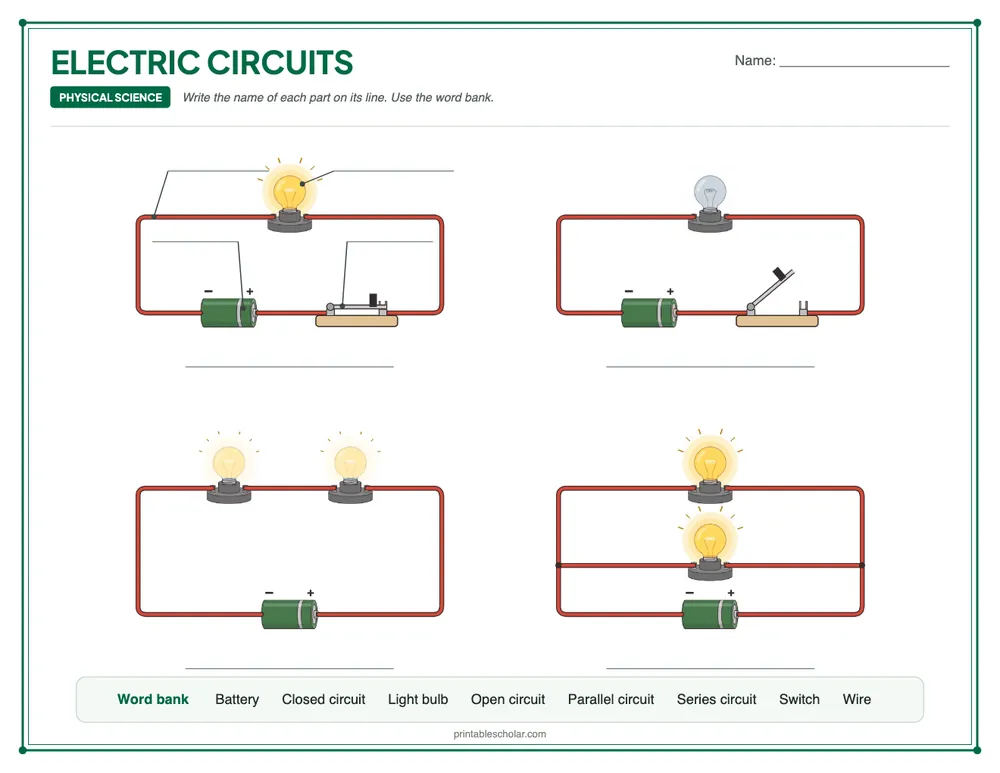
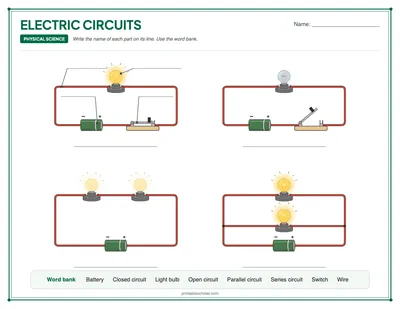
2. LabelBlank Electric Circuits DiagramStudents label 4 parts and 4 circuits from a word bank.Download free PDF
 In the pack
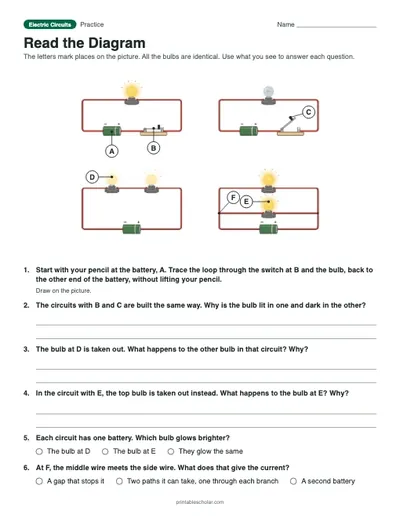
3. ReasonRead the DiagramRead the four circuits: trace a complete loop, explain why one bulb is dark, and predict what happens when a bulb is taken out of a series and a parallel circuit.In the $7 pack
 In the pack
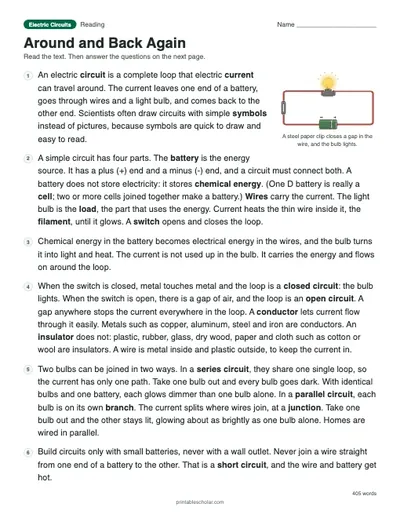
4. ReadAround and Back AgainA one-page text on circuits, the parts and the energy they carry, open and closed circuits, conductors and insulators, and series and parallel circuits, with eight questions.In the $7 pack
 In the pack
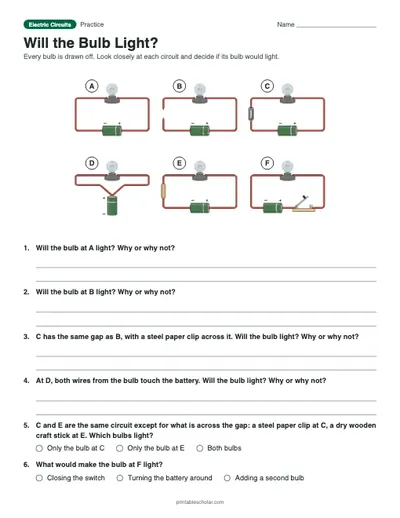
5. ApplyWill the Bulb Light?Predict whether the bulb lights in six circuits, from a gap, a paper clip, a craft stick, a switch and a battery wired to one end only, and say why.In the $7 pack
 In the pack
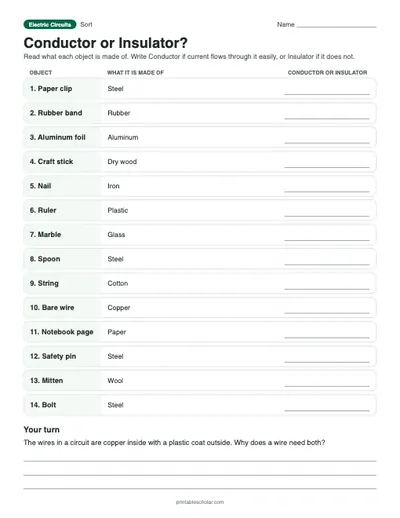
6. SortConductor or Insulator?Sort fourteen everyday objects as conductors or insulators by what they are made of, then explain why a wire is metal inside and plastic outside.In the $7 pack
 In the pack
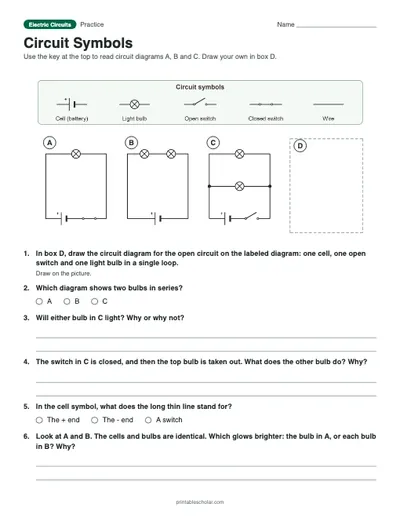
7. ConnectCircuit SymbolsRead three circuit diagrams drawn with symbols, decide which bulbs light, and draw the circuit diagram for an open circuit.In the $7 pack
 In the pack
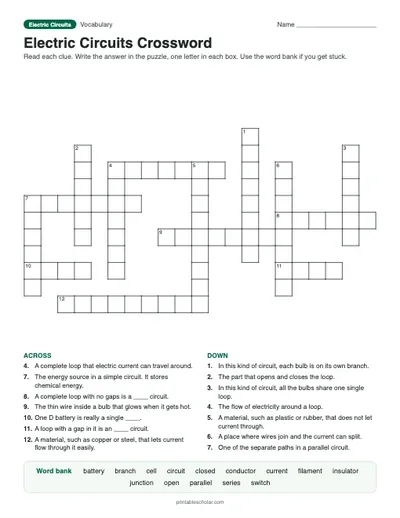
8. ReviewElectric Circuits CrosswordFourteen electric circuit words with clues and a word bank.In the $7 pack
 In the pack
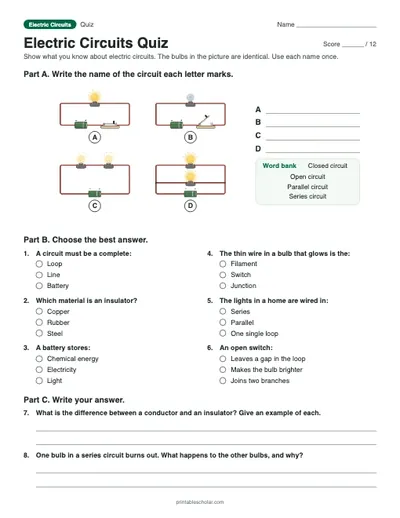
9. CheckElectric Circuits QuizName the four circuits on the diagram, six multiple choice and two written answers. Scored out of 12.In the $7 pack
Electric Circuits worksheets, crossword and quiz
The Electric Circuits teaching pack is 30 lesson slides (PowerPoint and PDF) and 10 printables with answer keys for grades 4 to 6, in the order you would teach them: the guided notes for the lesson slides, the labeled diagram and the blank one to label, then “Read the Diagram” (a worksheet), “Around and Back Again” (a reading passage), “Will the Bulb Light?” (a worksheet), “Conductor or Insulator?” (a sorting table), “Circuit Symbols” (a worksheet), a vocabulary crossword and a quiz.
The sheets are in a suggested teaching order: teach the lesson, have students label the blank diagram, then work through the practice sheets and finish with the quiz. Use them all over a week or pick the ones you need. The answer keys are together at the back.
The diagram and the blank one to label are free to download on this page. The other sheets come with the pack ($7), which is also in the Elementary Science bundle (grades 3 to 6).
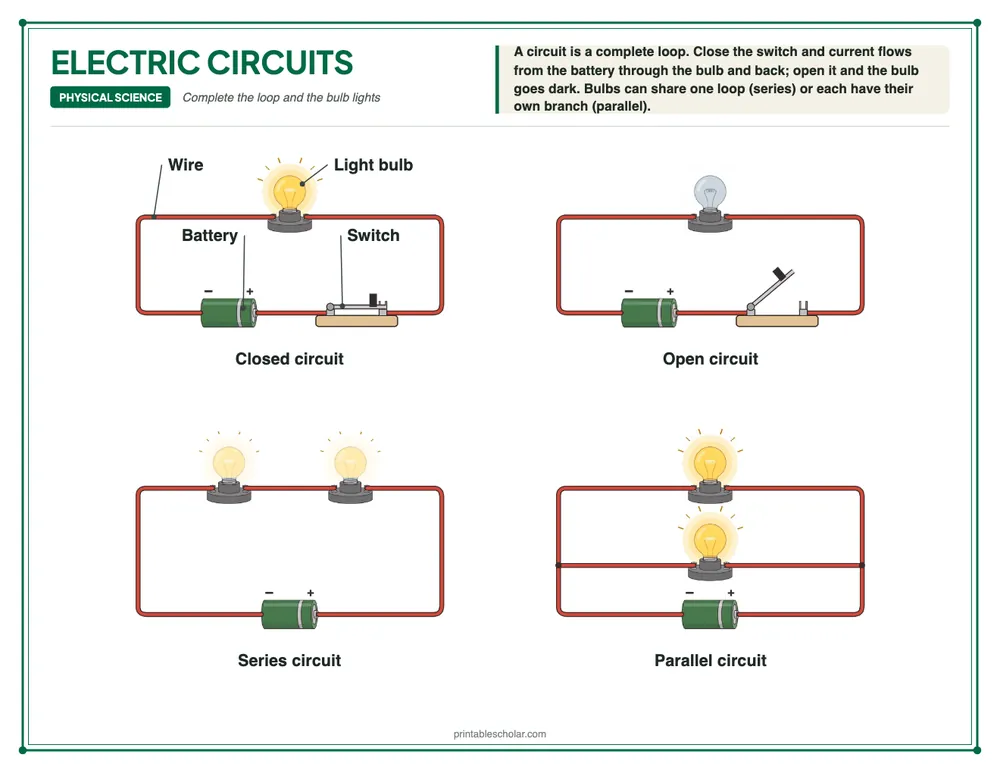
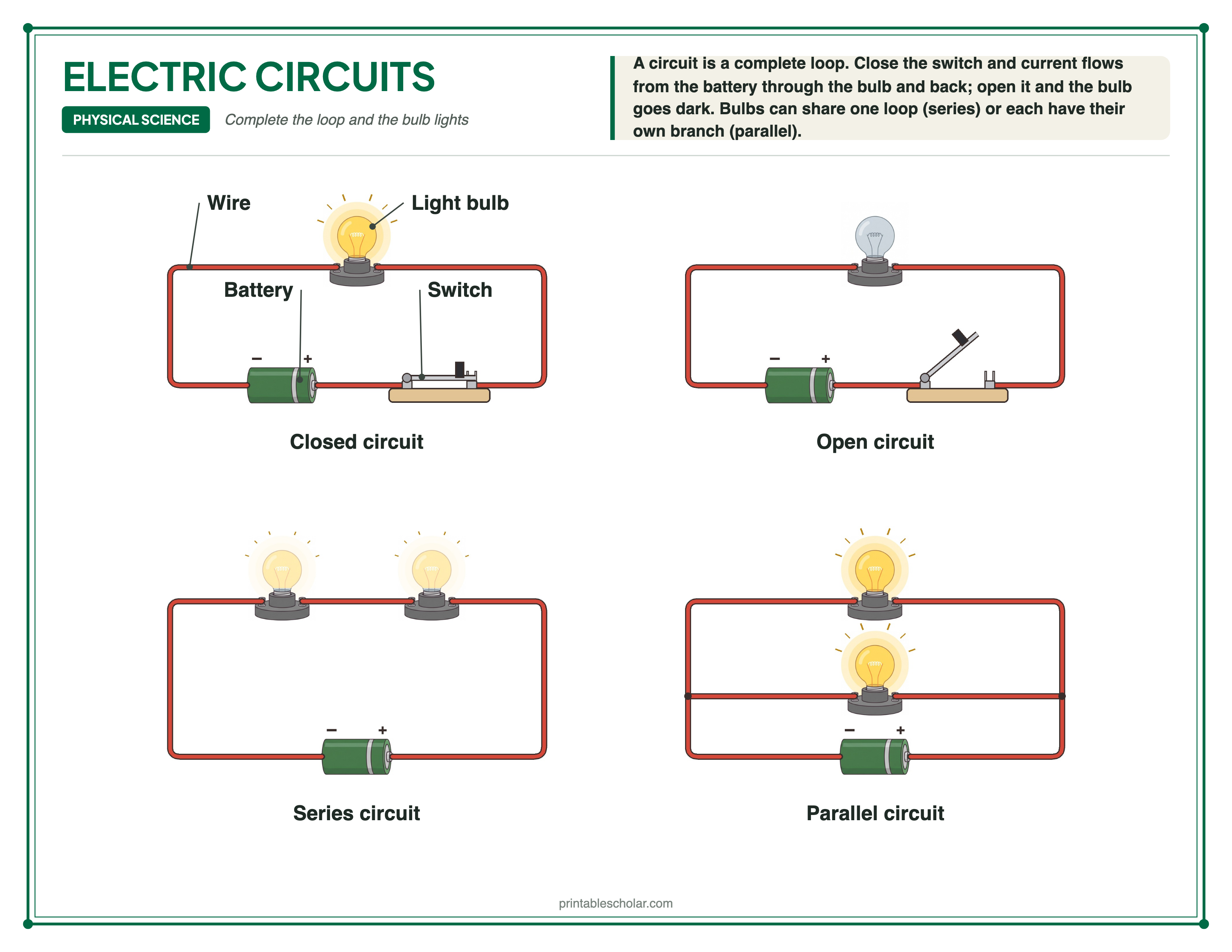
Electricity only flows when it has a complete path, called a closed circuit. A simple circuit has four parts: an energy source (a battery), wires that carry the current, a load that uses the energy (here a light bulb), and often a switch to open and close the loop. The battery stores chemical energy. When the loop is closed, the battery pushes an electric current through the wires and the bulb and back to the battery, and the bulb turns electrical energy into light and heat. Open the switch, or leave a gap anywhere, and the current stops everywhere in the loop at once: the bulb goes dark. Wires are made of metal, usually copper, because metals are good conductors; the plastic coat around them is an insulator, which keeps the current inside the wire. With more than one bulb, there are two ways to connect them. In a series circuit, everything is in one loop, so if one bulb is taken out the loop is broken and every bulb goes dark, and two identical bulbs on one battery each glow dimmer than one bulb alone. In a parallel circuit, each bulb is on its own branch, so if one goes out the others stay lit, and with identical bulbs and one battery each glows about as brightly as one bulb alone. The lights and outlets in a home are wired in parallel. Experiment only with batteries, never with wall outlets, and never connect a wire straight from one end of a battery to the other: that short circuit makes the wire and battery hot.
Four parts and four circuits
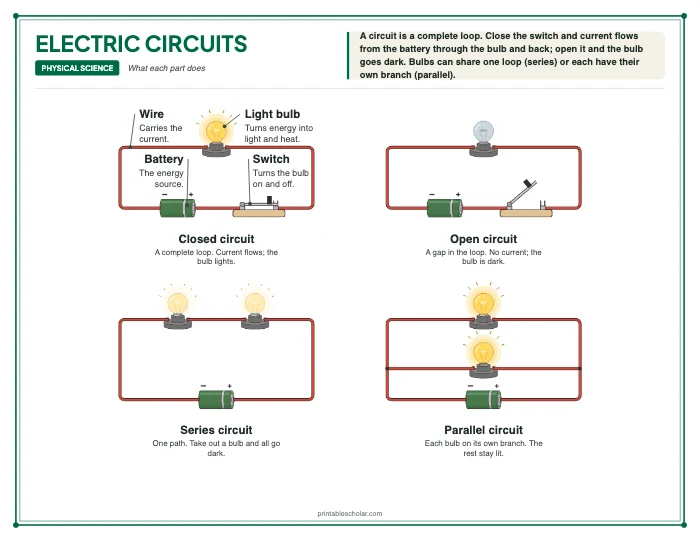
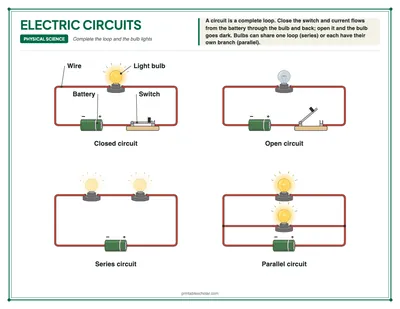
An electric circuit is a complete loop that electric current can travel around, from one end of a battery, through wires and a light bulb, and back to the other end. This diagram shows the parts of a simple circuit, what happens when the loop is open or closed, and two ways to connect more than one bulb: in series and in parallel. Here is what happens at each labeled part of the diagram:
| Part | What it does | Why it matters |
|---|---|---|
| Battery | The energy source. It stores chemical energy and pushes electric current around the loop from one end to the other. | A battery has two ends: the positive (+) end, with the small bump, and the negative (-) end, which is flat. A circuit must connect both ends. The battery does not store electricity itself; chemicals inside it react to push the current, and when they are used up the battery is dead. |
| Wire | Carries the current around the loop. Metal inside (a conductor), plastic outside (an insulator). | The metal inside a wire, usually copper, lets current flow through it easily. The plastic coat does not, so the current stays in the wire and you can hold the wire safely in a battery circuit. Every part of the loop must be joined metal to metal. |
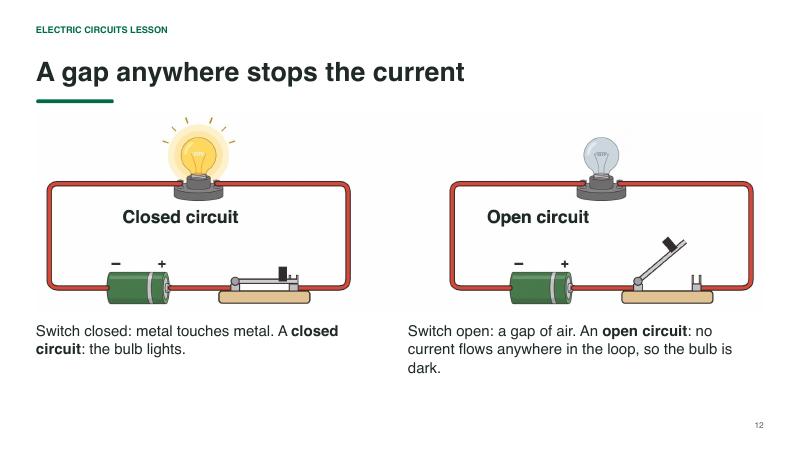
| Switch | Opens and closes the loop. Closed: metal touches metal and current flows. Open: a gap, and the current stops. | When the switch is closed, its metal lever rests in the clip and the circuit is complete. When it is open, the lever is lifted, leaving an air gap, and air does not let the current through. A light switch on a wall does the same job. |
| Light bulb | The load: it uses the energy. Current through the thin wire inside heats it until it glows, giving light and heat. | The thin coiled wire inside the bulb is the filament. Current has to pass through it to get from one side of the bulb to the other, and it heats the filament until it glows white-hot. In this kind of bulb most of the energy actually becomes heat, not light. Other loads include a buzzer (sound) and a motor (motion). |
| Closed circuit | A complete loop with no gaps. Current flows all the way around and the bulb lights. | Follow the loop with your finger: from the battery, through the wire, the switch and the bulb, and back to the other end of the battery without lifting your finger. If you can, the circuit is closed. |
| Open circuit | The loop has a gap (here the open switch), so no current flows anywhere and the bulb stays dark. | A gap anywhere stops the current everywhere in the loop, not only after the gap. A loose wire or a burned-out bulb can open a circuit as well as a switch. A dead battery is different: the loop is still complete, but the battery has no stored energy left to push the current. |
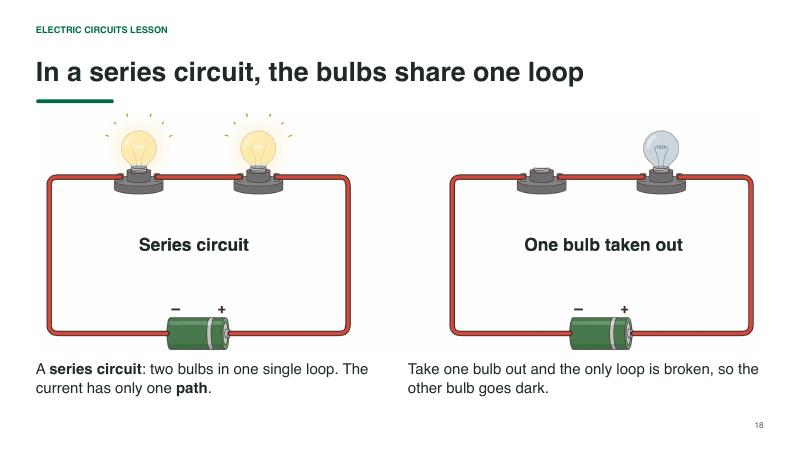
| Series circuit | Two or more bulbs in one single loop. Take one out and they all go dark. | The current has only one path, so it passes through each bulb in turn. With two identical bulbs on one battery, each bulb glows dimmer than one bulb on its own, because the battery has to push the current through both. Removing or breaking any bulb breaks the only path. |
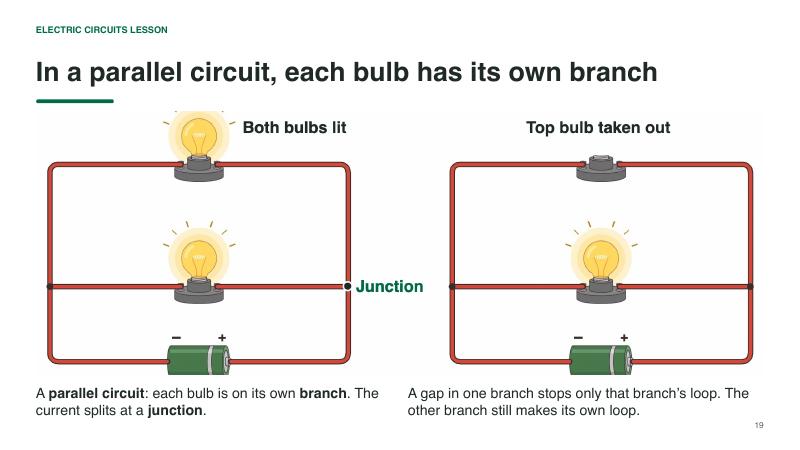
| Parallel circuit | Each bulb is on its own branch. Take one out and the others stay lit. | The current splits at a junction and each branch makes its own loop with the battery. With identical bulbs and one battery, each bulb glows about as brightly as a single bulb alone, but the battery runs down faster because it is lighting both. The lights and outlets in a home are wired in parallel. |
How to print
Choose Download PDF for a ready-to-print file that fits US Letter paper (8.5 × 11") in landscape, or Download PNG for the high-resolution image.
Frequently asked questions
What is an electric circuit?
An electric circuit is a complete path that electric current can flow around. In a simple circuit, current leaves one end of a battery, goes through wires and a load such as a light bulb, and comes back to the other end of the battery. If there is a gap anywhere, the current stops.
What are the parts of a simple circuit?
An energy source (a battery or cell), wires to carry the current (conductors), a load that uses the energy (a light bulb, buzzer or motor), and usually a switch to open and close the circuit.
What is the difference between an open and a closed circuit?
A closed circuit is a complete loop, so current flows and the bulb lights. An open circuit has a gap, such as an open switch or a loose wire, so no current flows and the bulb stays off.
What is the difference between a series and a parallel circuit?
In a series circuit, all the parts are in one loop, so the current has only one path: if one bulb goes out, they all go out. In a parallel circuit, each bulb is on its own branch: if one bulb goes out, the others stay lit. With identical bulbs and one battery, bulbs in parallel each glow brighter than bulbs in series.
Why are homes wired in parallel?
So that each light and outlet works on its own. You can switch off one lamp, or a bulb can burn out, and everything else keeps working. In a series circuit, one break would turn everything off.
What are conductors and insulators?
A conductor lets electric current flow through it easily: metals such as copper, aluminum and steel are good conductors. An insulator does not: plastic, rubber, glass, dry wood and cloth are insulators. Wires use both: copper inside to carry the current and plastic outside to keep it in.
What do circuit symbols mean?
A circuit diagram uses simple symbols in place of pictures. A cell is drawn as a long line and a short, thick line (the long line is the + end); a light bulb as a circle with an X; a wire as a straight line; and a switch as a break in the line with a lever that is either lifted (open) or flat (closed). Two or more cells joined together make a battery.
Which way does electric current flow?
Scientists draw current flowing out of the positive (+) end of the battery, around the circuit, and back into the negative (-) end. This is called conventional current. The tiny electrons in the metal actually drift the other way. For whether a bulb lights, the direction does not matter: what matters is a complete loop.
Is it safe to make circuits at home or in class?
Yes, with ordinary 1.5-volt AA, C or D batteries, wires and small bulbs. Never use a wall outlet, which can kill. Do not connect a wire straight from one end of a battery to the other (a short circuit): the wire and battery get hot quickly. Do not use lithium, rechargeable or 9-volt batteries for experiments.
What paper size should I print this on?
The diagram is sized for standard US Letter paper (8.5 × 11") in landscape orientation. Use "Download PDF" for a print-ready file that fits the page automatically.
Are there Electric Circuits worksheets to go with the diagram?
Yes. The Electric Circuits teaching pack, for grades 4 to 6, has 30 lesson slides and 10 printables with answer keys: the guided notes for the lesson slides, the labeled diagram and the blank one to label, then “Read the Diagram” (a worksheet), “Around and Back Again” (a reading passage), “Will the Bulb Light?” (a worksheet), “Conductor or Insulator?” (a sorting table), “Circuit Symbols” (a worksheet), a vocabulary crossword and a quiz. The diagram and the blank one to label are free to download on this page. The other sheets come with the pack ($7), which is also in the Elementary Science bundle (grades 3 to 6).
Related: Where the energy in a circuit comes from and where it goes is in the forms of energy diagram, and electric current can make a magnet, as the magnetic field diagram shows.