Life Cycle of a Plant
Free printable life cycle of a plant diagram — a labeled circular diagram showing seed, germination, seedling, adult plant, flower, pollination, and fruit and seeds. Download a high-resolution PDF or PNG for Letter paper.
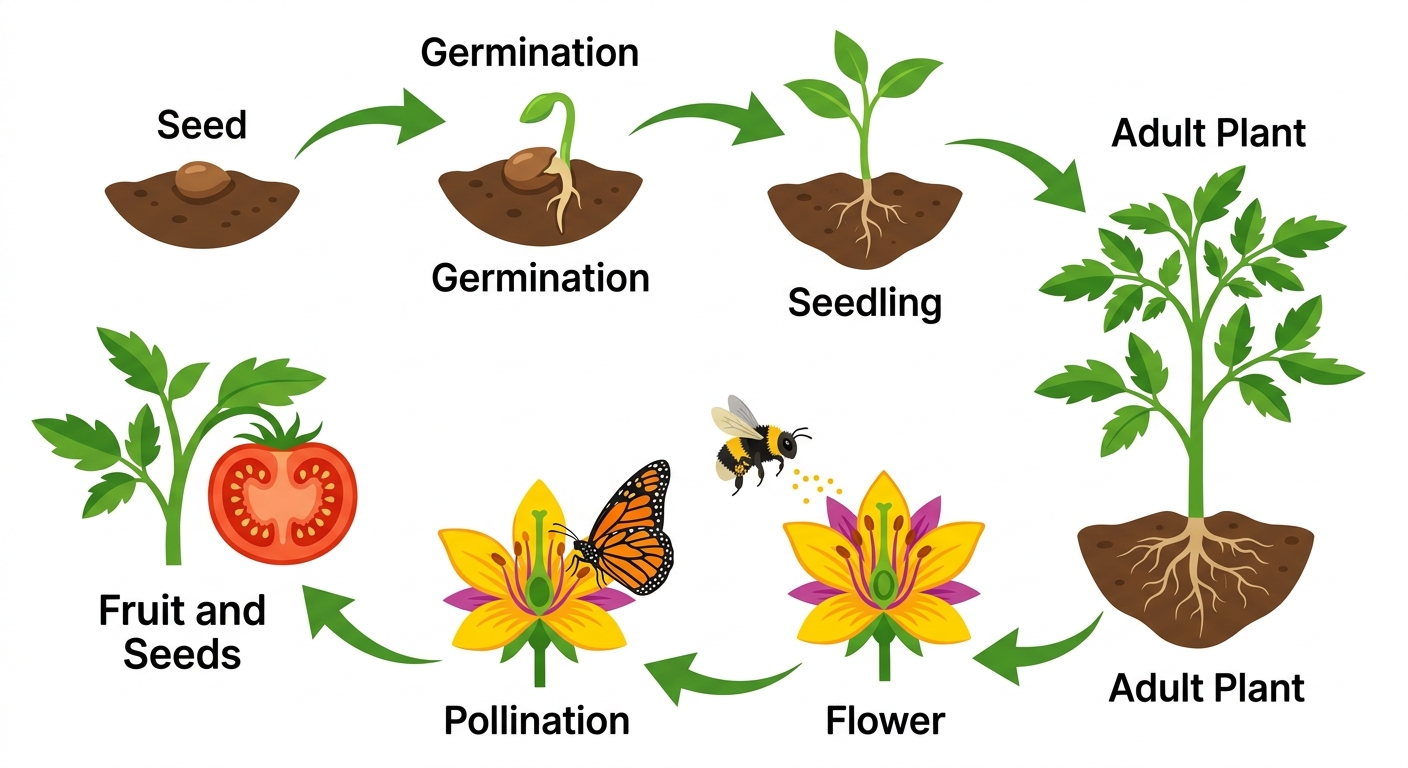

The life cycle of a flowering plant, stage by stage
A flowering plant's life cycle is a continuous loop — from seed to plant to flower to new seed — driven by the partnership between plants, pollinators, and the soil. Here is what happens at each labeled part of the diagram:
| Stage | What it does | Why it matters |
|---|---|---|
| Seed | A seed contains a tiny embryo plant and enough stored food to fuel its first days of growth. | A seed is essentially a plant in suspended animation, waiting for the right combination of moisture, warmth, and sometimes light before it will begin to grow. Seeds can remain dormant for years — some have been successfully germinated after decades in storage — which is how plants survive droughts, fires, and cold winters. Inside the tough protective coat are all the genetic instructions for building a complete plant, plus a food reserve (endosperm or cotyledon) to power the seedling before it can photosynthesise. |
| Germination | The seed absorbs water, swells, and the first root and shoot emerge. | Germination begins the moment a seed absorbs enough water to reactivate the embryo's cellular machinery. The first structure to emerge is the radicle — the primary root — which anchors the seedling and starts absorbing water and minerals from the soil. The shoot follows, pushing upward through the soil toward light. This early phase is the most vulnerable in a plant's life: it is using stored food and cannot yet photosynthesise, so it depends entirely on the nutrients packed into the seed. |
| Seedling | A young plant with its first true leaves, now able to photosynthesise. | Once the seedling's first true leaves unfurl and catch sunlight, it switches from running on seed reserves to making its own food through photosynthesis. The root system expands rapidly to supply water, and the shoot grows taller toward the light. At this stage the plant is still fragile — a late frost, pest, or drought can kill it — but it is no longer entirely dependent on its seed's food store. |
| Adult Plant | A fully grown plant with a developed root system, stem, and leaves. | The adult plant is the engine of the cycle — its roots anchor it and draw up water and minerals, its stem supports and transports, and its leaves capture sunlight to power photosynthesis. The plant's goal at this stage is to accumulate enough energy and resources to reproduce. Some plants reach this stage in weeks; trees may take decades. The size of an adult plant is a direct reflection of the energy and nutrients available in its environment. |
| Flower | The flower is the plant's reproductive structure, containing male and female parts. | Flowers are the plant's investment in reproduction: their colour, scent, and nectar are all designed to attract specific pollinators. The male parts (stamens) produce pollen containing the plant's male genetic material; the female parts (pistil) contain the ovules that, once fertilised, will become seeds. A plant that produces a showy flower is essentially advertising to pollinators — offering nectar in exchange for carrying pollen from flower to flower. |
| Pollination | Pollen is transferred from one flower to another, fertilising the ovule. | Pollination is the transfer of pollen from the anther of one flower to the stigma of another (or the same) flower. Bees, butterflies, birds, bats, and wind all serve as pollinators. When a bee visits a flower for nectar, pollen grains stick to its body; when it visits the next flower, some pollen rubs off onto the stigma. The pollen grain then grows a tube down into the ovary, allowing the male cell to reach and fertilise the ovule. Without pollination, no seeds form and the cycle cannot continue. |
| Fruit and Seeds | The fertilised ovule develops into a seed; the ovary becomes the fruit around it. | After fertilisation the ovule develops into a seed containing a new embryo plant, while the ovary wall swells into the fruit around it. Fruits serve a critical purpose: they attract animals to eat them, which then carry the seeds away from the parent plant in their digestive systems or fur, dropping them far away. This dispersal prevents the new plants from competing with their parent for light, water, and nutrients — ensuring the species spreads and the cycle begins again. |
Companion worksheet
A free fill-in worksheet with an answer key, built from the labels above — students match each stage to its description, then answer a couple of short questions. Great for a quick check after using the diagram.
How to print
Choose Download PDF for a ready-to-print file that fits US Letter paper (8.5 × 11") in landscape, or Download PNG for the high-resolution image.
Frequently asked questions
What are the stages of a plant's life cycle?
Seed, germination, seedling, adult plant, flower, pollination, and fruit and seeds — which then disperse to begin the cycle again.
Why do plants produce flowers?
Flowers attract pollinators like bees and butterflies, which transfer pollen between flowers and enable fertilisation — the step that produces seeds and continues the plant's life cycle.
What paper size should I print this on?
The diagram is sized for standard US Letter paper (8.5 × 11") in landscape orientation. Use "Download PDF" for a print-ready file that fits the page automatically.