 Printable Scholar
Parts of a Tooth
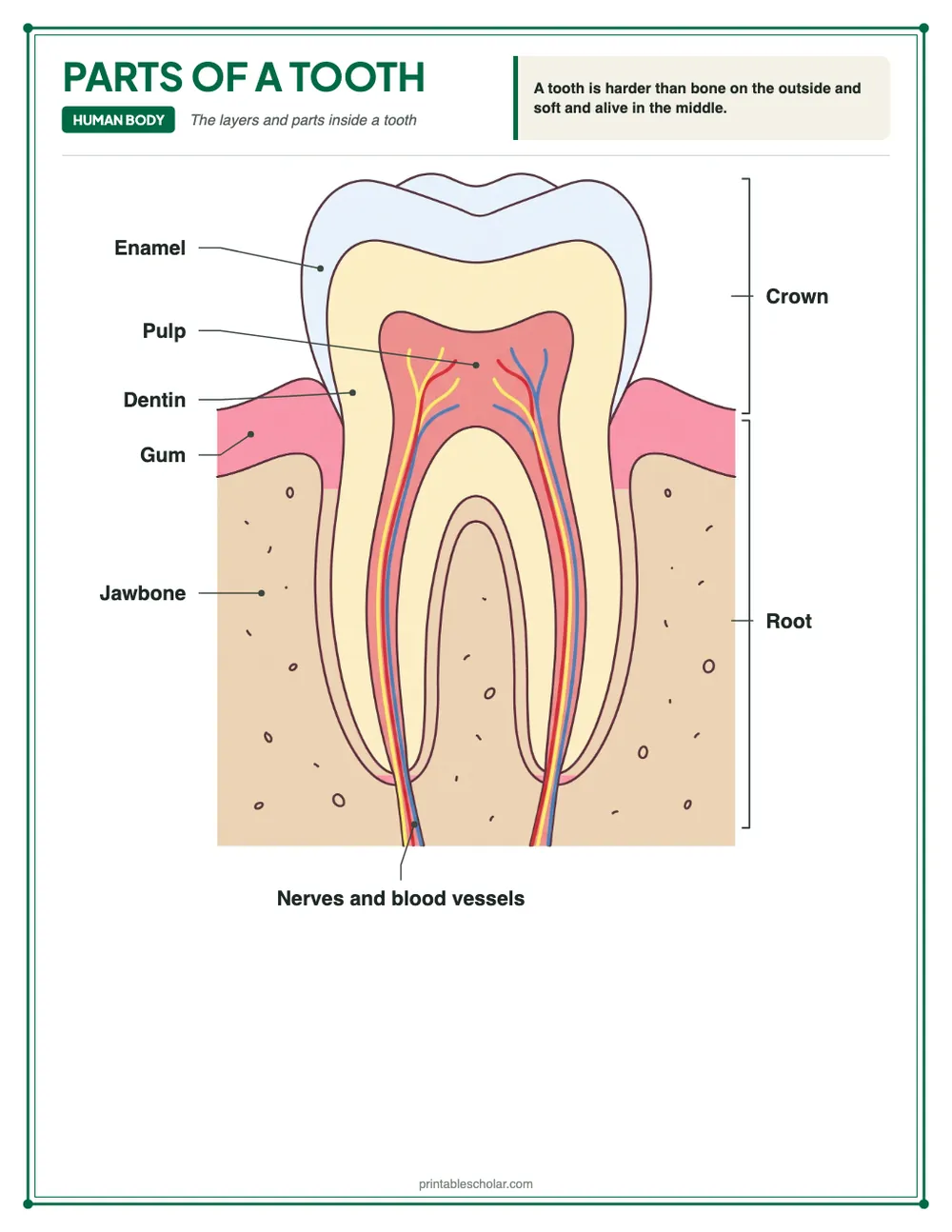
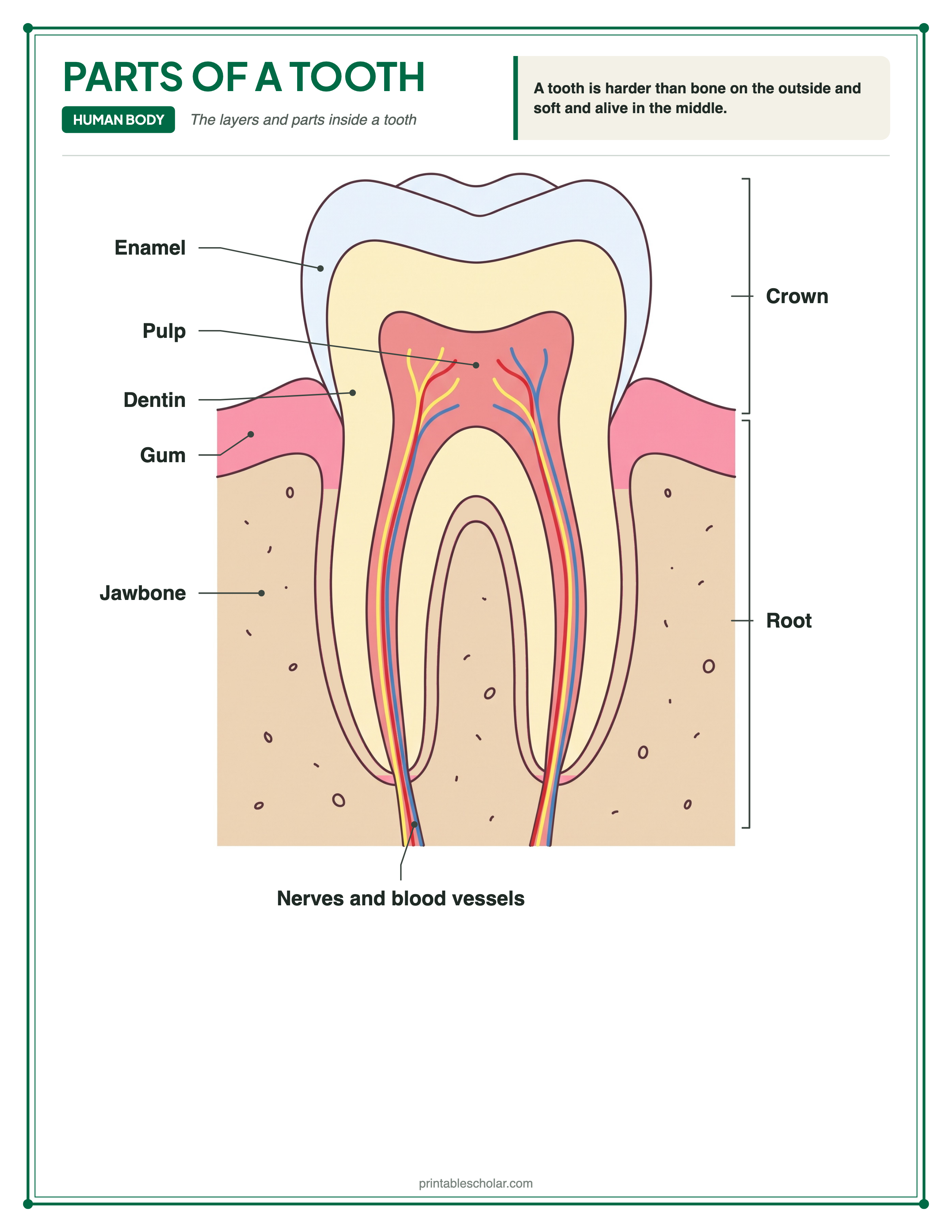
Free printable tooth diagram: the parts of a tooth (crown, root, enamel, dentin, pulp, gum and jawbone) labeled on a cross-section, plus a blank diagram to label. Download a high-resolution PDF or PNG for Letter paper.
Part of the Parts of a Tooth teaching pack for grades 3 to 5: 22 lesson slides and 8 printables with answer keys. The diagram and the blank one to label are free.
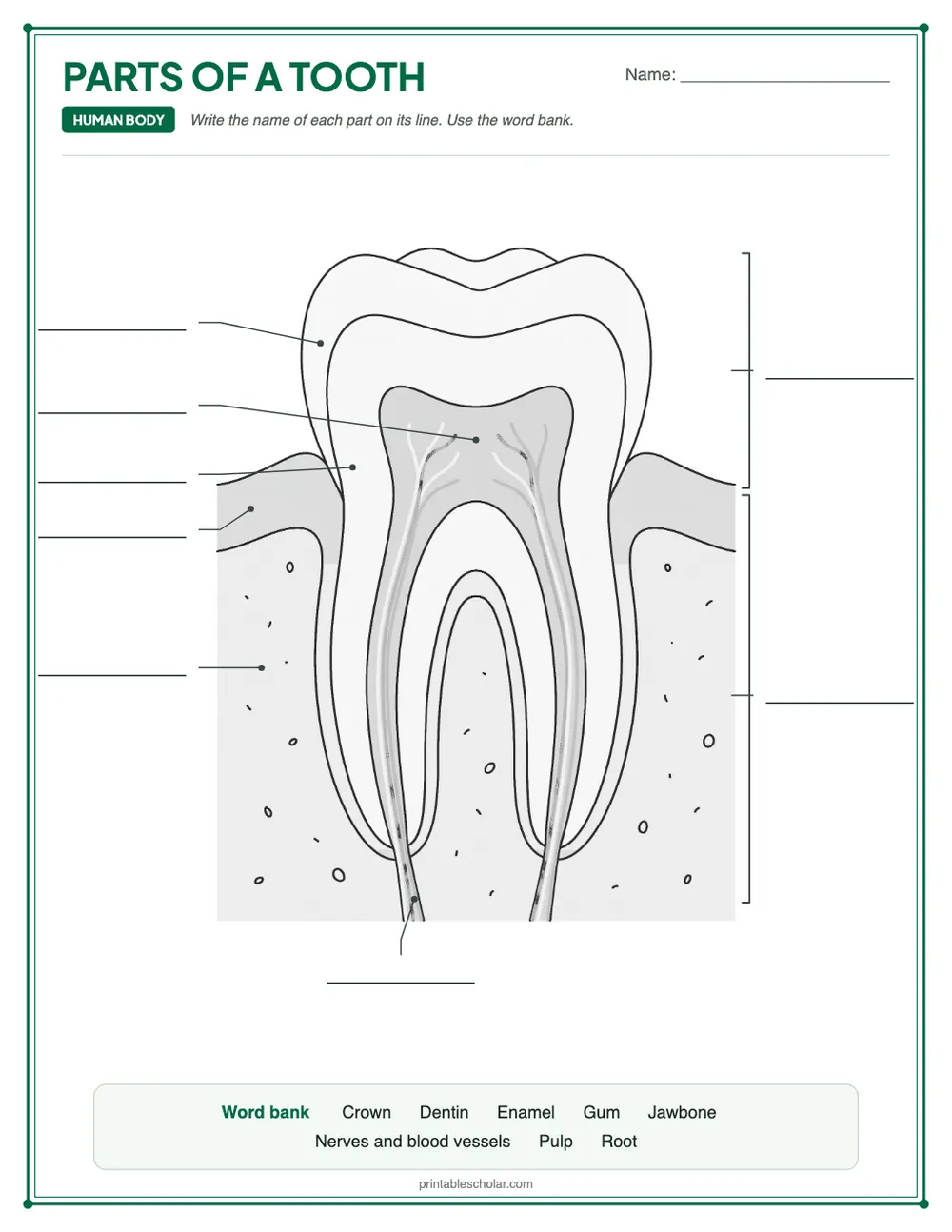
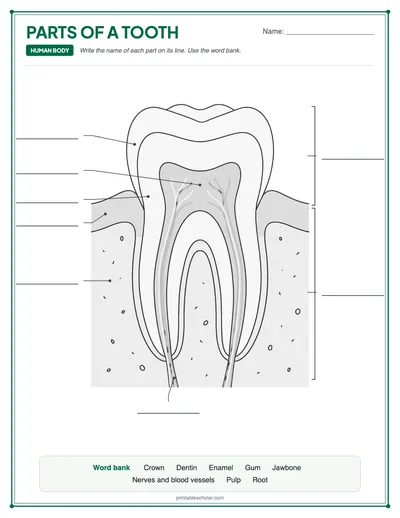
Blank diagram to label
Download blank version + answer key 8 blanks, a word bank, and the answer key on page 2Teaching ideas for Parts of a Tooth
Pick the ideas that suit your class, then follow the plan or use the sheets in any order.
- Mirror count. With a small plastic mirror, students look at their own teeth. They find their incisors and canines and count their back teeth, then point to each kind on the diagram. Counts will differ, since most students still have some baby teeth.
- Bite marks. Bring in an apple with one bite already taken out of it. Students look at the marks the incisors left and talk about how front teeth cut.
- Egg in vinegar. Put a raw egg in a clear plastic cup of vinegar for a day or two. The hard shell slowly wears away. Acid can wear away tooth enamel in a similar way. Wash hands after touching the raw egg.
- Brush an egg. Leave a hard-boiled egg, boiled at home, in dark soda or tea overnight. The shell stains brown. Students brush half of it with toothpaste and compare the two halves. Nobody eats the eggs.
A plan for the week
| Day 1 | Open with one of the ideas above. Teach the lesson with the slides while students fill in the guided notes. Then students label the blank diagram. | Lesson slides (PowerPoint) (in the pack) Parts of a Tooth Guided Notes (in the pack) Parts of a Tooth Diagram Blank Parts of a Tooth |
| Day 2 | Students match each part to its description on “Tooth Words” and answer the questions. | Tooth Words (in the pack) |
| Day 3 | Read “Inside Your Teeth” and answer the questions. | Inside Your Teeth (in the pack) |
| Day 4 | Students read the job and the clue for each row on “Kinds of Teeth” and name the kind of tooth. | Kinds of Teeth (in the pack) |
| Day 5 | Review with the crossword, then give the quiz. | Parts of a Tooth Crossword (in the pack) Parts of a Tooth Quiz (in the pack) |
The sheets marked “in the pack” are in the Parts of a Tooth teaching pack below.
NGSS standards
- Supports 4-LS1-1: Construct an argument that plants and animals have internal and external structures that function to support survival, growth, behavior, and reproduction.
Parts of a Tooth teaching pack
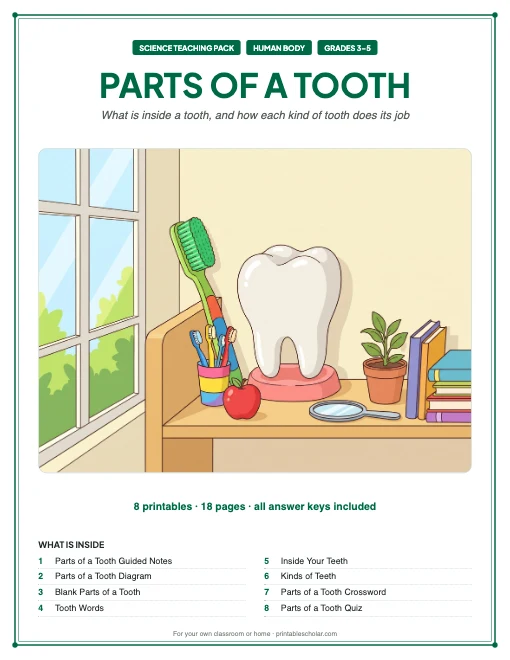
Teaching the parts of a tooth? This pack has ready-made lesson slides and 8 printables that cover the parts of a tooth, the four kinds of teeth and baby and adult teeth, in teaching order, with every answer key.
Free on this page: 2 of the 9 printables, marked Download below. The whole pack is $7: 18 pages in one print-ready file, the 22 lesson slides, the practice sheets, the crossword, the quiz and every answer key.
One-time purchase. Instant download. Secure checkout by Stripe. Want to see a whole pack first? The Skeletal System pack is free.See all 28 packs in the bundle
- The Microscope
- Photosynthesis
- Parts of a Plant and Flower
- Life Cycle of a Plant
- Life Cycles of a Butterfly and a Frog
- Food Chains and Food Webs
- The Water Cycle
- Skeletal System
- Muscular System
- Digestive System
- Respiratory System
- Heart and Circulation
- Nervous System and Brain
- Eye and Ear
- Parts of a Tooth (this pack)
- Inside the Earth and Volcanoes
- Rocks and the Rock Cycle
- Layers of the Atmosphere
- Types of Clouds
- Weathering, Erosion and Deposition
- Types of Landforms
- The Solar System
- The Seasons
- Moon Phases and Eclipses
- States of Matter
- Forms of Energy
- Simple Machines
- Magnets and Magnetic Fields
Teach Parts of a Tooth with 22 ready-made slides
Open the PowerPoint and teach: an opening question, the parts one at a time on the diagram, quick checks and an exit question. Your notes for each slide are in the speaker notes. Students fill in the guided notes sheet as you go.
The slides (PowerPoint and a PDF copy) and the guided notes sheet come with the pack.What is in the pack, in teaching order
 In the pack
1. TeachLesson Slides22 slides to present, with your notes for each one.In the $7 pack
 In the pack
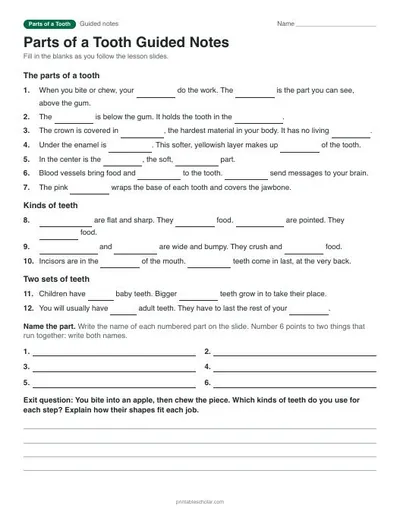
1. TeachParts of a Tooth Guided NotesStudents fill in the blanks as you present. With answer key.In the $7 pack
 Free
 Free
 In the pack
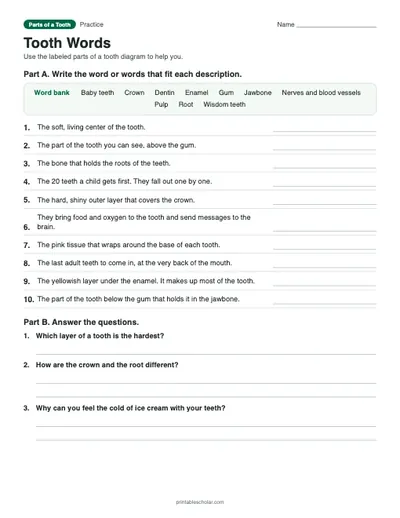
3. MatchTooth WordsMatch the 8 parts of a tooth and two more tooth words to their descriptions, then answer three questions.In the $7 pack
 In the pack
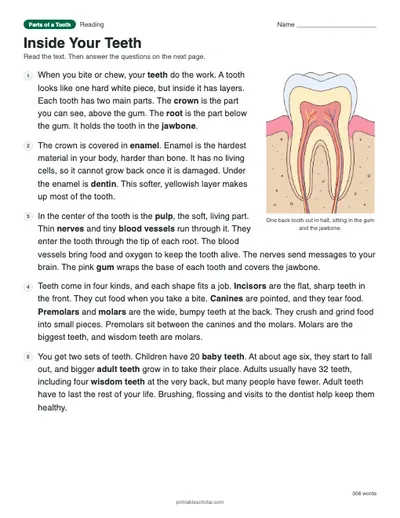
4. ReadInside Your TeethA one-page text on the parts of a tooth, the four kinds of teeth and baby and adult teeth, with eight questions.In the $7 pack
 In the pack
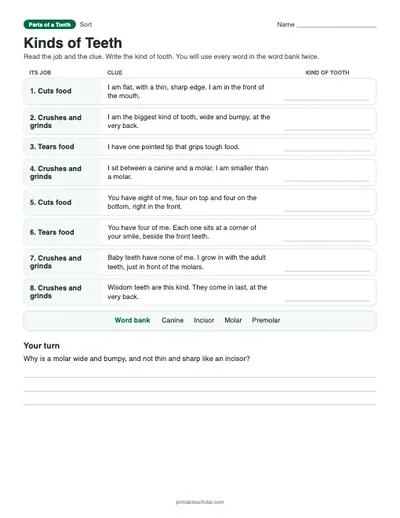
5. SortKinds of TeethRead the job and a clue for eight teeth and name each kind: incisor, canine, premolar or molar.In the $7 pack
 In the pack
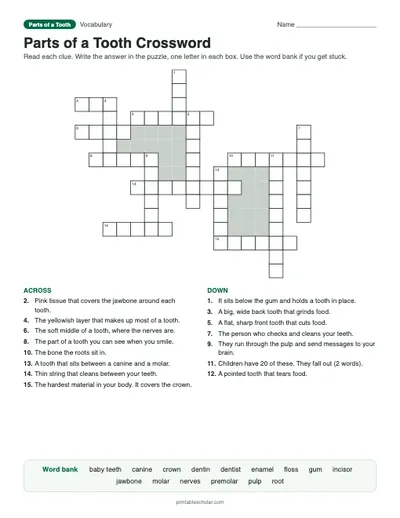
6. ReviewParts of a Tooth CrosswordFifteen tooth words with clues and a word bank.In the $7 pack
 In the pack
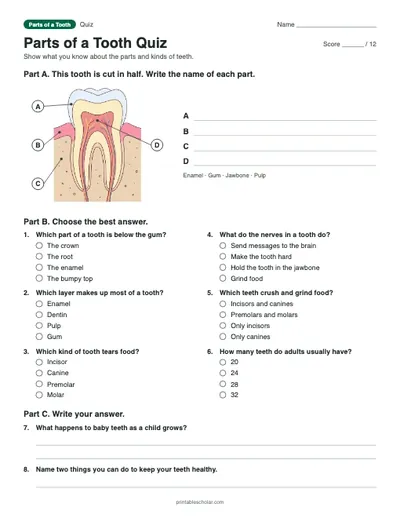
7. CheckParts of a Tooth QuizLabel four parts, six multiple choice and two written answers. Scored out of 12.In the $7 pack
Parts of a Tooth worksheets, crossword and quiz
The Parts of a Tooth teaching pack is 22 lesson slides (PowerPoint and PDF) and 8 printables with answer keys for grades 3 to 5, in the order you would teach them: the guided notes for the lesson slides, the labeled diagram and the blank one to label, then “Tooth Words” (a worksheet), “Inside Your Teeth” (a reading passage), “Kinds of Teeth” (a kinds-of-teeth table), a vocabulary crossword and a quiz.
The sheets are in a suggested teaching order: teach the lesson, have students label the blank diagram, then work through the practice sheets and finish with the quiz. Use them all over a week or pick the ones you need. The answer keys are together at the back.
The diagram and the blank one to label are free to download on this page. The other sheets come with the pack ($7), which is also in the Elementary Science bundle (grades 3 to 6).
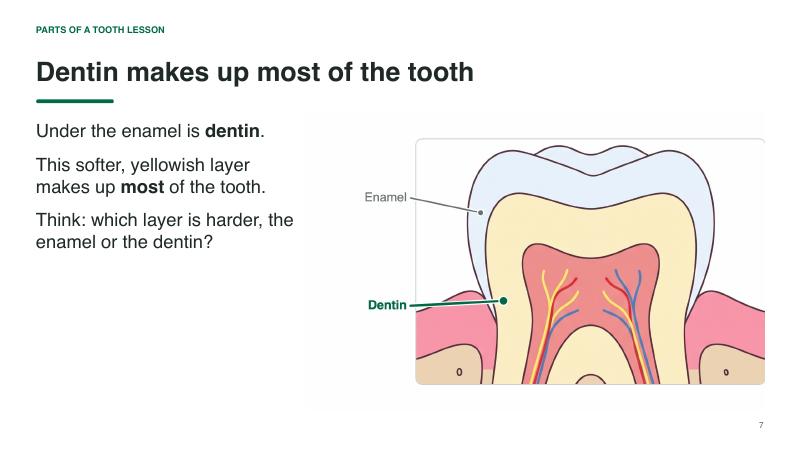
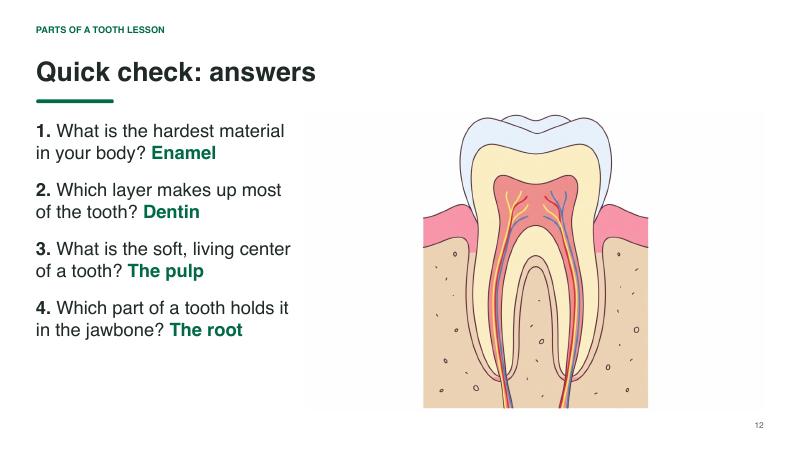
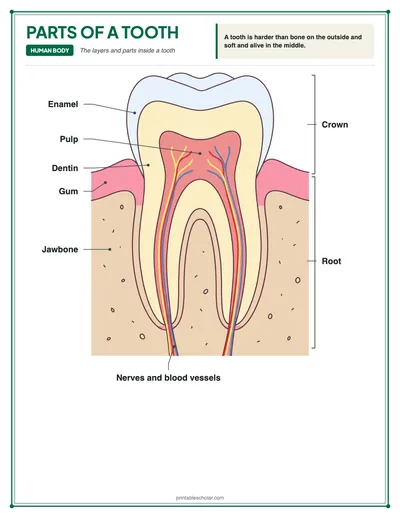
Each tooth has two main parts: the crown, which you can see above the gum, and the root, which holds the tooth in the jawbone. The crown is covered in enamel, the hardest material in the human body. Under the enamel is dentin, which makes up most of the tooth. In the center is the pulp, a soft part with nerves and blood vessels that keep the tooth alive and let you feel hot, cold and pain. Children have 20 baby teeth. They fall out and adult teeth grow in. Adults usually have 32 teeth, though many people have fewer. Teeth come in four kinds, each shaped for its job: incisors cut, canines tear, and premolars and molars crush and grind.
The parts of a tooth
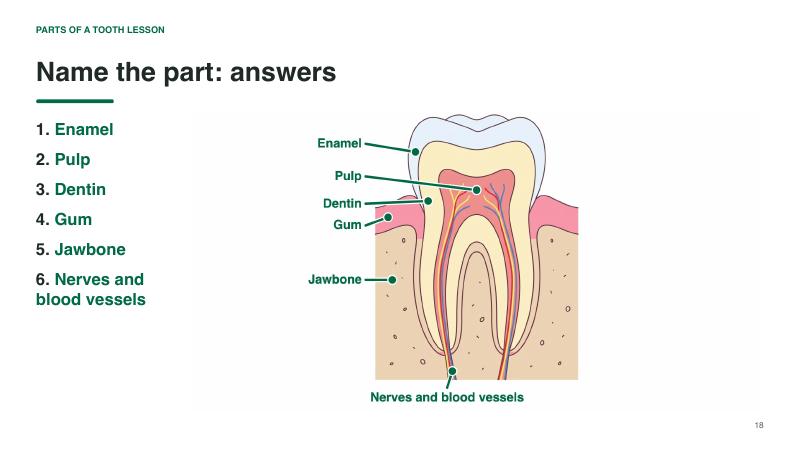
A tooth looks like one hard white piece, but inside it has layers. The outside is the hardest part of your body, and the middle is soft and alive. Here is what happens at each labeled part of the diagram:
| Part | What it does | Why it matters |
|---|---|---|
| Crown | The part of the tooth you can see, above the gum. | The crown does the biting and chewing. Its shape depends on the kind of tooth: flat and sharp in front, wide and bumpy at the back for grinding food. |
| Root | The part of the tooth below the gum that holds it in the jawbone. | Roots are usually longer than the crown. Front teeth have one root, and big back teeth (molars) usually have two or three, which hold them steady while you chew. |
| Enamel | The hard, shiny outer layer that covers the crown. | Enamel is the hardest material in your body, harder than bone. It has no living cells, so once it is damaged it cannot grow back. Brushing and fluoride help protect it from cavities. |
| Dentin | The yellowish layer under the enamel that makes up most of the tooth. | Dentin is softer than enamel. It has tiny tubes that lead to the pulp, so when enamel wears away, cold or sweet foods can make a tooth feel sensitive. |
| Pulp | The soft center of the tooth, inside the dentin. | The pulp is the living part of the tooth. It fills the middle of the crown and runs down a thin channel inside each root. |
| Nerves and blood vessels | Thin nerves and tiny blood vessels inside the pulp. They enter the tooth through the tip of each root. | The blood vessels bring food and oxygen to keep the tooth alive. The nerves send messages to your brain, which is why you feel a toothache or the cold of ice cream. |
| Gum | The pink tissue that wraps around the base of each tooth and covers the jawbone. | Healthy gums fit snugly around each tooth and protect the roots. Brushing and flossing along the gum line keep them healthy. |
| Jawbone | The bone that holds the roots of the teeth. | Your upper and lower jaws each hold a row of teeth. Each root sits in a socket in the bone, held in place by tiny fibers. |
How to print
Choose Download PDF for a ready-to-print file that fits US Letter paper (8.5 × 11") in portrait, or Download PNG for the high-resolution image.
Frequently asked questions
What are the main parts of a tooth?
The crown (above the gum) and the root (below it). The layers are the enamel on the outside, the dentin under it and the soft pulp in the center, with nerves and blood vessels.
What is the hardest part of a tooth?
The enamel, the outer layer of the crown. It is the hardest material in the human body.
How many teeth do people have?
Children have 20 baby teeth. Adults usually have 32 teeth, including four wisdom teeth, though many people have fewer.
What paper size should I print this on?
The diagram is sized for standard US Letter paper (8.5 × 11") in portrait orientation. Use "Download PDF" for a print-ready file that fits the page automatically.
Are there Parts of a Tooth worksheets to go with the diagram?
Yes. The Parts of a Tooth teaching pack, for grades 3 to 5, has 22 lesson slides and 8 printables with answer keys: the guided notes for the lesson slides, the labeled diagram and the blank one to label, then “Tooth Words” (a worksheet), “Inside Your Teeth” (a reading passage), “Kinds of Teeth” (a kinds-of-teeth table), a vocabulary crossword and a quiz. The diagram and the blank one to label are free to download on this page. The other sheets come with the pack ($7), which is also in the Elementary Science bundle (grades 3 to 6).