The Six Simple Machines
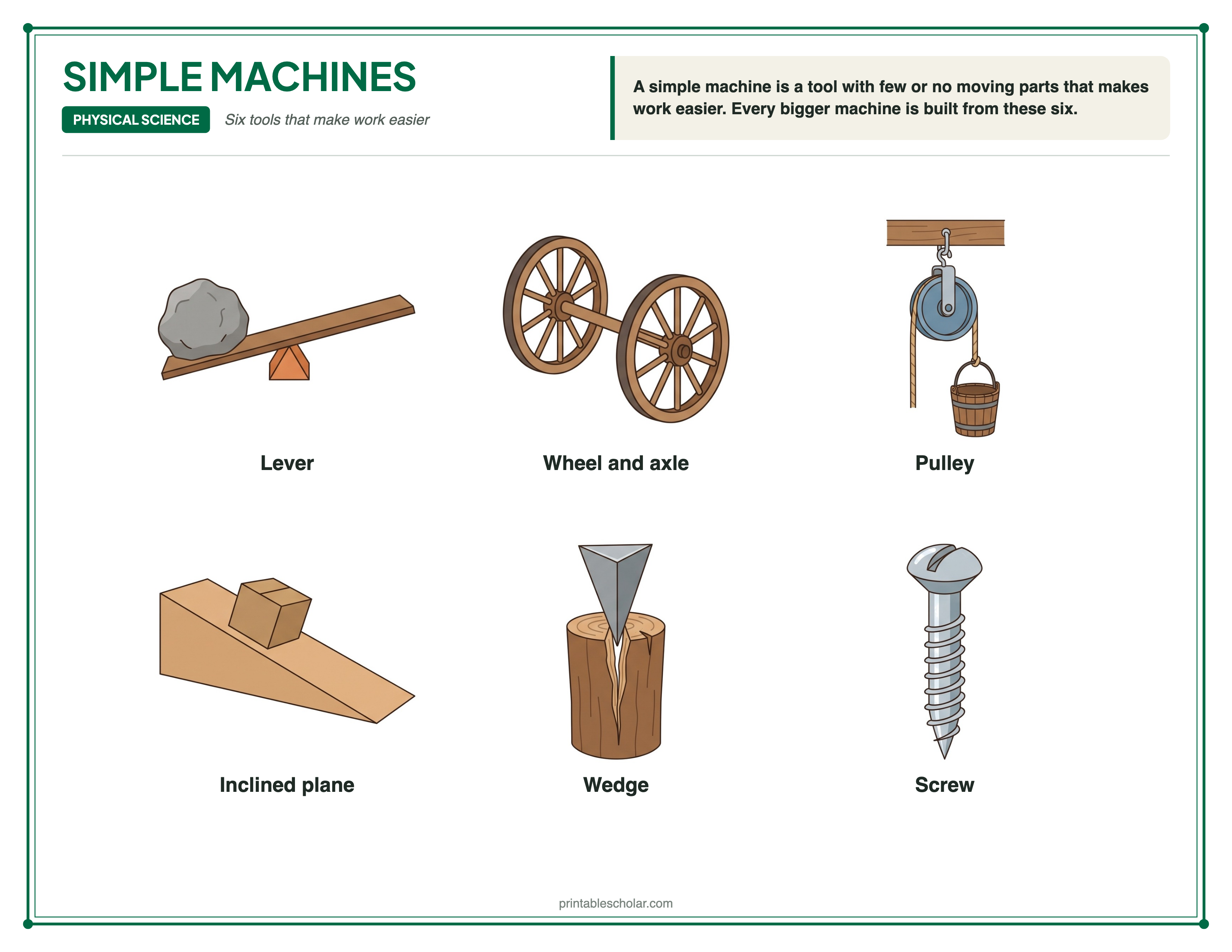
Free printable simple machines diagram — the six simple machines (lever, wheel and axle, pulley, inclined plane, wedge and screw) shown and labeled. Download a high-resolution PDF or PNG for Letter paper.
Part of the Simple Machines teaching pack: 7 printables with answer keys. The diagram, the blank one to label and the reading passage are free.
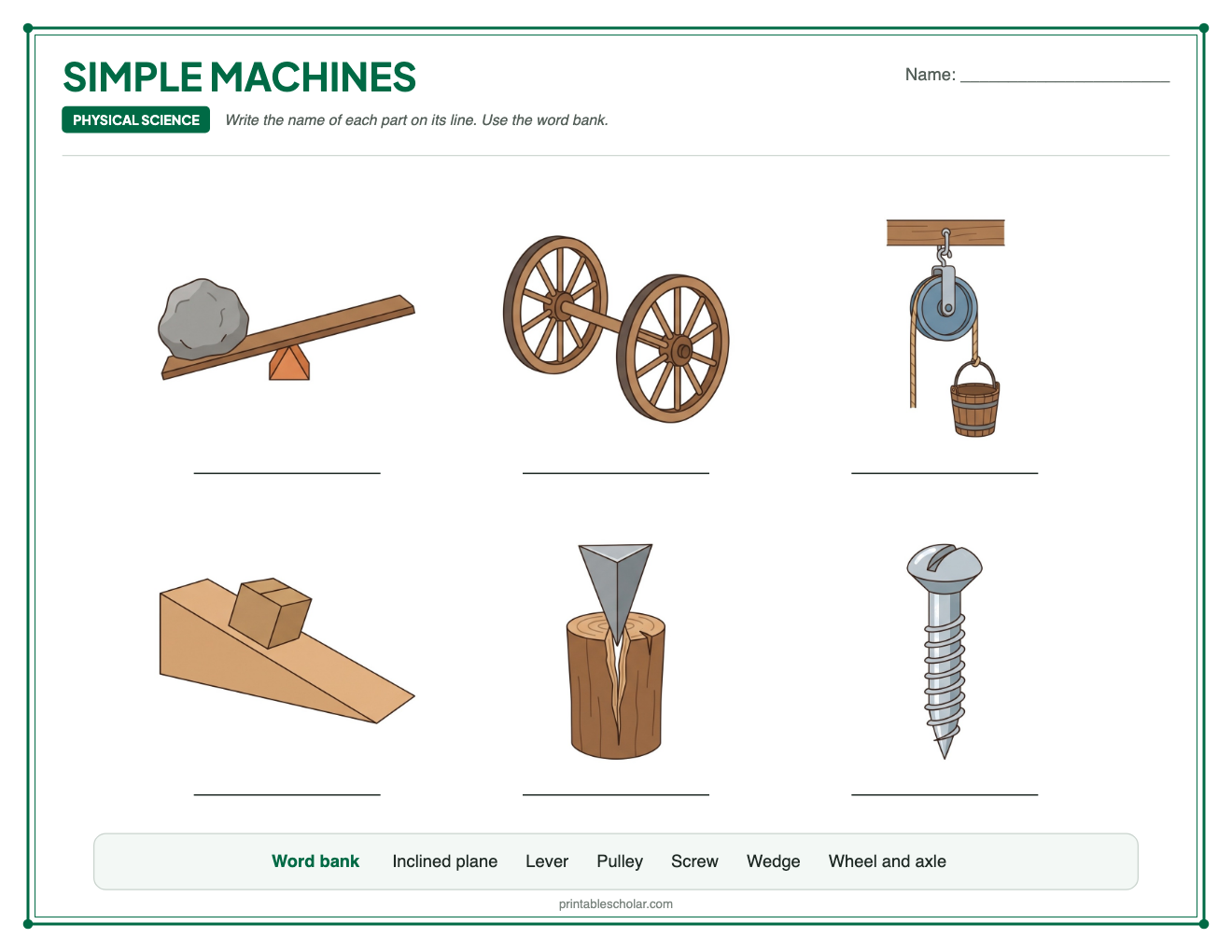
Blank diagram to label
Download blank version + answer key 6 blanks, a word bank, and the answer key on page 2Teaching ideas for Simple Machines
Pick the ideas that suit your class, then follow the plan or use the sheets in any order.
- Go on a machine hunt. Walk around the school. Students look for a ramp, a doorknob, a doorstop, a flagpole and a seesaw, and name the simple machine each one is.
- Lift with a ruler. Rest a ruler across a pencil and lift a small book with it. Slide the pencil closer to the book and students feel the push get easier.
- Wrap a ramp. Cut a paper triangle shaped like a ramp and wrap it around a pencil. The slanted edge winds up the pencil like the thread of a screw.
- Roll it up. Lean a board or a big book on a stack of books. Students push a toy car straight up the stack, then up the ramp, and compare.
- Open a jar. Pass around an empty plastic jar with a twist lid. Students find the spiral ridge and say which simple machine it is.
A plan for the week
| Day 1 | Open with one of the ideas above. Teach the six simple machines from the labeled diagram, then students label the blank one. | Simple Machines Diagram Blank Simple Machines |
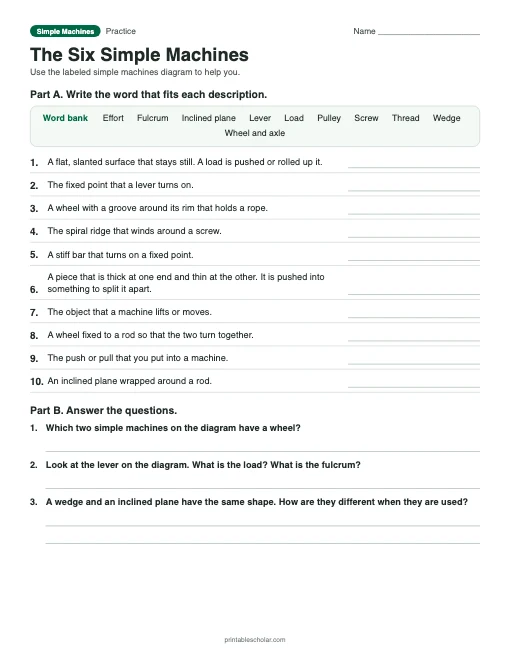
| Day 2 | Students match the machines and key words to their descriptions on “The Six Simple Machines.” | The Six Simple Machines (in the pack) |
| Day 3 | Read “Six Machines That Make Work Easier” and answer the questions. | Six Machines That Make Work Easier |
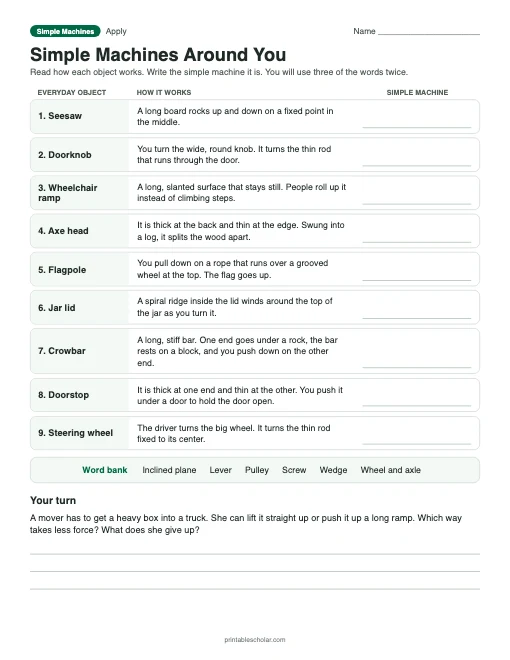
| Day 4 | Students name the simple machine in nine everyday objects on “Simple Machines Around You.” | Simple Machines Around You (in the pack) |
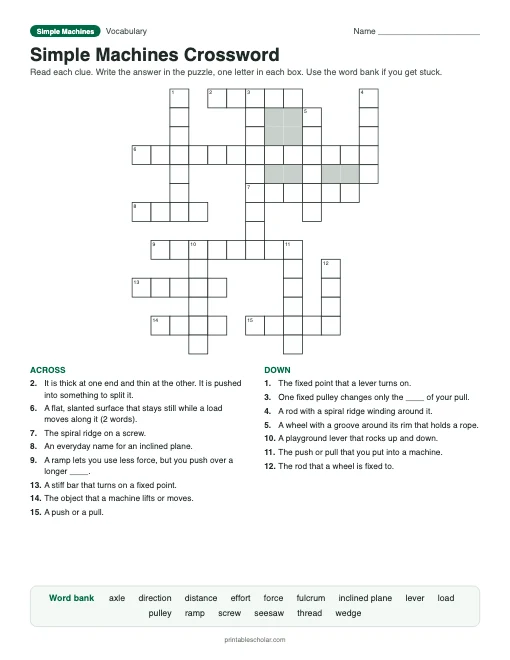
| Day 5 | Review with the crossword, then give the quiz. | Simple Machines Crossword (in the pack) Simple Machines Quiz (in the pack) |
The sheets marked “in the pack” are in the Simple Machines teaching pack below.
Simple Machines teaching pack
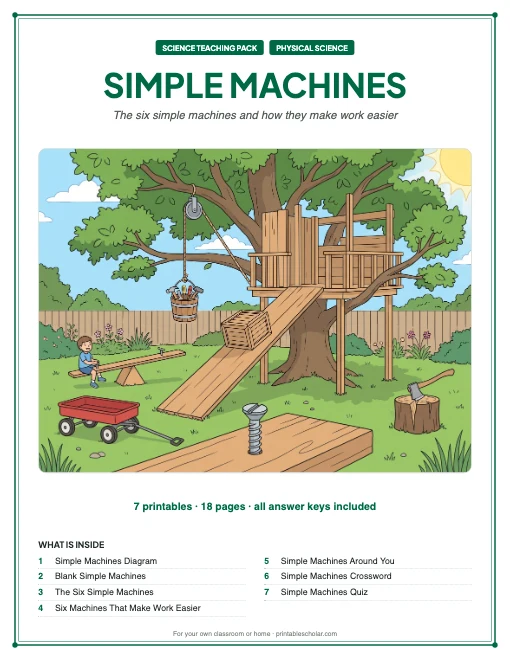
Teaching simple machines? This pack has 7 printables that cover the whole topic, in teaching order, with every answer key.
Free on this page: 3 of the 7 printables, marked Download below. The whole pack (18 pages in one print-ready file, with the practice sheets, the crossword, the quiz and every answer key) comes in the Physical Science bundle.
7 teaching packs, 131 pages, every answer key. One-time purchase. Instant download. Secure checkout by Stripe. Want to see a whole pack first? The Parts of an Atom pack is free.What is in the pack, in teaching order
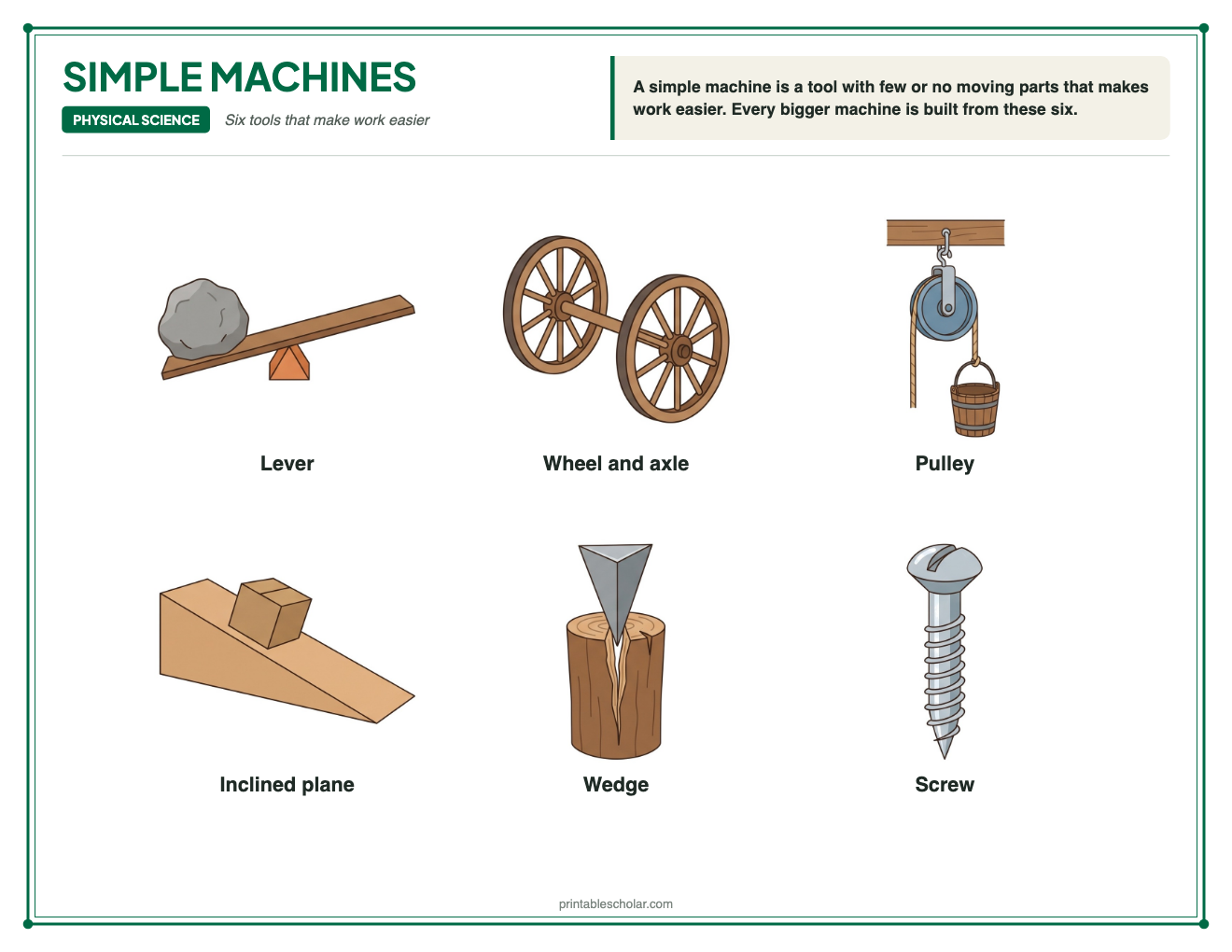 1. TeachSimple Machines DiagramThe labeled diagram, 6 machines.Download PDF
2. LabelBlank Simple MachinesStudents label 6 machines from a word bank.Download PDF
1. TeachSimple Machines DiagramThe labeled diagram, 6 machines.Download PDF
2. LabelBlank Simple MachinesStudents label 6 machines from a word bank.Download PDF
 In the bundle
3. MatchThe Six Simple MachinesMatch the 6 simple machines and 4 key words to their descriptions, then answer three questions.Get the bundle · $14
In the bundle
3. MatchThe Six Simple MachinesMatch the 6 simple machines and 4 key words to their descriptions, then answer three questions.Get the bundle · $14
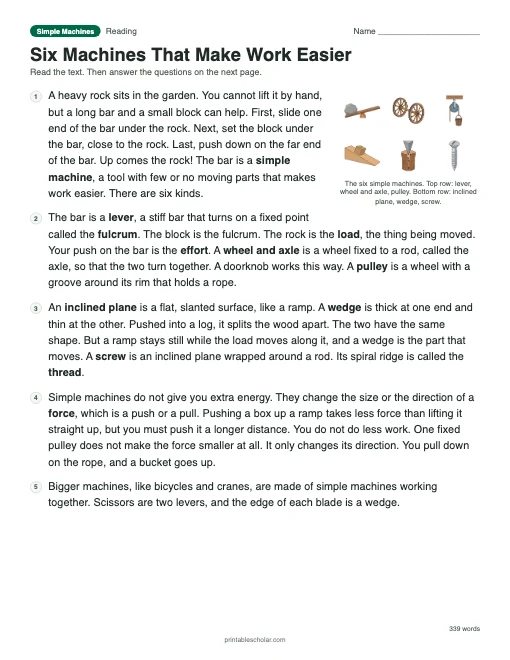 4. ReadSix Machines That Make Work EasierA one-page text on the six simple machines and how they make work easier, with eight questions.Download PDF
 In the bundle
5. ApplySimple Machines Around YouRead how nine everyday objects work and name the simple machine each one is.Get the bundle · $14
In the bundle
5. ApplySimple Machines Around YouRead how nine everyday objects work and name the simple machine each one is.Get the bundle · $14
 In the bundle
6. ReviewSimple Machines CrosswordFifteen simple machine words with clues and a word bank.Get the bundle · $14
In the bundle
6. ReviewSimple Machines CrosswordFifteen simple machine words with clues and a word bank.Get the bundle · $14
 In the bundle
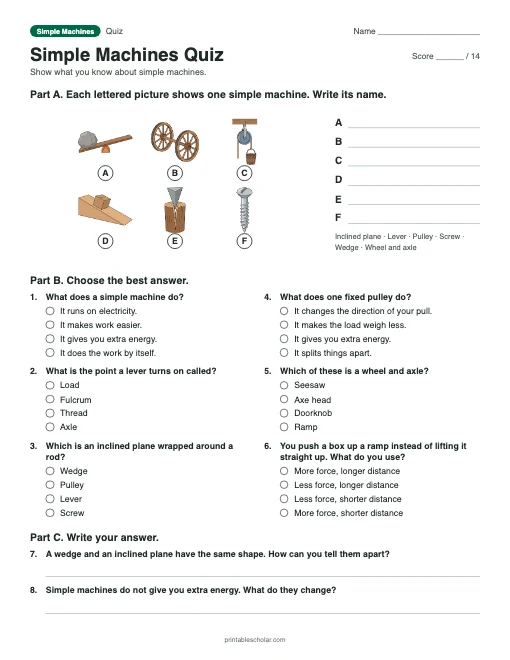
7. CheckSimple Machines QuizName the six simple machines from their pictures, six multiple choice and two written answers. Scored out of 14.Get the bundle · $14
In the bundle
7. CheckSimple Machines QuizName the six simple machines from their pictures, six multiple choice and two written answers. Scored out of 14.Get the bundle · $14
A simple machine does not give you extra energy. It changes the push or pull you put in: it can make the force bigger, change its direction, or spread the job over a longer distance. That trade is the big idea. A ramp lets you lift a heavy box with a small push, but you have to push it farther. Scissors, bikes, cranes and can openers are all made of simple machines working together.
The six simple machines
A simple machine is a tool with few or no moving parts that makes work easier. There are six of them, and every bigger machine is built from these six. Here is what happens at each labeled part of the diagram:
| Machine | What it does | Why it matters |
|---|---|---|
| Lever | A stiff bar that turns on a fixed point called the fulcrum. Push down on one end and the other end lifts a load. | The farther from the fulcrum you push, the less force you need. That is why a long crowbar can lift a rock you could never pick up by hand. Seesaws, bottle openers and wheelbarrows are all levers. |
| Wheel and axle | A wheel fixed to a rod, called the axle, so that the two turn together. | A small turning force on the big wheel becomes a strong turning force on the thin axle. A doorknob, a steering wheel and a screwdriver all work this way. Try opening a door by twisting the bare rod and you will see how much the knob helps. |
| Pulley | A wheel with a groove around its rim that holds a rope. Pull down on the rope and the load goes up. | One fixed pulley changes the direction of your pull, so you can use your body weight to raise a flag or a bucket. Several pulleys used together also cut the force you need, which is how a crane lifts a steel beam. |
| Inclined plane | A flat, slanted surface, like a ramp. It lets you raise a load a little at a time. | Pushing a load up a ramp takes less force than lifting it straight up, but you move it a longer distance. Wheelchair ramps, slides and winding mountain roads are inclined planes. |
| Wedge | A piece that is thick at one end and thin at the other. Pushed into something, it splits it apart. | A wedge turns a push on its thick end into a sideways push that forces things apart. An axe head, a knife blade, a doorstop and your front teeth are all wedges. |
| Screw | An inclined plane wrapped around a rod. The spiral ridge is called the thread. | Each turn moves the screw only a short way in, with a lot of force, so it holds things together tightly. Jar lids, bolts, light bulbs and drill bits all use a screw thread. |
How to print
Choose Download PDF for a ready-to-print file that fits US Letter paper (8.5 × 11") in landscape, or Download PNG for the high-resolution image.
Frequently asked questions
What are the six simple machines?
The lever, the wheel and axle, the pulley, the inclined plane, the wedge and the screw.
How do simple machines make work easier?
They change the size or the direction of a force. Most of them let you use a smaller force over a longer distance, so the job feels easier even though the total work is the same.
What is the difference between a wedge and an inclined plane?
They have the same shape, but an inclined plane stays still while a load moves along it, and a wedge is the part that moves, pushing into something to split or hold it.
What paper size should I print this on?
The diagram is sized for standard US Letter paper (8.5 × 11") in landscape orientation. Use "Download PDF" for a print-ready file that fits the page automatically.