 Printable Scholar
Weathering, Erosion and Deposition
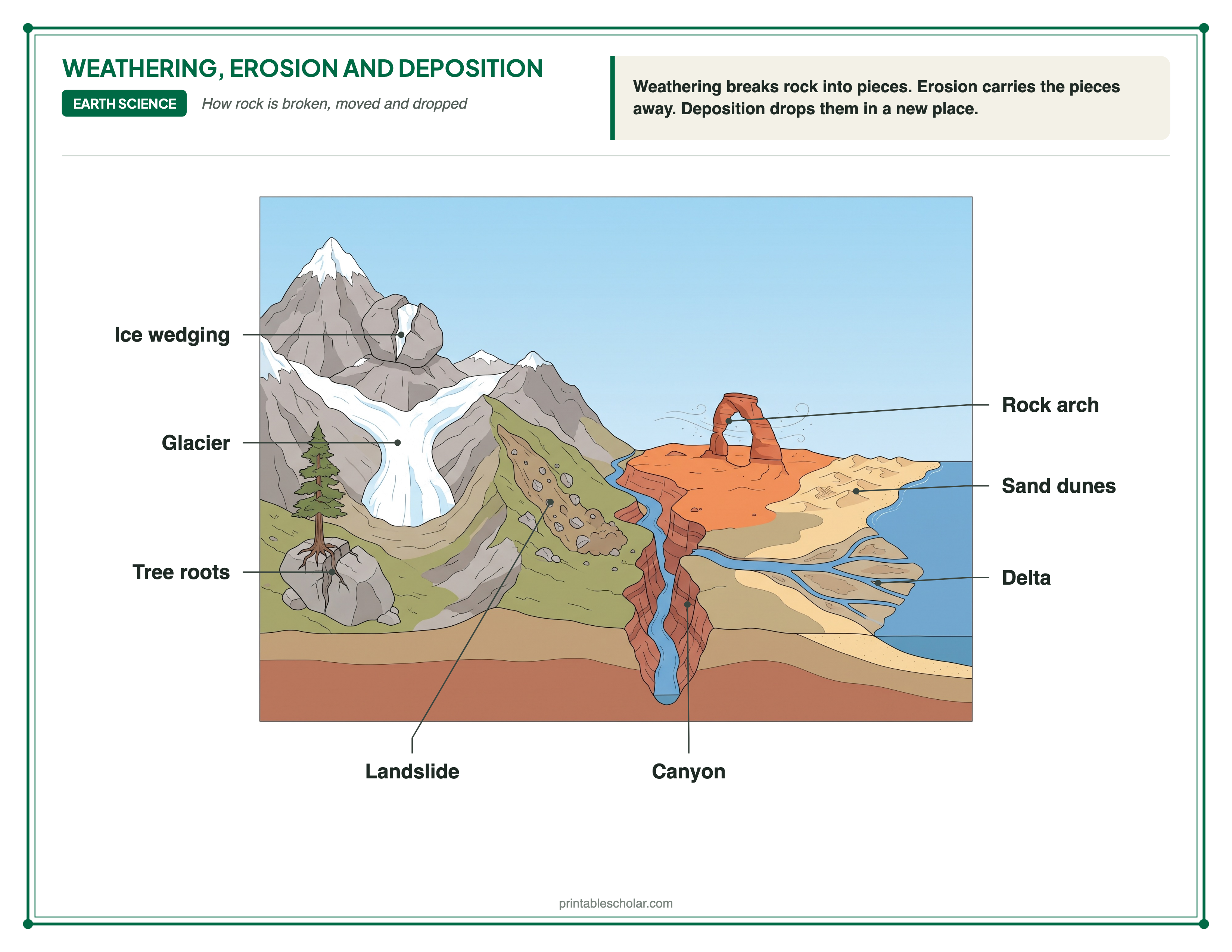
Free printable weathering, erosion and deposition diagram: one landscape from the mountains to the sea showing how rock is broken down, carried away and dropped, labeled, plus a blank diagram to label. Download a high-resolution PDF or PNG for Letter paper.
Part of the Weathering, Erosion and Deposition teaching pack for grades 4 to 6: 24 lesson slides and 8 printables with answer keys. The diagram and the blank one to label are free.
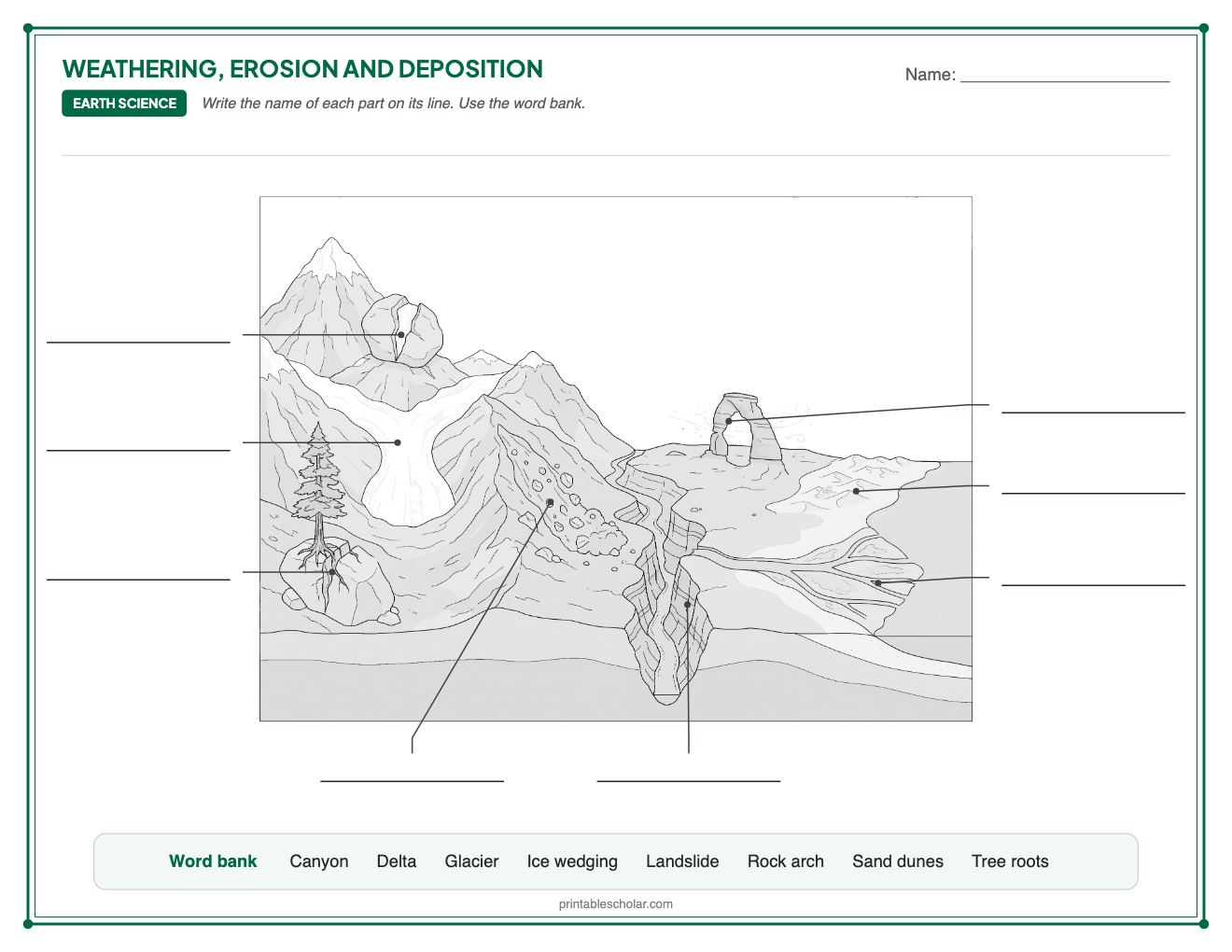
Blank diagram to label
Download blank version + answer key 8 blanks, a word bank, and the answer key on page 2Teaching ideas for Weathering, Erosion and Deposition
Pick the ideas that suit your class, then follow the plan or use the sheets in any order.
- Shake sugar cubes. Put a few sugar cubes in a plastic jar with a lid. Students take turns shaking it, then look at the rounded cubes and loose grains, like rock broken by weathering.
- Sand and water tray. Pile damp sand at one end of a tray to make a slope. Pour a cup of water down it. The water carries sand away and drops it where it slows down.
- Crack hunt. Walk around the school grounds looking for cracked sidewalks with plants growing in them and soil washed onto paths. Students decide which show weathering, erosion or deposition.
A plan for the week
| Day 1 | Open with one of the ideas above. Teach the lesson with the slides while students fill in the guided notes. Then students label the blank diagram. | Lesson slides (PowerPoint) (in the pack) Weathering, Erosion and Deposition Guided Notes (in the pack) Weathering, Erosion and Deposition Diagram Blank Weathering, Erosion and Deposition |
| Day 2 | Students match each feature to its description on “Shaping the Land” and answer the questions. | Shaping the Land (in the pack) |
| Day 3 | Read “Broken, Moved and Dropped” and answer the questions. | Broken, Moved and Dropped (in the pack) |
| Day 4 | Students read what is happening in ten examples on “Sort the Processes” and sort each one into weathering, erosion or deposition. | Sort the Processes (in the pack) |
| Day 5 | Review with the crossword, then give the quiz. | Weathering, Erosion and Deposition Crossword (in the pack) Weathering, Erosion and Deposition Quiz (in the pack) |
The sheets marked “in the pack” are in the Weathering, Erosion and Deposition teaching pack below.
NGSS standards
- Supports 4-ESS2-1: Make observations and/or measurements to provide evidence of the effects of weathering or the rate of erosion by water, ice, wind, or vegetation.
- Supports MS-ESS2-2: Construct an explanation based on evidence for how geoscience processes have changed Earth's surface at varying time and spatial scales.
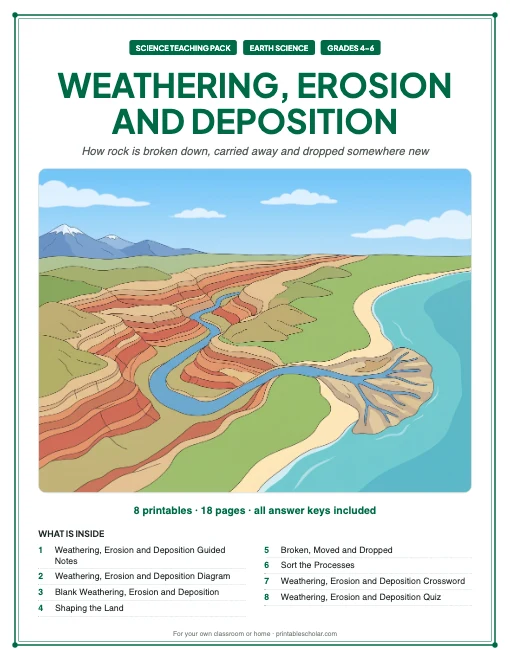
Weathering, Erosion and Deposition teaching pack
Teaching weathering, erosion and deposition? This pack has ready-made lesson slides and 8 printables that cover how rock is broken, moved and dropped, in teaching order, with every answer key.
Free on this page: 2 of the 9 printables, marked Download below. The whole pack is $7: 18 pages in one print-ready file, the 24 lesson slides, the practice sheets, the crossword, the quiz and every answer key.
One-time purchase. Instant download. Secure checkout by Stripe. Want to see a whole pack first? The Inside the Earth and Volcanoes pack is free.See all 27 packs in the bundle
- The Microscope
- Photosynthesis
- Parts of a Plant and Flower
- Life Cycle of a Plant
- Life Cycles of a Butterfly and a Frog
- Food Chains and Food Webs
- The Water Cycle
- Skeletal System
- Muscular System
- Digestive System
- Respiratory System
- Heart and Circulation
- Nervous System and Brain
- Eye and Ear
- Inside the Earth and Volcanoes
- Rocks and the Rock Cycle
- Layers of the Atmosphere
- Types of Clouds
- Weathering, Erosion and Deposition (this pack)
- Types of Landforms
- The Solar System
- The Seasons
- Moon Phases and Eclipses
- States of Matter
- Forms of Energy
- Simple Machines
- Magnets and Magnetic Fields
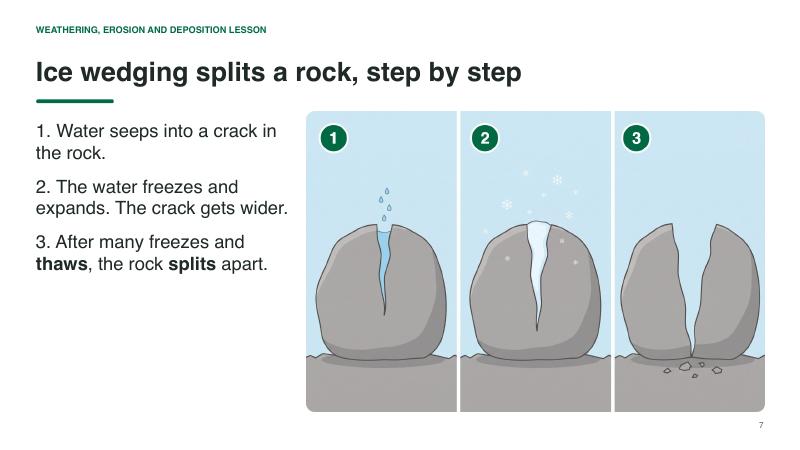
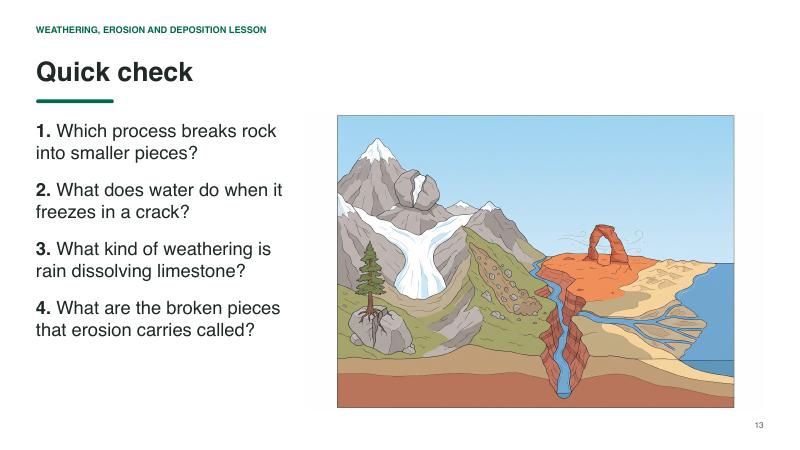
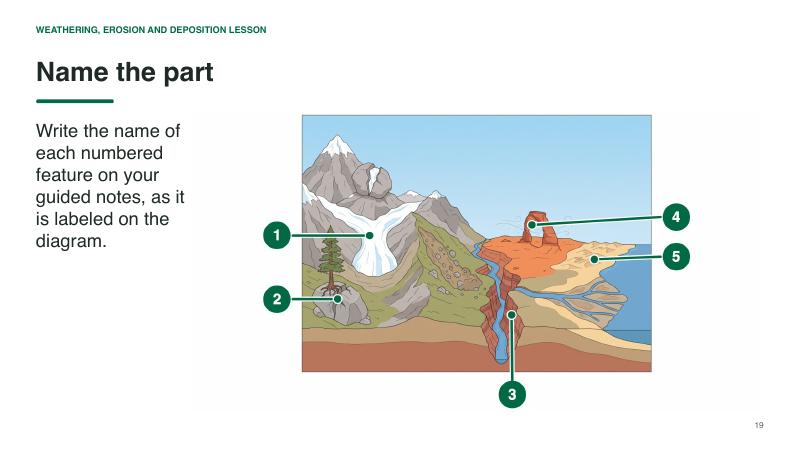
Teach Weathering, Erosion and Deposition with 24 ready-made slides
Open the PowerPoint and teach: an opening question, the parts one at a time on the diagram, quick checks and an exit question. Your notes for each slide are in the speaker notes. Students fill in the guided notes sheet as you go.
The slides (PowerPoint and a PDF copy) and the guided notes sheet come with the pack.What is in the pack, in teaching order
In the pack
1. TeachLesson Slides24 slides to present, with your notes for each one.In the $7 pack
 In the pack
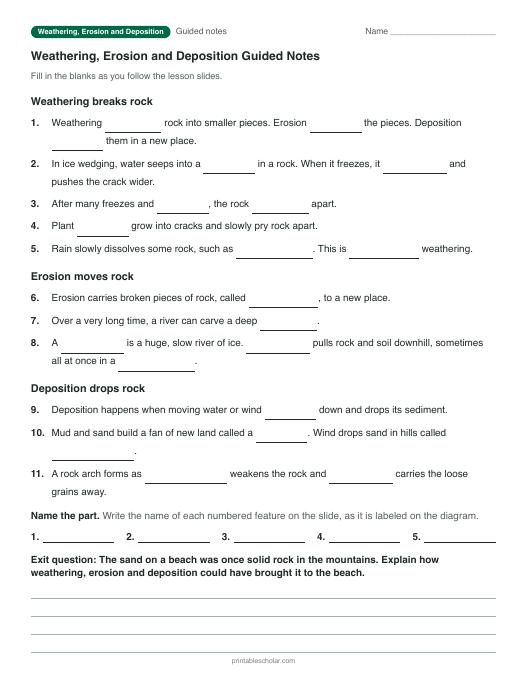
1. TeachWeathering, Erosion and Deposition Guided NotesStudents fill in the blanks as you present. With answer key.In the $7 pack
 Free
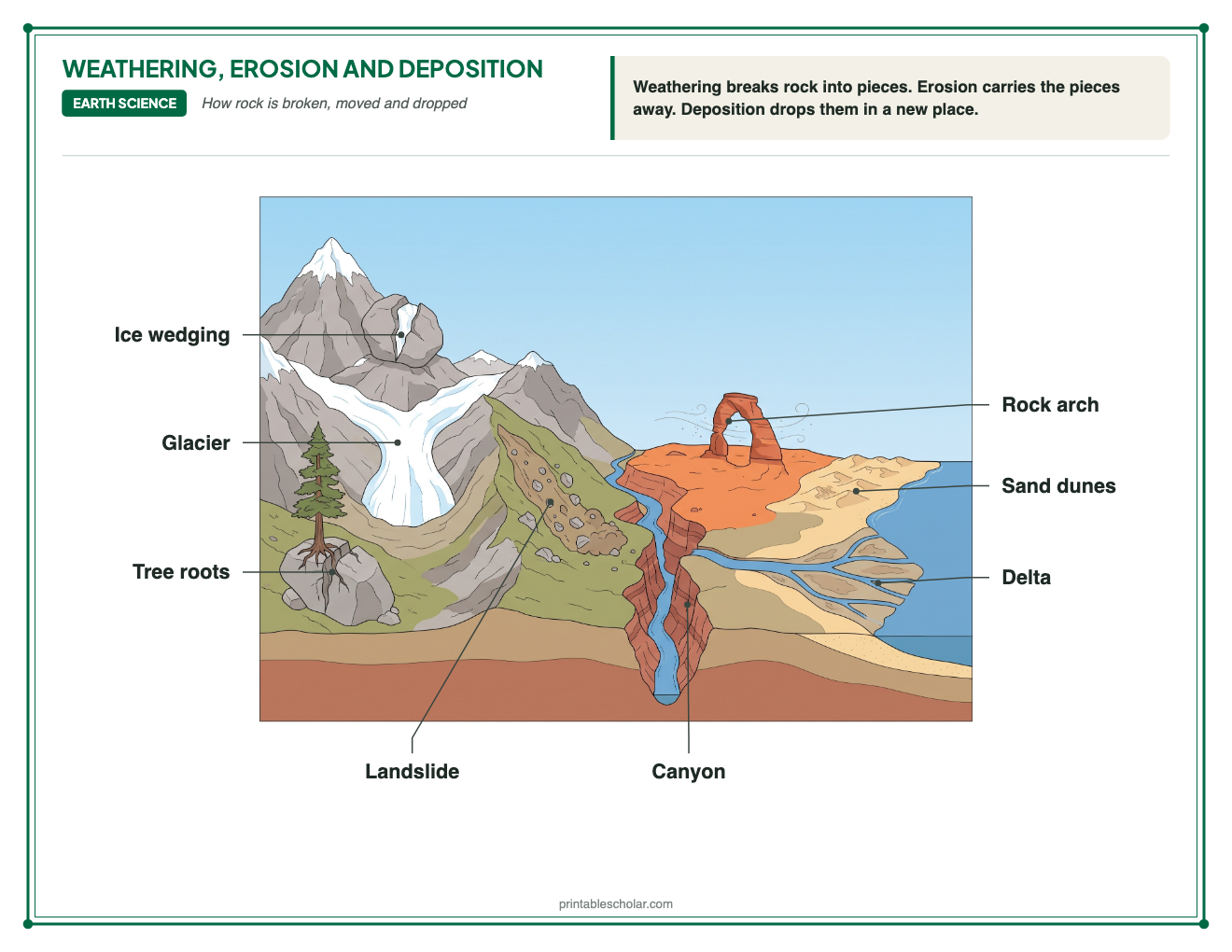
1. TeachWeathering, Erosion and Deposition DiagramThe labeled diagram, 8 features.Download free PDF
Free
2. LabelBlank Weathering, Erosion and DepositionStudents label 8 features from a word bank.Download free PDF
 In the pack
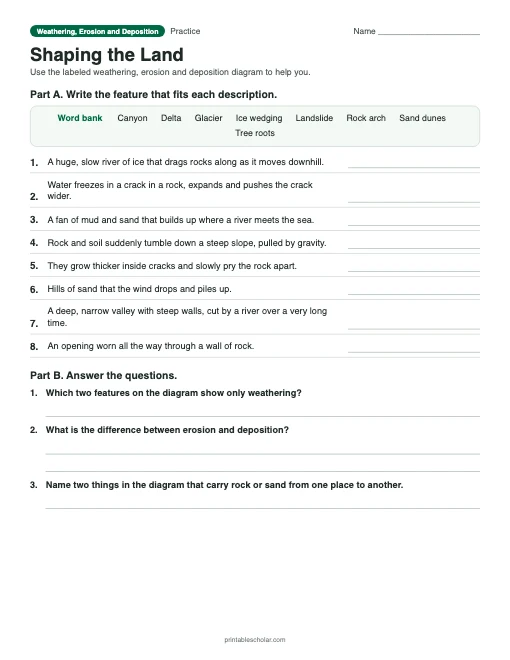
3. MatchShaping the LandMatch the 8 features on the diagram to their descriptions, then answer three questions.In the $7 pack
 In the pack
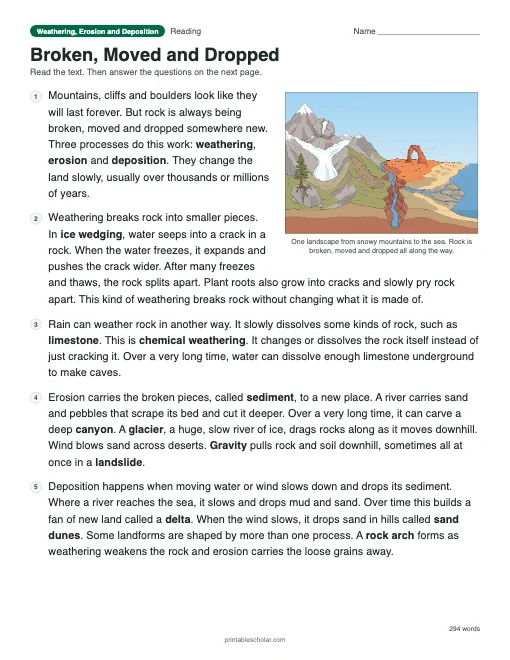
4. ReadBroken, Moved and DroppedA one-page text on how weathering, erosion and deposition break, move and drop rock, with eight questions.In the $7 pack
 In the pack
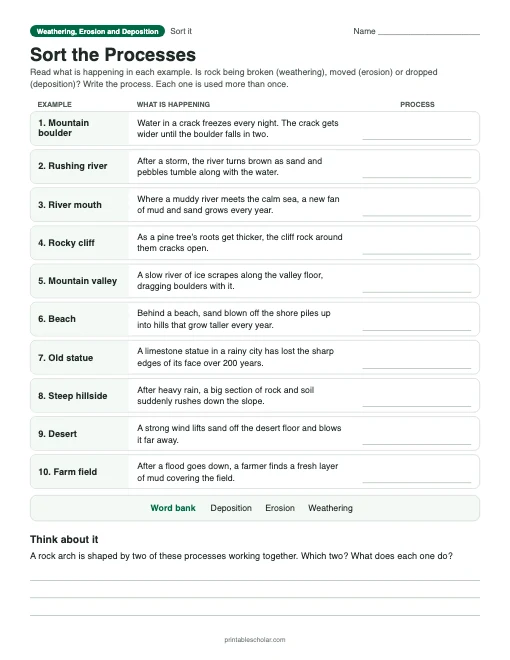
5. SortSort the ProcessesRead ten real-world scenes and sort each one into weathering, erosion or deposition.In the $7 pack
 In the pack
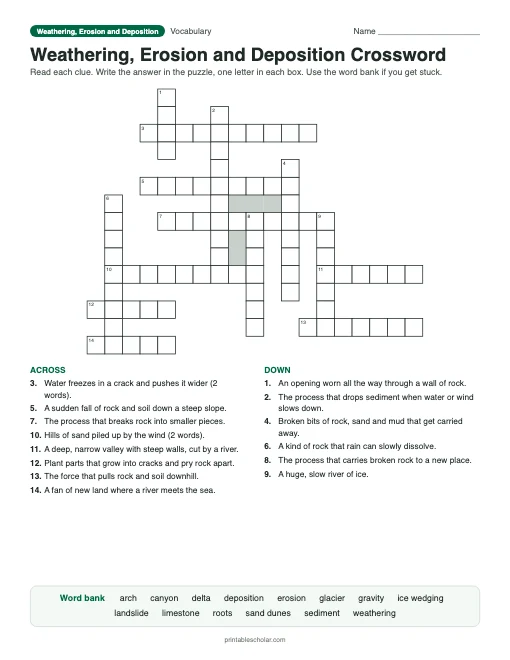
6. ReviewWeathering, Erosion and Deposition CrosswordFourteen weathering, erosion and deposition words with clues and a word bank.In the $7 pack
 In the pack
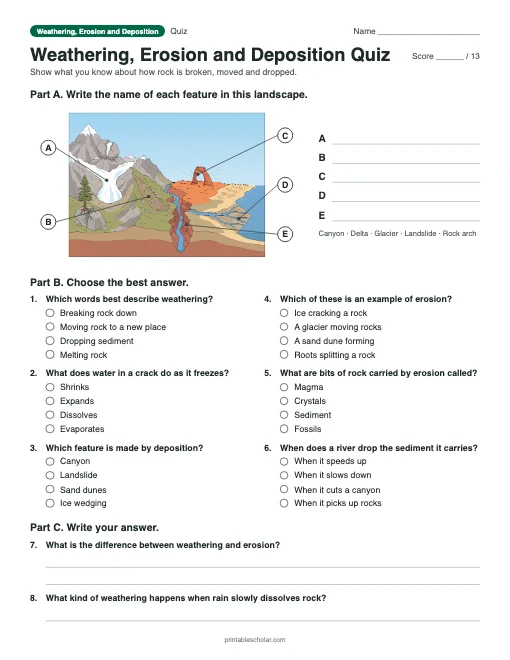
7. CheckWeathering, Erosion and Deposition QuizLabel five features, six multiple choice and two written answers. Scored out of 13.In the $7 pack
Weathering, Erosion and Deposition worksheets, crossword and quiz
The Weathering, Erosion and Deposition teaching pack is 24 lesson slides (PowerPoint and PDF) and 8 printables with answer keys for grades 4 to 6, in the order you would teach them: the guided notes for the lesson slides, the labeled diagram and the blank one to label, then “Shaping the Land” (a worksheet), “Broken, Moved and Dropped” (a reading passage), “Sort the Processes” (a sorting table), a vocabulary crossword and a quiz.
The sheets are in a suggested teaching order: teach the lesson, have students label the blank diagram, then work through the practice sheets and finish with the quiz. Use them all over a week or pick the ones you need. The answer keys are together at the back.
The diagram and the blank one to label are free to download on this page. The other sheets come with the pack ($7), which is also in the Elementary Science bundle (grades 3 to 6).
Rock looks permanent, but it is always being worn down and moved. Weathering is the breaking: water freezing in cracks, plant roots growing, and rain slowly dissolving some kinds of rock. Erosion is the moving: rivers, glaciers, wind, waves and gravity carry the broken pieces, called sediment, from one place to another. Deposition is the dropping: when the water or wind slows down, it lets go of its sediment, which piles up as deltas, beaches and sand dunes. Together these three processes carve canyons and valleys and build up new land, usually far too slowly to watch, over thousands to millions of years.
Weathering, erosion and deposition in one landscape
Weathering breaks rock into smaller pieces. Erosion carries the pieces away. Deposition drops them somewhere new. All three are slowly reshaping the land around you. Here is what happens at each labeled part of the diagram:
| Feature | What it does | Why it matters |
|---|---|---|
| Ice wedging | Water seeps into a crack in a rock, freezes and expands, and pushes the crack wider. This is weathering. | Water takes up more space when it freezes. When it thaws and freezes again and again, the crack grows a little each time until the rock splits apart. It happens most in places that freeze at night and thaw in the day, like high mountains. |
| Tree roots | Roots grow into cracks in rock and slowly pry the rock apart. This is weathering. | As a root grows thicker, it pushes on the sides of the crack. Over many years, roots can split boulders and lift sidewalks. Small plants, mosses and lichens weather rock too. |
| Glacier | A huge, slow river of ice that scrapes and carries rock as it moves downhill. This is erosion. | A glacier picks up rocks and drags them along its bottom like sandpaper. Glaciers carve wide valleys with steep sides and a rounded floor, shaped like the letter U. |
| Landslide | A sudden fall of rock and soil down a steep slope, pulled by gravity. This is erosion. | Heavy rain, earthquakes and loose soil on steep slopes can set off a landslide. Gravity also moves soil slowly downhill all the time, too slowly to see. |
| Canyon | A deep, narrow valley with steep sides, carved by a river over a very long time. Erosion does most of the carving. | Running water carries sand and pebbles that scrape the riverbed and cut it deeper, year after year. Weathering loosens rock on the steep walls, and the river carries it away. The Grand Canyon in Arizona was carved by the Colorado River and is about a mile deep. |
| Rock arch | An opening worn through a wall of rock. Weathering and erosion by water, ice and wind shape it. | Rain and frost weaken the rock, and wind and water carry the loose grains away. Arches National Park in Utah has more than 2,000 natural stone arches. |
| Sand dunes | Hills of sand piled up by the wind. They are made by deposition. | When the wind slows down, it drops the sand it was carrying. Dunes form in deserts and along beaches, and they slowly creep in the direction the wind blows. |
| Delta | A fan of mud and sand where a river slows down and meets a lake or the sea. It is made by deposition. | A fast river can carry a lot of sediment. When it reaches still water it slows down and drops its load, building new land. The Mississippi River delta in Louisiana is a famous example. |
How to print
Choose Download PDF for a ready-to-print file that fits US Letter paper (8.5 × 11") in landscape, or Download PNG for the high-resolution image.
Frequently asked questions
What is the difference between weathering and erosion?
Weathering breaks rock into smaller pieces where it is. Erosion moves those pieces somewhere else, carried by water, ice, wind or gravity.
What is deposition?
Deposition is when moving water, wind or ice slows down and drops the sediment it was carrying. Deltas, beaches and sand dunes are made by deposition.
What causes weathering?
Water freezing in cracks, growing plant roots, changes in temperature, and rainwater that slowly dissolves or changes some kinds of rock.
What paper size should I print this on?
The diagram is sized for standard US Letter paper (8.5 × 11") in landscape orientation. Use "Download PDF" for a print-ready file that fits the page automatically.
Are there Weathering, Erosion and Deposition worksheets to go with the diagram?
Yes. The Weathering, Erosion and Deposition teaching pack, for grades 4 to 6, has 24 lesson slides and 8 printables with answer keys: the guided notes for the lesson slides, the labeled diagram and the blank one to label, then “Shaping the Land” (a worksheet), “Broken, Moved and Dropped” (a reading passage), “Sort the Processes” (a sorting table), a vocabulary crossword and a quiz. The diagram and the blank one to label are free to download on this page. The other sheets come with the pack ($7), which is also in the Elementary Science bundle (grades 3 to 6).