Water Cycle Diagram
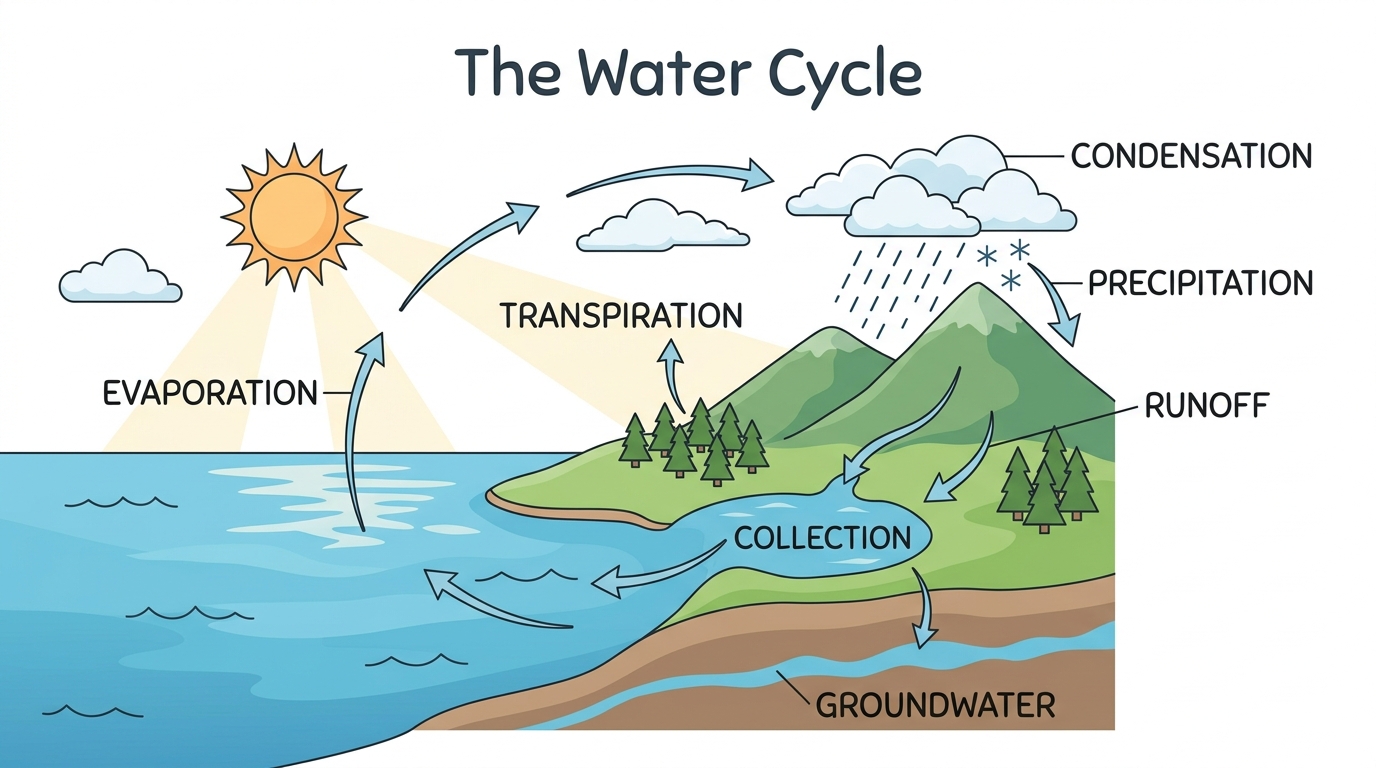
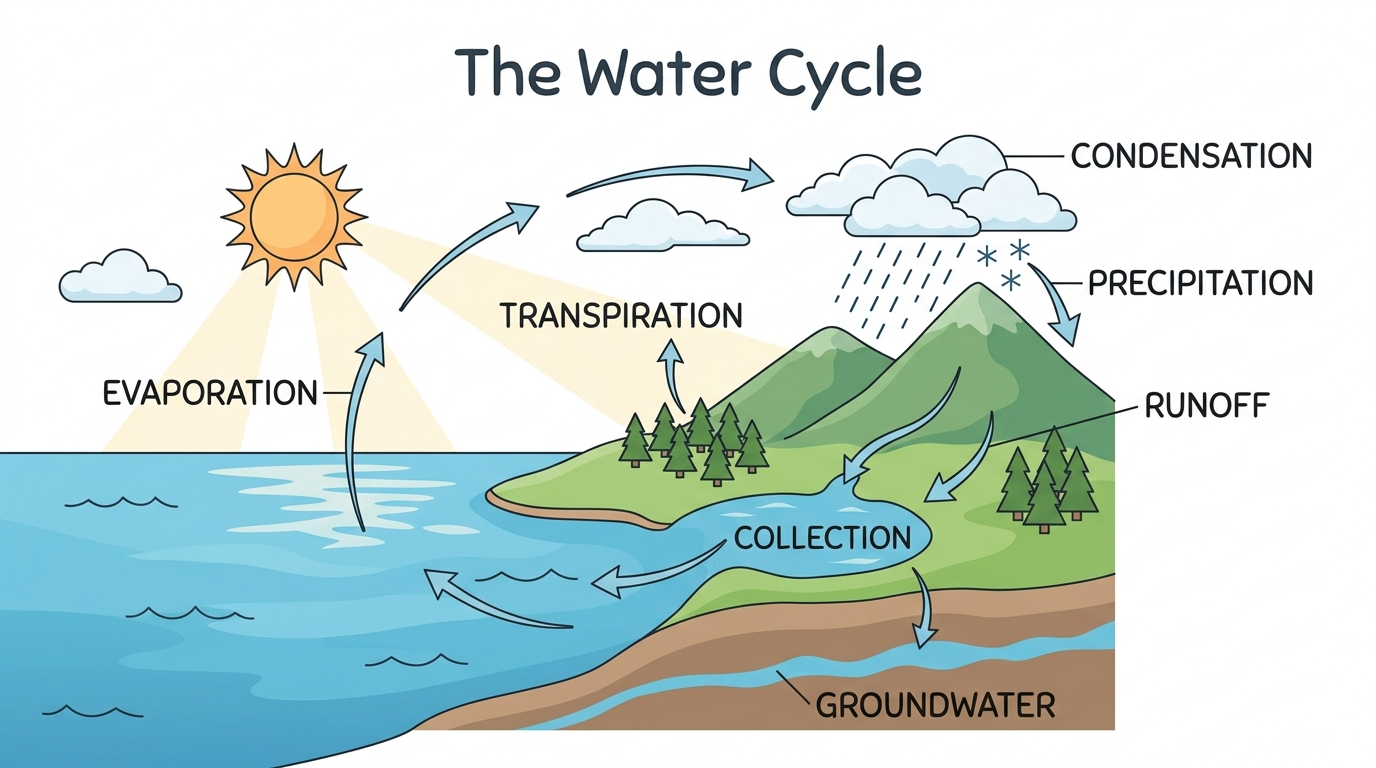
Free printable water cycle diagram showing evaporation, condensation, precipitation, collection and more — with labels and flow arrows. Download a high-resolution PDF or PNG for Letter paper.
The water cycle, stage by stage
The water cycle is the continuous journey water takes between the oceans, the air and the land. Here is what happens at each labeled part of the diagram:
| Stage | What it does | Why it matters |
|---|---|---|
| Evaporation | The sun heats water in oceans, lakes and rivers and turns it into invisible water vapor that rises into the air. | This is the engine that lifts water off the surface and gets the whole cycle moving — without it, all the planet's water would collect in the oceans and never return to land. The sun evaporates roughly 1.4 billion cubic kilometres of water from Earth's surface every year, quietly powering every rainstorm and river on the planet. |
| Transpiration | Plants release water vapor into the air through their leaves. | A single large oak tree can release up to 150 litres of water vapour into the air on a hot day, and a whole forest contributes so much moisture that it can generate its own regional rainfall. Strip the trees away — as deforestation does — and local rainfall patterns can collapse, turning fertile land into scrub. |
| Condensation | High in the sky the vapor cools and turns into tiny droplets that form clouds. | Clouds are not just scenery — they are the reservoir stage of the cycle, holding water in suspension high above the ground until conditions are right to release it. Without condensation, water vapour would simply drift in the upper atmosphere and never come back down as usable fresh water. |
| Precipitation | When the droplets grow heavy enough, water falls back to Earth as rain, snow, sleet or hail. | Every drop of fresh water that fills a river, feeds a crop, or flows from your tap started as precipitation — it is the only delivery mechanism the cycle has for returning ocean water to the land. A failure in precipitation, even for a single growing season, is enough to trigger famine across entire regions. |
| Collection | The fallen water gathers in oceans, lakes, rivers and streams. | Oceans, lakes and rivers act as the cycle's storage tanks, holding water long enough for the sun to start evaporating it again. About 96.5 percent of all the water on Earth sits in the oceans, making them by far the most important starting point for the next cycle. |
| Runoff | Water flows downhill across the land into rivers, lakes and the ocean. | Runoff is what carves valleys and canyons over millions of years — the Grand Canyon exists entirely because water kept flowing downhill across the same landscape. It also carries dissolved minerals from the land into the sea, which is why ocean water is salty and river water is not. |
| Groundwater | Some water soaks into the soil and is stored underground. | About two billion people rely on groundwater drawn from underground aquifers as their primary drinking source, yet these reserves can take thousands of years to refill once emptied. When we pump groundwater faster than rain can replenish it — which is happening in many farming regions right now — we are spending a savings account that nature took millennia to build. |
Companion worksheet
A free fill-in worksheet with an answer key, built from the labels above — students match each stage to its description, then answer a couple of short questions. Great for a quick check after using the diagram.
How to print
Choose Download PDF for a ready-to-print file that fits US Letter paper (8.5 × 11") in landscape, or Download PNG for the high-resolution image.
Frequently asked questions
What is the water cycle?
The water cycle is the continuous process by which water moves between the oceans, the air and the land — evaporating, condensing into clouds, falling as precipitation, and collecting again.
What are the stages of the water cycle?
The main stages are evaporation, transpiration, condensation, precipitation, collection, runoff and groundwater.
What paper size should I print this on?
The diagram is sized for standard US Letter paper (8.5 × 11") in landscape orientation. Use "Download PDF" for a print-ready file that fits the page automatically.