Layers of the Atmosphere
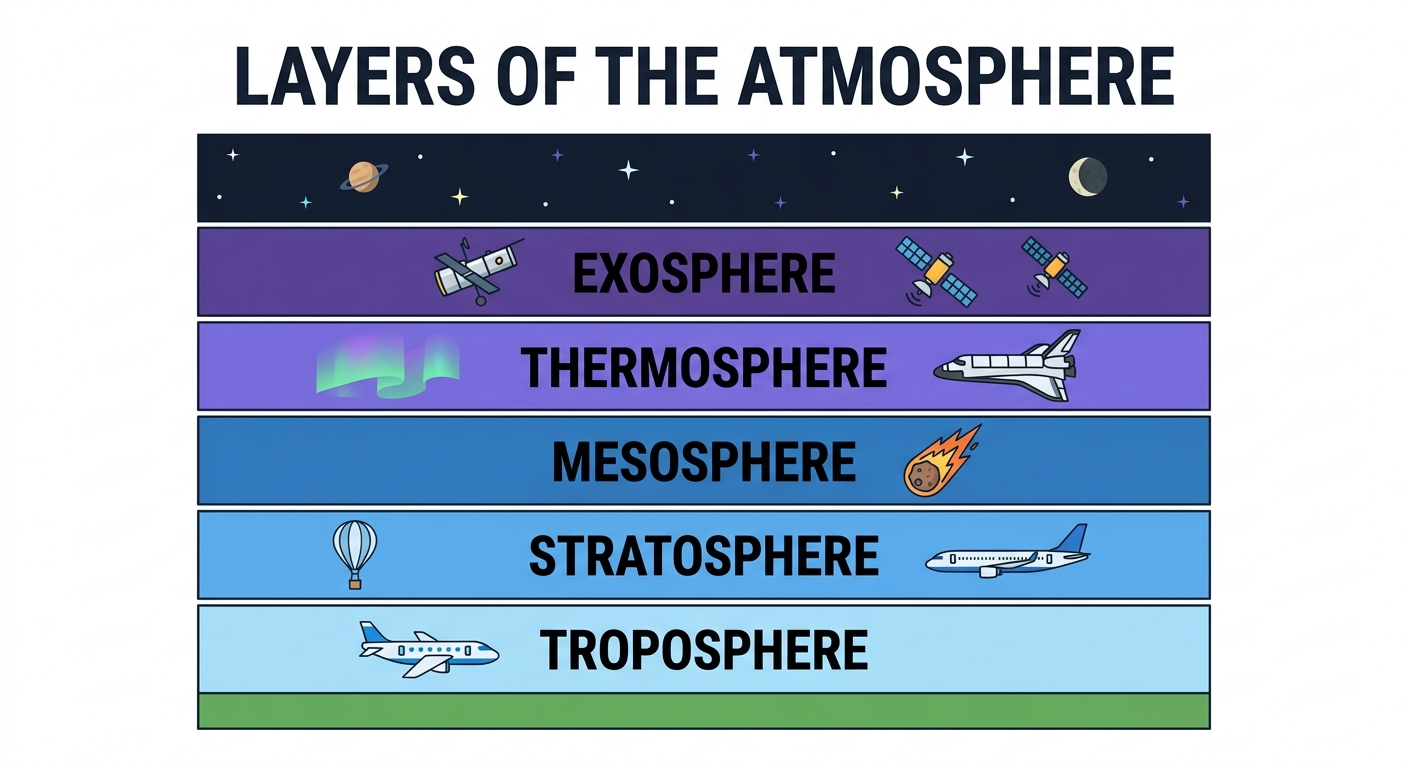
Free printable layers of the atmosphere diagram — the five layers from the troposphere to the exosphere, in order, each labeled. Download a high-resolution PDF or PNG for Letter paper.
Earth's atmosphere, layer by layer
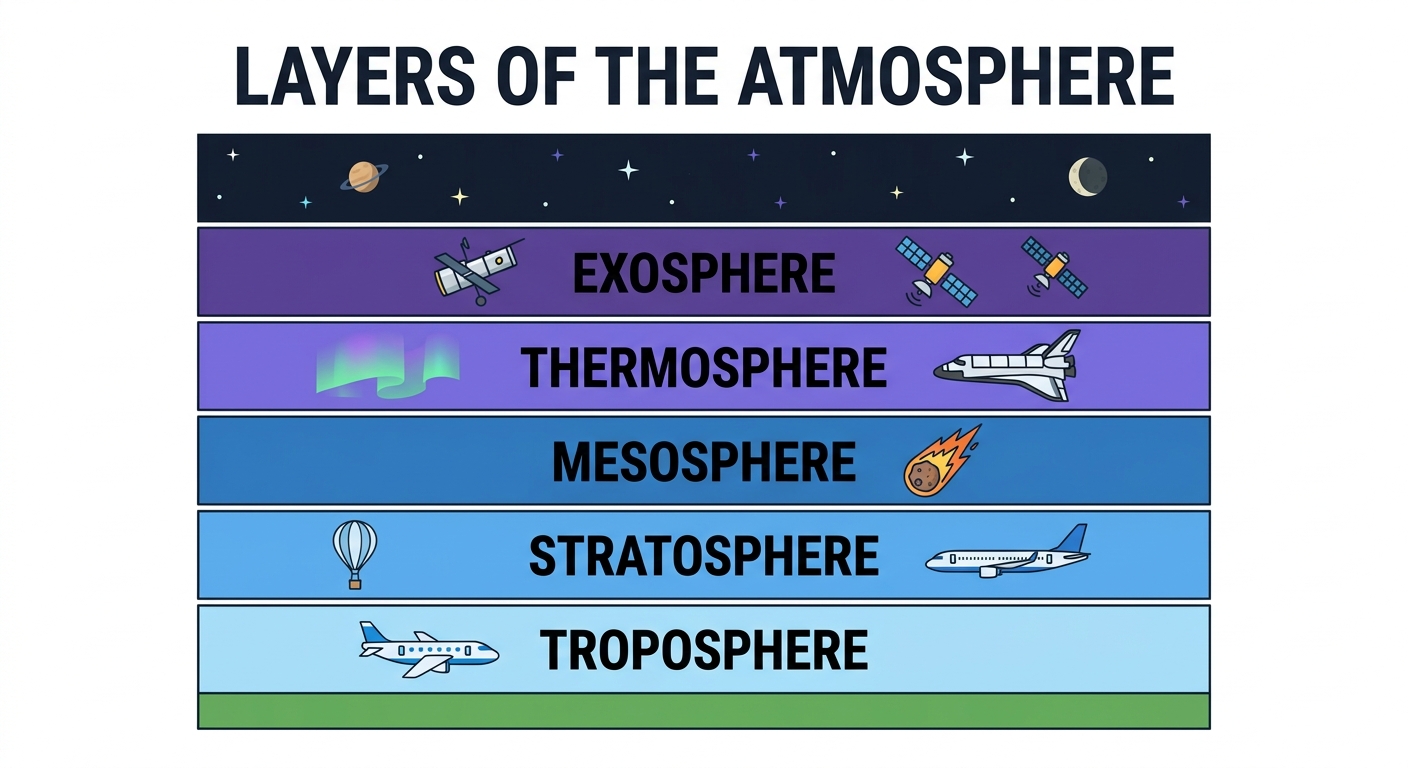
The Earth is wrapped in a blanket of air called the atmosphere. It is made of five layers, stacked from the ground all the way up to space. Here is what happens at each labeled part of the diagram:
| Layer | What it does | Why it matters |
|---|---|---|
| Troposphere | The bottom layer, where we live and where weather happens. Airplanes fly near the top of it. | Every cloud, storm, hurricane, and snowflake forms right here — without this layer, Earth would have no weather and no liquid water cycle to keep life going. It also contains about 75% of all the air in the atmosphere, so every breath you have ever taken came from this thin ribbon of sky. |
| Stratosphere | The next layer up, home to the ozone layer that blocks harmful rays from the Sun. | The ozone layer in this zone absorbs most of the Sun's ultraviolet radiation before it reaches you — without it, sunburns would be the least of your worries, since UV rays at full strength would damage DNA and make life on land nearly impossible. Jet aircraft fly near the boundary between the troposphere and stratosphere specifically to avoid turbulence while staying just beneath the ozone shield. |
| Mesosphere | The coldest layer, where most meteors burn up and become shooting stars. | Dozens of meteors streak into Earth's atmosphere every day, and almost all of them are incinerated right here before they can reach the ground — those brilliant shooting stars you wish on are actually rocks the size of a pea burning up at nearly 160,000 km/h. Without the mesosphere acting as a natural shield, far more space debris would survive the fall and bombard the surface. |
| Thermosphere | A very hot layer where the auroras glow and the space station orbits. | Temperatures here can exceed 2,000°C during periods of high solar activity, yet it would not feel hot to you because the air is so thin that almost no molecules exist to transfer heat to your skin. This is also where charged particles from the Sun collide with gases to produce the auroras — the northern and southern lights that ripple across polar skies in curtains of green, red, and violet. |
| Exosphere | The top layer, which slowly fades into outer space. Many satellites orbit here. | Hundreds of the satellites that power GPS navigation, weather forecasting, and global communication orbit in this outermost shell, where the atmosphere is so sparse it barely qualifies as air at all. Because there is almost no friction here, a satellite can circle the planet for years without its orbit decaying — the near-vacuum is what makes long-term space infrastructure possible. |
Companion worksheet
A free fill-in worksheet with an answer key, built from the labels above — students match each layer to its description, then answer a couple of short questions. Great for a quick check after using the diagram.
How to print
Choose Download PDF for a ready-to-print file that fits US Letter paper (8.5 × 11") in landscape, or Download PNG for the high-resolution image.
Frequently asked questions
What are the 5 layers of the atmosphere in order?
From the ground up: the troposphere, stratosphere, mesosphere, thermosphere and exosphere.
Which layer do we live in?
We live in the troposphere, the lowest layer, which is also where all of our weather happens.
What paper size should I print this on?
The diagram is sized for standard US Letter paper (8.5 × 11") in landscape orientation. Use "Download PDF" for a print-ready file that fits the page automatically.