Skeletal System Diagram
Free printable skeletal system diagram — a labeled human skeleton showing the skull, ribs, spine, pelvis, femur and more. Download a high-resolution PDF or PNG for Letter paper.
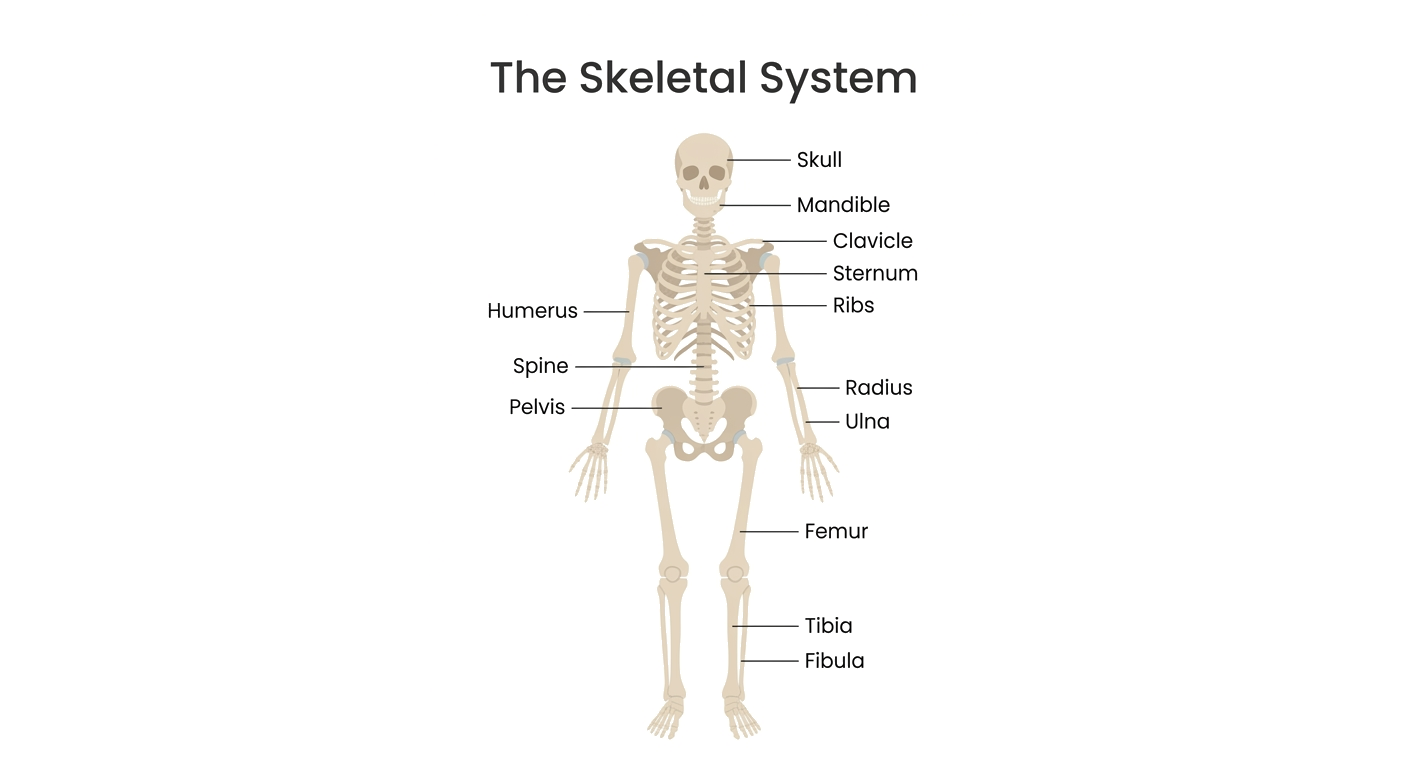
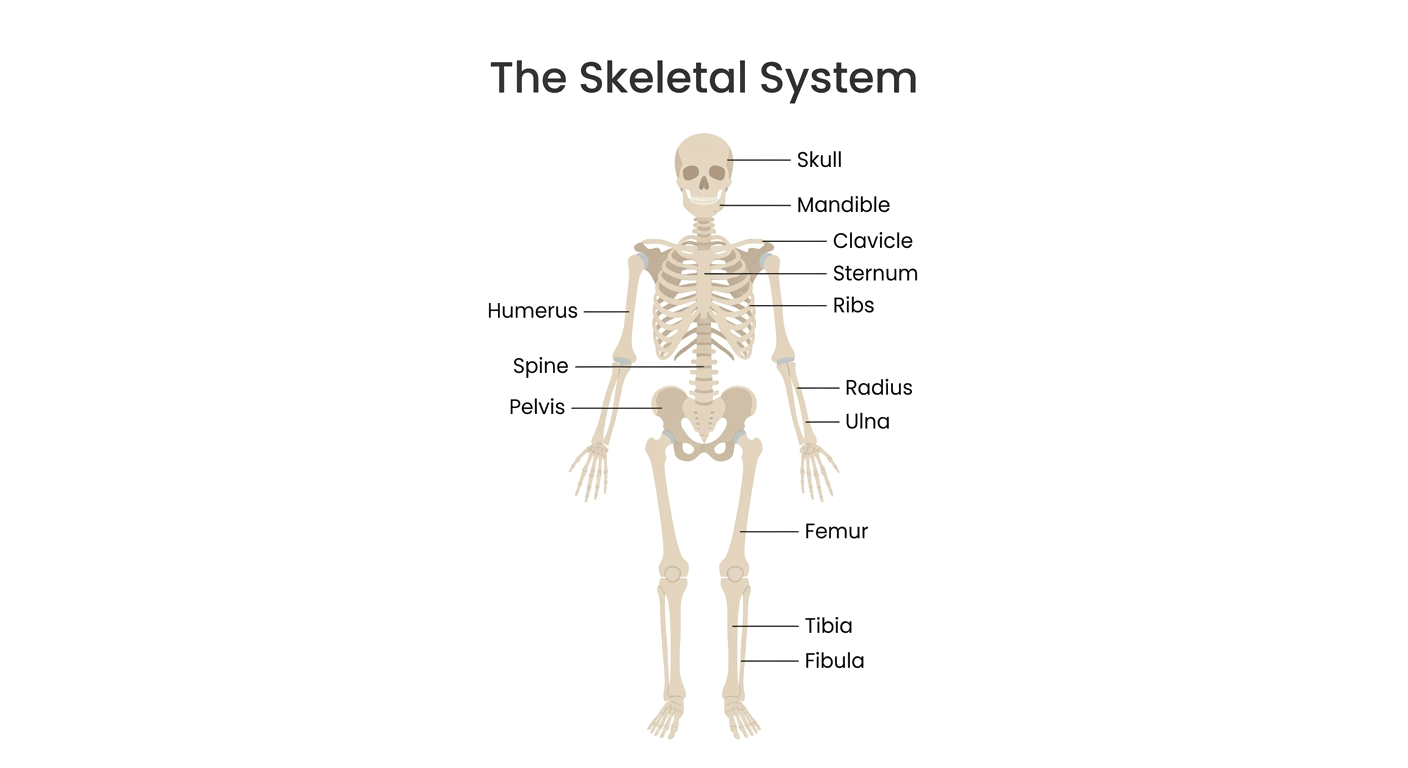
The major bones of the body
The skeletal system is made of 206 bones that support the body, protect the organs, and let us move. Here is what happens at each labeled part of the diagram:
| Bone | What it does | Why it matters |
|---|---|---|
| Skull | Protects the brain and forms the shape of the face. | Your brain is soft — roughly the texture of firm gelatin — so it needs the hardest protection in the body. The skull's curved dome shape distributes impact force around the bone rather than straight through it, the same engineering principle used in modern helmets. |
| Mandible | The lower jaw — the only bone of the skull that moves. | Being the only skull bone that moves is what makes eating and speaking possible. Every word you say requires the mandible to drop, close, and shift dozens of times per second in precise coordination with your tongue and teeth. |
| Clavicle | The collarbone, connecting the arm to the body. | This slender S-shaped bone acts like a strut, holding your shoulder out away from your chest so your arm has room to swing freely. It is also one of the most commonly broken bones in the body — a testament to how much force it absorbs when you reach out to break a fall. |
| Sternum | The breastbone at the front of the chest. | Flat and sturdy in the center of your chest, the sternum is the anchor point where most of your ribs connect at the front. Doctors sometimes deliver CPR compressions directly to it because pressing the sternum inward can manually squeeze the heart and keep blood moving during a cardiac emergency. |
| Ribs | Curved bones that form a cage protecting the heart and lungs. | The rib cage expands and contracts roughly 20,000 times a day as you breathe, acting like a flexible bellows rather than a solid shell. Without this protective cage, a single hard bump could puncture your heart or lungs. |
| Humerus | The upper arm bone. | This single bone connects your shoulder socket to your elbow, creating the long lever that lets you reach, throw, and swing with real power. A famous nerve runs right alongside it, which is why hitting your elbow the wrong way sends that electric-shock tingle down to your fingers — the sensation people call hitting your "funny bone" is actually the humerus. |
| Spine | The column of small bones (vertebrae) that supports the body and protects the spinal cord. | The 33 small bones of the spine do two opposite jobs at once: stacked together they form a rigid pillar strong enough to support your entire upper body, yet the joints and cushioning discs between them give you enough flexibility to bend and twist. The hollow channel running through the center of the spine protects the spinal cord — the nerve highway that carries every signal between your brain and the rest of your body. |
| Pelvis | The hip bones that support the body and connect to the legs. | Shaped like a bowl, the pelvis transfers the entire weight of your upper body down into your legs with each step you take — a load that can be several times your body weight when you run or jump. It also cradles and protects the bladder, lower intestines, and in females, the reproductive organs. |
| Radius | One of the two forearm bones, on the thumb side. | The radius is what rotates when you flip your hand from palm-down to palm-up — it literally pivots around the ulna so you can twist a doorknob or catch a ball. Its thumb-side position also makes it the main weight-bearing bone of the forearm. |
| Ulna | The other forearm bone, on the little-finger side. | The bony point of your elbow that presses into the desk when you lean on your arm is the top of the ulna. It forms the stable hinge at the elbow joint, keeping the joint locked in one plane so your arm can fold precisely rather than wobbling in every direction. |
| Femur | The thigh bone — the longest and strongest bone in the body. | The femur is the longest and strongest bone in the body, capable of withstanding a force equal to about 30 times your body weight without breaking. Deep inside its shaft, spongy bone marrow produces millions of new red blood cells every second to replace the ones constantly wearing out in your bloodstream. |
| Tibia | The shinbone, the larger of the two lower-leg bones. | Running just under the skin at the front of your lower leg, the tibia is the main load-bearing bone from your knee to your ankle — it carries roughly 85 percent of your body weight with every step. That exposed position is also why a kick to the shin hurts so much: there is almost no muscle cushioning between the bone and the impact. |
| Fibula | The thinner bone beside the tibia in the lower leg. | Although it bears little of the body's weight, the fibula is critical for ankle stability — without it, the ankle joint would buckle sideways under even normal walking. Stress fractures of the fibula are common in runners, because the bone absorbs the subtle twisting forces that the tibia passes off with each stride. |
Companion worksheet
A free fill-in worksheet with an answer key, built from the labels above — students match each bone to its description, then answer a couple of short questions. Great for a quick check after using the diagram.
How to print
Choose Download PDF for a ready-to-print file that fits US Letter paper (8.5 × 11") in portrait, or Download PNG for the high-resolution image.
Frequently asked questions
How many bones are in the human body?
An adult human body has 206 bones.
What does the skeletal system do?
It gives the body its shape and support, protects organs like the brain, heart and lungs, and works with muscles to let us move.
What paper size should I print this on?
The diagram is sized for standard US Letter paper (8.5 × 11") in portrait orientation. Use "Download PDF" for a print-ready file that fits the page automatically.