 Printable Scholar
Types of Clouds
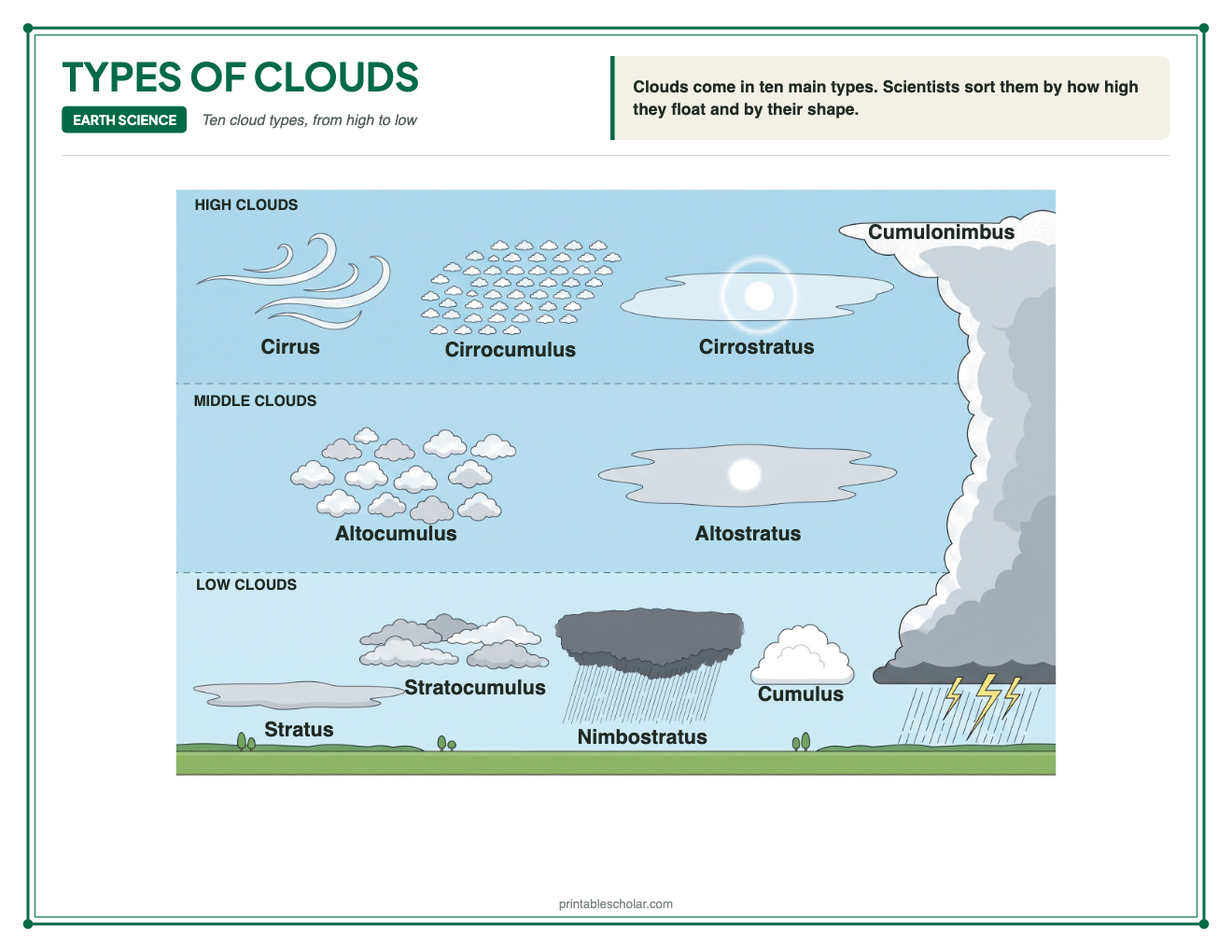
Free printable types of clouds chart — all ten cloud types (cirrus, cumulus, stratus, cumulonimbus and more) labeled at their heights in the sky, plus a blank chart to label. Download a high-resolution PDF or PNG for Letter paper.
Part of the Types of Clouds teaching pack for grades 4 to 6: 25 lesson slides and 8 printables with answer keys. The diagram and the blank one to label are free.
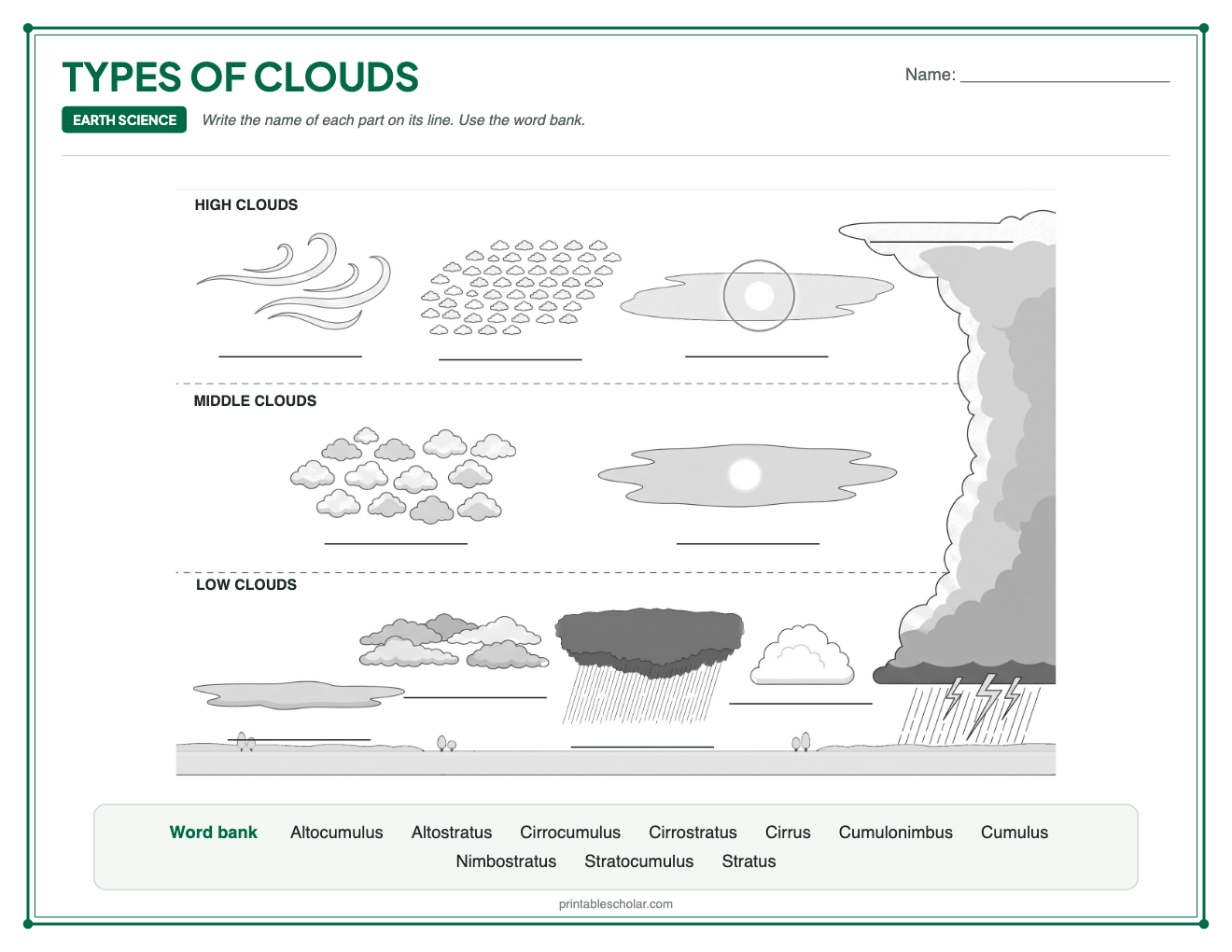
Blank diagram to label
Download blank version + answer key 10 blanks, a word bank, and the answer key on page 2Teaching ideas for Types of Clouds
Pick the ideas that suit your class, then follow the plan or use the sheets in any order.
- Look up. Take the class outside on a day with clouds. Students sketch what they see and use the diagram to name each cloud. Never look at the Sun.
- Cloud diary. Each day for a week, students draw the sky, name the clouds and write down the weather. At the end, look for the clouds that came before rain.
- Cotton ball clouds. Students pull, stretch and stack cotton balls on blue paper to make a few cloud types, then write the name under each one.
- Window watch. Pick one window with a view of the sky. Each morning a different student names the clouds and asks the class what weather they might bring.
A plan for the week
| Day 1 | Open with one of the ideas above. Teach the lesson with the slides while students fill in the guided notes. Then students label the blank diagram. | Lesson slides (PowerPoint) (in the pack) Types of Clouds Guided Notes (in the pack) Types of Clouds Diagram Blank Types of Clouds |
| Day 2 | Students match each cloud to its description on “Cloud Words” and answer the questions. | Cloud Words (in the pack) |
| Day 3 | Read “Reading the Clouds” and answer the questions. | Reading the Clouds (in the pack) |
| Day 4 | Students use the word parts on “Build a Cloud Name” to name ten clouds from their height and shape. | Build a Cloud Name (in the pack) |
| Day 5 | Review with the crossword, then give the quiz. | Types of Clouds Crossword (in the pack) Types of Clouds Quiz (in the pack) |
The sheets marked “in the pack” are in the Types of Clouds teaching pack below.
NGSS standards
- Supports 5-ESS2-1: Develop a model using an example to describe ways the geosphere, biosphere, hydrosphere, and/or atmosphere interact.
Types of Clouds teaching pack
Teaching the types of clouds? This pack has ready-made lesson slides and 8 printables that cover all ten cloud types, in teaching order, with every answer key.
Free on this page: 2 of the 9 printables, marked Download below. The whole pack is $7: 18 pages in one print-ready file, the 25 lesson slides, the practice sheets, the crossword, the quiz and every answer key.
One-time purchase. Instant download. Secure checkout by Stripe. Want to see a whole pack first? The Inside the Earth and Volcanoes pack is free.See all 25 packs in the bundle
- The Microscope
- Photosynthesis
- Parts of a Plant and Flower
- Life Cycle of a Plant
- Life Cycles of a Butterfly and a Frog
- Food Chains and Food Webs
- The Water Cycle
- Skeletal System
- Muscular System
- Digestive System
- Respiratory System
- Heart and Circulation
- Nervous System and Brain
- Eye and Ear
- Inside the Earth and Volcanoes
- Rocks and the Rock Cycle
- Layers of the Atmosphere
- Types of Clouds (this pack)
- The Solar System
- The Seasons
- Moon Phases and Eclipses
- States of Matter
- Forms of Energy
- Simple Machines
- Magnets and Magnetic Fields
Teach Types of Clouds with 25 ready-made slides
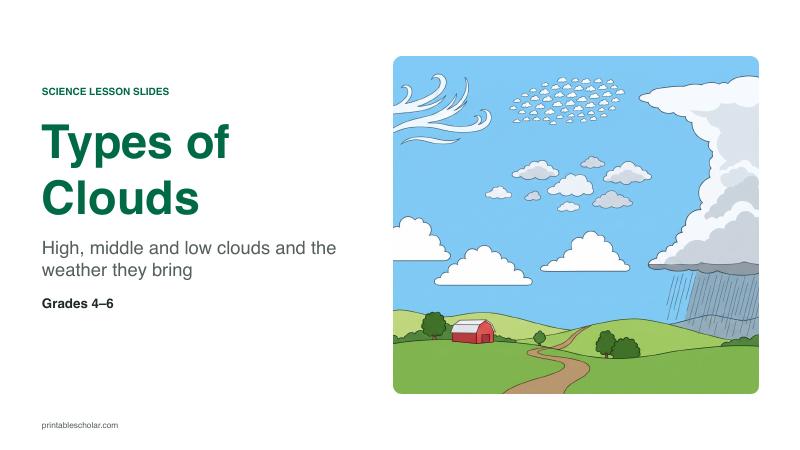
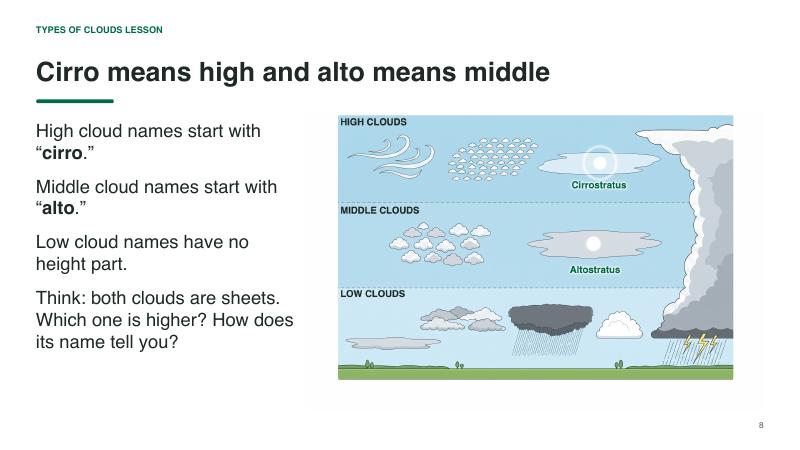
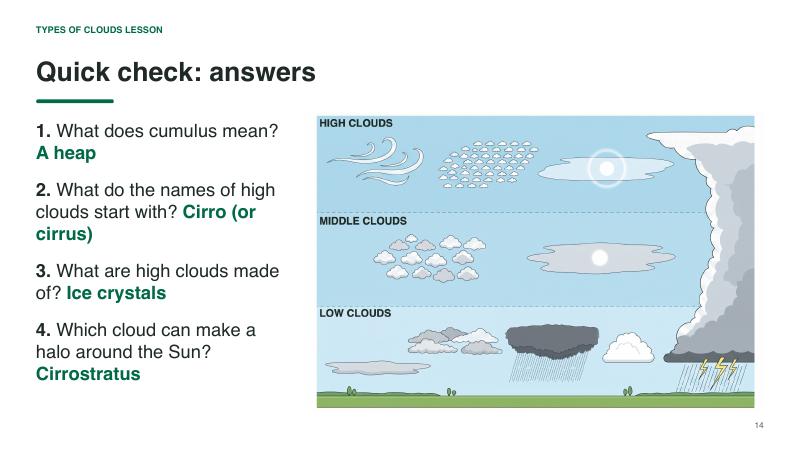
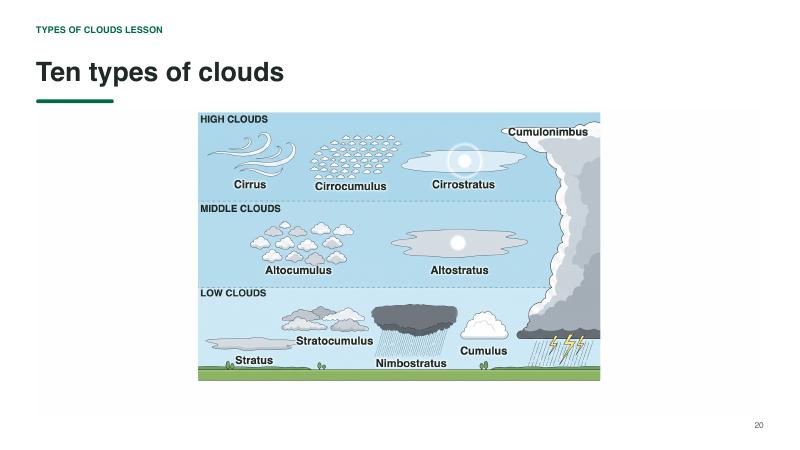
Open the PowerPoint and teach: an opening question, the parts one at a time on the diagram, quick checks and an exit question. Your notes for each slide are in the speaker notes. Students fill in the guided notes sheet as you go.
The slides (PowerPoint and a PDF copy) and the guided notes sheet come with the pack.What is in the pack, in teaching order
In the pack
1. TeachLesson Slides25 slides to present, with your notes for each one.In the $7 pack
 In the pack
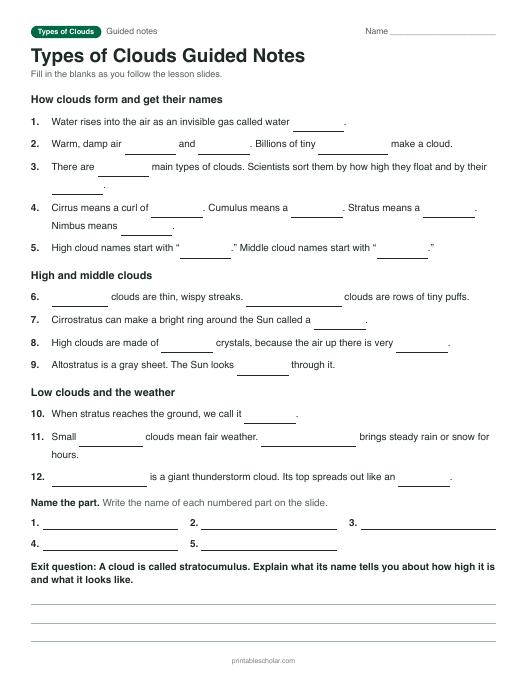
1. TeachTypes of Clouds Guided NotesStudents fill in the blanks as you present. With answer key.In the $7 pack
 In the pack
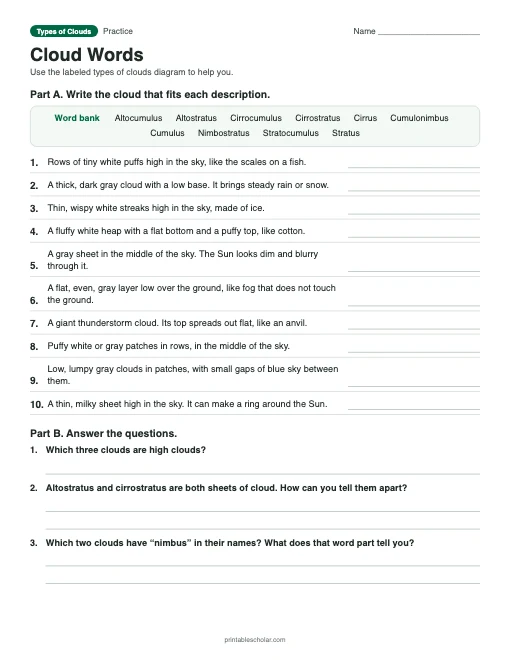
3. MatchCloud WordsMatch the 10 cloud types to their descriptions, then answer three questions.In the $7 pack
 In the pack
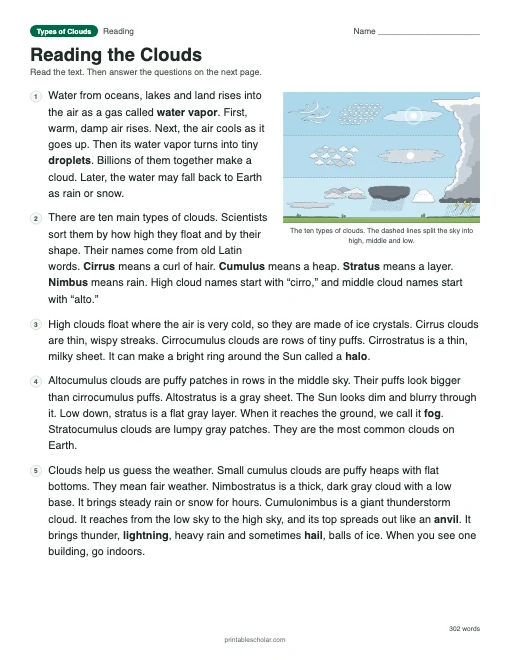
4. ReadReading the CloudsA one-page text on how clouds form, how they are named, and what weather they bring, with eight questions.In the $7 pack
 In the pack
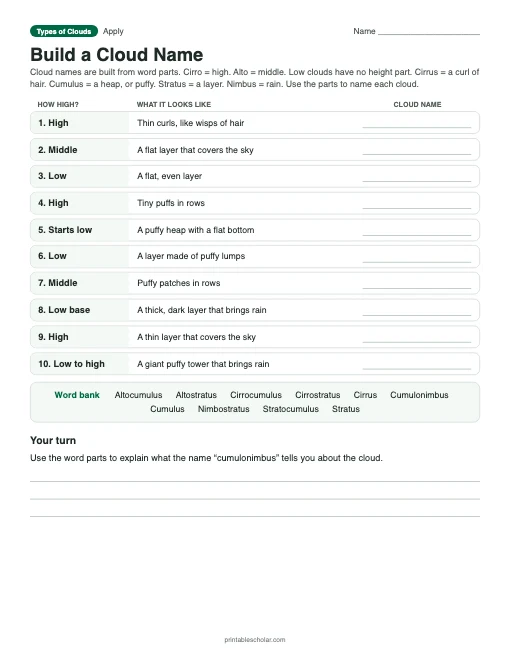
5. ApplyBuild a Cloud NameUse Latin word parts to name ten clouds from their height and shape.In the $7 pack
 In the pack
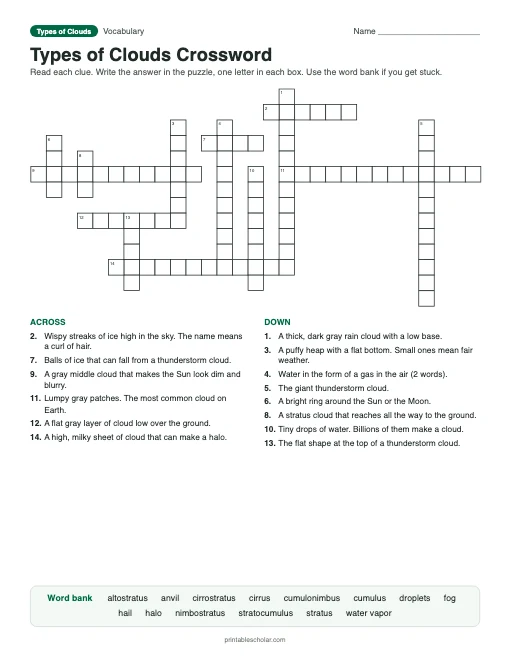
6. ReviewTypes of Clouds CrosswordFourteen cloud words with clues and a word bank.In the $7 pack
 In the pack
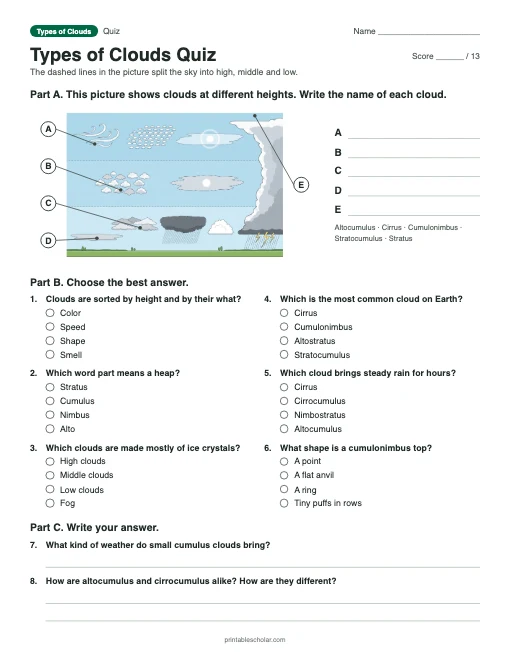
7. CheckTypes of Clouds QuizLabel five clouds, six multiple choice and two written answers. Scored out of 13.In the $7 pack
Types of Clouds worksheets, crossword and quiz
The Types of Clouds teaching pack is 25 lesson slides (PowerPoint and PDF) and 8 printables with answer keys for grades 4 to 6, in the order you would teach them: the guided notes for the lesson slides, the labeled diagram and the blank one to label, then “Cloud Words” (a worksheet), “Reading the Clouds” (a reading passage), “Build a Cloud Name” (a cloud names table), a vocabulary crossword and a quiz.
The sheets are in a suggested teaching order: teach the lesson, have students label the blank diagram, then work through the practice sheets and finish with the quiz. Use them all over a week or pick the ones you need. The answer keys are together at the back.
The diagram and the blank one to label are free to download on this page. The other sheets come with the pack ($7), which is also in the Elementary Science bundle (grades 3 to 6).
A cloud is made of billions of tiny water droplets or ice crystals floating in the air. Clouds form when warm, damp air rises and cools, and its water vapor turns into droplets. Their names are built from a few Latin words. Cirrus means a curl of hair, cumulus means a heap, stratus means a layer, and nimbus means rain. High cloud names start with “cirro,” and middle cloud names start with “alto.” Low clouds float below about 6,500 feet (2 kilometers), middle clouds between about 6,500 and 20,000 feet (2 to 6 kilometers), and high clouds above that, where the air is so cold that they are made of ice. Reading the clouds is one of the oldest ways to tell what the weather will do next.
The ten types of clouds
Clouds come in ten main types. Scientists sort them by how high they float and by their shape: wispy, puffy, or flat and spread out. Here is what happens at each labeled part of the diagram:
| Cloud | What it does | Why it matters |
|---|---|---|
| Cirrus | Thin, wispy white streaks high in the sky, sometimes called mares’ tails. | Cirrus clouds are made of ice crystals, because the air that high is far below freezing. They usually mean fair weather for now, but a sky filling up with cirrus can be the first sign that a change in the weather is coming in a day or so. |
| Cirrocumulus | Rows of tiny white puffs high in the sky, like the scales on a fish. | This pattern is sometimes called a mackerel sky, after the striped fish. Each puff is small because the cloud is so far away. Cirrocumulus clouds do not last long and do not bring rain themselves. |
| Cirrostratus | A thin, milky sheet that covers the high sky. The Sun or Moon can shine through it. | Light passing through its ice crystals can make a bright ring, called a halo, around the Sun or the Moon. A halo is a good clue that cirrostratus is up there, and that rain or snow may arrive within a day. |
| Altocumulus | Puffy white or gray patches in the middle of the sky, often in rows or rolls. | Each puff of altocumulus looks bigger than a cirrocumulus puff because it floats lower. On a warm, sticky morning, altocumulus can be a sign that thunderstorms may build later in the day. |
| Altostratus | A gray or blue-gray sheet that covers the middle sky. The Sun looks dim and blurry through it. | Altostratus is thicker than cirrostratus, so the Sun shines through it like it is behind frosted glass, and it does not make a halo. It often spreads in ahead of a long, steady rain or snow. |
| Stratocumulus | Low, lumpy gray clouds in patches or rows, with small gaps of blue sky between them. | Stratocumulus is the most common cloud on Earth. It can make a day look dull and gray, but it rarely brings more than a light drizzle. |
| Stratus | A flat, gray, even layer of cloud low over the ground, like fog that does not touch the ground. | Stratus can cover the whole sky and hide the Sun all day. If a stratus cloud reaches all the way down to the ground, we call it fog. It may bring a light drizzle, but not heavy rain. |
| Nimbostratus | A thick, dark gray rain cloud with no clear shape that blocks out the Sun. | Nimbostratus brings steady rain or snow that can last for hours. Its base is low, but it can be thousands of feet thick, and the falling rain often hides its bottom edge. |
| Cumulus | A fluffy white heap with a flat bottom and a puffy top, like cotton or cauliflower. | Cumulus clouds form on sunny days, when the ground warms the air and pockets of warm air rise. Small ones mean fair weather. If they keep growing taller through the afternoon, they can turn into thunderstorm clouds. |
| Cumulonimbus | A giant thunderstorm cloud that rises from low in the sky all the way to the top, where it spreads out in a flat anvil shape. | Cumulonimbus is the only cloud that reaches through the low, middle and high sky, and it can stand more than 10 miles tall. It brings thunder, lightning, heavy rain and sometimes hail or tornadoes. When you see one building, it is time to go indoors. |
How to print
Choose Download PDF for a ready-to-print file that fits US Letter paper (8.5 × 11") in landscape, or Download PNG for the high-resolution image.
Frequently asked questions
What are the ten types of clouds?
High clouds: cirrus, cirrocumulus and cirrostratus. Middle clouds: altocumulus and altostratus. Low clouds: stratocumulus, stratus and nimbostratus. Cumulus and cumulonimbus start low, and cumulonimbus grows up through all three levels.
What are the four main types of clouds?
Many classes start with four: cirrus (wispy), cumulus (puffy), stratus (flat layers) and nimbus (rain clouds). All ten cloud types are made from these word parts.
Which clouds bring rain?
Nimbostratus brings long, steady rain or snow, and cumulonimbus brings heavy showers and thunderstorms. Stratus and stratocumulus can bring a light drizzle.
What paper size should I print this on?
The chart is sized for standard US Letter paper (8.5 × 11") in landscape orientation. Use "Download PDF" for a print-ready file that fits the page automatically.
Are there Types of Clouds worksheets to go with the diagram?
Yes. The Types of Clouds teaching pack, for grades 4 to 6, has 25 lesson slides and 8 printables with answer keys: the guided notes for the lesson slides, the labeled diagram and the blank one to label, then “Cloud Words” (a worksheet), “Reading the Clouds” (a reading passage), “Build a Cloud Name” (a cloud names table), a vocabulary crossword and a quiz. The diagram and the blank one to label are free to download on this page. The other sheets come with the pack ($7), which is also in the Elementary Science bundle (grades 3 to 6).