Forms of Energy
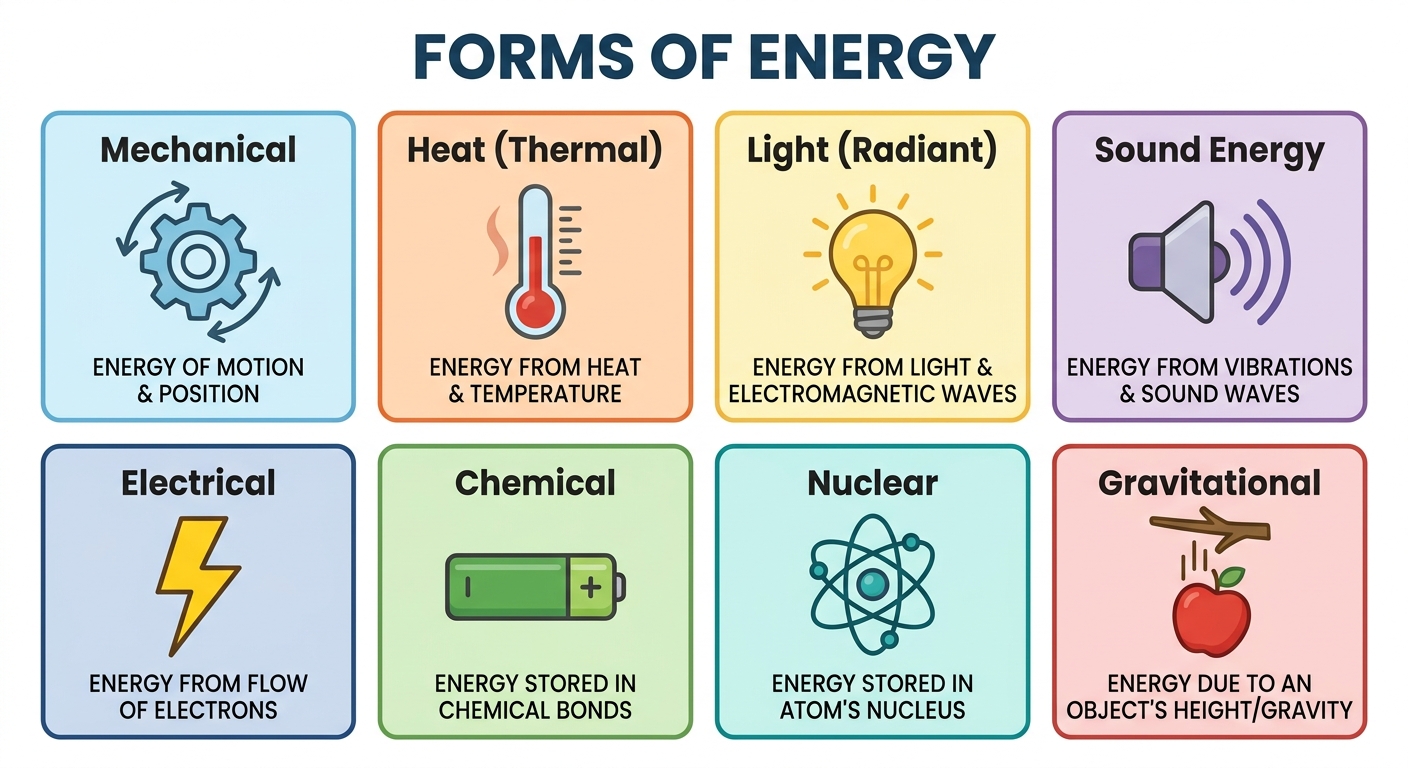
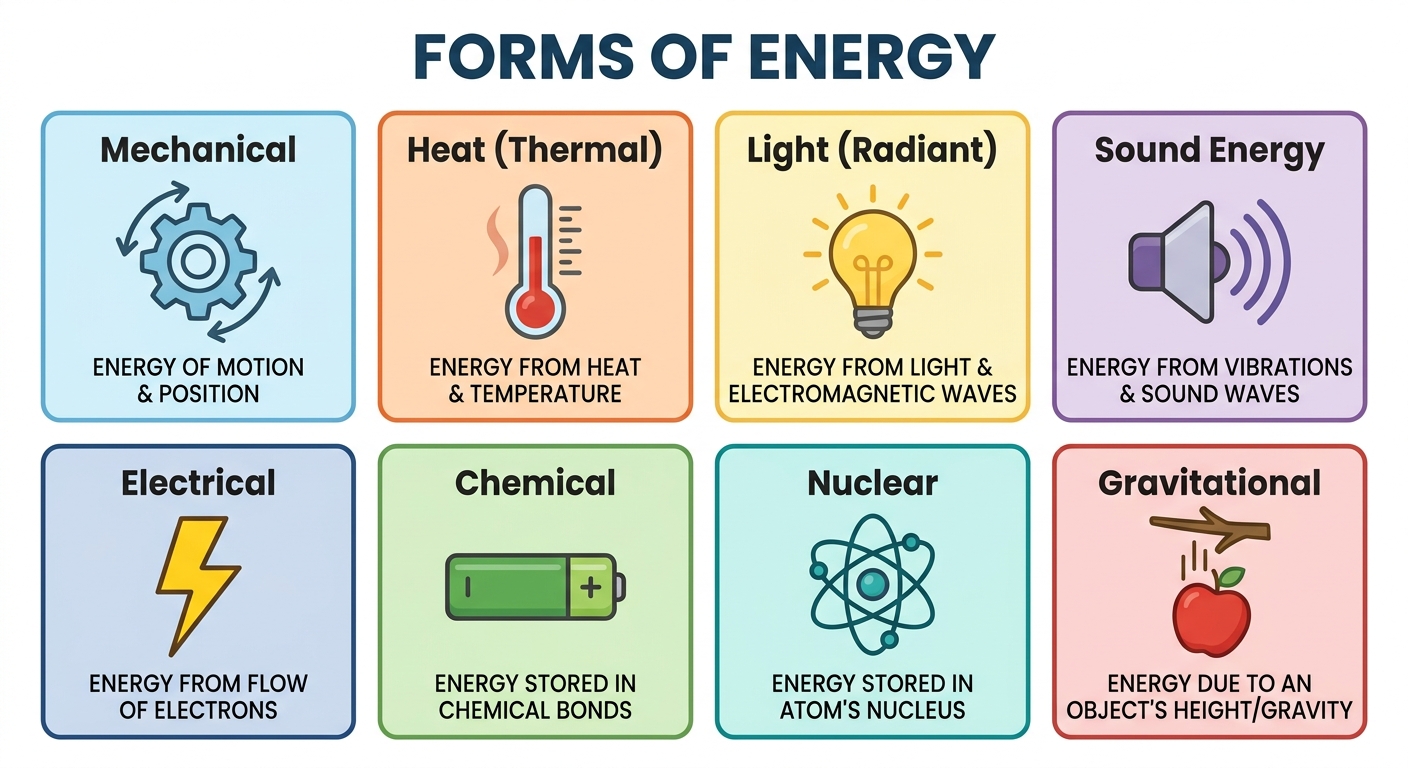
Free printable forms of energy diagram — the eight forms of energy (mechanical, heat, light, sound, electrical, chemical, nuclear and gravitational) with icons and labels. Download a high-resolution PDF or PNG for Letter paper.
Energy is the ability to do work or cause change — it's what makes things move, heat up, glow, vibrate, or react. You can't create energy from nothing, and it never truly disappears; it only changes from one form into another. Every time you ride a bike, cook food, or flip on a light switch, you're watching energy transform right in front of you. Knowing the different forms helps you trace those transformations and understand why the world behaves the way it does.
The forms of energy
Energy is the ability to do work or cause change, and it comes in many different forms. Energy can also change from one form into another. Here is what happens at each labeled part of the diagram:
| Form | What it does | Why it matters |
|---|---|---|
| Mechanical | The energy of motion and position, like a moving ball or a stretched spring. | Without mechanical energy, nothing would ever move or be lifted off the ground. A spinning turbine, a thrown baseball, and a compressed spring all carry mechanical energy — and engineers harness it to build everything from clocks to roller coasters. |
| Heat (thermal) | Energy from the movement of tiny particles; the faster they move, the hotter something is. | Thermal energy flows from hotter objects to cooler ones, which is why your hot cocoa eventually goes cold. Our entire global climate, the weather, and even the way engines and power plants work all depend on controlling where heat flows and how fast. |
| Light (radiant) | Energy that travels as light and other electromagnetic waves. | Plants use light energy from the sun to make food through photosynthesis — without it, the entire food chain collapses. Radiant energy also carries warmth across 93 million miles of empty space from the sun, making life on Earth possible in the first place. |
| Sound | Energy carried by vibrations traveling as sound waves. | Sound energy is what lets you hear a friend's voice, a fire alarm, or music — all carried by invisible pressure waves rippling through the air. Doctors even use sound energy in ultrasound machines to safely see inside the human body. |
| Electrical | Energy from the flow of tiny charged particles called electrons. | The steady flow of electrons through a wire is what powers every device you plug in or charge up, from phones to hospital equipment. Your own nervous system runs on tiny electrical signals too — they're how your brain tells your hand to catch a ball in under a second. |
| Chemical | Energy stored in the bonds between atoms, like in food, fuel and batteries. | Every bite of food you eat is chemical energy waiting to be released — your body breaks those molecular bonds to fuel every heartbeat and every thought. Fuels like gasoline and natural gas store chemical energy the same way, releasing it as heat and motion when they burn. |
| Nuclear | Energy stored in the nucleus of an atom, released in nuclear reactions. | A tiny amount of nuclear fuel holds an enormous amount of energy — one uranium pellet the size of a fingertip contains as much energy as 17,000 cubic feet of natural gas. The sun itself runs on nuclear energy, fusing hydrogen atoms in its core and releasing the light and heat that reach Earth. |
| Gravitational | Stored energy an object has because of its height above the ground. | Gravitational energy explains why a ball rolls downhill and why water rushes down a waterfall with such force. Hydroelectric dams work by converting exactly this stored energy — the height of water held behind a dam — into electrical power for entire cities. |
Companion worksheet
A free fill-in worksheet with an answer key, built from the labels above — students match each form to its description, then answer a couple of short questions. Great for a quick check after using the diagram.
How to print
Choose Download PDF for a ready-to-print file that fits US Letter paper (8.5 × 11") in landscape, or Download PNG for the high-resolution image.
Frequently asked questions
What are the main forms of energy?
Mechanical, heat (thermal), light (radiant), sound, electrical, chemical, nuclear and gravitational energy.
Can energy change from one form to another?
Yes. For example, a battery changes chemical energy into electrical energy, and a light bulb changes electrical energy into light and heat.
What paper size should I print this on?
The diagram is sized for standard US Letter paper (8.5 × 11") in landscape orientation. Use "Download PDF" for a print-ready file that fits the page automatically.