Zones of the Ocean
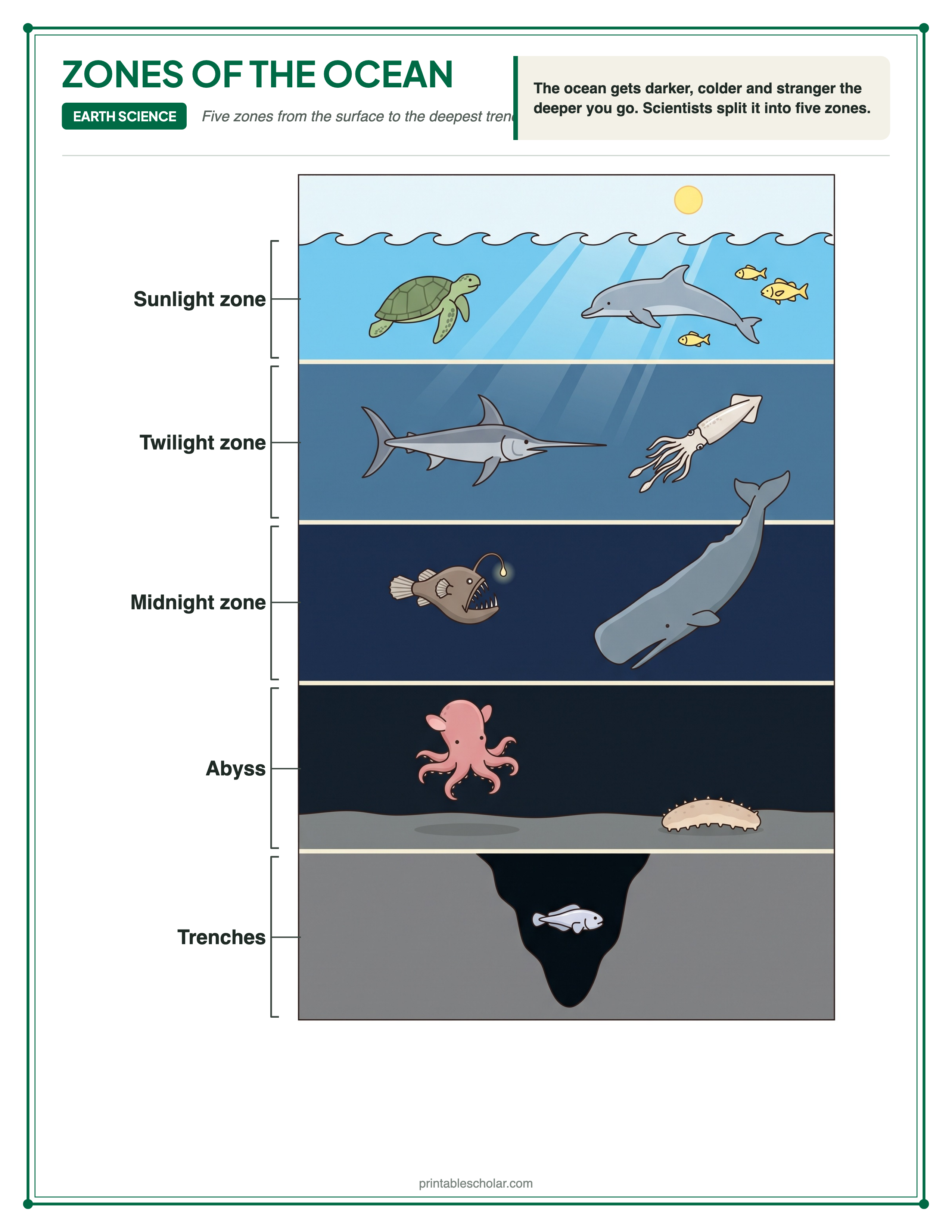
Free printable ocean zones diagram — the sunlight zone, twilight zone, midnight zone, abyss and trenches, labeled, with animals that live in each one. Download a high-resolution PDF or PNG for Letter paper.
Comes with a book and 4 free printables for grades 1 to 3, with answer keys.
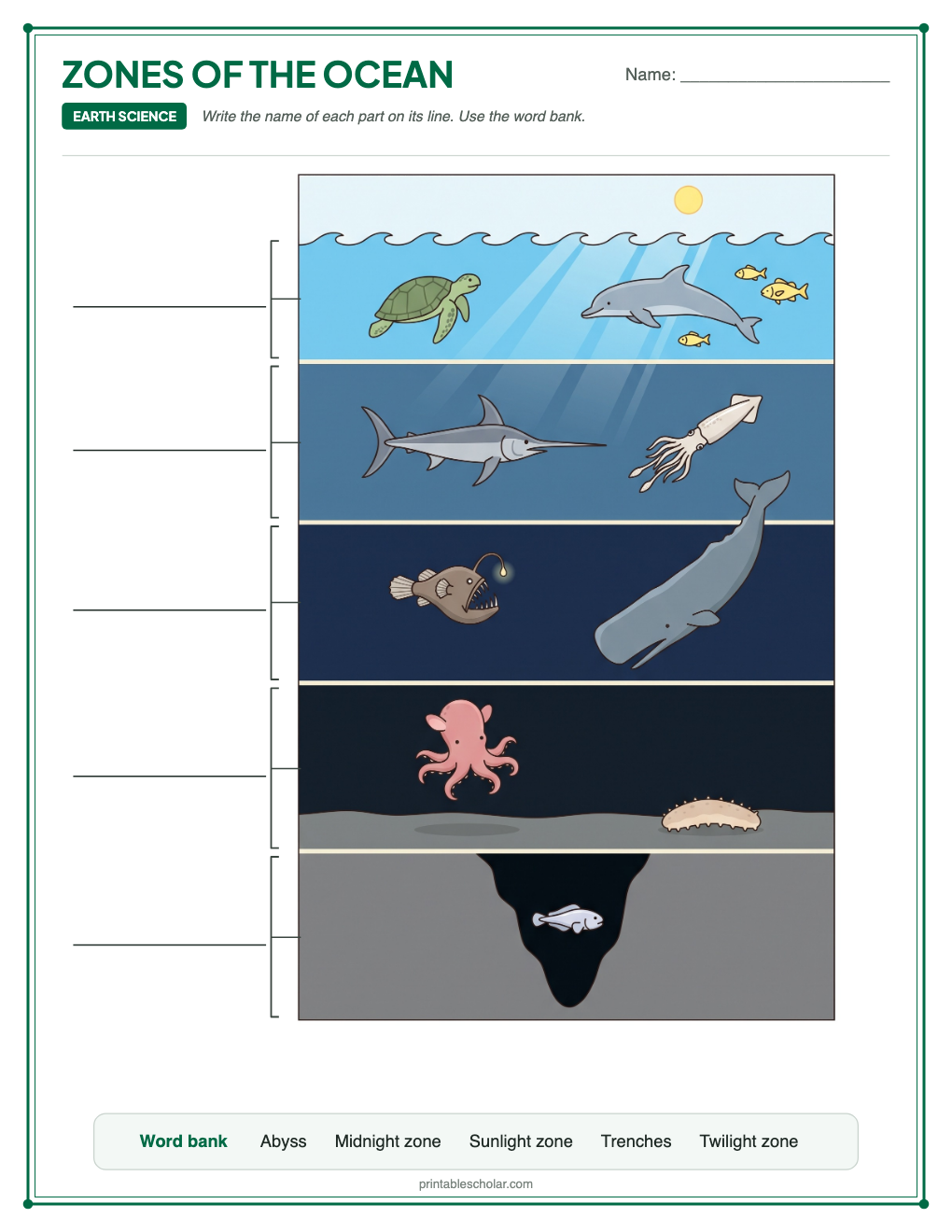
Blank diagram to label
Download blank version + answer key 5 blanks, a word bank, and the answer key on page 2Teaching ideas for Zones of the Ocean
Pick the ideas that suit your class, then follow the plan or use the sheets in any order.
- Walk the dive. Mark the five zones along a hallway or the playground at their real sizes: 1 step for the sunlight zone, 4 for the twilight zone, 15 for the midnight zone, 10 for the abyss and 25 for the trenches. Students walk from the surface to the bottom.
- Dim the lights. Read the book with the lights on for the sunlight zone. Turn some off for the twilight zone, and the rest for the midnight zone. Finish the book by flashlight.
- Point to the zone. Name an animal from the labeled diagram. Students point to its zone and say what the water is like there.
A plan for the week
| Day 1 | Open with one of the ideas above. Show the labeled diagram and name the five zones together. Then students label the blank one. | Ocean Zones Diagram Blank Ocean Zones |
| Day 2 | Cut and staple the book “How Deep Is the Ocean?” and read it together. | How Deep Is the Ocean? Book How Deep Is the Ocean? Book, Black and White |
| Day 3 | Students color each zone darker than the last on “Color the Ocean Zones.” | Color the Ocean Zones |
| Day 4 | Students draw what they would see from a submarine on “Dive, Dive, Dive!” | Dive, Dive, Dive! |
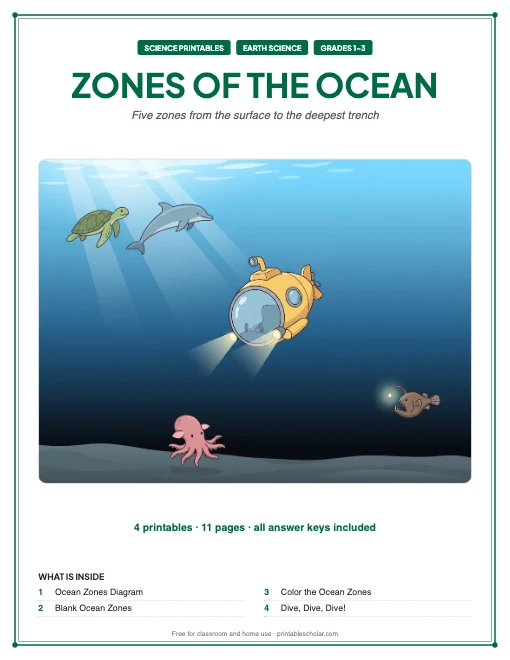
Zones of the Ocean: a book and 4 free printables
Teaching the zones of the ocean? Here are a cut-and-staple book and 4 free printables for grades 1 to 3, with answer keys.
Download the 4 sheets (PDF, 11 pages) One file, ready to print. Or pick single sheets below. The book is its own file.The printables
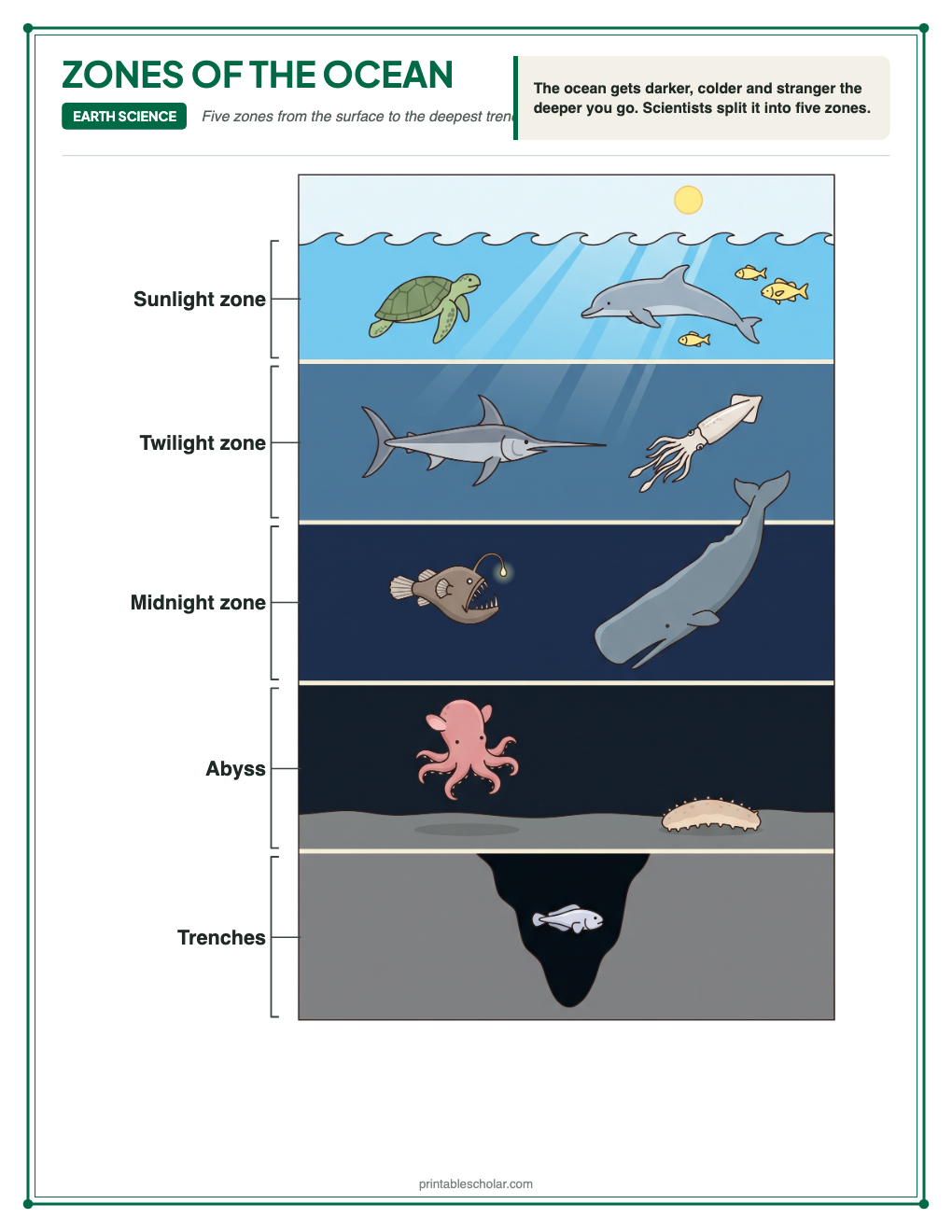 1. TeachOcean Zones DiagramThe labeled diagram, 5 zones.Download PDF
2. LabelBlank Ocean ZonesStudents label 5 zones from a word bank.Download PDF
1. TeachOcean Zones DiagramThe labeled diagram, 5 zones.Download PDF
2. LabelBlank Ocean ZonesStudents label 5 zones from a word bank.Download PDF
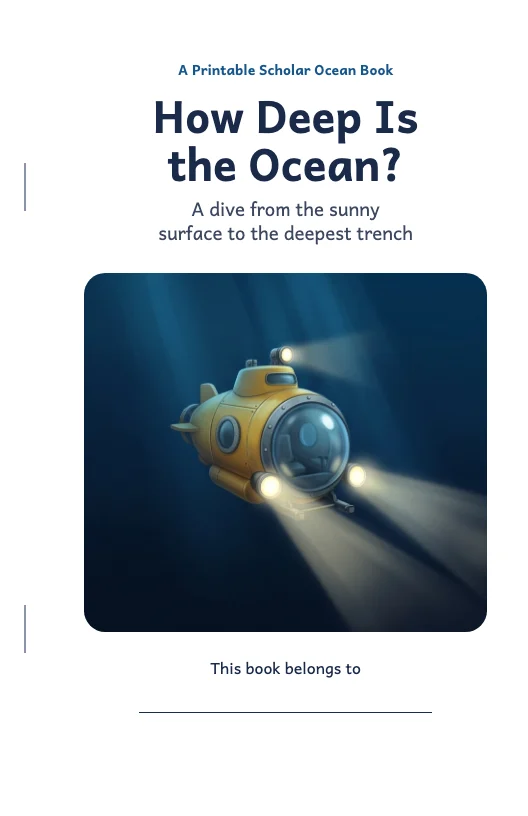 3. ReadHow Deep Is the Ocean? BookA 10-page cut-and-staple book: a dive through the five zones with real depths. In color.Download PDF
 3. ReadHow Deep Is the Ocean? Book, Black and WhiteThe same book as line art to color in. Uses little ink.Download PDF
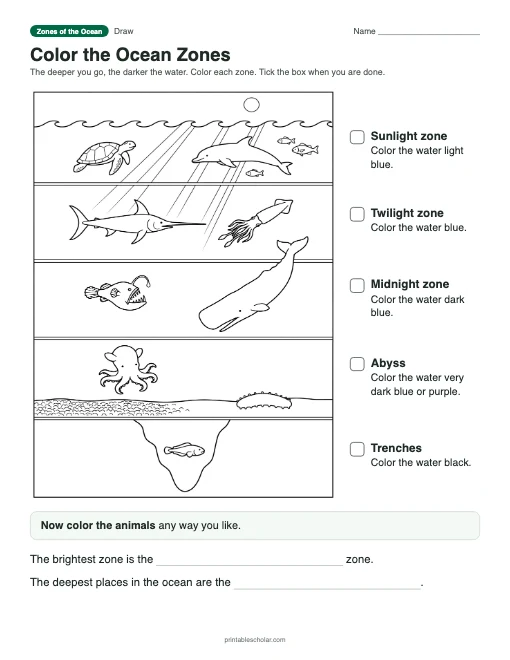 4. ColorColor the Ocean ZonesColor each zone darker than the one above it, then finish two sentences.Download PDF
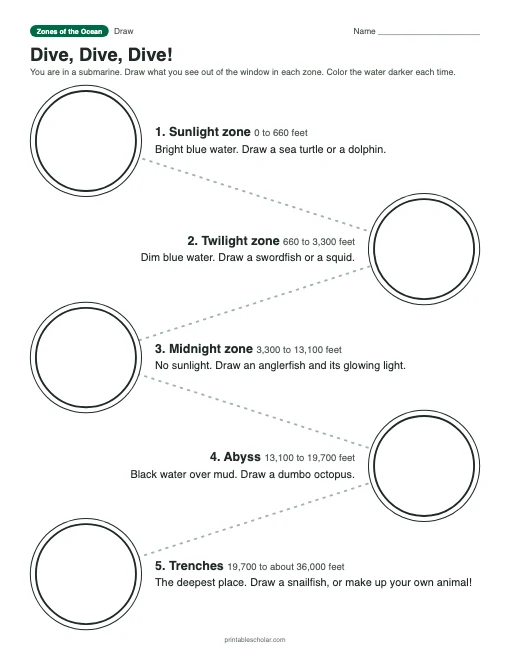 5. DrawDive, Dive, Dive!Five submarine windows on the way down: draw what you see in each zone.Download PDF
Zones of the Ocean worksheets
There is a book and 4 free printables with answer keys for grades 1 to 3: the cut-and-staple book “How Deep Is the Ocean?” in color and in black and white, the labeled diagram and the blank one to label, then “Color the Ocean Zones” (a coloring sheet) and “Dive, Dive, Dive!” (a drawing sheet).
Show the labeled diagram and have students label the blank one. Read the book together. Then students color the zones and draw what they would see on a dive. The answer keys are together at the back.
Every sheet is free to download on this page, one at a time or as one file.
Sunlight only reaches a little way into the sea. Below about 660 feet there is not enough light for plants to grow, and below about 3,300 feet there is no sunlight at all. The water also gets colder, and the weight of all the water above presses harder and harder. Each zone has animals that are suited to its light, its cold and its pressure. The deepest spot in the ocean, the Challenger Deep, is almost 7 miles down.
The five zones of the ocean
The ocean gets darker, colder and stranger the deeper you go. Scientists split it into five zones. Here is what happens at each labeled part of the diagram:
| Zone | What it does | Why it matters |
|---|---|---|
| Sunlight zone | The top layer, from the surface down to about 660 feet (200 meters). It is bright, and it is the warmest zone. | Sunlight lets tiny plants and seaweed grow here, so this zone has the most food and the most life. Sea turtles, dolphins, many sharks and most of the fish people eat live here. |
| Twilight zone | From about 660 feet down to 3,300 feet (1,000 meters). Only a faint blue glow gets this far. | It is too dim for plants to grow. Swordfish and squid hunt here, and many small fish make their own light. |
| Midnight zone | From about 3,300 feet down to 13,100 feet (4,000 meters). No sunlight reaches it at all. | It is pitch dark and near freezing. The only light comes from animals that glow, like the anglerfish with its lure. Sperm whales can dive down this far to hunt squid. |
| Abyss | From about 13,100 feet down to 19,700 feet (6,000 meters), just above the deep sea floor. | It is black and near freezing, and the water presses hard. Dumbo octopuses swim just above the mud and sea cucumbers crawl across it. |
| Trenches | Deep, narrow canyons in the sea floor, from about 19,700 feet down to almost 36,000 feet (11,000 meters). | These are the deepest places on Earth. The pressure is like having a pile of cars stacked on every part of you, yet snailfish and tiny shrimp-like animals live here. |
How to print
Choose Download PDF for a ready-to-print file that fits US Letter paper (8.5 × 11") in portrait, or Download PNG for the high-resolution image.
Frequently asked questions
What are the five zones of the ocean?
From top to bottom: the sunlight zone, the twilight zone, the midnight zone, the abyss and the trenches. Scientists also call them the epipelagic, mesopelagic, bathypelagic, abyssopelagic and hadal zones.
How deep is the ocean?
The deepest spot, the Challenger Deep in the Mariana Trench, is almost 36,000 feet down, close to 7 miles. Most of the sea floor is much shallower: the ocean is about 12,100 feet deep on average.
Which ocean zone has the most life?
The sunlight zone. It is the only zone with enough light for plants to grow, so it has the most food.
What paper size should I print this on?
The diagram is sized for standard US Letter paper (8.5 × 11") in portrait orientation. Use "Download PDF" for a print-ready file that fits the page automatically.
Are there Zones of the Ocean worksheets to go with the diagram?
Yes. There is a book and 4 free printables with answer keys for grades 1 to 3: the cut-and-staple book “How Deep Is the Ocean?” in color and in black and white, the labeled diagram and the blank one to label, then “Color the Ocean Zones” (a coloring sheet) and “Dive, Dive, Dive!” (a drawing sheet). Every sheet is free to download on this page, one at a time or as one file.