 Printable Scholar
The Three Types of Rocks
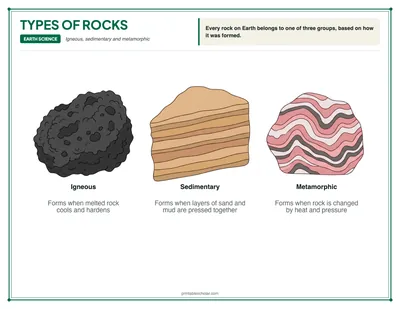
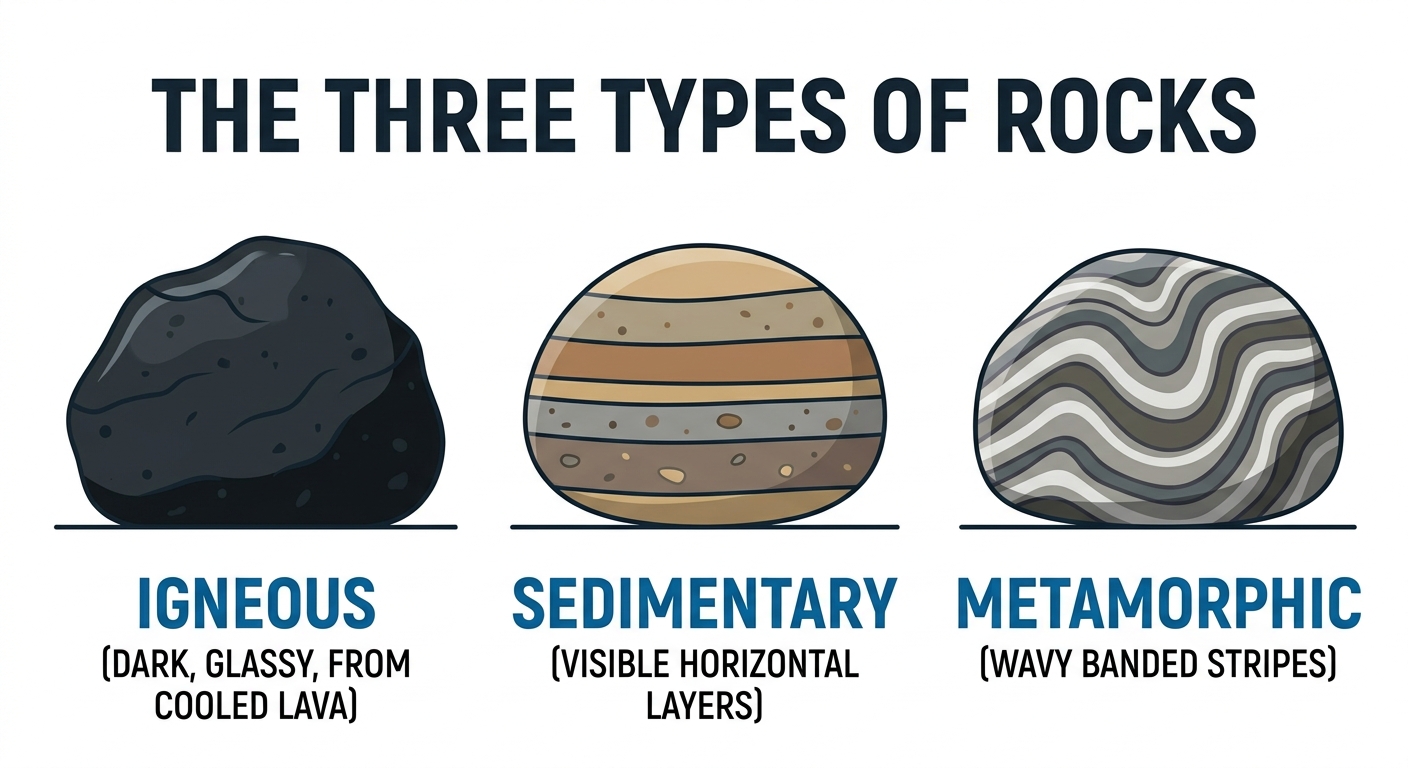
Free printable types of rocks diagram — igneous, sedimentary and metamorphic rock shown and labeled with how each one forms. Download a high-resolution PDF or PNG for Letter paper.
Part of the Rocks and the Rock Cycle teaching pack for grades 4 to 6: 26 lesson slides and 10 printables with answer keys. The diagrams are free.
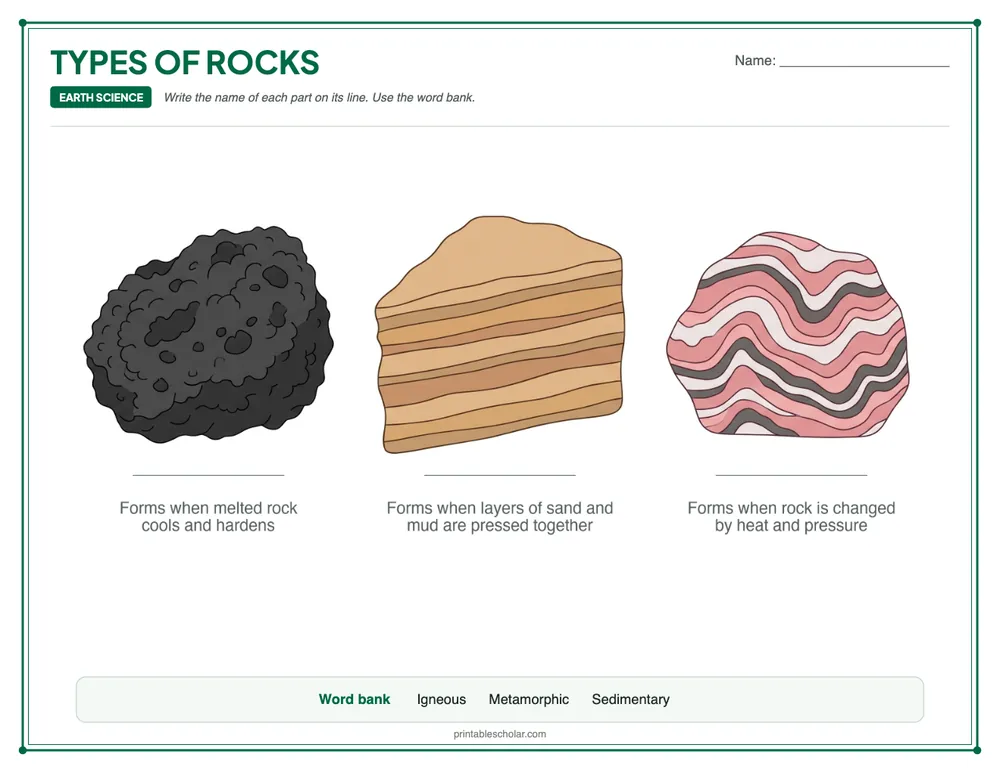
Blank diagram to label
Download blank version + answer key 3 blanks, a word bank, and the answer key on page 2Teaching ideas for Rocks and the Rock Cycle
Pick the ideas that suit your class, then follow the plan or use the sheets in any order.
- Hunt for rocks. Go outside and collect a few rocks. Students look at them with a hand lens for crystals, layers or bands and guess which type each one might be.
- Sort some rocks. Bring in rocks you can name, such as granite, sandstone, marble and slate. Students sort them into igneous, sedimentary and metamorphic, using the types of rocks diagram.
- Settle some sediment. Shake sand, soil and small pebbles with water in a clear plastic bottle. Leave it overnight. The sediment settles in layers, as in deposition.
- Press clay layers. Stack flat pieces of colored clay like the layers in sedimentary rock. Then squeeze and fold the stack. The wavy bands look like metamorphic rock.
A plan for the week
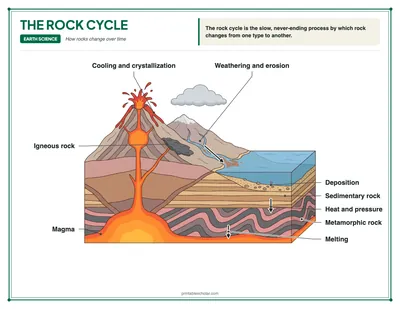
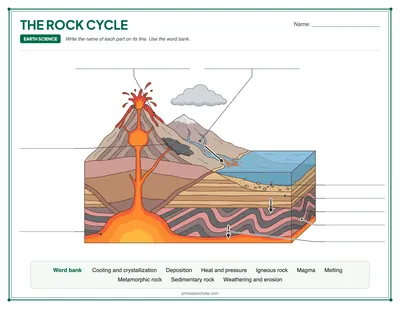
| Day 1 | Open with one of the ideas above. Teach the lesson with the slides while students fill in the guided notes. Then students label the blank diagram. | Lesson slides (PowerPoint) (in the pack) Rocks and the Rock Cycle Guided Notes (in the pack) Rock Cycle Diagram Blank Rock Cycle |
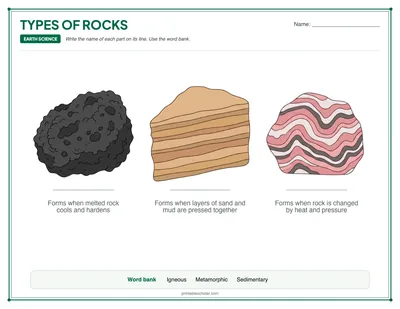
| Day 2 | Teach the three types of rock from the labeled diagram, with real rocks if you have them. Students label the blank one. | Types of Rocks Diagram Blank Types of Rocks |
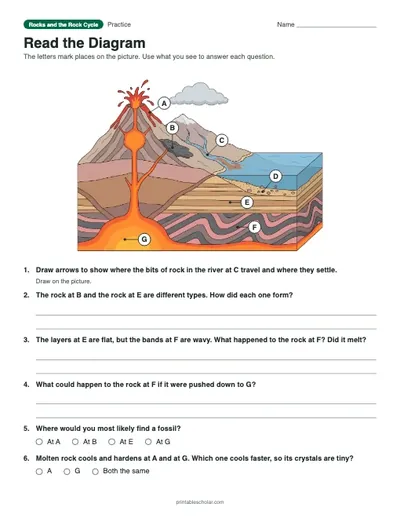
| Day 3 | Students work out what is happening on the picture on “Read the Diagram”: where the sediment goes, how each rock formed and where fossils are. Then read “Rocks That Change” and answer the questions. | Read the Diagram (in the pack) Rocks That Change (in the pack) |
| Day 4 | Students read how ten well known rocks formed and write the type of each one. | Which Type of Rock? (in the pack) |
| Day 5 | Review with the crossword, then give the quiz. | Rocks and the Rock Cycle Crossword (in the pack) Rocks and the Rock Cycle Quiz (in the pack) |
The sheets marked “in the pack” are in the Rocks and the Rock Cycle teaching pack below.
NGSS standards
- Supports 4-ESS2-1: Make observations and/or measurements to provide evidence of the effects of weathering or the rate of erosion by water, ice, wind, or vegetation.
- Supports MS-ESS2-1: Develop a model to describe the cycling of Earth's materials and the flow of energy that drives this process.
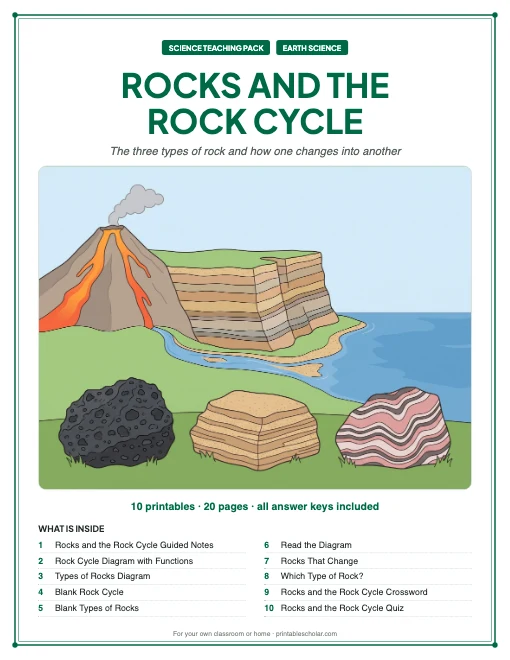
Rocks and the Rock Cycle teaching pack
Teaching the types of rocks and the rock cycle? Here is a ready-to-teach lesson. 26 slides and 10 printables that cover the whole topic, from the guided notes to the quiz. Present the slides while students fill in the guided notes, then use the worksheets, crossword and quiz, with every answer key.
Free on this page: 4 of the 10 printables, marked Download below. The whole pack is $7: 20 pages in one print-ready file, the 26 lesson slides, the practice sheets, the crossword, the quiz and every answer key.
OnlineThe pack also comes as an online lesson for Google Classroom: every part on screen for students, plus a self-grading Google Forms quiz.
One-time purchase. Instant download. Secure checkout by Stripe. Want to see a whole pack first? The Inside the Earth and Volcanoes pack is free.See all 31 packs in the bundle
- The Microscope
- Photosynthesis
- Parts of a Plant and Flower
- Life Cycle of a Plant
- Life Cycles of a Butterfly and a Frog
- Food Chains and Food Webs
- The Water Cycle
- Human Body Organs
- Skeletal System
- Muscular System
- Digestive System
- Respiratory System
- Heart and Circulation
- Nervous System and Brain
- Eye and Ear
- Parts of a Tooth
- Inside the Earth and Volcanoes
- Rocks and the Rock Cycle (this pack)
- Layers of the Atmosphere
- Types of Clouds
- Weathering, Erosion and Deposition
- Types of Landforms
- The Solar System
- The Seasons
- Moon Phases and Eclipses
- States of Matter
- Electric Circuits
- Forms of Energy
- Scientific Method
- Simple Machines
- Magnets and Magnetic Fields
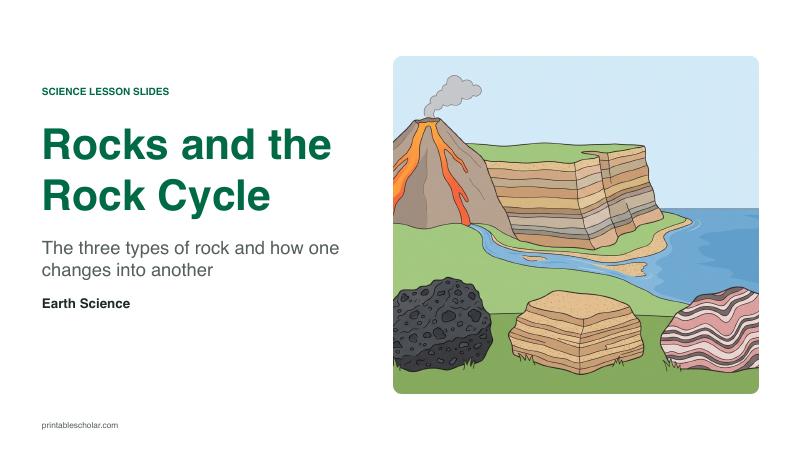
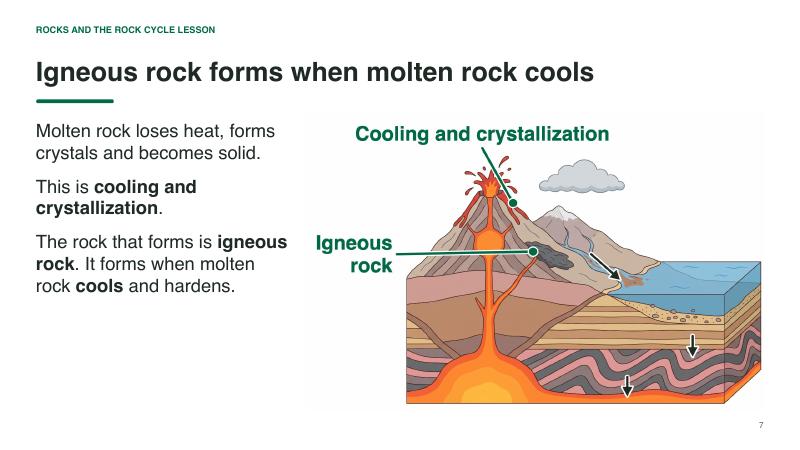
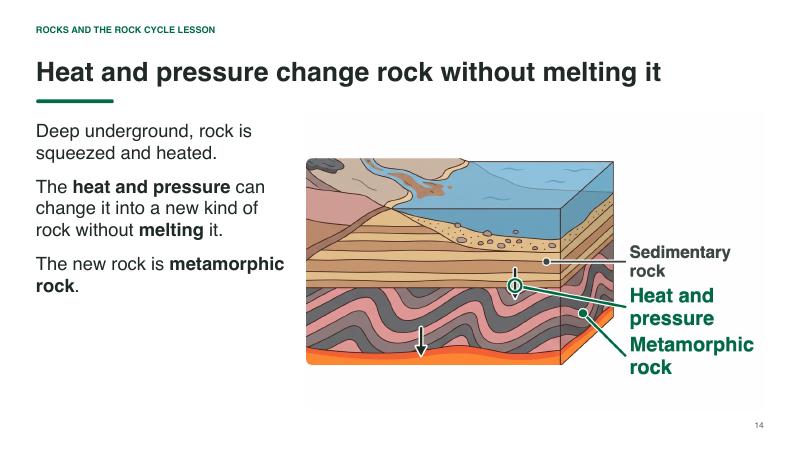
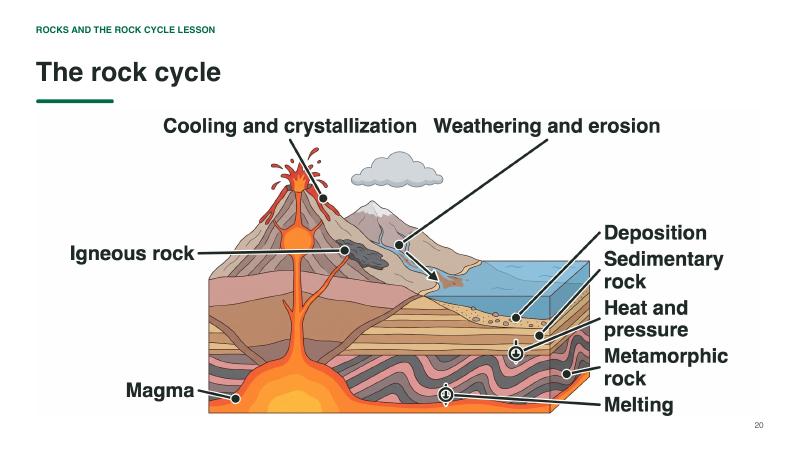
Teach Rocks and the Rock Cycle with 26 ready-made slides
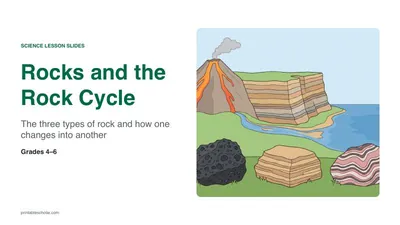
Open the PowerPoint and teach: an opening question, the parts one at a time on the diagram, quick checks and an exit question. Students fill in the guided notes sheet as you go.
Every slide comes with teacher notes: what to say, what to ask, and sample answers.
The slides (PowerPoint and a PDF copy) and the guided notes sheet come with the pack.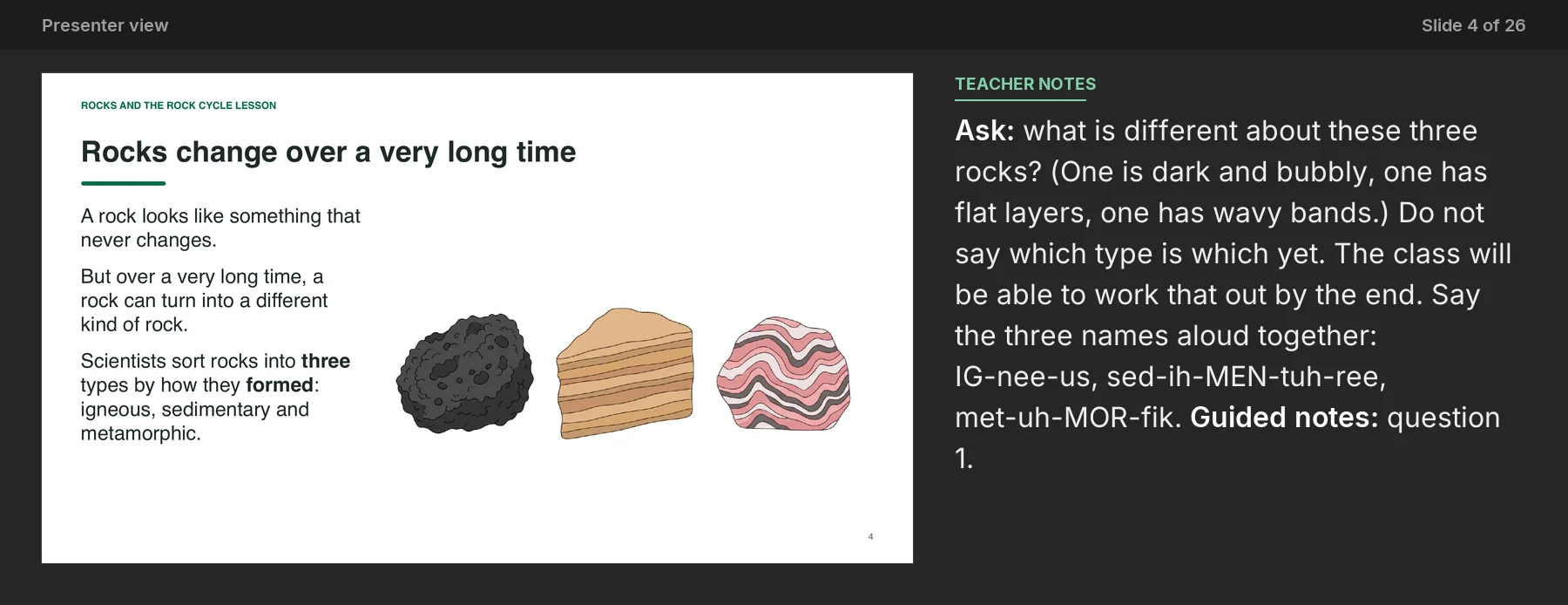
What is in the pack, in teaching order
 In the pack
1. TeachLesson Slides26 slides to present, with your notes for each one.In the $7 pack
 In the pack
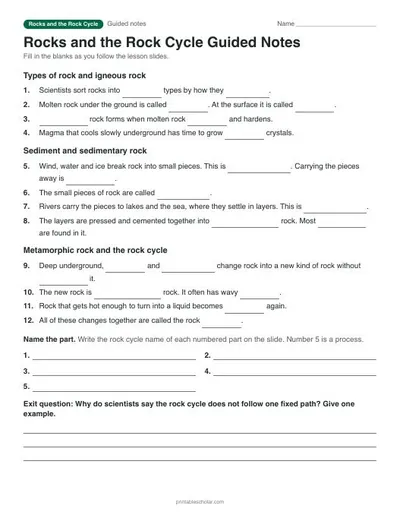
1. TeachRocks and the Rock Cycle Guided NotesStudents fill in the blanks as you present. With answer key.In the $7 pack
 Free
 Free
 Free
 Free
 In the pack
3. ReasonRead the DiagramRead the rock cycle picture: draw where the sediment goes, work out how each rock formed, where fossils are and where crystals are tiny.In the $7 pack
 In the pack
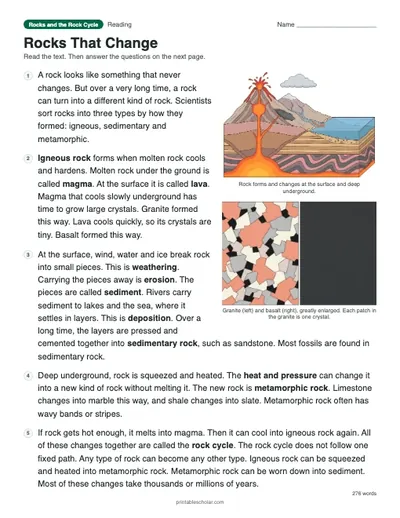
4. ReadRocks That ChangeA one-page text on the three types of rock and how one changes into another, with eight questions.In the $7 pack
 In the pack
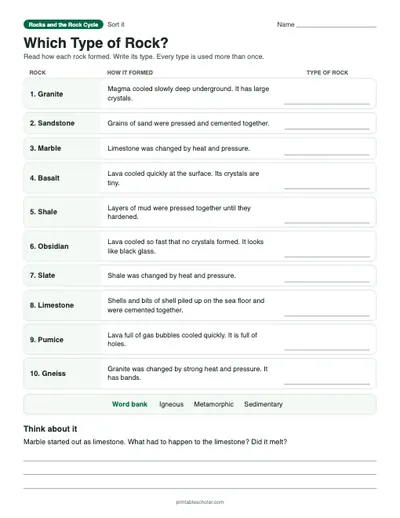
5. SortWhich Type of Rock?Read how ten well-known rocks formed and write the type of each one.In the $7 pack
 In the pack
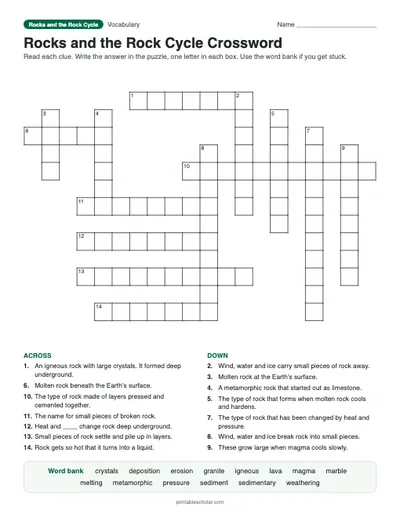
6. ReviewRocks and the Rock Cycle CrosswordFourteen rock and rock cycle words with clues and a word bank.In the $7 pack
 In the pack
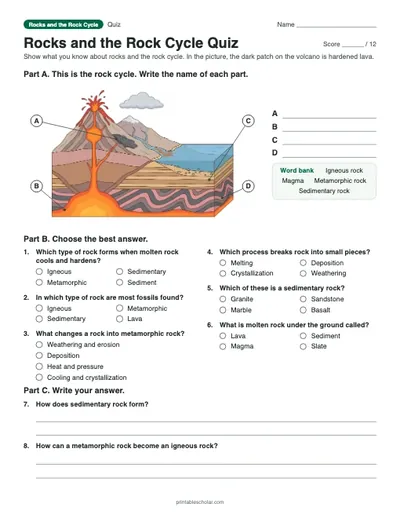
7. CheckRocks and the Rock Cycle QuizLabel four parts of the rock cycle, six multiple choice and two written answers. Scored out of 12.In the $7 pack
Rocks and the Rock Cycle worksheets, crossword and quiz
The Rocks and the Rock Cycle teaching pack is 26 lesson slides (PowerPoint and PDF) and 10 printables with answer keys for grades 4 to 6, in the order you would teach them: the guided notes for the lesson slides, 4 diagram sheets, then “Read the Diagram” (a worksheet), “Rocks That Change” (a reading passage), “Which Type of Rock?” (a sorting table), a vocabulary crossword and a quiz.
The sheets are in a suggested teaching order: teach the lesson, have students label the blank diagrams, then work through the practice sheets and finish with the quiz. Use them all over a week or pick the ones you need. The answer keys are together at the back.
The diagrams are free to download on this page. The other sheets come with the pack ($7), which is also in the Elementary Science bundle (grades 3 to 6).
The three types of rock
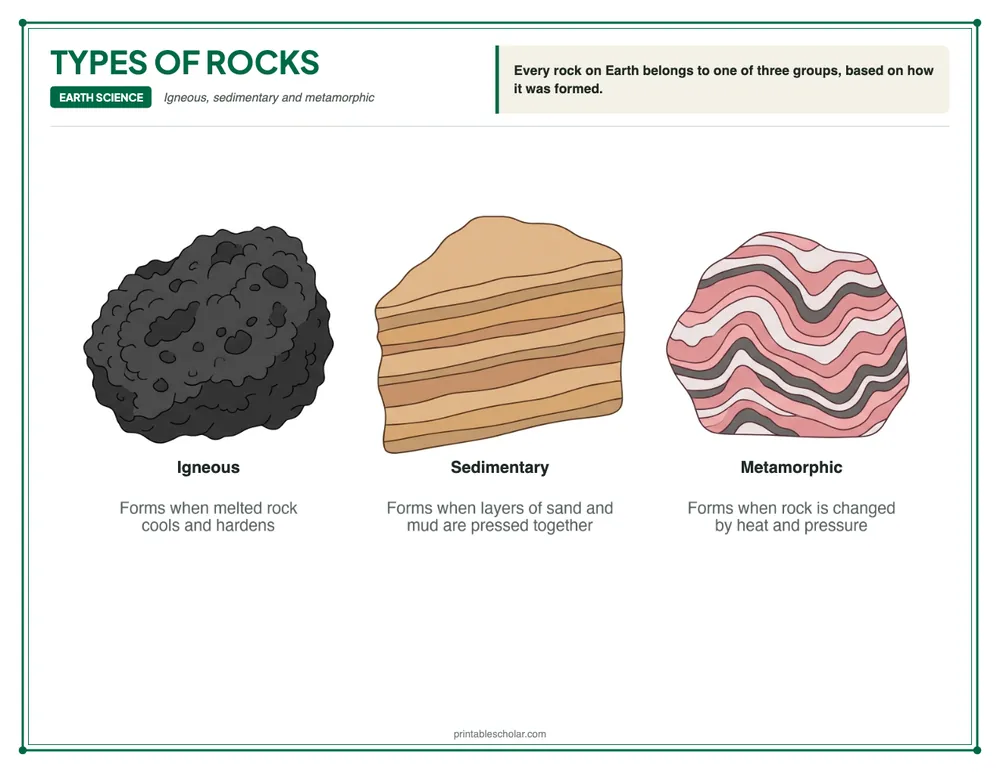
Every rock on Earth belongs to one of three groups, based on how it was formed. Here is what happens at each labeled part of the diagram:
| Rock type | What it does | Why it matters |
|---|---|---|
| Igneous | Forms when melted rock (magma or lava) cools and hardens. Often dark and glassy, like cooled lava. | Most of Earth's crust — the ground beneath your feet — started out as igneous rock. Without it, the ocean floors wouldn't exist, and volcanic islands like Hawaii would never have risen from the sea. |
| Sedimentary | Forms when layers of sand, mud and tiny bits of rock are pressed together over a long time. You can often see the flat layers. | Fossils are almost always found in sedimentary rock, because the layering process buries and preserves shells, bones, and leaves before they can decay. Strip away sedimentary rock, and most of the fossil record — everything we know about dinosaurs and ancient life — disappears with it. |
| Metamorphic | Forms when an existing rock is changed by heat and pressure deep underground, often showing wavy bands or stripes. | Marble, one of the most prized building stones in history, is metamorphic — it began as ordinary limestone before heat and pressure transformed it into something harder and more beautiful. The same process that produces marble also builds mountain ranges, squeezing and reshaping rock as tectonic plates collide. |
How to print
Choose Download PDF for a ready-to-print file that fits US Letter paper (8.5 × 11") in landscape, or Download PNG for the high-resolution image.
Frequently asked questions
What are the three types of rock?
Igneous (cooled magma or lava), sedimentary (pressed layers of sediment), and metamorphic (rock changed by heat and pressure).
How is each type of rock formed?
Igneous rock forms from cooling melted rock, sedimentary rock forms from compacted layers of sediment, and metamorphic rock forms when heat and pressure change an existing rock.
What paper size should I print this on?
The diagram is sized for standard US Letter paper (8.5 × 11") in landscape orientation. Use "Download PDF" for a print-ready file that fits the page automatically.
Are there Rocks and the Rock Cycle worksheets to go with the diagram?
Yes. The Rocks and the Rock Cycle teaching pack, for grades 4 to 6, has 26 lesson slides and 10 printables with answer keys: the guided notes for the lesson slides, 4 diagram sheets, then “Read the Diagram” (a worksheet), “Rocks That Change” (a reading passage), “Which Type of Rock?” (a sorting table), a vocabulary crossword and a quiz. The diagrams are free to download on this page. The other sheets come with the pack ($7), which is also in the Elementary Science bundle (grades 3 to 6).
Related: Where plates meet, rock melts and is squeezed into new rock. See the plates on our tectonic plate map.