Solar System Diagram
Free printable solar system diagram — a labeled illustration of the Sun and the eight planets in order, from Mercury to Neptune. Download a high-resolution PDF or PNG for Letter paper.
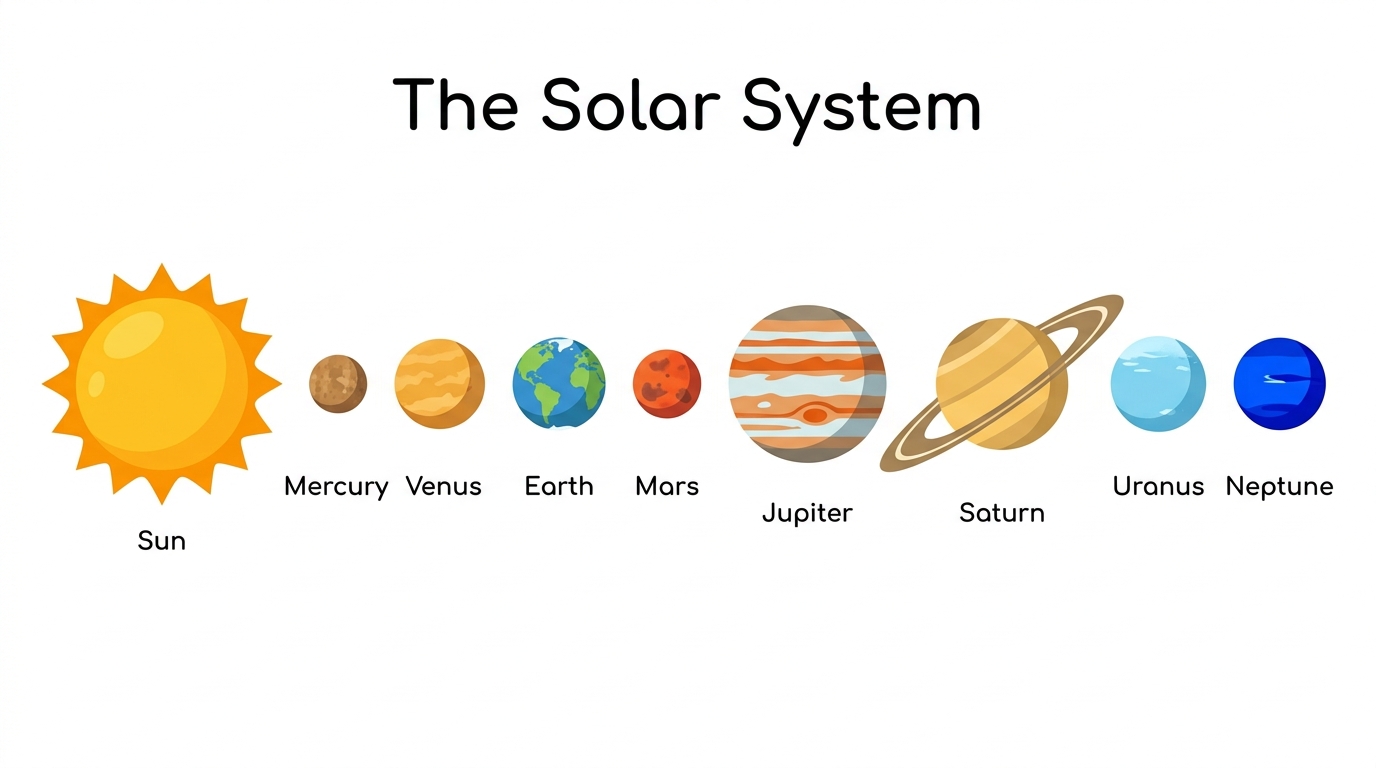
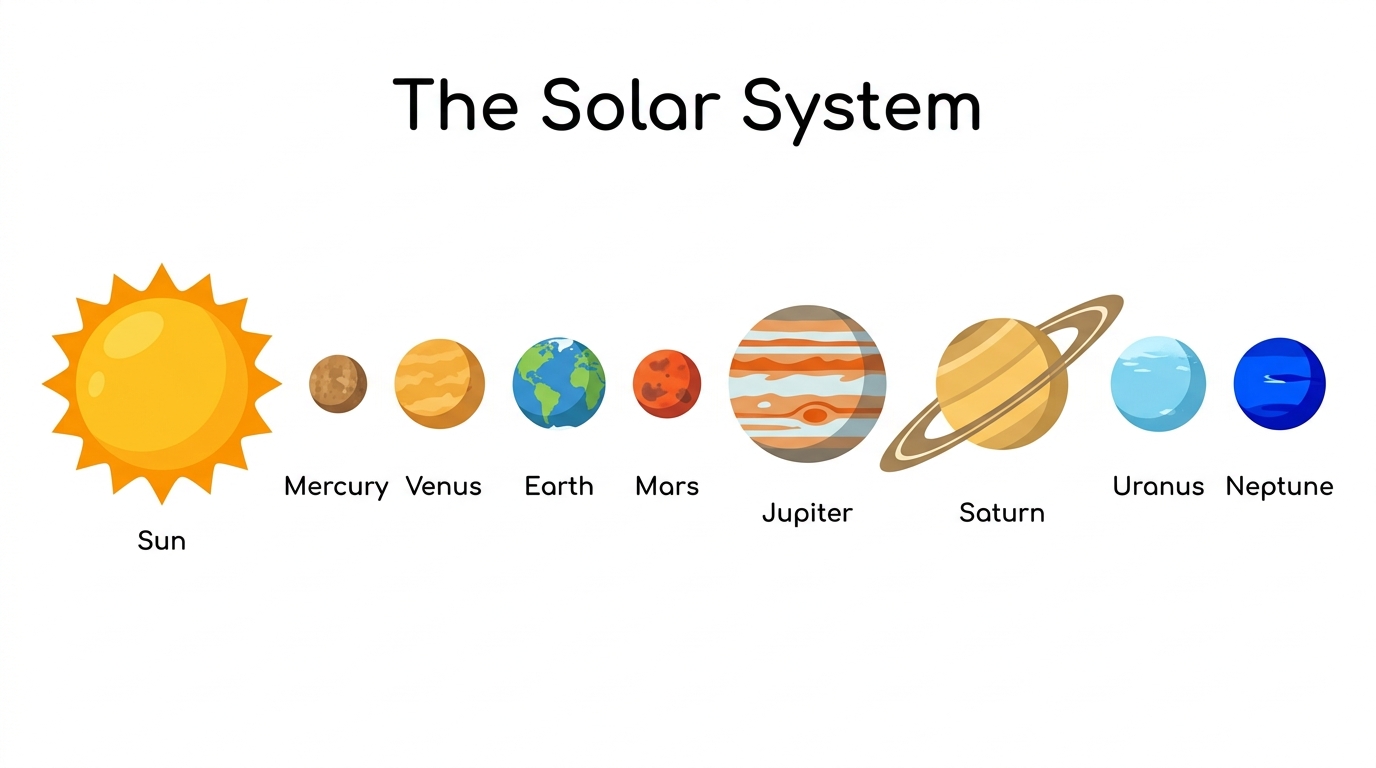
The Sun and the eight planets
The solar system is the Sun and everything that orbits it, including the eight planets. Here is what happens at each labeled part of the diagram:
| Object | What it does | Why it matters |
|---|---|---|
| Sun | The star at the center of the solar system; its gravity holds everything in orbit. | Remove the sun and nearly every food chain on Earth collapses within days, because there would be no new energy entering the living world at all. A few rare ecosystems near deep-sea vents run on chemical energy instead, but for the vast majority of life — including every plant, animal, and person you've ever seen — it all starts here. |
| Mercury | The smallest planet and the closest to the Sun. | Being so close to the Sun with almost no atmosphere means Mercury swings from 430°C during the day to -180°C at night — the most extreme temperature swings of any planet. It shows us how much a blanket of air really matters for making a world livable. |
| Venus | The hottest planet, wrapped in thick, cloudy air. | Even though Venus is farther from the Sun than Mercury, it is hotter — proving that distance alone doesn't decide a planet's temperature. Its thick atmosphere traps heat like a sealed car on a summer day, a runaway greenhouse effect that turned it into a 465°C oven. |
| Earth | Our home — the only planet known to have life and liquid water. | Sitting at just the right distance from the Sun — the so-called "Goldilocks zone" — Earth is warm enough for liquid water but cool enough that water doesn't all boil away. That liquid water is the reason every living thing you have ever seen exists. |
| Mars | The red planet, named for its rusty, iron-rich soil. | Mars once had rivers and possibly oceans, which means conditions for life may have existed there billions of years ago. Scientists study it today as the best nearby test case for understanding how a planet can lose its atmosphere and go from wet to bone-dry. |
| Jupiter | The largest planet, a giant ball of gas with a Great Red Spot. | Jupiter's enormous gravity acts like a cosmic vacuum cleaner, pulling in asteroids and comets that might otherwise streak toward the inner solar system — and Earth. The Great Red Spot is a storm wider than our entire planet that has been raging for at least 350 years. |
| Saturn | The ringed planet, famous for its bright rings of ice and rock. | Saturn's rings look solid from a distance, but they are actually billions of individual chunks of ice and rock, each one orbiting on its own path. So little mass is packed into such a wide volume that Saturn is the only planet in the solar system less dense than water — it would float in a big enough ocean. |
| Uranus | An ice giant that spins on its side. | Uranus is tipped so far on its axis that its poles take turns pointing directly at the Sun, giving it seasons that each last about 21 years. That strange tilt was almost certainly caused by a massive collision with an Earth-sized object billions of years ago. |
| Neptune | The farthest planet from the Sun — a cold, windy ice giant. | Despite receiving almost no heat from the Sun, Neptune generates winds that top 2,000 km/h — the fastest in the solar system — powered by heat escaping from deep inside the planet itself. It reminds us that a world can be wildly active even in the frozen outer reaches of space. |
Companion worksheet
A free fill-in worksheet with an answer key, built from the labels above — students match each object to its description, then answer a couple of short questions. Great for a quick check after using the diagram.
How to print
Choose Download PDF for a ready-to-print file that fits US Letter paper (8.5 × 11") in landscape, or Download PNG for the high-resolution image.
Frequently asked questions
How many planets are in the solar system?
There are eight planets: Mercury, Venus, Earth, Mars, Jupiter, Saturn, Uranus and Neptune.
What is the order of the planets from the Sun?
From closest to farthest: Mercury, Venus, Earth, Mars, Jupiter, Saturn, Uranus and Neptune.
Is Pluto a planet?
Pluto is now classified as a "dwarf planet," so it is not counted among the eight main planets of the solar system.
What paper size should I print this on?
The diagram is sized for standard US Letter paper (8.5 × 11") in landscape orientation. Use "Download PDF" for a print-ready file that fits the page automatically.