Parts of a Flower Diagram
Free printable parts of a flower diagram — a labeled cross-section showing the petal, sepal, stamen, pistil and more. Download a high-resolution PDF or PNG for Letter paper.
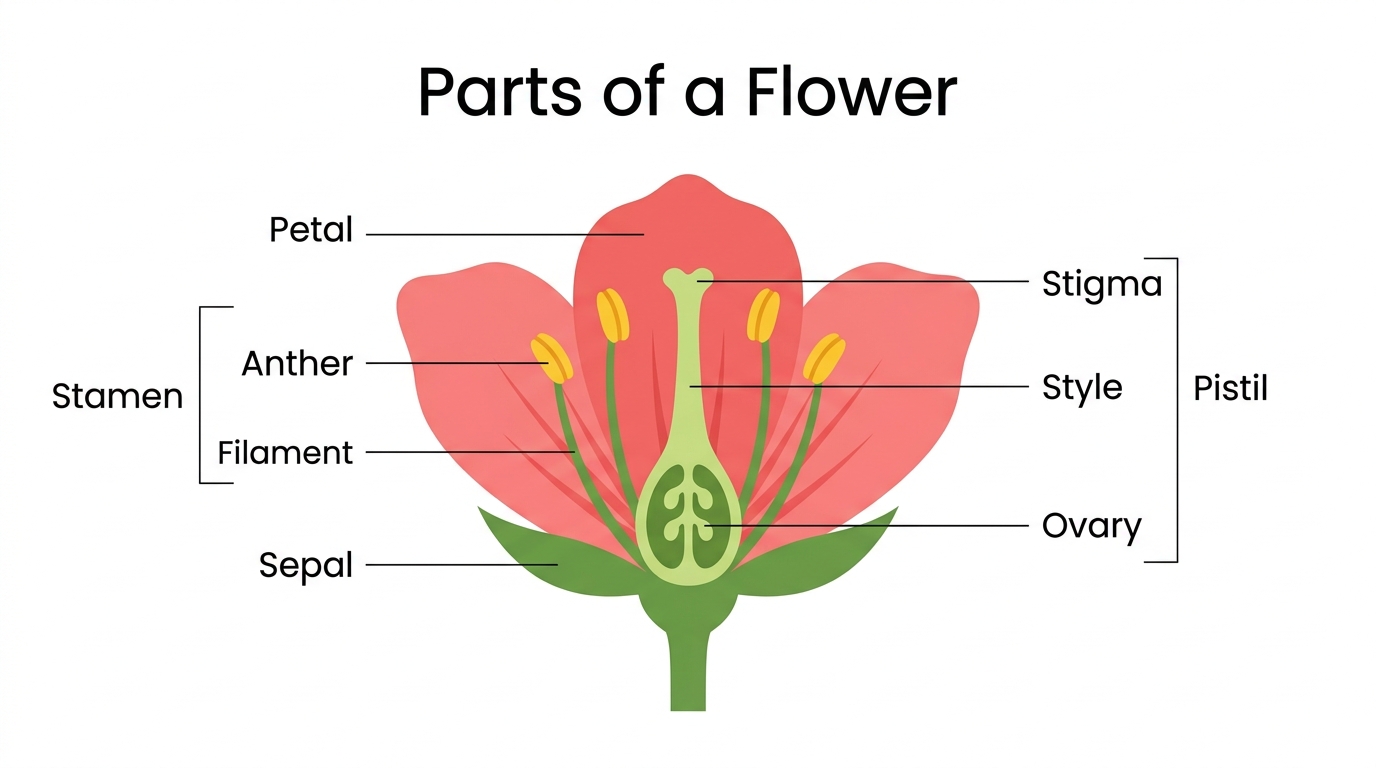
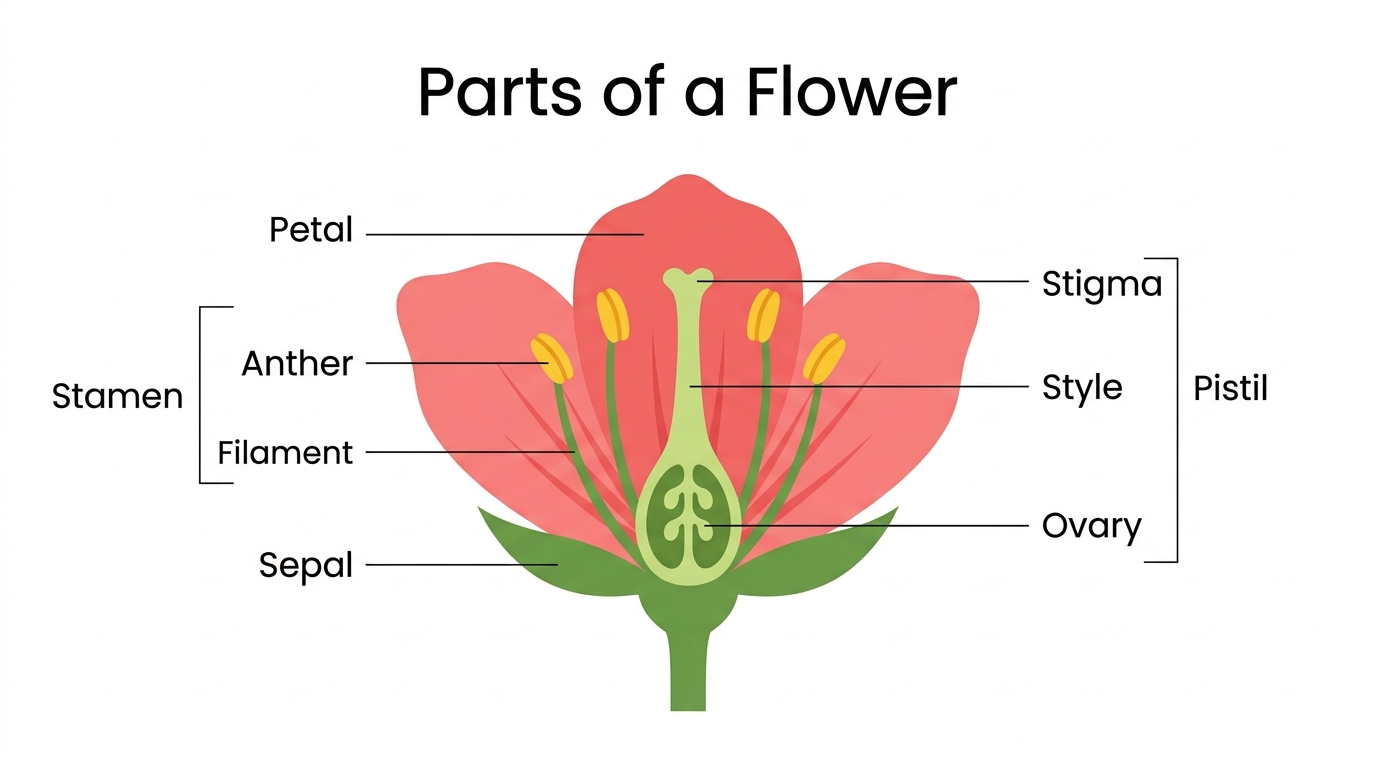
The parts of a flower
A flower has male parts (the stamen) and female parts (the pistil) that work together to make seeds. Here is what happens at each labeled part of the diagram:
| Part | What it does | Why it matters |
|---|---|---|
| Petal | The colorful part that attracts insects and birds to the flower. | Without petals, a flower would have no way to advertise itself — no visiting bee means no pollen delivery and no seeds. The color and shape of petals are so precisely tuned to pollinators that some flowers can only be pollinated by one specific species of insect. |
| Sepal | A small leaf-like part that protects the flower bud before it opens. | Before a bud opens, the sepals wrap tightly around it like a protective jacket, shielding the delicate inner parts from cold, dryness, and hungry insects. If sepals failed, many flowers would be damaged before they ever got the chance to bloom. |
| Stamen | The male part of the flower, made of the anther and the filament. | Stamens are the flower's pollen factory — no stamen means no pollen, and no pollen means reproduction simply stops. A single flower can have anywhere from one to hundreds of stamens, and having more generally improves the odds that a pollinator picks some up. |
| Anther | Produces pollen at the top of the stamen. | The anther is where pollen grains are actually manufactured and stored, so it is the origin point of the entire reproductive process. When an insect brushes against it, thousands of microscopic pollen grains cling to the visitor's body, ready to be carried away. |
| Filament | The stalk that holds up the anther. | Holding the anther up on a long filament positions it right in the path of any passing pollinator, dramatically increasing the chances of contact. A filament that is too short would bury the anther deep inside the flower where visitors might never reach it. |
| Pistil | The female part of the flower, made of the stigma, style and ovary. | The pistil is the entire female side of the equation — damage or remove it, and the flower cannot produce a single seed no matter how much pollen arrives. Plants that produce fruit (including apples, tomatoes, and strawberries) depend entirely on a healthy pistil developing into that fruit after fertilization. |
| Stigma | The sticky top of the pistil that catches pollen. | That stickiness is not an accident — the stigma's surface is coated with special proteins that also check whether arriving pollen is from the right species, rejecting incompatible grains before wasting energy on fertilization. Without it, pollen would simply blow past with nowhere to land. |
| Style | The stalk that connects the stigma to the ovary. | Once pollen lands on the stigma, it has to grow a microscopic tube all the way down the style to reach the ovary — a journey that can take hours. The style acts as both a highway and a filter, with some plants using chemical signals along its length to block pollen from closely related plants and prevent inbreeding. |
| Ovary | Holds the ovules that become seeds after fertilization. | After fertilization, the ovary swells and transforms into what we usually call a fruit — the fleshy part of an apple, the pod of a pea, or the berry on a tomato plant. Every seed inside that fruit was once an ovule sitting in the ovary, waiting for a pollen tube to arrive. |
Companion worksheet
A free fill-in worksheet with an answer key, built from the labels above — students match each part to its description, then answer a couple of short questions. Great for a quick check after using the diagram.
How to print
Choose Download PDF for a ready-to-print file that fits US Letter paper (8.5 × 11") in landscape, or Download PNG for the high-resolution image.
Frequently asked questions
What are the parts of a flower?
The main parts are the petal, sepal, stamen (anther and filament) and pistil (stigma, style and ovary).
What is the difference between the stamen and the pistil?
The stamen is the male part that makes pollen; the pistil is the female part that receives pollen and makes seeds.
What paper size should I print this on?
The diagram is sized for standard US Letter paper (8.5 × 11") in landscape orientation. Use "Download PDF" for a print-ready file that fits the page automatically.