 Printable Scholar
Scientific Method Diagram
Free printable scientific method diagram for grades 3-5: the seven steps, from asking a question to sharing the results, shown as one bean plant experiment, plus a blank diagram to label. PDF or PNG for Letter paper.
Part of the Scientific Method teaching pack for grades 3 to 5: 24 lesson slides and 9 printables with answer keys. The diagram and the blank one to label are free.
Teaching ideas for Scientific Method
Pick the ideas that suit your class, then follow the plan or use the sheets in any order.
- Bean plants, sun and dark. Plant bean seeds in two matching pots with the same soil. Put one on a sunny windowsill and one in a dark cupboard, water both the same, and compare them over two weeks.
- Paper towel climb. Hang strips of different paper towels with their ends in a cup of colored water. Students predict, then watch which strip the water climbs highest.
- Paper airplane test. Students fold two paper airplanes from the same paper, changing only one thing. They throw both the same way from the same spot and compare.
- Spot the unfair test. Drop two different balls from two different heights. Ask the class what changed, why the test is not fair and how to fix it.
A plan for the week
| Day 1 | Open with one of the ideas above. Teach the lesson with the slides while students fill in the guided notes. Then students label the blank diagram. | Lesson slides (PowerPoint) (in the pack) Scientific Method Guided Notes (in the pack) Scientific Method Diagram Blank Scientific Method Diagram |
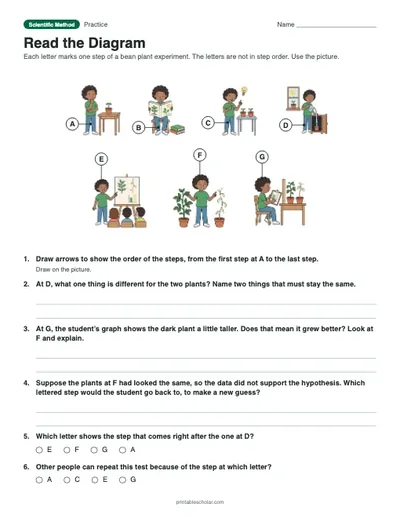
| Day 2 | Students work out what is happening on the picture on “Read the Diagram”: the order of the steps, the one thing that changes in the bean plant test and what the student would do if the results did not support the hypothesis. | Read the Diagram (in the pack) |
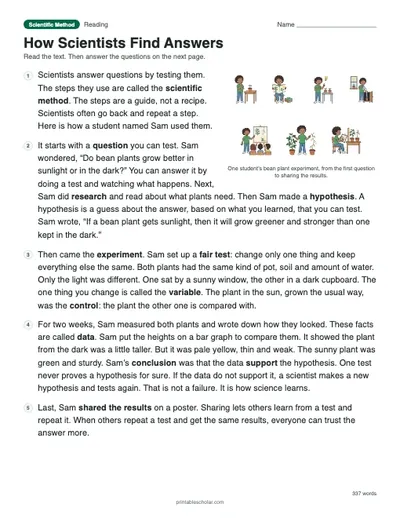
| Day 3 | Read “How Scientists Find Answers” and answer the questions. | How Scientists Find Answers (in the pack) |
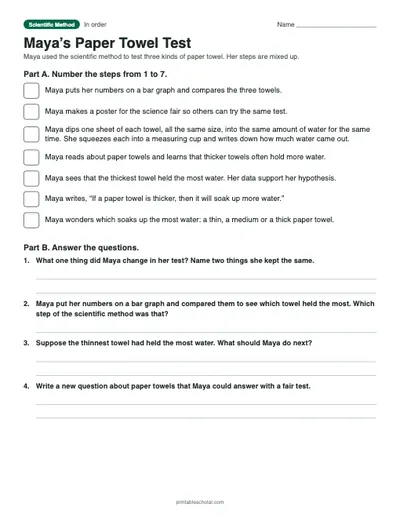
| Day 4 | Students put a paper towel investigation in order on “Maya’s Paper Towel Test”, then decide which tests are fair on “Spot the Fair Test.” | Maya’s Paper Towel Test (in the pack) Spot the Fair Test (in the pack) |
| Day 5 | Review with the crossword, then give the quiz. | Scientific Method Crossword (in the pack) Scientific Method Quiz (in the pack) |
The sheets marked “in the pack” are in the Scientific Method teaching pack below.
NGSS standards
- Supports 3-5-ETS1-3: Plan and carry out fair tests in which variables are controlled and failure points are considered to identify aspects of a model or prototype that can be improved.
Scientific Method teaching pack
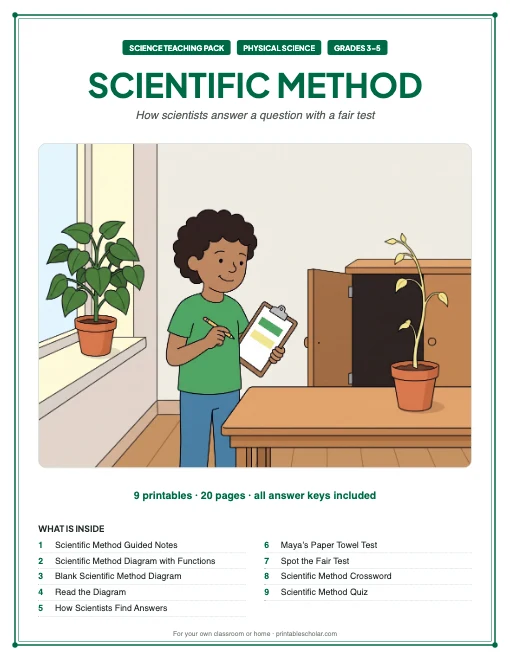
A ready-to-teach lesson: 24 slides and 9 printables. Present the slides while students fill in the guided notes, then use the worksheets, crossword and quiz, with every answer key.
Teaching the scientific method? This pack has ready-made lesson slides and 8 printables that follow one bean plant experiment through all seven steps and teach fair tests, data and conclusions, in teaching order, with every answer key.
Free on this page: the diagram and the blank one to label, marked Download below. The whole pack is $7: 20 pages in one print-ready file, the 24 lesson slides, the practice sheets, the crossword, the quiz and every answer key.
OnlineThe pack also comes as an online lesson for Google Classroom: every part on screen for students, plus a self-grading Google Forms quiz.
One-time purchase. Instant download. Secure checkout by Stripe. Want to see a whole pack first? The Skeletal System pack is free.See all 30 packs in the bundle
- The Microscope
- Photosynthesis
- Parts of a Plant and Flower
- Life Cycle of a Plant
- Life Cycles of a Butterfly and a Frog
- Food Chains and Food Webs
- The Water Cycle
- Human Body Organs
- Skeletal System
- Muscular System
- Digestive System
- Respiratory System
- Heart and Circulation
- Nervous System and Brain
- Eye and Ear
- Parts of a Tooth
- Inside the Earth and Volcanoes
- Rocks and the Rock Cycle
- Layers of the Atmosphere
- Types of Clouds
- Weathering, Erosion and Deposition
- Types of Landforms
- The Solar System
- The Seasons
- Moon Phases and Eclipses
- States of Matter
- Forms of Energy
- Scientific Method (this pack)
- Simple Machines
- Magnets and Magnetic Fields
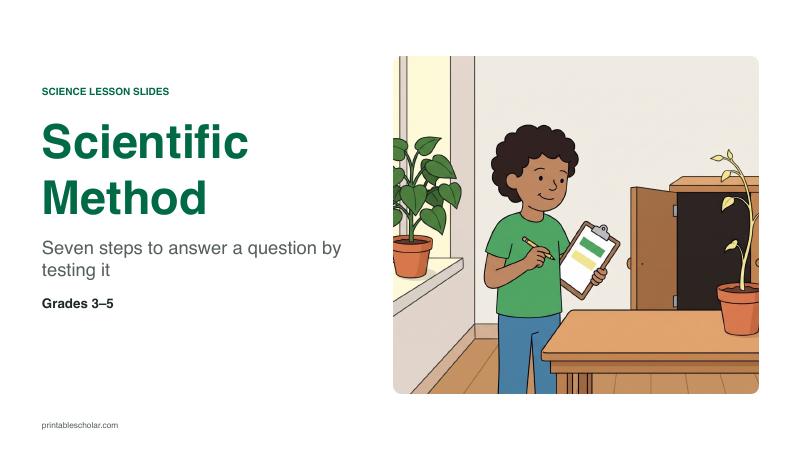
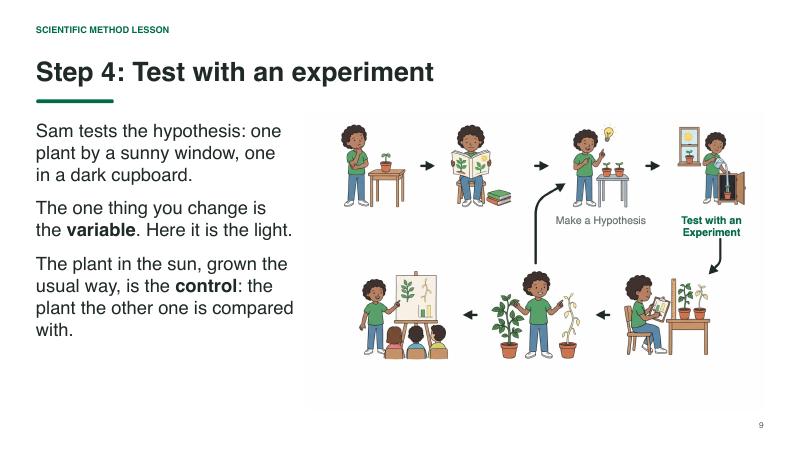
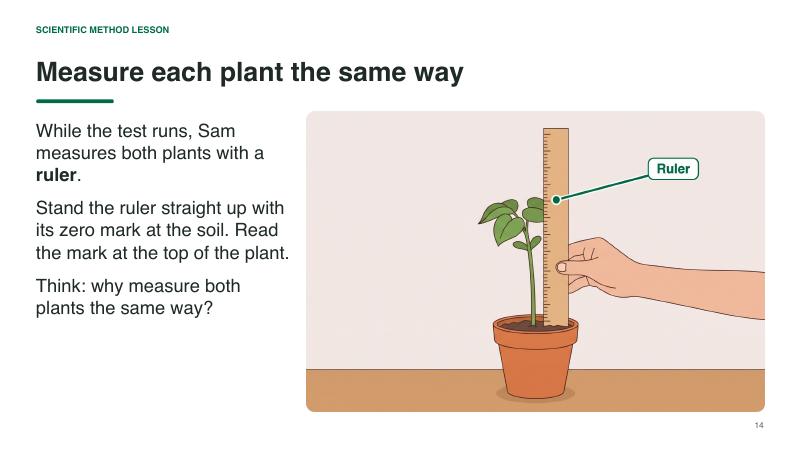
Teach Scientific Method with 24 ready-made slides
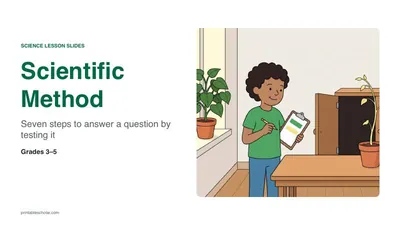
Open the PowerPoint and teach: an opening question, the parts one at a time on the diagram, quick checks and an exit question. Your notes for each slide are in the speaker notes. Students fill in the guided notes sheet as you go.
The slides (PowerPoint and a PDF copy) and the guided notes sheet come with the pack.What is in the pack, in teaching order
 In the pack
1. TeachLesson Slides24 slides to present, with your notes for each one.In the $7 pack
 In the pack
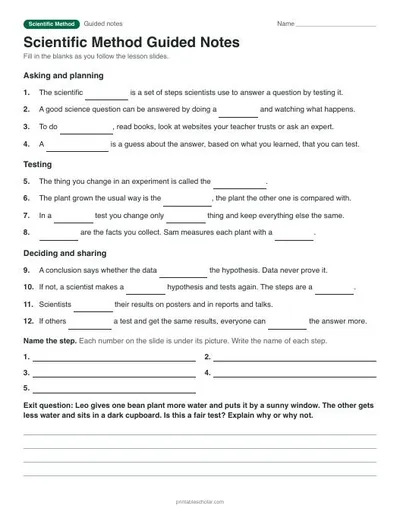
1. TeachScientific Method Guided NotesStudents fill in the blanks as you present. With answer key.In the $7 pack
 Free
 Free
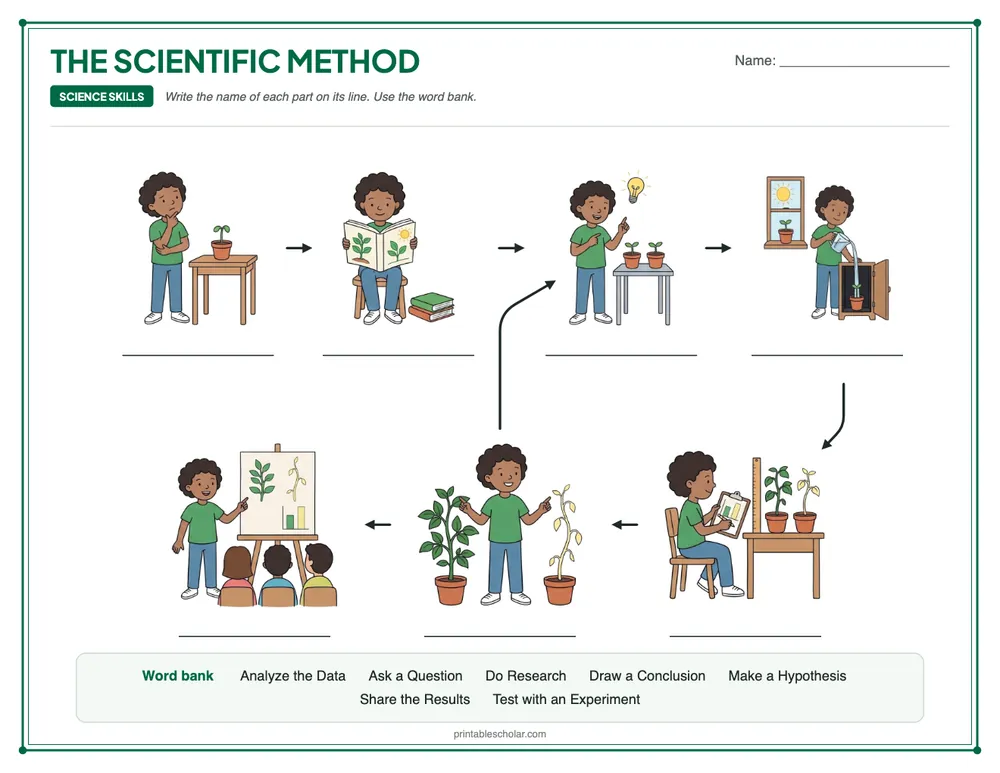
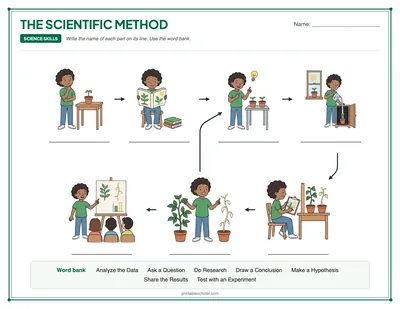
2. LabelBlank Scientific Method DiagramStudents label 7 steps from a word bank.Download free PDF
 In the pack
3. ReasonRead the DiagramRead the scientific method picture: draw the order of the steps, find the one thing that changes in the bean plant test, read the graph with the plants and decide where to go back to.In the $7 pack
 In the pack
4. ReadHow Scientists Find AnswersA one-page text on how one student used the scientific method to test bean plants, with eight questions.In the $7 pack
 In the pack
5. OrderMaya’s Paper Towel TestNumber the seven steps of a paper towel investigation in order, then answer four questions about it.In the $7 pack
 In the pack
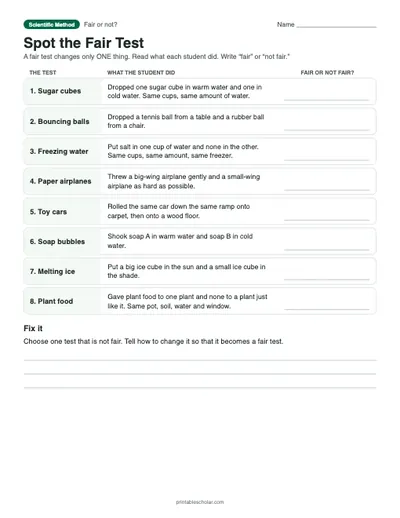
6. ApplySpot the Fair TestRead eight student experiments and decide whether each one is a fair test, then fix one that is not.In the $7 pack
 In the pack
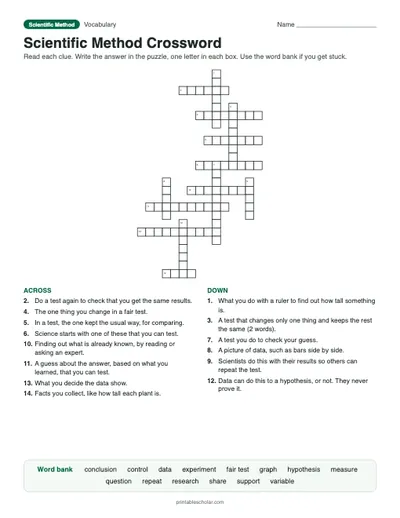
7. ReviewScientific Method CrosswordFourteen scientific method words with clues and a word bank.In the $7 pack
 In the pack
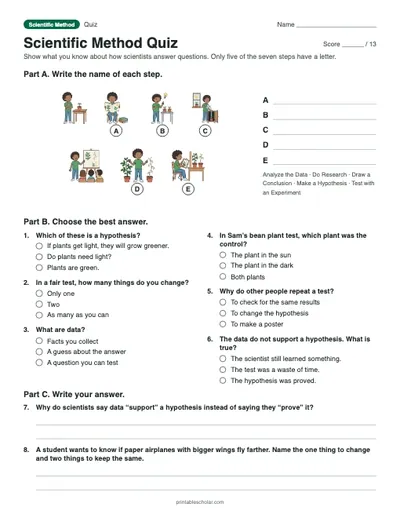
8. CheckScientific Method QuizName five steps on the picture, six multiple choice and two written answers. Scored out of 13.In the $7 pack
Scientific Method worksheets, crossword and quiz
The Scientific Method teaching pack is 24 lesson slides (PowerPoint and PDF) and 9 printables with answer keys for grades 3 to 5, in the order you would teach them: the guided notes for the lesson slides, the labeled diagram and the blank one to label, then “Read the Diagram” (a worksheet), “How Scientists Find Answers” (a reading passage), “Maya’s Paper Towel Test” (a sequencing sheet), “Spot the Fair Test” (a sorting table), a vocabulary crossword and a quiz.
The sheets are in a suggested teaching order: teach the lesson, have students label the blank diagram, then work through the practice sheets and finish with the quiz. Use them all over a week or pick the ones you need. The answer keys are together at the back.
The diagram and the blank one to label are free to download on this page. The other sheets come with the pack ($7), which is also in the Elementary Science bundle (grades 3 to 6).
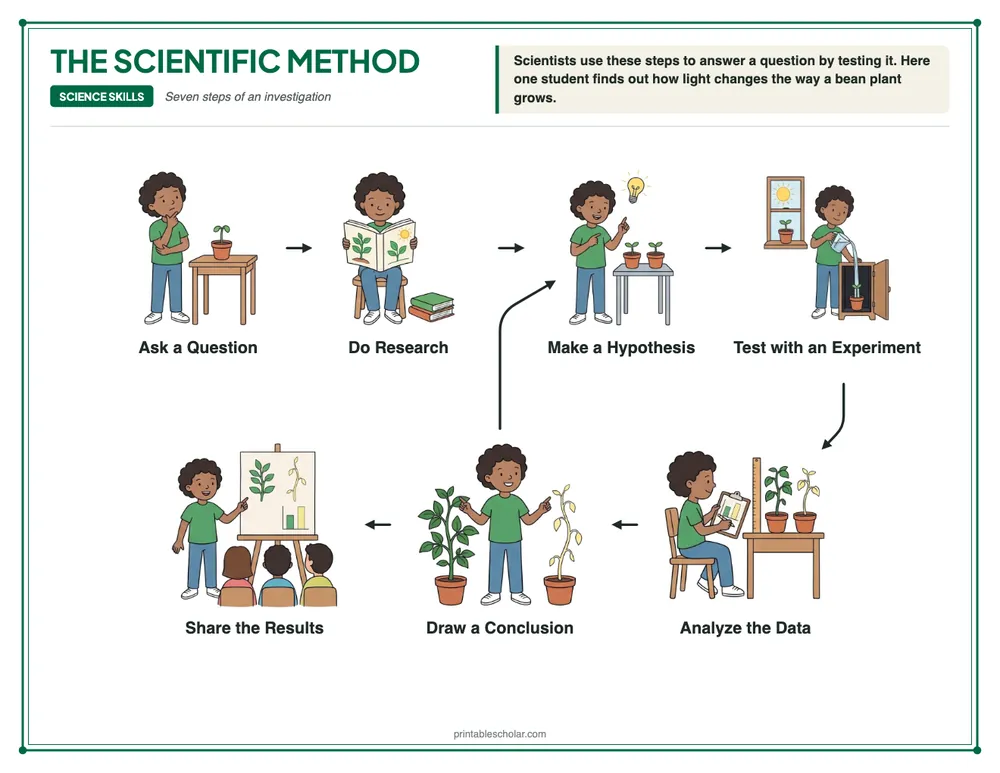
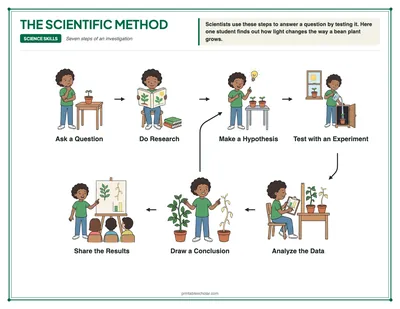
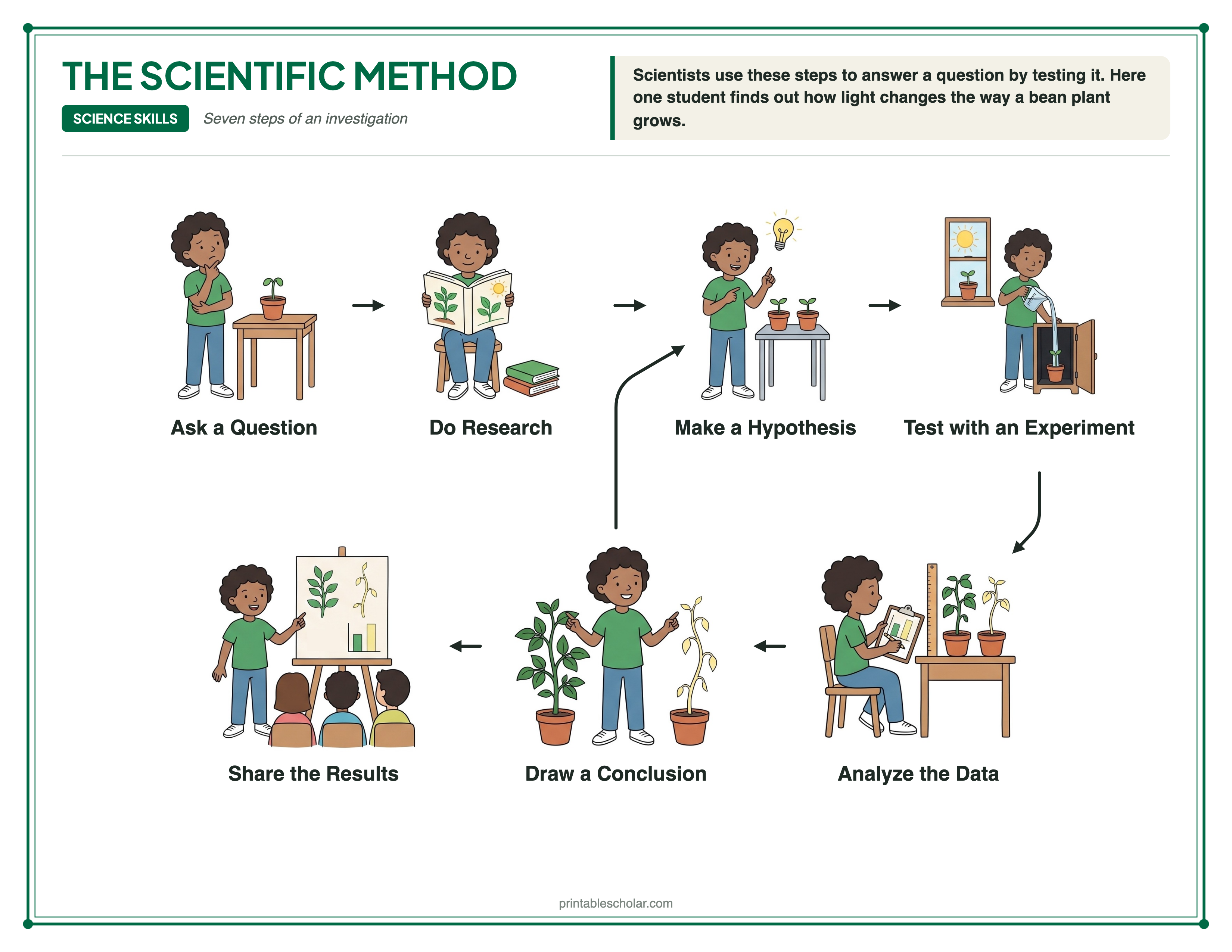
Science starts with a question. The scientific method turns that question into a test that gives an answer you can trust. The steps on this diagram are the ones most grade 3-5 classes learn: ask a question, do research, make a hypothesis, test with an experiment, analyze the data, draw a conclusion and share the results. The arrow from Draw a Conclusion back to Make a Hypothesis shows that science often goes round again: if the results don’t support the hypothesis, scientists form a new one and test again. Real scientists don’t always follow the steps in a fixed order, and they often repeat some of them. Think of the steps as a guide to careful, fair science, not a recipe that must be followed exactly.
The seven steps of the scientific method
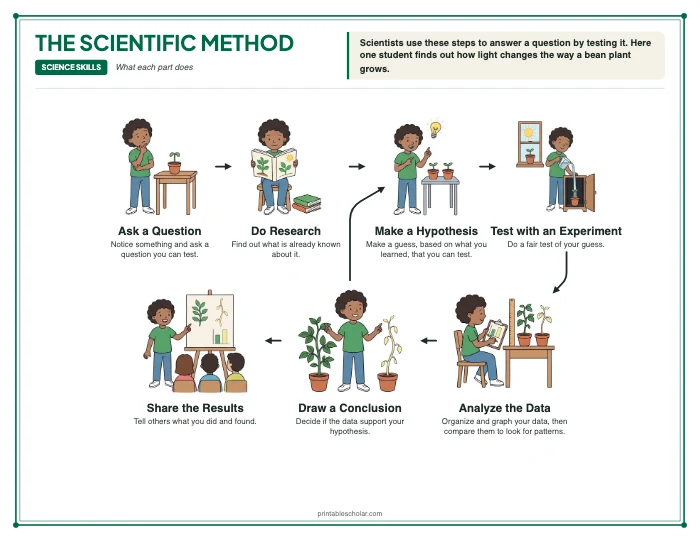
The scientific method is a set of steps scientists use to answer a question by testing it. This diagram follows one student through all seven steps, from asking whether bean plants grow better in sunlight or in the dark to sharing what they found. Here is what happens at each labeled part of the diagram:
| Step | What it does | Why it matters |
|---|---|---|
| Ask a Question | Notice something and ask a question you can test. | A good science question can be answered by doing a test and watching what happens. “Do bean plants grow better in sunlight or in the dark?” is a question you can test. “Which plant is the prettiest?” is not, because different people would give different answers. |
| Do Research | Find out what is already known about your question. | Read books, look at trusted websites or ask an expert. In the picture, the student reads about what plants need to grow. Research helps you make a smart guess and plan a fair test. |
| Make a Hypothesis | Make a guess, based on what you learned, that you can test. | A hypothesis is often written as an “If ... then ...” sentence: “If a bean plant gets sunlight, then it will grow greener and stronger than a bean plant kept in the dark.” It is based on what you learned in your research, and it does not have to turn out to be right. |
| Test with an Experiment | Do a fair test to check your hypothesis. | In a fair test you change only one thing and keep everything else the same. The student gives two bean plants the same kind of pot, the same soil and the same amount of water, and changes only the light: one plant sits by a sunny window and the other in a dark cupboard. The one thing you change is called the variable. While the test runs, the student measures both plants with a ruler and writes down what they see. |
| Analyze the Data | Organize and graph your data, then compare them to look for patterns. | Data are the facts you collect during the test, like how tall each plant is and what color its leaves are. The student puts the ruler measurements on a bar graph, so the two plants are easy to compare, and looks for what the numbers show. |
| Draw a Conclusion | Decide what the data show and whether they support your hypothesis. | The plant in the sun is green and sturdy. The plant in the dark is pale yellow, thin and weak, even though it stretched a little taller. The results support the hypothesis. If the results don’t support the hypothesis, scientists form a new one and test again. That is not a failure: it is how science learns. |
| Share the Results | Tell others what you did and what you found out. | Scientists share their results in reports, talks and posters, so others can learn from them and try the same test. When other people repeat a test and get the same results, everyone can trust the answer more. |
How to print
Choose Download PDF for a ready-to-print file that fits US Letter paper (8.5 × 11") in landscape, or Download PNG for the high-resolution image.
Frequently asked questions
What are the steps of the scientific method?
The seven steps on this diagram are: ask a question, do research, make a hypothesis, test with an experiment, analyze the data, draw a conclusion and share the results. Some books join or rename steps, for example calling the first step “observe”, or list five or six steps, but the ideas are the same.
What is a hypothesis?
A hypothesis is a smart guess about the answer to a question, based on what you already know, that can be checked with a test. It is often written as an “If ... then ...” sentence.
What happens if the hypothesis is wrong?
That is a normal part of science. A result that does not support the hypothesis still teaches you something. Scientists use what they learned to form a new hypothesis and test again.
What is a fair test?
A fair test changes only one thing, called the variable, and keeps everything else the same. Then you know that the one change you made is what caused the result.
What paper size should I print this on?
The diagram is sized for standard US Letter paper (8.5 × 11") in landscape orientation. Use "Download PDF" for a print-ready file that fits the page automatically.
Are there Scientific Method worksheets to go with the diagram?
Yes. The Scientific Method teaching pack, for grades 3 to 5, has 24 lesson slides and 9 printables with answer keys: the guided notes for the lesson slides, the labeled diagram and the blank one to label, then “Read the Diagram” (a worksheet), “How Scientists Find Answers” (a reading passage), “Maya’s Paper Towel Test” (a sequencing sheet), “Spot the Fair Test” (a sorting table), a vocabulary crossword and a quiz. The diagram and the blank one to label are free to download on this page. The other sheets come with the pack ($7), which is also in the Elementary Science bundle (grades 3 to 6).
Related: Find out what plants need to grow with our parts of a plant and photosynthesis diagrams.