Parts of a Wave Diagram
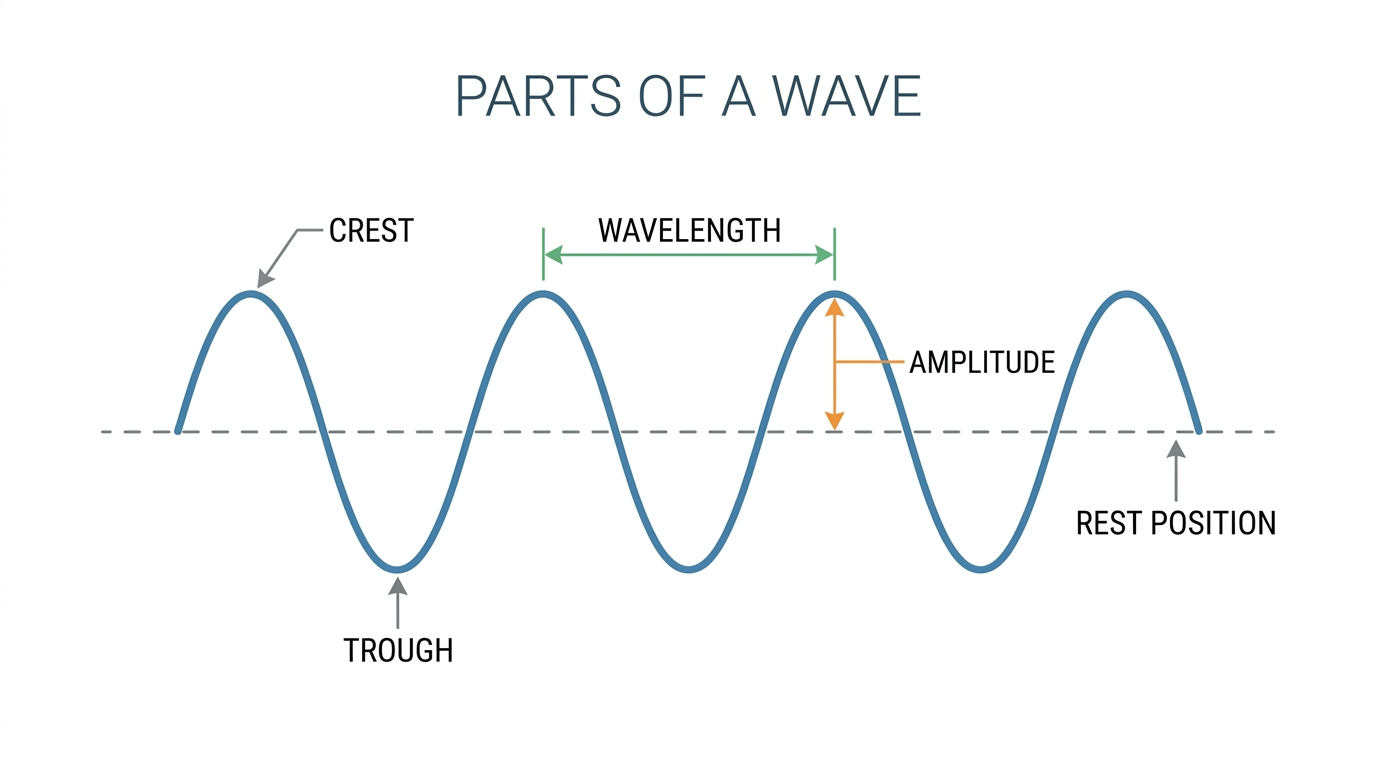
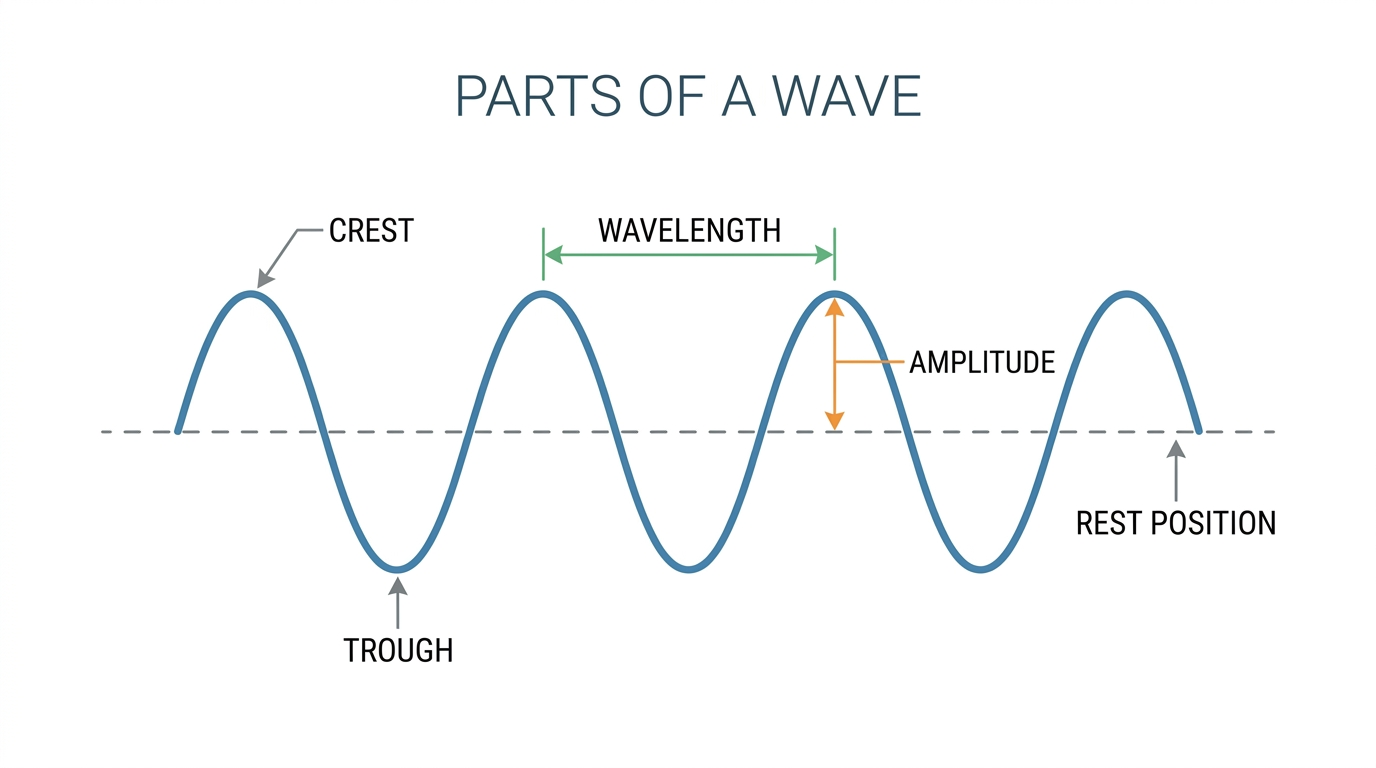
Free printable parts of a wave diagram — a labeled illustration showing the crest, trough, wavelength, amplitude and rest position. Download a high-resolution PDF or PNG for Letter paper.
The parts of a wave
A wave carries energy from one place to another. These are its main parts. Here is what happens at each labeled part of the diagram:
| Part | What it does | Why it matters |
|---|---|---|
| Crest | The highest point of a wave. | The crest is the peak of a wave's energy delivery — ocean waves crash on a beach at the crest, which is why that's the moment a surfer gets the biggest push. Without a defined high point, we couldn't compare the strength of one wave to another. |
| Trough | The lowest point of a wave. | Between every push of energy comes a pull: the trough is that low dip, and ships at sea actually dip down into troughs between swells. If a wave had no trough, it would just be a steady, flat push — not a wave at all. |
| Wavelength | The distance from one crest to the next crest. | Wavelength is what separates a radio wave from a microwave from visible light — they are all the same kind of wave, just stretched or compressed to different lengths. Change the wavelength of light slightly and your eye sees a completely different color. |
| Amplitude | The height of the wave from the rest position up to a crest. | Amplitude controls the intensity of the energy being carried: a loud sound has a large amplitude, and a whisper has a tiny one. In the ocean, a wave with a greater amplitude hits the shore with far more force — which is why tsunami waves, though often invisible out at sea, become catastrophically tall as they approach shallow water. |
| Rest position | The level line the wave moves up and down from. | The rest position is the baseline everything else is measured from — without it, amplitude would have no meaning because you'd have nothing to measure the height against. Think of it like sea level: it's the agreed-upon zero that makes all other measurements possible. |
Companion worksheet
A free fill-in worksheet with an answer key, built from the labels above — students match each part to its description, then answer a couple of short questions. Great for a quick check after using the diagram.
How to print
Choose Download PDF for a ready-to-print file that fits US Letter paper (8.5 × 11") in landscape, or Download PNG for the high-resolution image.
Frequently asked questions
What are the parts of a wave?
The main parts are the crest, the trough, the wavelength, the amplitude and the rest position.
What is the difference between wavelength and amplitude?
Wavelength is the distance from one crest to the next, while amplitude is the height of the wave from the middle to a crest.
What paper size should I print this on?
The diagram is sized for standard US Letter paper (8.5 × 11") in landscape orientation. Use "Download PDF" for a print-ready file that fits the page automatically.