 Printable Scholar
US History Timeline
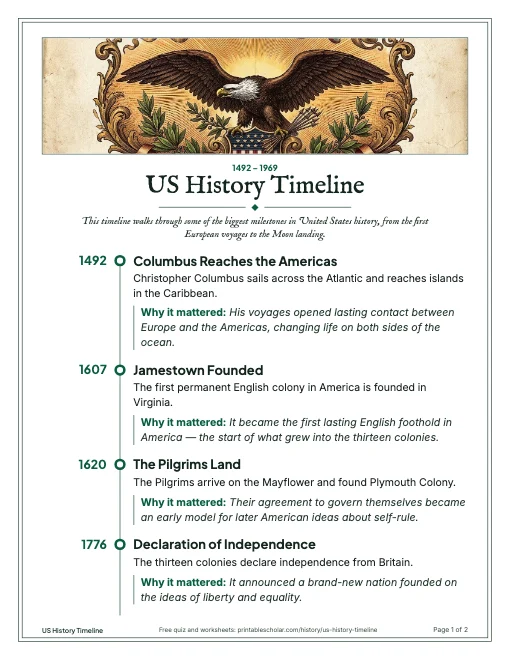
This timeline walks through some of the biggest milestones in United States history, from the first European voyages to the Moon landing.
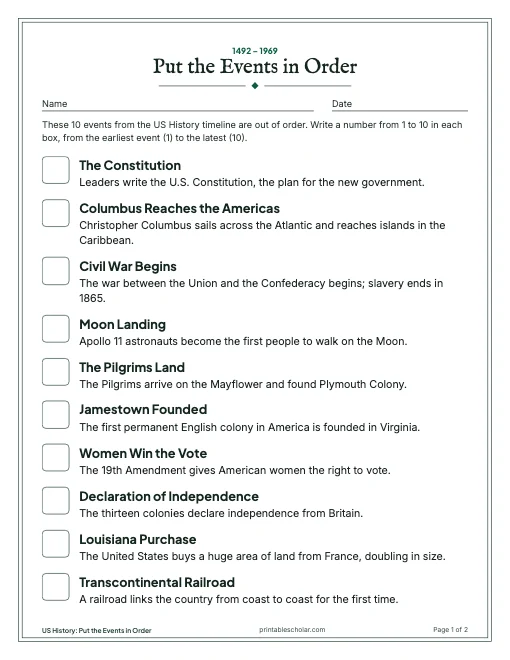
Put the Events in Order
The events shuffled, to number from first to last. With answer key.
Download PDF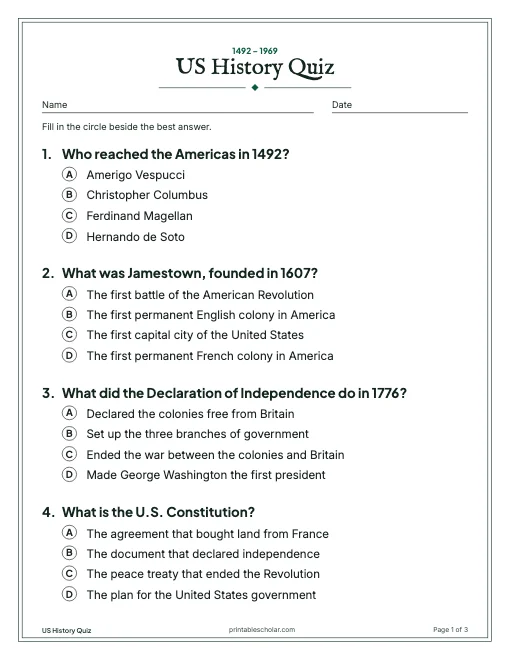
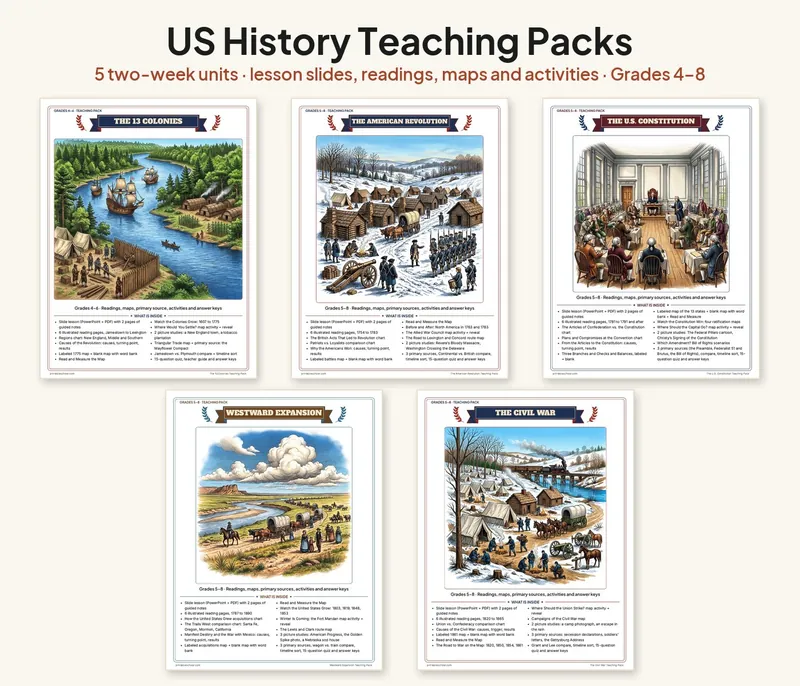
US History Bundle
Seven two-week units, Native American Regions to the Civil War, for grades 4 to 8.
See the bundleThe story of the United States stretches across more than 500 years — from the first ocean crossings, to a brand-new nation founded on big ideas, to astronauts walking on the Moon. This timeline pulls out some of the biggest milestones along the way. Read them in order and you get the shape of American history: exploration, colonies, a fight for independence, growth across a whole continent, a civil war, and a country that reached for the stars.
- 1492
Columbus Reaches the Americas
Christopher Columbus sails across the Atlantic and reaches islands in the Caribbean.
Why it mattered: His voyages opened lasting contact between Europe and the Americas, changing life on both sides of the ocean.
- 1607
Jamestown Founded
The first permanent English colony in America is founded in Virginia.
Why it mattered: It became the first lasting English foothold in America — the start of what grew into the thirteen colonies.
- 1620
The Pilgrims Land
The Pilgrims arrive on the Mayflower and found Plymouth Colony.
Why it mattered: Their agreement to govern themselves became an early model for later American ideas about self-rule.
- 1776
Declaration of Independence
The thirteen colonies declare independence from Britain.
Why it mattered: It announced a brand-new nation founded on the ideas of liberty and equality.
- 1787
The Constitution
Leaders write the U.S. Constitution, the plan for the new government.
Why it mattered: It created the framework of government the United States still uses today.
- 1803
Louisiana Purchase
The United States buys a huge area of land from France, doubling in size.
Why it mattered: It doubled the size of the country and opened the West to exploration and settlement.
- 1861
Civil War Begins
The war between the Union and the Confederacy begins; slavery ends in 1865.
Why it mattered: The war decided that the nation would stay united and brought slavery in the United States to an end.
- 1869
Transcontinental Railroad
A railroad links the country from coast to coast for the first time.
Why it mattered: It tied the country together, turning a months-long journey across the continent into a matter of days.
- 1920
Women Win the Vote
The 19th Amendment gives American women the right to vote.
Why it mattered: It roughly doubled the number of Americans allowed to vote, a huge step for equal rights.
- 1969
Moon Landing
Apollo 11 astronauts become the first people to walk on the Moon.
Why it mattered: It showed the United States reaching a goal many once thought was impossible.
US History Quiz
Check what you learned — read on screen, or download the Quiz with Answer Key above for a worksheet version.
Who reached the Americas in 1492?
- A) Amerigo Vespucci
- B) Christopher Columbus
- C) Ferdinand Magellan
- D) Hernando de Soto
What was Jamestown, founded in 1607?
- A) The first battle of the American Revolution
- B) The first permanent English colony in America
- C) The first capital city of the United States
- D) The first permanent French colony in America
What did the Declaration of Independence do in 1776?
- A) Declared the colonies free from Britain
- B) Set up the three branches of government
- C) Ended the war between the colonies and Britain
- D) Made George Washington the first president
What is the U.S. Constitution?
- A) The agreement that bought land from France
- B) The document that declared independence
- C) The peace treaty that ended the Revolution
- D) The plan for the United States government
What did the Louisiana Purchase do in 1803?
- A) Took California from Mexico for the United States
- B) Bought Alaska from Russia for the United States
- C) Doubled the size of the United States
- D) Bought Florida from Spain for the United States
What did the Transcontinental Railroad do in 1869?
- A) Connected the country from coast to coast
- B) Connected New York City to Washington, D.C.
- C) Connected the United States to Mexico City
- D) Connected the Great Lakes to the Atlantic Ocean
What did the 19th Amendment do in 1920?
- A) Gave Congress the right to tax income
- B) Gave 18-year-olds the right to vote
- C) Gave Black men the right to vote
- D) Gave women the right to vote
What big event happened in 1969?
- A) The first space shuttle was launched
- B) A robot rover landed on Mars
- C) Astronauts landed on the Moon
- D) The first satellite reached orbit
Show answer key
1. B · 2. B · 3. A · 4. D · 5. C · 6. A · 7. D · 8. C
Related timelines
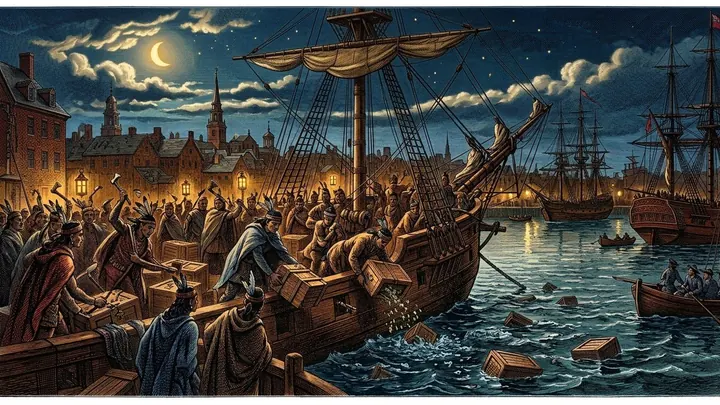 American Revolution Timeline — The American Revolution was the war in which the thirteen colonies broke away from Great Britain and became the United States. Open →
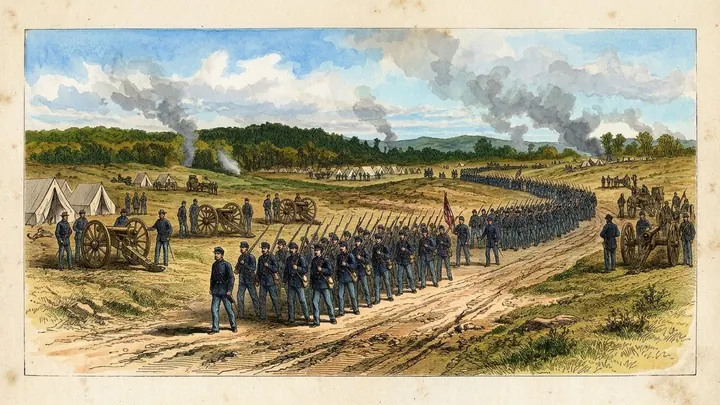 Civil War Timeline — The Civil War was the war between the Northern states (the Union) and the Southern states (the Confederacy) over slavery, states’ rights, and whether states could leave the Union. Open →
How to print
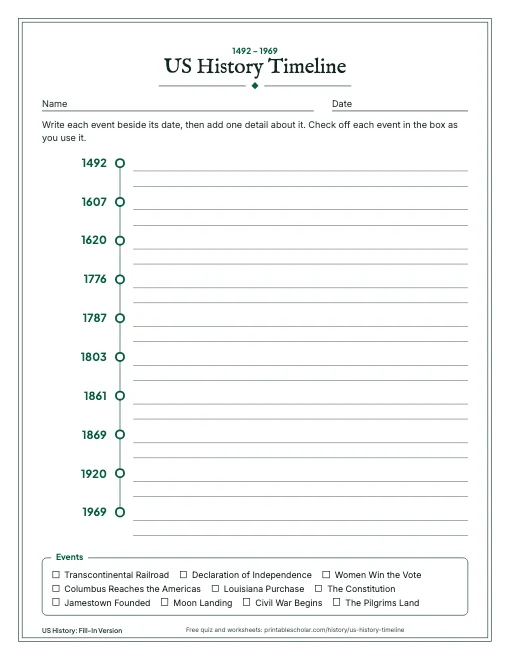
Every sheet above is a ready-to-print PDF sized for US Letter paper (8.5 × 11"). The fill-in version keeps the dates and gives students lines to write each event, with the events listed at the bottom to place — good for review. The ordering activity and the quiz each end with an answer key.
Frequently asked questions
What are the most important events in US history?
Common milestones taught in school include the founding of Jamestown, the Declaration of Independence, the Constitution, the Louisiana Purchase, the Civil War, and the Moon landing.
Is this a complete history of the United States?
No — it is a starter timeline of major milestones for elementary and middle-school students. Each event links to deeper reading and, where we have one, a matching printable map.
What paper size should I print this on?
The timeline is sized for standard US Letter paper (8.5 × 11"). Use “Download PDF” for a print-ready file that fits the page automatically.