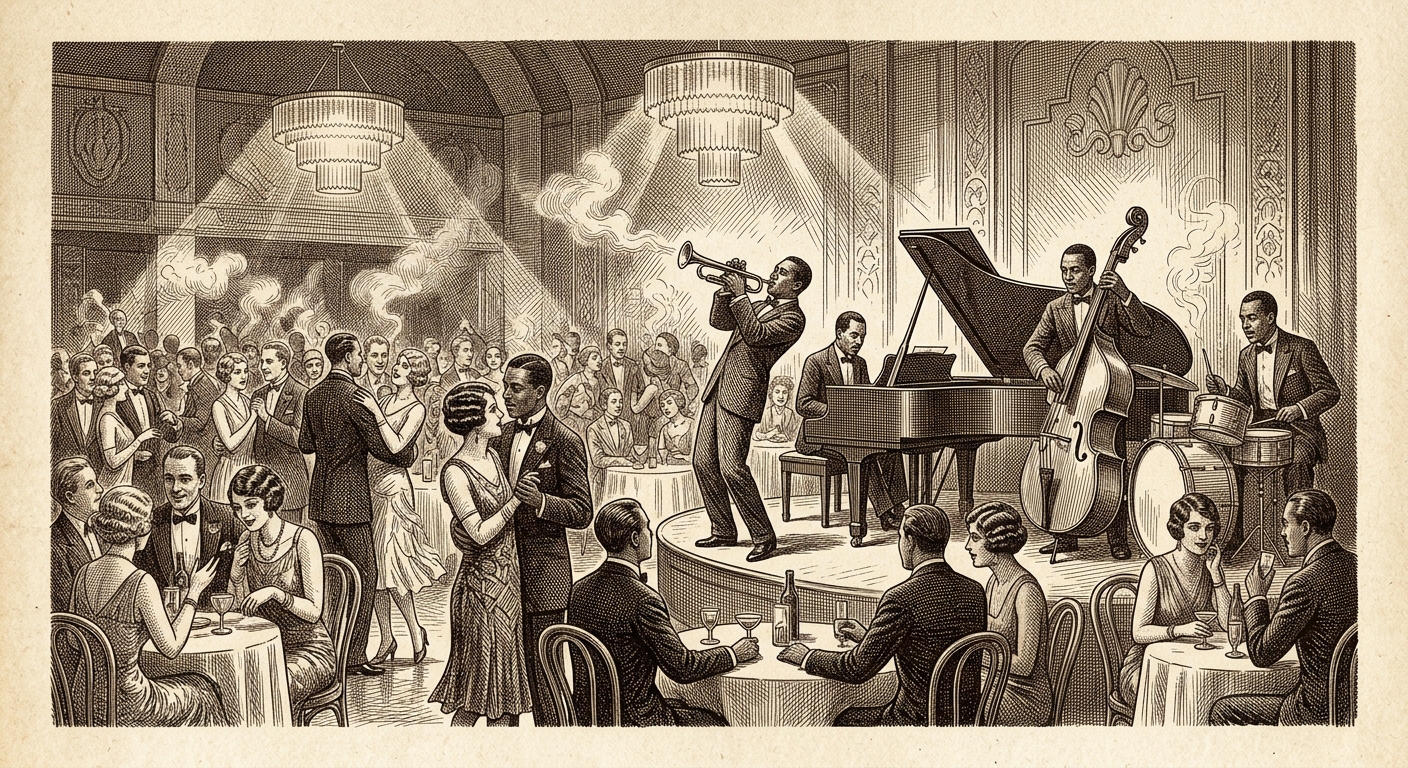
Harlem Renaissance Timeline
The Harlem Renaissance was a flowering of Black American art, literature, music, and intellectual life centered in Harlem, New York City, during the 1920s and 1930s — one of the most creative and influential cultural movements in American history.
The Harlem Renaissance was born out of the Great Migration. Starting around 1910, hundreds of thousands of Black Americans left the Jim Crow South — escaping sharecropping, violence, and segregation — and came north to cities like New York, Chicago, and Detroit. In Harlem, they found something new: a Black community large enough and confident enough to build its own cultural world. Jazz clubs, poetry journals, political manifestos, and paintings poured out of a neighborhood that became the creative capital of Black America. Writers like Langston Hughes and Zora Neale Hurston gave voice to the Black experience with pride and artistry. Musicians like Duke Ellington and Louis Armstrong invented a new American sound. The Harlem Renaissance didn't fix Jim Crow — it never claimed it would. But it changed how Black Americans saw themselves and how the world saw Black America.
- 1910–20
The Great Migration
Hundreds of thousands of Black Americans leave the Jim Crow South — escaping sharecropping, lynching, and segregation — and settle in northern cities, with many arriving in Harlem, New York City.
Why it mattered: The Great Migration created the critical mass that made the Harlem Renaissance possible — a concentrated community of writers, musicians, artists, and intellectuals who built institutions and fed each other's creativity.
- 1917
Silent Protest Parade
Ten thousand Black New Yorkers march silently down Fifth Avenue in New York City to protest lynching and racial violence — the first major civil rights demonstration in the North and a signal that Harlem's Black community would assert itself publicly.
Why it mattered: The Silent Protest Parade showed that Harlem's growing Black community had the numbers and the organization to make a national statement — a preview of the cultural and political confidence that would define the Renaissance years ahead.
- 1920
Jazz Age Harlem
Harlem's nightclubs — including the famous Cotton Club — become the center of American popular music; Duke Ellington, Louis Armstrong, Bessie Smith, and others define the Jazz Age and reach white audiences nationwide.
Why it mattered: Jazz was Black America's most powerful cultural export — it attracted wide audiences to Black art and challenged the racial assumptions of Jim Crow society by making Black creativity undeniable.
- 1923
Jean Toomer's Cane
Jean Toomer publishes Cane, a groundbreaking blend of prose and poetry about Black life in the South and North — widely regarded as the first major literary work of the Harlem Renaissance.
Why it mattered: Cane demonstrated that Black American literature could be artistically ambitious — not just protest writing — opening the door for the creative explosion of Black writing that followed throughout the 1920s.
- 1925
The New Negro
Philosopher Alain Locke edits The New Negro, a landmark anthology of Black art, literature, and thought that declares a new era of Black self-determination and cultural pride.
Why it mattered: The New Negro gave the Harlem Renaissance its intellectual framework — the idea that Black Americans could assert full humanity through art and culture — and introduced many Renaissance writers to a national audience for the first time.
- 1926–37
Langston Hughes and Zora Neale Hurston
Langston Hughes publishes The Weary Blues (1926) and other poetry celebrating Black life; Zora Neale Hurston publishes her landmark novel Their Eyes Were Watching God (1937); together they become the most celebrated voices of the Renaissance.
Why it mattered: Hughes and Hurston created literature rooted in the Black vernacular — blues, jazz rhythms, Southern speech — insisting that ordinary Black life was worthy of great art, not just uplift narratives written for white approval.
- 1929
Great Depression Hits
The stock market crash plunges the country into economic depression; the collapse dries up the patronage, publishing opportunities, and white interest in Black culture that had fueled the Renaissance.
Why it mattered: The Great Depression didn't end Black American culture, but it ended the particular conditions that had made the Harlem Renaissance flourish — the prosperity, optimism, and white fascination with Black art that had funded and publicized the movement.
- 1935
Harlem Riot
Economic despair, unemployment, and persistent racial discrimination spark a riot in Harlem — a sign that the optimism of the Renaissance had collided with the harsh reality of racial inequality in the North.
Why it mattered: The 1935 riot marked a shift from cultural celebration to urgent political struggle — the Harlem Renaissance's faith that art could transform race relations gave way to harder-edged political organizing that would eventually become the Civil Rights Movement.
Harlem Renaissance Quiz
Check what you learned — read on screen, or use the Printable quiz button above for a worksheet version with an answer key.
What event created the population growth that made the Harlem Renaissance possible?
- A) The end of World War I, which brought Black soldiers back to northern cities
- B) The Great Migration, which brought hundreds of thousands of Black Americans from the South to northern cities
- C) The founding of the NAACP, which organized Black communities in northern cities
- D) The Harlem Riot of 1935, which drew national attention to Black neighborhoods
What is the Harlem Renaissance best known for?
- A) A period of rapid economic growth that made Harlem the wealthiest neighborhood in New York City
- B) A flowering of Black American art, literature, music, and intellectual life in the 1920s and 1930s
- C) A political movement that successfully ended segregation in New York State
- D) A religious revival movement that spread Black churches throughout the northern United States
Which musician helped define the Jazz Age and became one of the Harlem Renaissance's most famous figures?
- A) James Weldon Johnson
- B) Alain Locke
- C) Duke Ellington
- D) Langston Hughes
What was Alain Locke's The New Negro?
- A) A political manifesto calling for Black Americans to return to Africa
- B) A landmark anthology of Black art, literature, and thought declaring a new era of Black cultural pride and self-determination
- C) A novel about life in Harlem during the jazz era
- D) A government report on living conditions for Black Americans in northern cities
What distinguished Langston Hughes's poetry?
- A) He wrote exclusively about life in the South, rejecting the Northern urban experience
- B) He used European classical forms and avoided references to Black vernacular music
- C) He celebrated Black life using jazz rhythms, blues, and the language of ordinary Black people
- D) He focused entirely on political arguments rather than artistic expression
What ended the Harlem Renaissance?
- A) The outbreak of World War II, which redirected national attention to military matters
- B) The Great Depression, which dried up the prosperity and patronage that had fueled the movement
- C) The relocation of most Harlem residents to other cities after the 1935 riot
- D) New York City's decision to ban jazz music in public venues
Why did the Harlem Renaissance matter beyond its artistic achievements?
- A) It successfully lobbied Congress to pass civil rights legislation in the 1920s
- B) It showed that Black Americans could create high-quality art — challenging the racial assumptions that justified segregation and inequality
- C) It produced economic prosperity that allowed Harlem to avoid the worst effects of the Great Depression
- D) It established Harlem as the headquarters of the NAACP and other civil rights organizations
Who was Zora Neale Hurston?
- A) The founder of the Cotton Club jazz venue in Harlem
- B) A pioneering Black novelist and anthropologist whose work celebrated Southern Black folk culture
- C) A political leader who organized the Great Migration from the South
- D) The editor who published The New Negro anthology of Black art and literature
Show answer key
1. B · 2. B · 3. C · 4. B · 5. C · 6. B · 7. B · 8. B
Related timelines
 Civil Rights Movement Timeline — The Civil Rights Movement was a struggle by Black Americans to end legal discrimination and win equal rights under the law, led by figures like Dr. Martin Luther King Jr. Open →
 Reconstruction Era Timeline — Reconstruction was the period after the Civil War when the federal government worked to reunite the nation and define the rights of formerly enslaved Black Americans. Open →
How to print
Choose Download PDF for a ready-to-print timeline that fits US Letter paper (8.5 × 11"). The blank fill-in version keeps the dates and gives students empty lines to write each event — great for review and quizzes.
Frequently asked questions
What was the Harlem Renaissance?
The Harlem Renaissance was a cultural movement of the 1920s and 1930s centered in the Harlem neighborhood of New York City, where a concentration of Black writers, musicians, artists, and intellectuals created an explosion of creative work. Major figures included writers Langston Hughes and Zora Neale Hurston, musicians Duke Ellington and Louis Armstrong, visual artists Aaron Douglas, and philosophers like Alain Locke. The movement celebrated Black identity and culture with pride, challenging the racist assumptions of the era through artistic excellence.
How did the Harlem Renaissance connect to the Civil Rights Movement?
The Harlem Renaissance didn't produce immediate political change — Jim Crow laws remained in place across the South — but it transformed how Black Americans saw themselves and how the wider culture perceived Black people. By creating undeniably great art, its figures challenged the dehumanizing assumptions behind segregation. Many scholars see a direct line from the cultural confidence of the Harlem Renaissance to the political confidence of the Civil Rights Movement — leaders like Martin Luther King Jr. drew on the tradition of Black intellectual achievement that the Renaissance had established.
What paper size should I print this on?
The timeline is sized for standard US Letter paper (8.5 × 11 in.). The Download PDF button gives you a print-ready file that fits the page automatically.