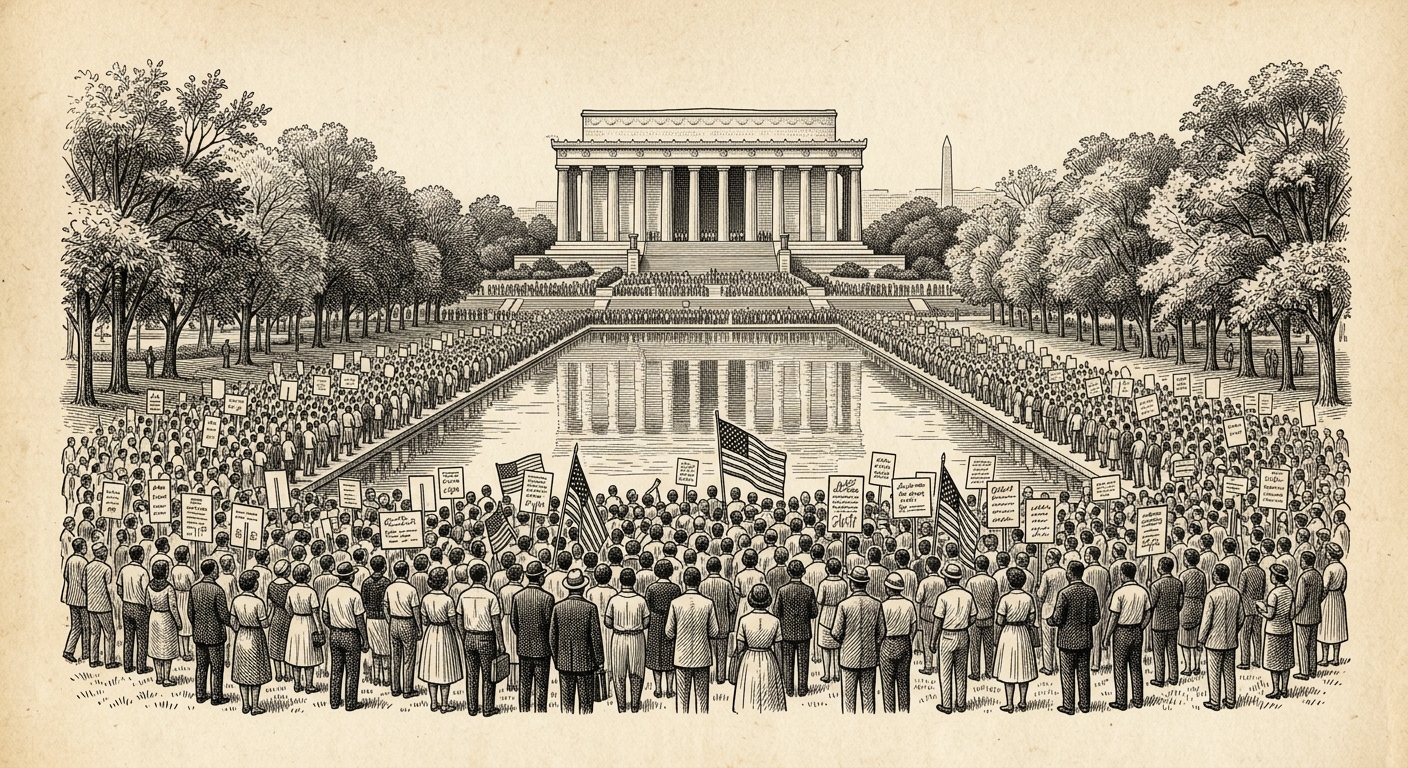
Civil Rights Movement Timeline
The Civil Rights Movement was a struggle by Black Americans to end legal discrimination and win equal rights under the law, led by figures like Dr. Martin Luther King Jr.
After the Civil War ended slavery in 1865, Black Americans in the South faced a new set of laws called Jim Crow laws that kept them separated from white Americans, blocked them from voting, and treated them as second-class citizens. For decades, Black Americans and their allies fought back through the courts, the churches, and the streets. The Civil Rights Movement of the 1950s and 1960s used peaceful protest, legal challenges, and moral persuasion to force the country to live up to its founding promise that all people are created equal. It was dangerous work — activists faced beatings, arrests, and worse — but by 1965 two landmark laws had been passed and the face of American democracy had changed.
- 1954
Brown v. Board of Education
The Supreme Court unanimously rules that racial segregation in public schools is unconstitutional.
Why it mattered: It overturned the ruling that had made separate-but-equal the law of the land, striking the legal foundation of segregation in America.
- 1955
Montgomery Bus Boycott
Rosa Parks is arrested for refusing to give up her bus seat to a white passenger; Black residents boycott the city's buses for 381 days.
Why it mattered: The boycott succeeded — bus segregation was ruled unconstitutional — and it launched Dr. Martin Luther King Jr. as a national civil rights leader.
- 1957
Little Rock Nine
Nine Black students attempt to integrate Central High School in Arkansas; the governor calls the National Guard to block them.
Why it mattered: President Eisenhower sent federal troops to enforce integration, showing the federal government would protect civil rights against state resistance.
- 1960
Greensboro Sit-Ins
Four Black college students sit at a segregated lunch counter in North Carolina and refuse to leave when denied service.
Why it mattered: Their peaceful protest spread to dozens of cities and helped desegregate lunch counters across the South.
- 1963
Birmingham Campaign
Civil rights leaders organize peaceful marches in Birmingham, Alabama; police use fire hoses and dogs on the protesters, including children.
Why it mattered: Shocking photos and TV footage of peaceful demonstrators being attacked shifted national opinion and put direct pressure on Congress.
- 1963
March on Washington
About 250,000 people gather at the Lincoln Memorial in Washington, D.C., where Dr. King delivers his famous speech including the words I Have a Dream.
Why it mattered: The march showed the enormous public support for civil rights and pushed Congress and the Kennedy administration toward legislation.
- 1964
Civil Rights Act of 1964
President Johnson signs a landmark law banning discrimination based on race, color, or religion in public places and employment.
Why it mattered: It made legal segregation across the United States illegal — the most sweeping civil rights legislation since Reconstruction.
- 1965
Bloody Sunday — Selma
State troopers attack peaceful marchers at the Edmund Pettus Bridge in Selma, Alabama, in full view of television cameras.
Why it mattered: Footage of the brutal attack shocked the nation and directly led President Johnson to push for the Voting Rights Act within weeks.
- 1965
Voting Rights Act
President Johnson signs a law banning discriminatory practices like literacy tests that had been used to prevent Black Americans from voting.
Why it mattered: Millions of Black citizens in the South could now vote for the first time, permanently changing American politics.
- 1968
Assassination of Dr. King
Dr. Martin Luther King Jr. is shot and killed in Memphis, Tennessee, on April 4, while supporting striking sanitation workers.
Why it mattered: The nation mourned the movement's most prominent leader; Congress passed the Fair Housing Act — another major civil rights law — just days later.
Civil Rights Movement Quiz
Check what you learned — read on screen, or use the Printable quiz button above for a worksheet version with an answer key.
What did the Supreme Court decide in Brown v. Board of Education?
- A) Lunch counters must be integrated
- B) Bus segregation was unconstitutional
- C) Racial segregation in public schools is unconstitutional
- D) Black Americans have the right to vote
Why was Rosa Parks arrested in 1955?
- A) She organized a march
- B) She refused to give up her bus seat to a white passenger
- C) She led a sit-in at a lunch counter
- D) She spoke at a rally
What were sit-ins?
- A) Large outdoor marches
- B) Peaceful protests where activists sat at segregated counters and refused to leave
- C) Boycotts of city buses
- D) Church prayer meetings
What footage from Birmingham in 1963 shocked the nation?
- A) Dr. King's speech at the Lincoln Memorial
- B) Rosa Parks being arrested
- C) Police using fire hoses and dogs on peaceful protesters
- D) The signing of the Civil Rights Act
What famous phrase did Dr. King include in his 1963 speech?
- A) We Shall Overcome
- B) Give Me Liberty or Give Me Death
- C) I Have a Dream
- D) Power to the People
What did the Civil Rights Act of 1964 do?
- A) Ended school segregation
- B) Banned discrimination in public places and employment
- C) Gave Black Americans the right to vote
- D) Freed enslaved people
What was Bloody Sunday?
- A) Rosa Parks's arrest
- B) The assassination of Dr. King
- C) State troopers attacking peaceful marchers at the Edmund Pettus Bridge in Selma
- D) The Birmingham police attack on protesters
What did the Voting Rights Act of 1965 do?
- A) Banned discrimination in restaurants
- B) Desegregated public schools
- C) Banned practices like literacy tests that had blocked Black voters
- D) Made the Civil Rights Act permanent
Show answer key
1. C · 2. B · 3. B · 4. C · 5. C · 6. B · 7. C · 8. C
Related timelines
 Reconstruction Era Timeline — Reconstruction was the period after the Civil War when the federal government worked to reunite the nation and define the rights of formerly enslaved Black Americans. Open →
 Vietnam War Timeline — The Vietnam War was a long and deeply divisive conflict in which the United States spent two decades trying to prevent a communist takeover of South Vietnam — and ultimately failed. Open →
How to print
Choose Download PDF for a ready-to-print timeline that fits US Letter paper (8.5 × 11"). The blank fill-in version keeps the dates and gives students empty lines to write each event — great for review and quizzes.
Frequently asked questions
What was the Civil Rights Movement?
The Civil Rights Movement was a long effort by Black Americans and their allies to end racial segregation and win equal rights under the law. Its most active period was roughly 1954 to 1968, during which peaceful protests, court cases, and political pressure won landmark legislation — the Civil Rights Act of 1964 and the Voting Rights Act of 1965.
Who was Dr. Martin Luther King Jr.?
Dr. King was a Baptist minister from Atlanta, Georgia, and the most prominent leader of the Civil Rights Movement. He championed nonviolent protest, led the Montgomery Bus Boycott and the March on Washington, and was awarded the Nobel Peace Prize in 1964. He was assassinated in Memphis, Tennessee, in 1968.
What paper size should I print this on?
The timeline is sized for standard US Letter paper (8.5 × 11 in.). The Download PDF button gives you a print-ready file that fits the page automatically.