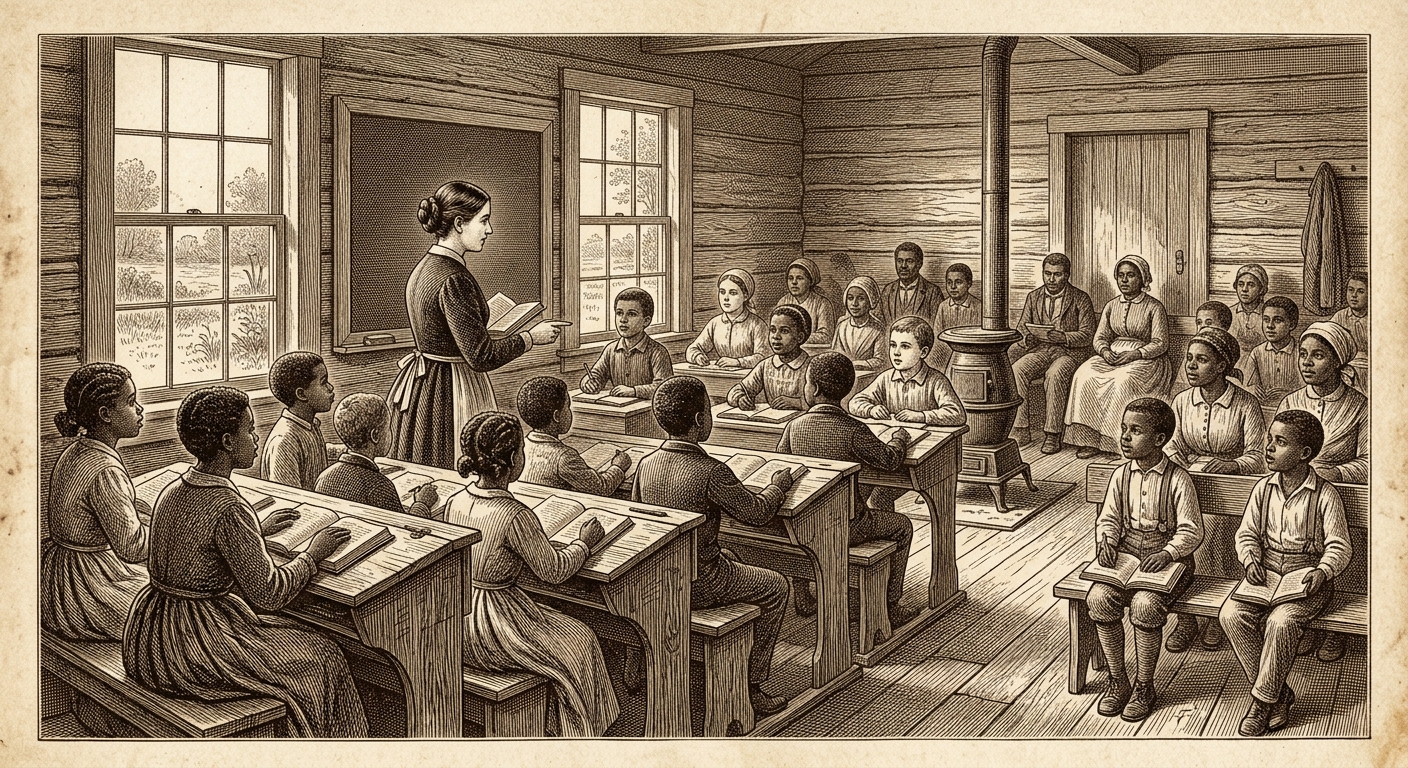
Reconstruction Era Timeline
Reconstruction was the period after the Civil War when the federal government worked to reunite the nation and define the rights of formerly enslaved Black Americans.
When the Civil War ended in April 1865, the United States faced enormous questions: What would happen to four million people who had been enslaved and were now free? How would the rebellious Southern states be brought back into the Union? What rights would Black Americans have? The period of Reconstruction was the government's attempt to answer those questions. It produced the 13th, 14th, and 15th Amendments — and for a brief time, Black men voted and held office across the South. But Reconstruction ended abruptly in 1877 when a political deal removed the last federal troops from the South, leaving Black Americans unprotected as Southern states stripped their rights through Jim Crow laws that would stand for nearly a century.
- 1865
Civil War Ends; Lincoln Assassinated
The Civil War ends in April with the Confederate surrender; President Lincoln is assassinated by John Wilkes Booth five days after Lee surrenders.
Why it mattered: Lincoln's death was a catastrophic blow — his plan for a lenient reconciliation was replaced by a harder Congressional approach, and leadership passed to the far less skilled Andrew Johnson.
- 1865
13th Amendment — Slavery Abolished
The 13th Amendment is ratified in December, abolishing slavery everywhere in the United States.
Why it mattered: Slavery's legal end was Reconstruction's greatest achievement — but it left four million formerly enslaved people free with no land, no money, and uncertain legal rights.
- 1865
Freedmen's Bureau Created
Congress creates the Bureau of Refugees, Freedmen, and Abandoned Lands to help formerly enslaved people transition to freedom.
Why it mattered: The Freedmen's Bureau provided food, housing, schools, and legal assistance to millions of Black Americans — the first major federal social welfare program in US history.
- 1865–66
Black Codes
Southern states pass restrictive laws called Black Codes to limit Black Americans' rights and keep them in conditions as close to slavery as possible.
Why it mattered: The Black Codes outraged Republicans in Congress and led them to take control of Reconstruction away from President Johnson — triggering the more radical phase.
- 1867
Congressional Reconstruction
Congress passes the Reconstruction Acts, dividing the South into military districts and requiring states to grant Black men the right to vote before rejoining the Union.
Why it mattered: For the first time, Black men across the South voted and held office — electing senators, congressmen, and local officials in significant numbers.
- 1868
14th Amendment
The 14th Amendment is ratified, granting citizenship to everyone born in the United States and guaranteeing equal protection of the laws to all persons.
Why it mattered: The 14th Amendment fundamentally changed the Constitution — its equal protection clause became the legal foundation for almost every major civil rights advance in the 20th century.
- 1870
15th Amendment
The 15th Amendment is ratified, prohibiting the denial of voting rights based on race, color, or previous condition of servitude.
Why it mattered: For the first time Black men throughout the nation had a constitutional right to vote — a right they exercised in large numbers across the South during Reconstruction.
- 1870–71
Ku Klux Klan Acts
Congress passes laws giving the federal government power to prosecute the Ku Klux Klan and other groups using terrorism to stop Black Americans from voting.
Why it mattered: The Klan Acts led to real prosecutions and temporarily reduced Klan violence — demonstrating that federal enforcement could protect civil rights when the will existed to use it.
- 1873
Economic Panic Shifts Attention
A severe financial panic leads to a deep economic depression; Northern Republicans lose interest in Reconstruction as economic problems dominate attention.
Why it mattered: The panic shifted Northern focus away from the South — and without Northern pressure, the forces working to end Reconstruction grew stronger year by year.
- 1877
Reconstruction Ends
A political compromise to resolve the disputed 1876 presidential election results in the withdrawal of the last federal troops from the South.
Why it mattered: Without federal troops, Southern states rapidly stripped Black Americans of voting rights and civil liberties through Jim Crow laws — rights that would not be restored for nearly a century.
Reconstruction Era Quiz
Check what you learned — read on screen, or use the Printable quiz button above for a worksheet version with an answer key.
What did the 13th Amendment, ratified in 1865, do?
- A) Gave Black Americans the right to vote
- B) Made everyone born in the US a citizen
- C) Abolished slavery throughout the United States
- D) Divided the South into military districts
What were Black Codes?
- A) Rules for Black Americans to follow in church
- B) Laws passed by Southern states to restrict Black Americans' rights and keep them in conditions similar to slavery
- C) Rules set by the Freedmen's Bureau for running schools
- D) Constitutional amendments proposed by Radical Republicans
What was the Freedmen's Bureau?
- A) A police force that enforced Black Codes
- B) A federal agency providing food, housing, schools, and legal help to formerly enslaved people
- C) The organization that wrote the 13th Amendment
- D) A Southern agency that enforced Jim Crow laws
What did Congressional Reconstruction require Southern states to do?
- A) Pay reparations to formerly enslaved people
- B) Return to the Union within one year
- C) Write new constitutions and grant Black men the right to vote
- D) Accept permanent military governors
What does the 14th Amendment guarantee?
- A) The right of all men to vote regardless of race
- B) The abolition of slavery
- C) Citizenship for everyone born in the US and equal protection under the law
- D) The division of the South into military districts
What did the 15th Amendment prohibit?
- A) Slavery throughout the United States
- B) Child labor in factories
- C) Denying the right to vote based on race
- D) Former Confederate leaders from holding office
What did the Ku Klux Klan Acts do?
- A) Created the Klan to enforce Black Codes
- B) Gave the federal government power to prosecute groups using violence to stop Black Americans from voting
- C) Required former Confederate states to formally rejoin the Union
- D) Ended Congressional Reconstruction
How did Reconstruction end?
- A) Congress passed a law officially ending it
- B) Black Americans won enough political power that federal troops were no longer needed
- C) A political compromise to resolve the disputed 1876 election led to withdrawal of federal troops from the South
- D) President Grant declared that Reconstruction's goals had been achieved
Show answer key
1. C · 2. B · 3. B · 4. C · 5. C · 6. C · 7. B · 8. C
Related timelines
 Civil War Timeline — The Civil War was the war between the Northern states (the Union) and the Southern states (the Confederacy) over slavery, states’ rights, and whether states could leave the Union. Open →
 Civil Rights Movement Timeline — The Civil Rights Movement was a struggle by Black Americans to end legal discrimination and win equal rights under the law, led by figures like Dr. Martin Luther King Jr. Open →
How to print
Choose Download PDF for a ready-to-print timeline that fits US Letter paper (8.5 × 11"). The blank fill-in version keeps the dates and gives students empty lines to write each event — great for review and quizzes.
Frequently asked questions
What was Reconstruction?
Reconstruction (1865-1877) was the period after the Civil War when the federal government worked to reunite the South with the rest of the country and define the rights of formerly enslaved Black Americans. It was a period of genuine progress — the 13th, 14th, and 15th Amendments were ratified, and Black men voted and held office across the South — but it ended with a political compromise that left Black Americans unprotected for nearly a century.
Why did Reconstruction fail to secure lasting rights for Black Americans?
Reconstruction failed because white Southerners used violence, legal trickery, and eventually Jim Crow laws to deny Black Americans their rights once federal troops were withdrawn. Northern will to enforce Reconstruction faded after the 1873 economic panic, and the compromise that resolved the disputed 1876 election led to the removal of the last federal troops from the South in 1877 — leaving Black Southerners without protection.
What paper size should I print this on?
The timeline is sized for standard US Letter paper (8.5 × 11 in.). The Download PDF button gives you a print-ready file that fits the page automatically.