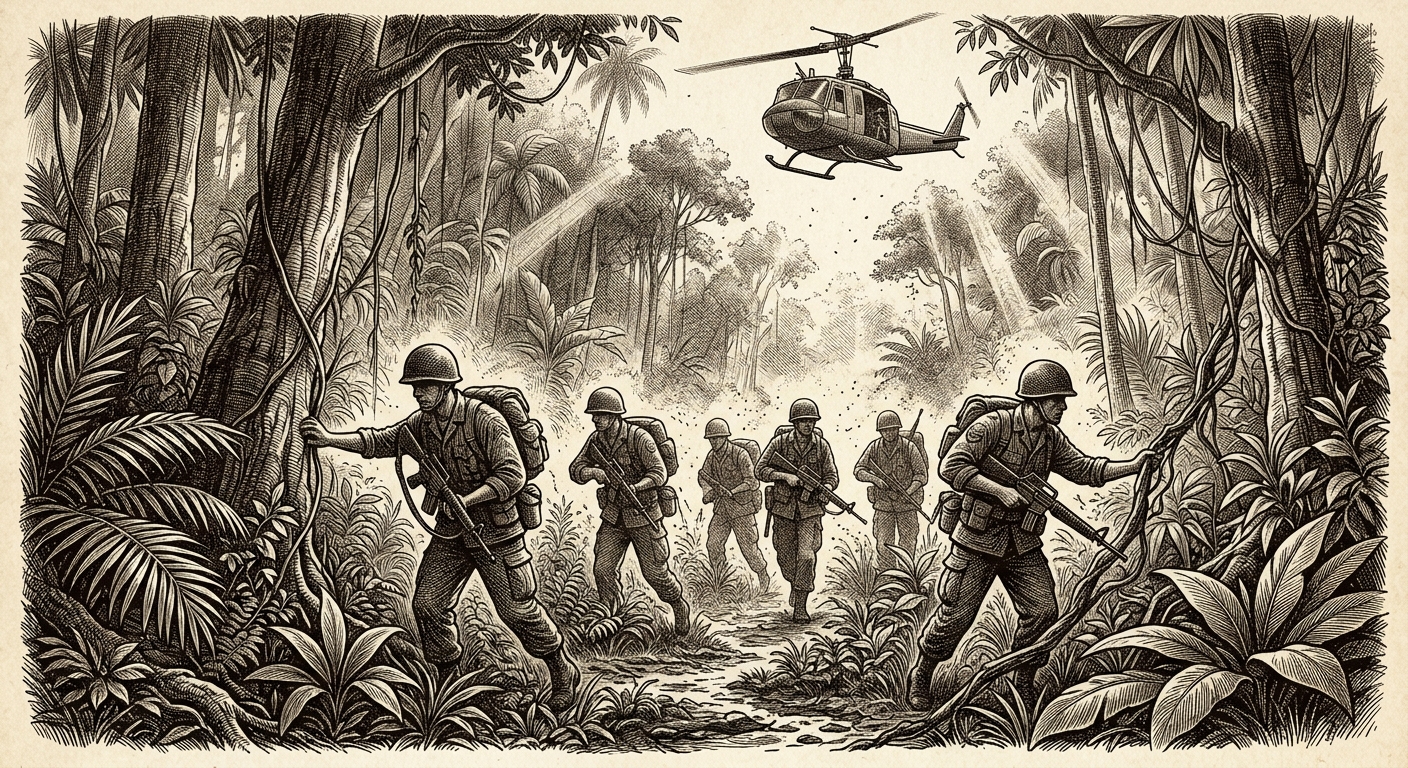
Vietnam War Timeline
The Vietnam War was a long and deeply divisive conflict in which the United States spent two decades trying to prevent a communist takeover of South Vietnam — and ultimately failed.
After France was driven out of Vietnam in 1954, the country was divided into communist North Vietnam and non-communist South Vietnam. The United States, fearing the spread of communism across Southeast Asia, began sending military advisors to help South Vietnam — a commitment that grew, year by year, into a full-scale war involving more than half a million American troops. The war was brutal and confusing, fought not in open fields but in dense jungles against an enemy that blended into the civilian population. At home, it tore the country apart: millions of Americans marched against it, while others fiercely supported it. By 1975, when North Vietnamese tanks rolled into Saigon, more than 58,000 Americans and millions of Vietnamese had died.
- 1954
Vietnam Divided
After France is defeated at Dien Bien Phu, Vietnam is temporarily divided at the 17th parallel into communist North Vietnam and non-communist South Vietnam.
Why it mattered: The division set the stage for a civil war — and for the United States to replace France in trying to prevent a communist takeover of the south.
- 1955
US Advisors Arrive
President Eisenhower sends American military advisors to help train South Vietnam's army.
Why it mattered: US involvement began small but the commitment to keeping South Vietnam non-communist would grow steadily over the next decade into a full-scale war.
- 1964
Gulf of Tonkin Resolution
After reported attacks on US Navy ships in the Gulf of Tonkin, Congress passes a resolution giving President Johnson sweeping authority to escalate military action in Vietnam.
Why it mattered: The resolution became the legal basis for sending hundreds of thousands of US troops to Vietnam without a formal declaration of war.
- 1965
First US Combat Troops
President Johnson sends the first US combat troops to Vietnam; by year's end, nearly 200,000 American soldiers are in the country.
Why it mattered: The US was now fighting the war directly, not just advising, and American casualties began to mount alongside South Vietnamese ones.
- 1968
Tet Offensive
North Vietnamese and Viet Cong forces launch a massive surprise attack on more than 100 South Vietnamese cities during the Tet holiday.
Why it mattered: Though US forces repelled the attacks, the scale of the offensive shocked Americans who had been told the war was nearly won — and decisively turned public opinion against the war.
- 1969
Vietnamization
President Nixon begins withdrawing US troops and shifting the fighting to South Vietnamese forces, a policy he calls Vietnamization.
Why it mattered: Vietnamization acknowledged the US could not win militarily and began the long withdrawal — but the war continued for six more years.
- 1970
Kent State Shootings
National Guard soldiers kill four students during an antiwar protest at Kent State University in Ohio.
Why it mattered: Kent State intensified the antiwar movement and deepened the painful divide at home — support for continued US involvement collapsed further.
- 1973
Paris Peace Accords
The United States and North Vietnam sign a peace agreement; US combat troops withdraw from Vietnam.
Why it mattered: The accords ended direct US military involvement, but fighting between North and South Vietnam continued almost immediately.
- 1974
South Vietnam Weakens
With US troops gone and Congress cutting military aid, South Vietnam struggles to hold off North Vietnamese advances.
Why it mattered: Without American support, South Vietnam's government and military steadily weakened — the final collapse was approaching.
- 1975
Fall of Saigon
North Vietnamese forces capture Saigon, the capital of South Vietnam, on April 30; the last Americans are evacuated by helicopter from the US embassy roof.
Why it mattered: The fall of Saigon ended the war with a complete North Vietnamese victory. Vietnam was reunified under communist rule, and more than 58,000 Americans had died in the conflict.
Vietnam War Quiz
Check what you learned — read on screen, or use the Printable quiz button above for a worksheet version with an answer key.
Why was Vietnam divided in 1954?
- A) France split it to maintain colonial control
- B) After France's defeat, Vietnam was divided between communist North and non-communist South at peace talks
- C) The United States created the division as a buffer zone
- D) China and the Soviet Union divided Vietnam between them
What was the Gulf of Tonkin Resolution?
- A) A peace treaty with North Vietnam
- B) A law banning protests against the war
- C) A congressional resolution giving the president broad authority to escalate military action after reported attacks on US ships
- D) An agreement for South Vietnam to pay for its own defense
What was the Tet Offensive?
- A) A US bombing campaign against North Vietnam
- B) A massive surprise attack by North Vietnamese and Viet Cong forces on South Vietnamese cities
- C) The final North Vietnamese offensive that ended the war
- D) A US strategy to cut off North Vietnamese supply routes
Why did the Tet Offensive change the war politically?
- A) It was a complete communist victory that captured South Vietnam
- B) It was a US triumph that finally weakened North Vietnam
- C) Its unexpected scale shocked Americans who had been told the war was nearly won, turning public opinion against it
- D) It led directly to the Paris Peace Accords
What was Vietnamization?
- A) A plan to bomb North Vietnam into surrender
- B) Nixon's plan to withdraw US troops and shift fighting to South Vietnamese forces
- C) A program to relocate South Vietnamese civilians
- D) The North Vietnamese strategy for winning the war
What happened at Kent State in May 1970?
- A) US troops won a major battle against North Vietnamese forces
- B) National Guard soldiers killed four students during an antiwar protest
- C) President Nixon announced the end of US involvement
- D) Congress passed the Gulf of Tonkin Resolution
What did the Paris Peace Accords of 1973 do?
- A) Ended the war with a South Vietnamese victory
- B) Required North Vietnam to abandon the fight
- C) Ended direct US military involvement, though fighting between North and South Vietnam continued
- D) Created a permanent division of Vietnam
How did the Vietnam War end?
- A) South Vietnam won with continued US air support
- B) A negotiated peace left Vietnam permanently divided
- C) North Vietnamese forces captured Saigon and reunified Vietnam under communist rule
- D) The US and Soviet Union brokered a final peace settlement
Show answer key
1. B · 2. C · 3. B · 4. C · 5. B · 6. B · 7. C · 8. C
Related timelines
 Cold War Timeline — The Cold War was a decades-long rivalry between the United States and the Soviet Union, fought through arms races, proxy wars, and the constant threat of nuclear destruction. Open →
 Civil Rights Movement Timeline — The Civil Rights Movement was a struggle by Black Americans to end legal discrimination and win equal rights under the law, led by figures like Dr. Martin Luther King Jr. Open →
How to print
Choose Download PDF for a ready-to-print timeline that fits US Letter paper (8.5 × 11"). The blank fill-in version keeps the dates and gives students empty lines to write each event — great for review and quizzes.
Frequently asked questions
Why did the United States get involved in the Vietnam War?
The US got involved primarily to stop the spread of communism in Southeast Asia. Under the domino theory, American leaders believed that if South Vietnam fell to communism, neighboring countries would follow. The US first sent military advisors in the 1950s, then combat troops in 1965, eventually committing more than half a million soldiers at the peak of the conflict in 1968-69.
How did the Vietnam War affect the United States?
The Vietnam War had a profound and lasting impact: more than 58,000 Americans died and hundreds of thousands were wounded or suffered lasting psychological trauma. The war deeply divided American society, created a widespread loss of trust in the government, and produced the War Powers Act of 1973, which limits the president's ability to commit troops without congressional approval.
What paper size should I print this on?
The timeline is sized for standard US Letter paper (8.5 × 11 in.). The Download PDF button gives you a print-ready file that fits the page automatically.