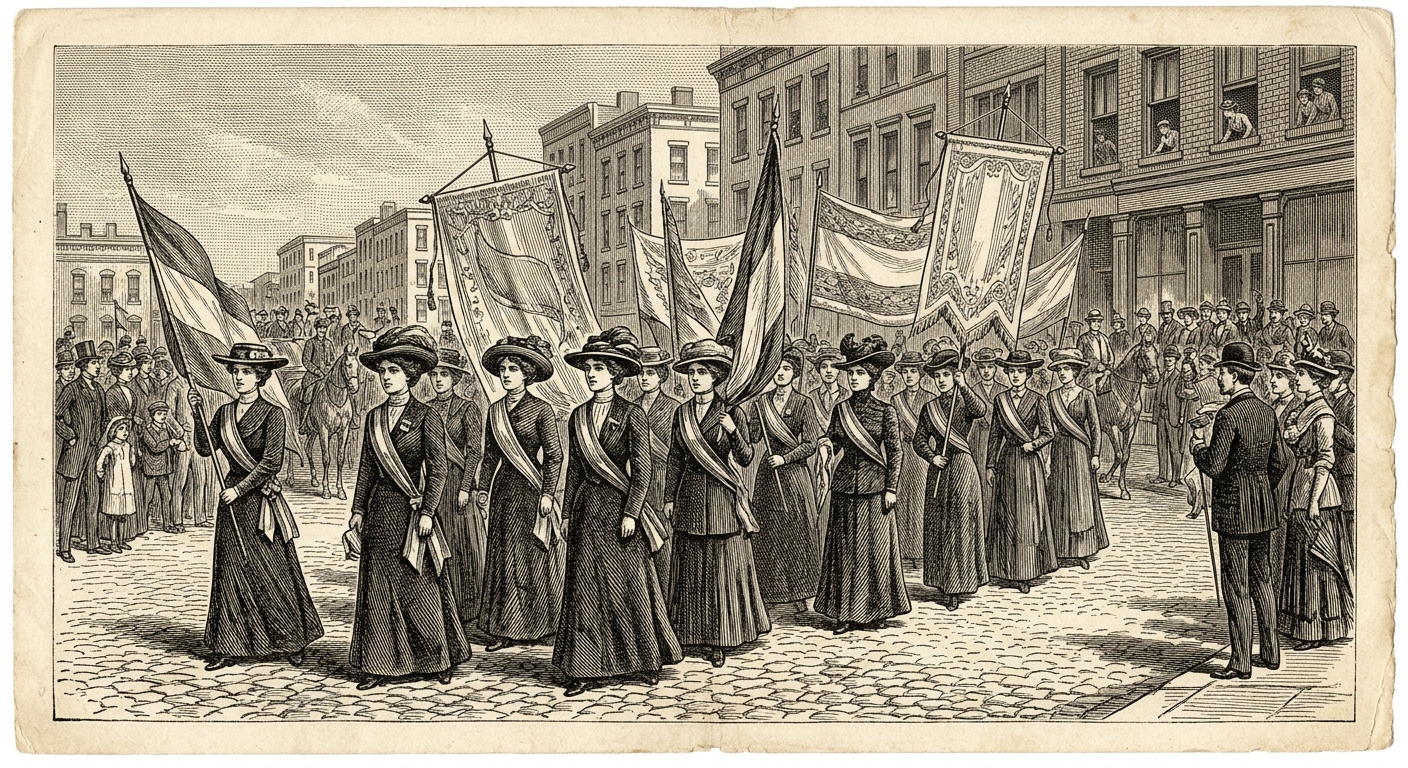
Women's Suffrage Timeline
The women's suffrage movement was a 72-year campaign that won American women the right to vote, culminating in the 19th Amendment in 1920.
When the United States was founded, women could not vote. For most of the 1800s, the law treated women as legal dependents of their husbands — unable to vote, own property in their own names, or participate in public life. Beginning with the Seneca Falls Convention in 1848, a growing movement of women — and some men — organized, petitioned, marched, and protested to change this. They faced ridicule, arrest, and worse. The movement split over strategy, reunited, and kept fighting for seven decades. On August 18, 1920, Tennessee cast the deciding vote to ratify the 19th Amendment — and for the first time in American history, all adult women could vote.
- 1848
Seneca Falls Convention
The first women's rights convention in the United States is held in Seneca Falls, New York, organized by Elizabeth Cady Stanton and Lucretia Mott.
Why it mattered: Seneca Falls launched the organized women's suffrage movement, adopting a Declaration of Sentiments that declared all men and women are created equal and demanded the right to vote.
- 1851
Sojourner Truth Speaks
Sojourner Truth, a formerly enslaved woman and abolitionist, delivers a powerful speech at a women's rights convention in Akron, Ohio.
Why it mattered: Truth connected the fight for women's rights to the fight against slavery — and challenged those who argued women were too weak or delicate to deserve equal rights.
- 1869
The Movement Splits
The women's suffrage movement divides into two organizations: one pushing for a federal constitutional amendment, the other working state by state.
Why it mattered: The split slowed progress for two decades, but both strategies ultimately contributed to winning the vote.
- 1869
Wyoming Grants Women the Vote
The Wyoming Territory becomes the first government in the United States to grant women the right to vote.
Why it mattered: Wyoming proved women's suffrage could work — and the territory kept it when it became a state in 1890, giving the movement a powerful model to point to.
- 1872
Susan B. Anthony Arrested
Susan B. Anthony is arrested for casting a ballot in the presidential election, knowing it was illegal for women to vote, and is fined $100.
Why it mattered: Anthony's arrest and trial drew national attention to the injustice of excluding women from the vote and made her one of the movement's most famous champions.
- 1890
Movement Reunites
The two suffrage organizations merge into the National American Woman Suffrage Association, led by Elizabeth Cady Stanton and later Susan B. Anthony.
Why it mattered: The reunified movement regained momentum and became the main force pushing for a constitutional amendment to give women the vote.
- 1912–16
States Grant Suffrage
Several western and midwestern states grant women the right to vote, adding political pressure on Congress for a national amendment.
Why it mattered: As more states granted suffrage, women who could vote used their power to demand action from Congress — making the federal amendment increasingly hard to avoid.
- 1917
White House Pickets
Suffragists led by Alice Paul begin picketing the White House every day, the first group ever to do so, carrying silent protest banners.
Why it mattered: The pickets, and the brutal treatment of arrested protesters who were force-fed in prison, drew public sympathy and put intense pressure on President Wilson.
- 1919
19th Amendment Passes Congress
Congress passes the 19th Amendment — prohibiting denial of the vote based on sex — and sends it to the states for ratification.
Why it mattered: After 71 years of organizing, marching, petitioning, and protest, women's suffrage had finally cleared Congress.
- 1920
19th Amendment Ratified
Tennessee becomes the 36th and deciding state to ratify the 19th Amendment on August 18, making it the law of the land.
Why it mattered: The 19th Amendment roughly doubled the number of eligible American voters overnight — one of the greatest expansions of democracy in US history.
Women's Suffrage Quiz
Check what you learned — read on screen, or use the Printable quiz button above for a worksheet version with an answer key.
What happened at the Seneca Falls Convention in 1848?
- A) Women voted for the first time in US history
- B) The first organized women's rights convention launched the suffrage movement
- C) The 19th Amendment was signed into law
- D) Susan B. Anthony was arrested for voting
What did Sojourner Truth's 1851 speech connect?
- A) The women's rights movement with the abolition of slavery
- B) The split in the suffrage movement into two groups
- C) The demand for suffrage with the right to own property
- D) The White House pickets with the right to vote
Which was the first US government to grant women the right to vote?
- A) Massachusetts, in 1848
- B) New York, in 1869
- C) Wyoming Territory, in 1869
- D) California, in 1912
Why was Susan B. Anthony arrested in 1872?
- A) She organized a march on Washington
- B) She illegally cast a ballot in the presidential election to protest women's exclusion from voting
- C) She burned a White House protest banner
- D) She refused to pay taxes as a protest against taxation without representation
What tactic did Alice Paul's suffragists use at the White House starting in 1917?
- A) A hunger strike outside the Capitol
- B) Silent daily picketing — the first group ever to picket the White House
- C) A one-million-woman march to Washington
- D) Filing lawsuits in the Supreme Court
What does the 19th Amendment do?
- A) Gives women the right to own property in their own names
- B) Abolishes slavery throughout the United States
- C) Prohibits denying any citizen the right to vote based on sex
- D) Requires states to allow women to run for office
When did Congress pass the 19th Amendment?
- A) 1848, at the Seneca Falls Convention
- B) 1872, after Susan B. Anthony was arrested
- C) 1917, after the White House picketing began
- D) 1919, after 71 years of organizing
What was the significance of Tennessee ratifying the 19th Amendment in 1920?
- A) It was the first state to ratify the amendment
- B) It was the 36th and deciding state, making the amendment law
- C) It was the last state ever to allow women to vote
- D) It gave Congress the votes needed to pass the amendment
Show answer key
1. B · 2. A · 3. C · 4. B · 5. B · 6. C · 7. D · 8. B
Related timelines
 Civil Rights Movement Timeline — The Civil Rights Movement was a struggle by Black Americans to end legal discrimination and win equal rights under the law, led by figures like Dr. Martin Luther King Jr. Open →
 Reconstruction Era Timeline — Reconstruction was the period after the Civil War when the federal government worked to reunite the nation and define the rights of formerly enslaved Black Americans. Open →
How to print
Choose Download PDF for a ready-to-print timeline that fits US Letter paper (8.5 × 11"). The blank fill-in version keeps the dates and gives students empty lines to write each event — great for review and quizzes.
Frequently asked questions
What was the women's suffrage movement?
The women's suffrage movement was a decades-long campaign to win American women the right to vote. It began with the Seneca Falls Convention in 1848 and ended with the ratification of the 19th Amendment in 1920 — 72 years later. Led by figures including Elizabeth Cady Stanton, Susan B. Anthony, and Alice Paul, it used conventions, marches, petitions, legal challenges, and direct protest to achieve its goal.
Why did women not have the right to vote in early US history?
The original US Constitution left voting rules to the states, and most states limited the franchise to men — and often only to white men who owned property. Women were excluded based on prevailing beliefs that politics was a male sphere and that women's place was in the home. Changing this required a constitutional amendment, which took 72 years of sustained, organized effort to achieve.
What paper size should I print this on?
The timeline is sized for standard US Letter paper (8.5 × 11 in.). The Download PDF button gives you a print-ready file that fits the page automatically.