Korean War Timeline
The Korean War was the first major military conflict of the Cold War, in which the United States and its allies fought to defend South Korea from a communist invasion — ending in a stalemate that divides Korea to this day.
When Japan was defeated in World War II, Korea — which Japan had colonized since 1910 — was divided at the 38th parallel between Soviet-occupied North Korea and US-occupied South Korea. What was supposed to be a temporary arrangement hardened into two hostile states. On June 25, 1950, North Korean forces suddenly invaded South Korea, nearly overrunning the entire peninsula before a United Nations force led by the US pushed them back. Then China entered the war with hundreds of thousands of troops, pushing the UN force back south. After two years of grinding trench warfare near the original dividing line, an armistice was signed in July 1953. The shooting stopped — but the war was never officially ended.
- 1945
Korea Divided
After Japan's defeat in World War II, Korea is divided at the 38th parallel between Soviet-occupied North Korea and US-occupied South Korea.
Why it mattered: The division, meant to be temporary, hardened into two hostile states — communist North Korea and non-communist South Korea — with no agreement on how or whether to reunify.
- 1948
Two Koreas Established
The Democratic People's Republic of Korea (North) and the Republic of Korea (South) are formally established as separate governments.
Why it mattered: With two rival governments each backed by an opposing superpower, the Korean peninsula became one of the most dangerous flashpoints of the Cold War.
- June 25, 1950
North Korea Invades
North Korean forces cross the 38th parallel and invade South Korea, rapidly overrunning most of the peninsula.
Why it mattered: The surprise invasion nearly succeeded — within weeks UN forces were pushed into a small corner of southern Korea around the port of Pusan, fighting for survival.
- September 1950
Inchon Landing
General Douglas MacArthur leads a bold amphibious landing at Inchon, behind North Korean lines, cutting off the invaders and turning the tide of the war.
Why it mattered: The Inchon landing was one of the most daring operations of the war — it cut North Korean supply lines and allowed UN forces to rapidly retake South Korea.
- October 1950
China Enters the War
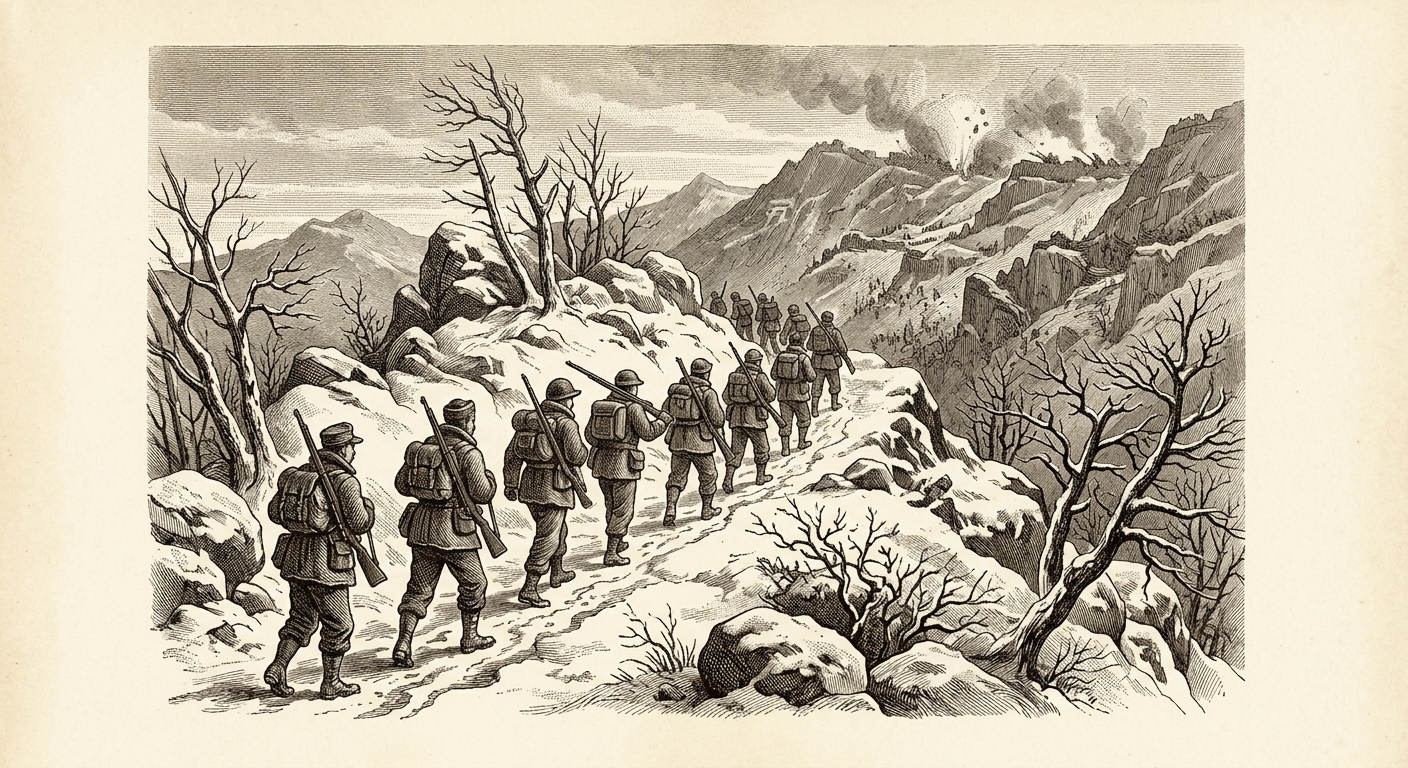
As UN forces approach the Chinese border, China sends hundreds of thousands of troops across the Yalu River, pushing UN forces back south in brutal winter fighting.
Why it mattered: China's intervention transformed the war — what had seemed like a near-victory became a grinding stalemate fought near the original dividing line.
- April 1951
MacArthur Fired
President Truman fires General MacArthur for publicly criticizing the administration's decision to limit the war and not attack China directly.
Why it mattered: MacArthur's firing reinforced the crucial democratic principle that military commanders are subordinate to civilian leadership — even in wartime.
- 1951–53
Stalemate and Trench Warfare
The front stabilizes near the 38th parallel; both sides dig in for two years of grinding warfare while peace talks drag on.
Why it mattered: The stalemate was enormously costly — hundreds of thousands of soldiers died while negotiators argued over the precise location of the ceasefire line.
- 1952
Eisenhower Elected
Dwight Eisenhower wins the presidential election largely by promising to visit Korea and end the war.
Why it mattered: Eisenhower's election shifted the political pressure to end the war, and hints that he might consider using nuclear weapons accelerated the peace negotiations.
- July 27, 1953
Armistice Signed
An armistice is signed at Panmunjom, ending the fighting; the boundary between North and South Korea is fixed near the 38th parallel.
Why it mattered: The armistice ended the shooting — but it was not a peace treaty. Technically, North and South Korea remain at war to this day.
- 1953 onward
The Divided Peninsula
The Demilitarized Zone — a 2.5-mile-wide buffer strip across the peninsula — becomes one of the most heavily fortified borders on Earth.
Why it mattered: The Korean War ended exactly where it started — with a divided Korea. North Korea became a closed authoritarian state; South Korea eventually became a democracy and economic powerhouse.
Korean War Quiz
Check what you learned — read on screen, or use the Printable quiz button above for a worksheet version with an answer key.
Why was Korea divided after World War II?
- A) Japan divided it before surrendering
- B) The US and Soviet Union each occupied half after Japan's defeat, and the temporary division hardened into two separate states
- C) The Korean people voted in a referendum to divide the country
- D) The United Nations created the division as part of a postwar peace agreement
What happened on June 25, 1950?
- A) The US invaded North Korea to stop communism
- B) China entered the Korean War
- C) North Korean forces invaded South Korea in a surprise attack
- D) An armistice ended three years of Korean War fighting
What was the Inchon Landing?
- A) The original North Korean invasion of South Korea
- B) A bold amphibious landing by MacArthur behind North Korean lines that turned the tide of the war
- C) China's surprise intervention in the war
- D) The signing of the Korean War armistice
Why did China enter the Korean War in October 1950?
- A) China had supported North Korea's invasion from the beginning
- B) The US asked China to help fight North Korea
- C) As UN forces approached the Chinese border, China intervened to prevent a hostile army on its doorstep
- D) China was fulfilling a treaty obligation to the Soviet Union
Why was General MacArthur fired by President Truman?
- A) He retreated without orders during the Chinese offensive
- B) He lost the Battle of Inchon
- C) He publicly criticized Truman's decision to limit the war and not attack China
- D) He signed an unauthorized ceasefire with North Korea
What was the result of the Korean War armistice of 1953?
- A) North Korea was reunified with the South
- B) South Korea won the war and occupied all of Korea
- C) Fighting stopped near the 38th parallel where it started, but no peace treaty was signed
- D) Both Koreas agreed to hold democratic elections to determine reunification
Why is the Korean War sometimes called the Forgotten War?
- A) The US government classified all records of the conflict
- B) It has been largely overlooked compared to World War II before it and Vietnam after, despite massive casualties
- C) Very few Americans served in the Korean War
- D) It was fought in secret without congressional authorization
What is the current status of the Korean War?
- A) It ended permanently with a peace treaty in 1953
- B) It was officially ended by a UN resolution in 1991
- C) Technically it never ended — the armistice stopped the fighting but North and South Korea are still at war
- D) A final peace treaty was signed in 2000 during Korean reunification talks
Show answer key
1. B · 2. C · 3. B · 4. C · 5. C · 6. C · 7. B · 8. C
Related timelines
 Cold War Timeline — The Cold War was a decades-long rivalry between the United States and the Soviet Union, fought through arms races, proxy wars, and the constant threat of nuclear destruction. Open →
 Vietnam War Timeline — The Vietnam War was a long and deeply divisive conflict in which the United States spent two decades trying to prevent a communist takeover of South Vietnam — and ultimately failed. Open →
How to print
Choose Download PDF for a ready-to-print timeline that fits US Letter paper (8.5 × 11"). The blank fill-in version keeps the dates and gives students empty lines to write each event — great for review and quizzes.
Frequently asked questions
Is the Korean War over?
Technically, no. The Korean War ended in a military armistice in July 1953, not a peace treaty. This means North and South Korea are still officially in a state of war, though no fighting has occurred since 1953. The Demilitarized Zone remains one of the most heavily fortified borders in the world. Periodic negotiations over the decades have not produced a permanent peace settlement, and North Korea's nuclear weapons program has made the situation more dangerous in recent decades.
Why is the Korean War called the Forgotten War?
The Korean War is often called the Forgotten War because it was sandwiched between World War II — the most dramatic conflict in American history — and the Vietnam War, which deeply divided American society. More than 36,000 Americans died in Korea and the war reshaped the Cold War, yet it receives relatively little attention in American memory compared to those conflicts. It was the first major hot-war test of the Cold War and established that the US would use military force to resist communist expansion.
What paper size should I print this on?
The timeline is sized for standard US Letter paper (8.5 × 11 in.). The Download PDF button gives you a print-ready file that fits the page automatically.