 Printable Scholar
Free Printable Periodic Table
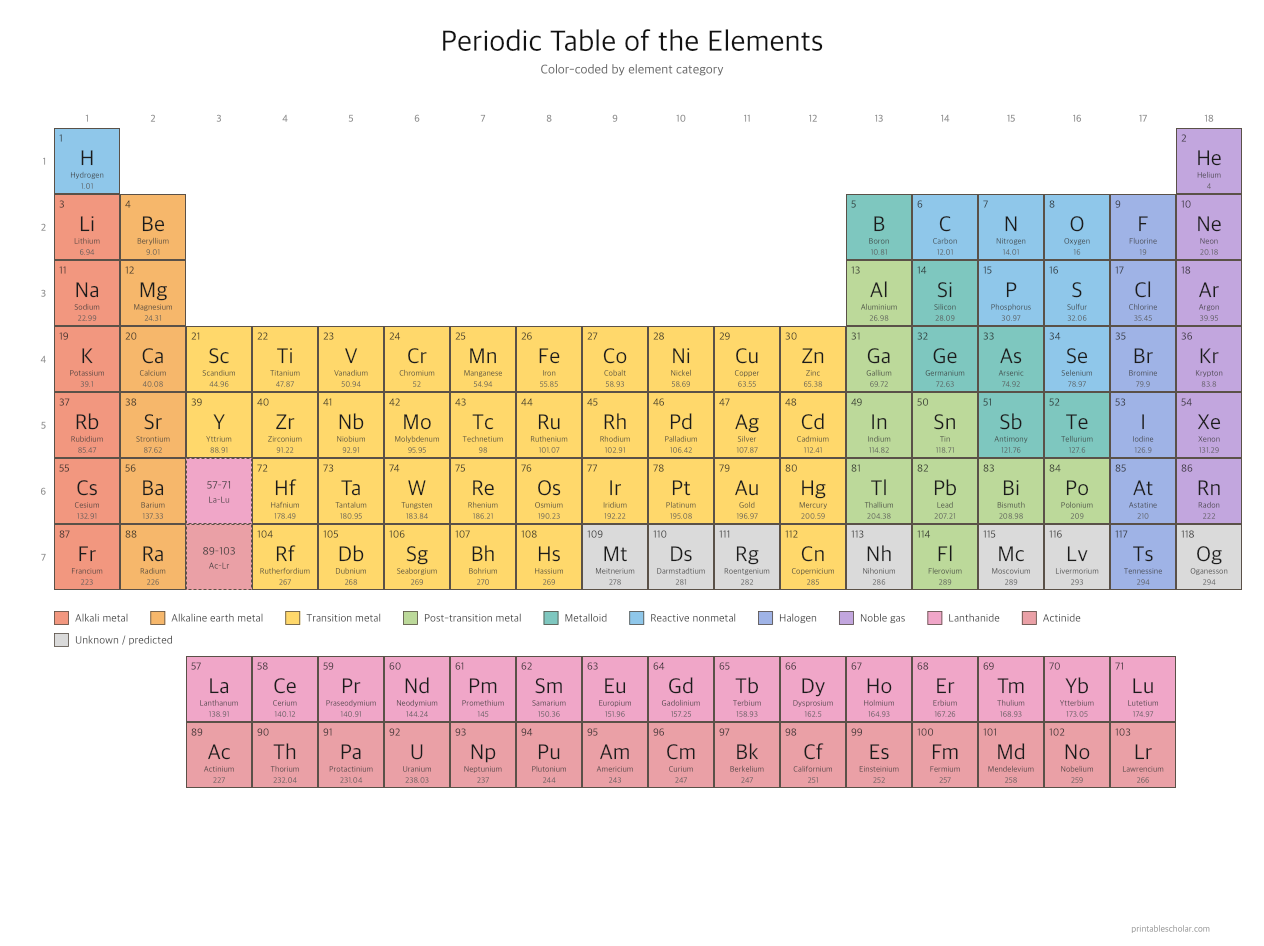
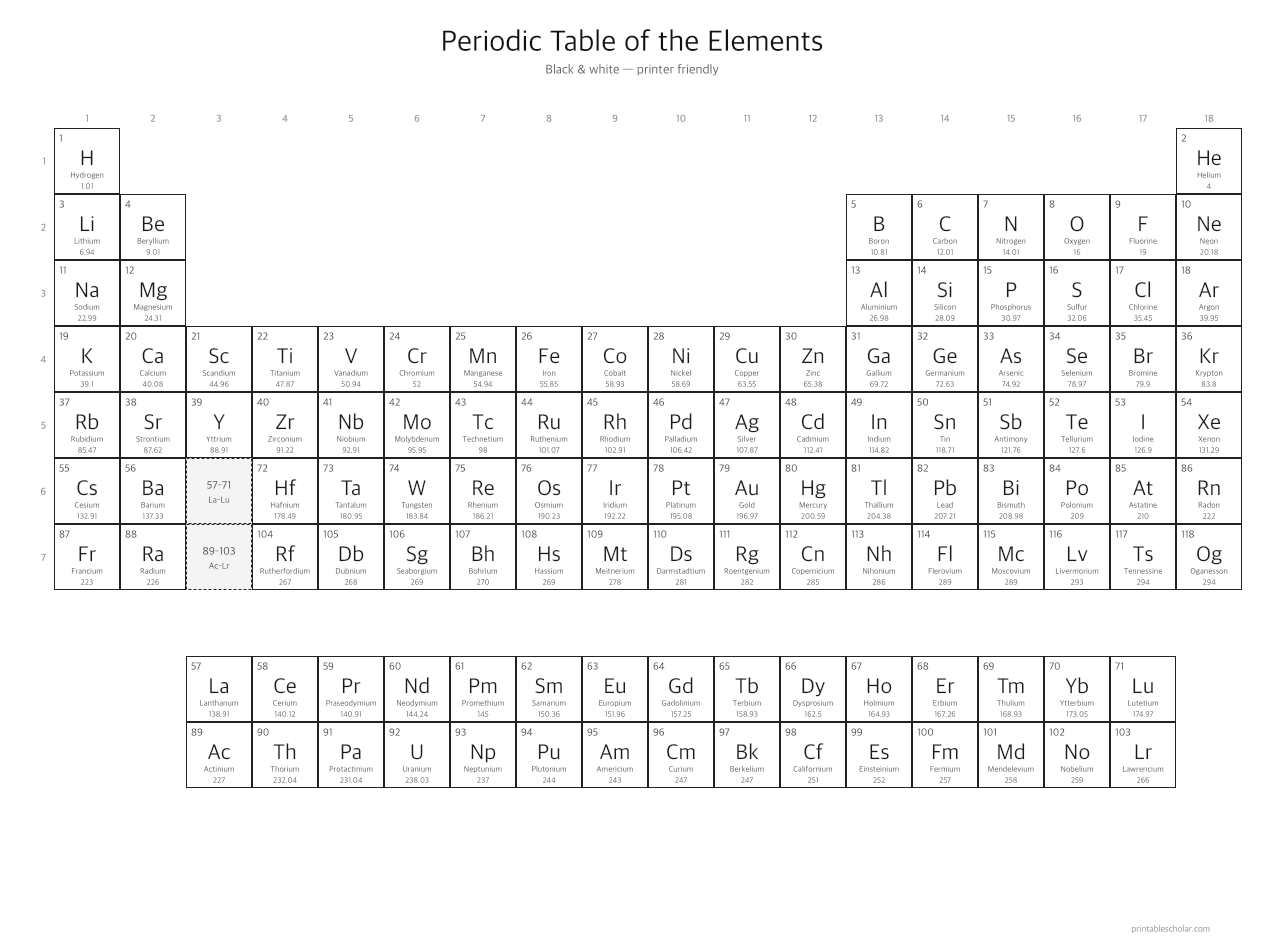
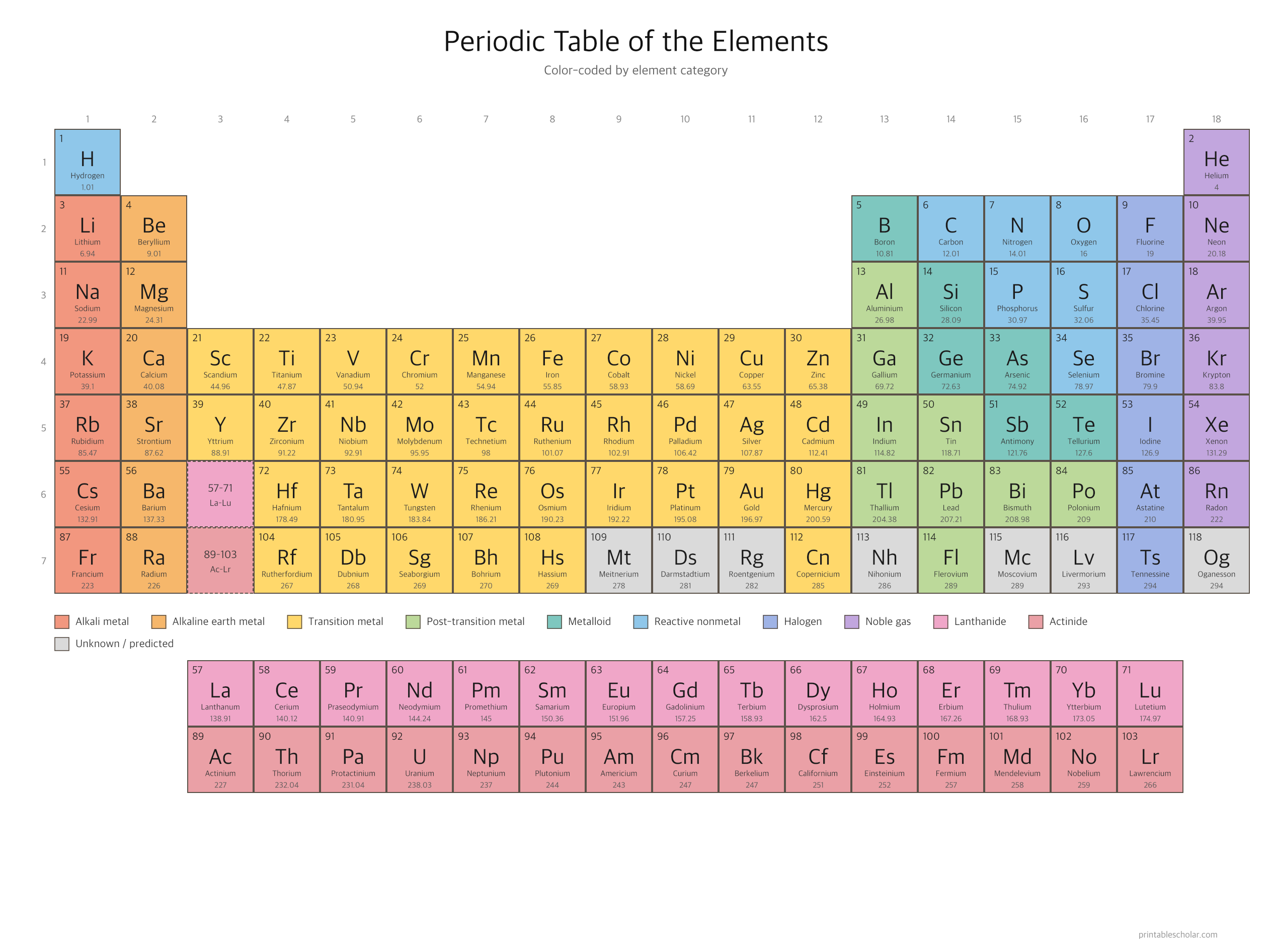
Free printable periodic table of the elements — color-coded, with names, symbols, atomic numbers and atomic masses. Download a high-resolution PDF or PNG sized for Letter paper.
Part of the The Periodic Table teaching pack for grades 6 to 8 (introductory level): 26 lesson slides and 9 printables with answer keys. The diagram and the blank one to label are free.
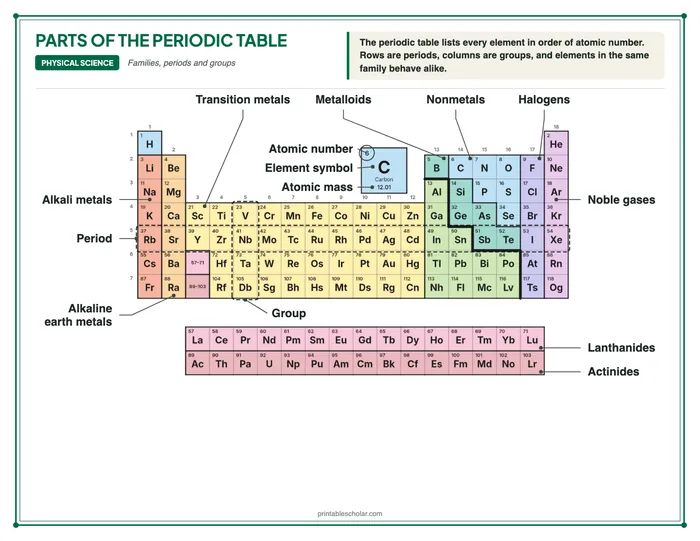
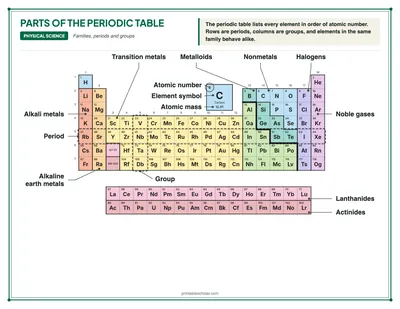
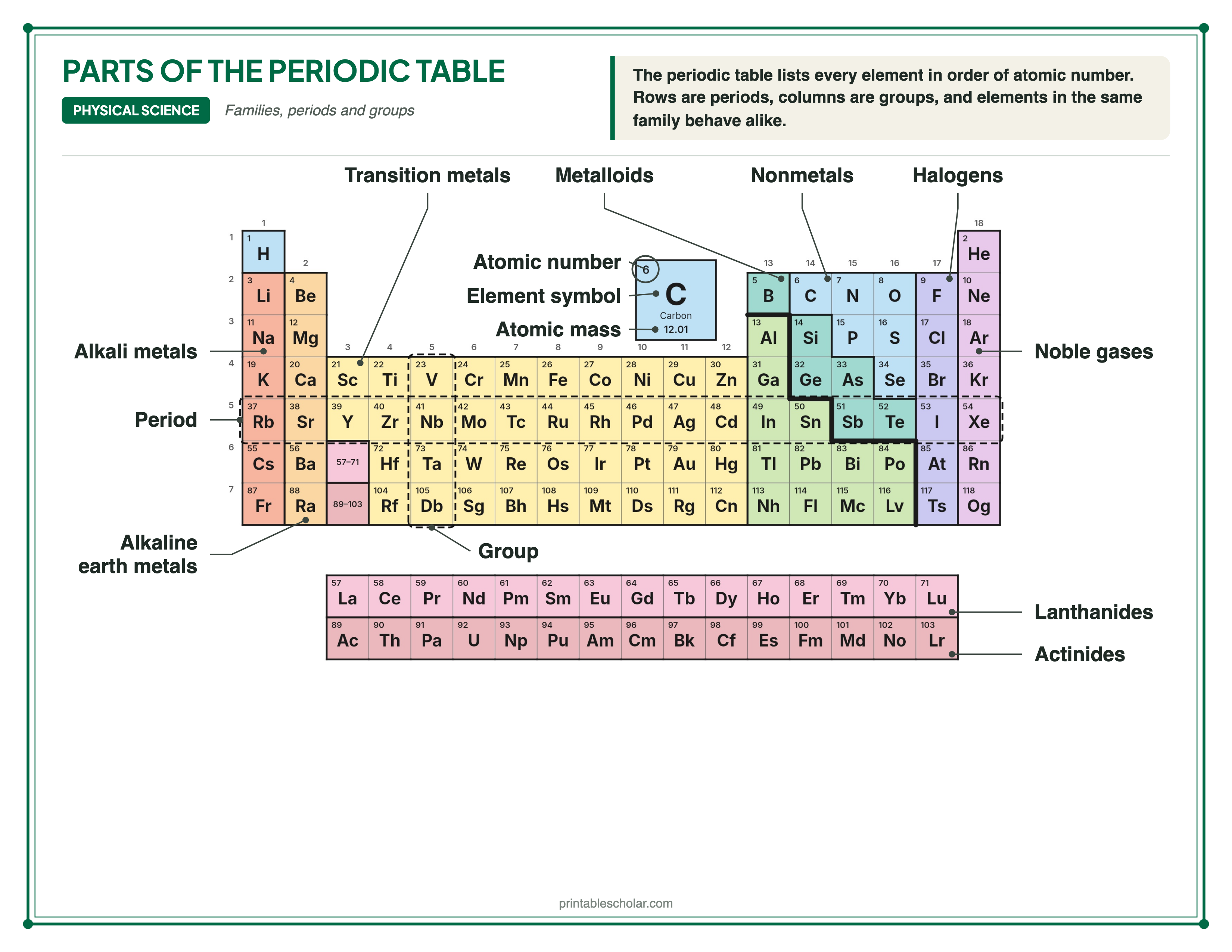
Parts of the Periodic Table diagram
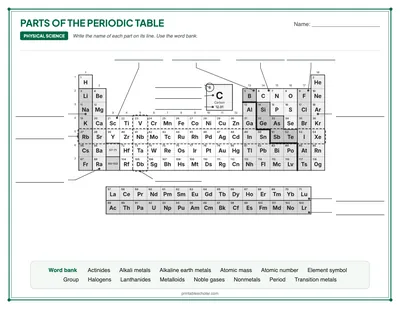
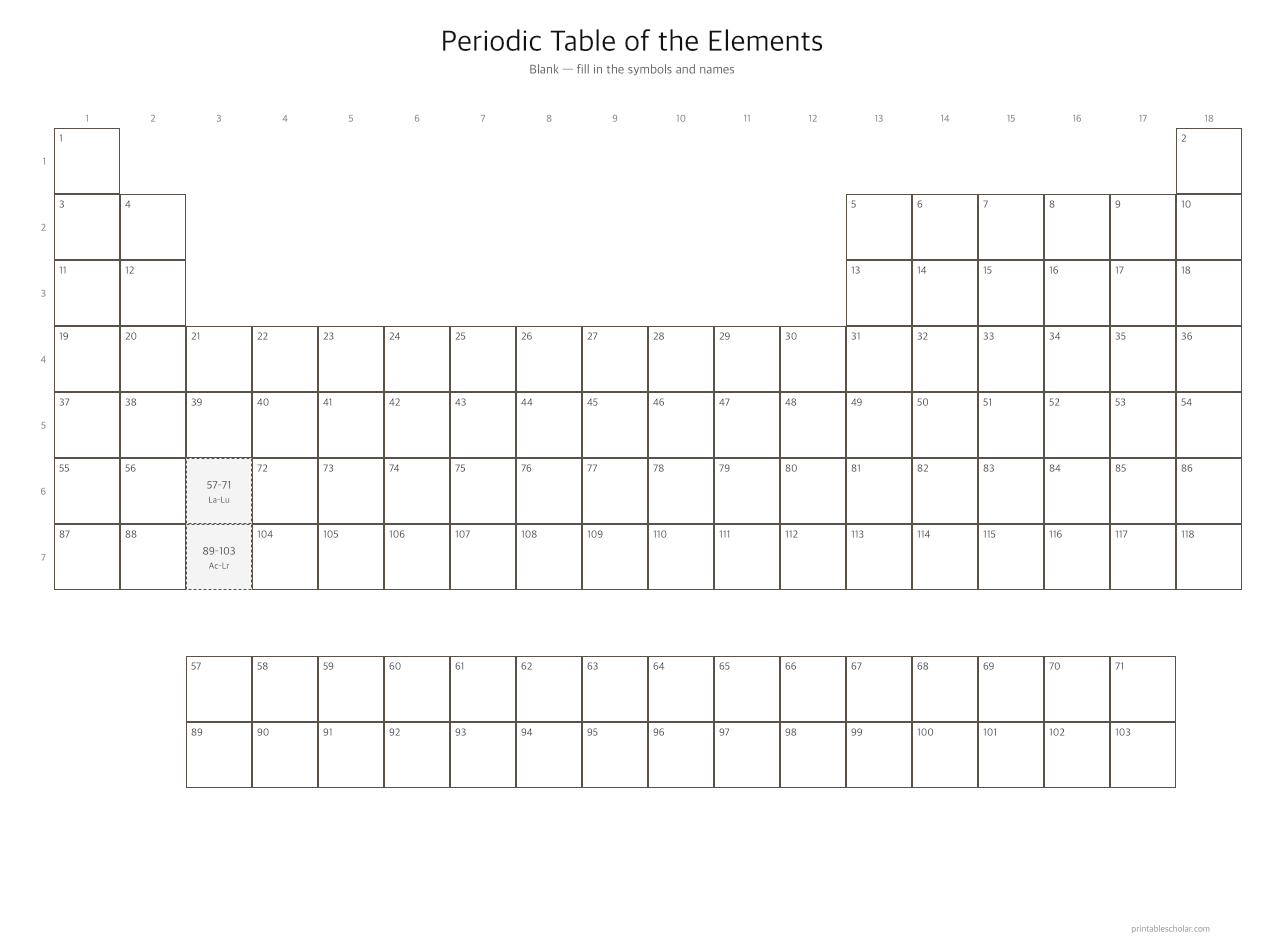
A labeled diagram of the periodic table's parts: periods and groups, the element families, and what each part of an element's square means. The blank copy has a word bank, with the answer key on page 2.
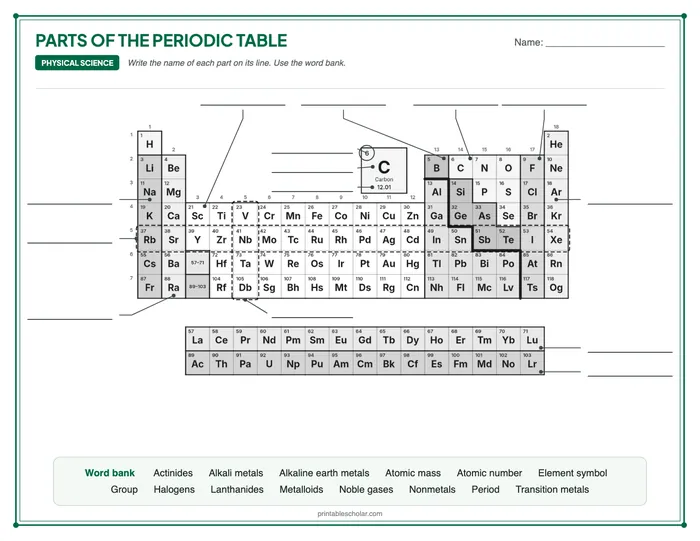
Blank diagram to label
Download blank version + answer key 14 blanks, a word bank, and the answer key on page 2Teaching ideas for The Periodic Table
Pick the ideas that suit your class, then follow the plan or use the sheets in any order.
- Metal or not?. Pass round an iron nail, a strip of aluminum foil and a piece of copper wire. Students look for the shine, bend the foil and the wire, then find iron, aluminum and copper on the table.
- A human table. Give each student a card for one of the first 18 elements. They stand in rows and columns in order of atomic number, then the students in groups 1, 2, 17 and 18 say which family they are, and hydrogen explains why it is not an alkali metal.
- Find the gaps. Hand out cards for elements 1 to 20 with two cards taken out. Students lay the cards out like the table and work out which elements are missing, as Mendeleev did.
- Element hunt. Students list things at home made mostly of one element, such as aluminum foil or a copper pipe, and find each element on the table.
A plan for the week
| Day 1 | Open with one of the ideas above. Teach the lesson with the slides while students fill in the guided notes. Then students label the blank diagram. | Lesson slides (PowerPoint) (in the pack) The Periodic Table Guided Notes (in the pack) Parts of the Periodic Table Diagram Blank Parts of the Periodic Table |
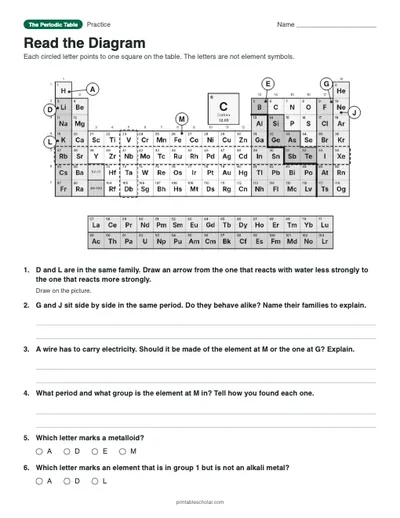
| Day 2 | Students work out what the table tells them on “Read the Diagram”: which metal reacts more strongly, whether two neighbors behave alike and where an element sits. | Read the Diagram (in the pack) |
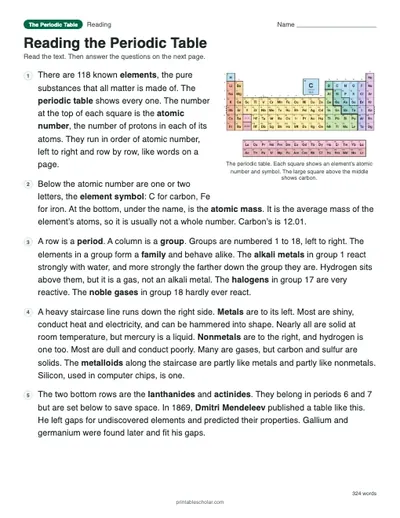
| Day 3 | Read “Reading the Periodic Table” and answer the questions. | Reading the Periodic Table (in the pack) |
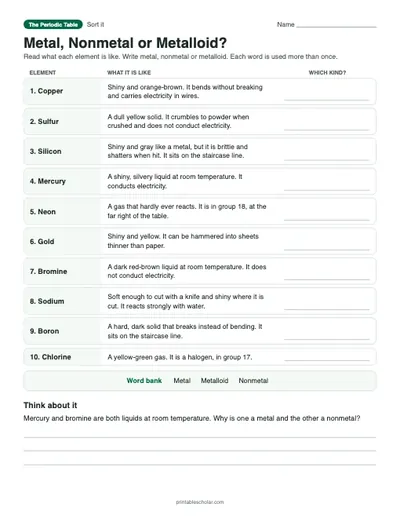
| Day 4 | Students sort ten elements by what they are like on “Metal, Nonmetal or Metalloid?”, then find elements by period, group and symbol on “Find the Element.” | Metal, Nonmetal or Metalloid? (in the pack) Find the Element (in the pack) |
| Day 5 | Review with the crossword, then give the quiz. | Periodic Table Crossword (in the pack) The Periodic Table Quiz (in the pack) |
The sheets marked “in the pack” are in the The Periodic Table teaching pack below.
NGSS standards
- Supports MS-PS1-1: Develop models to describe the atomic composition of simple molecules and extended structures.
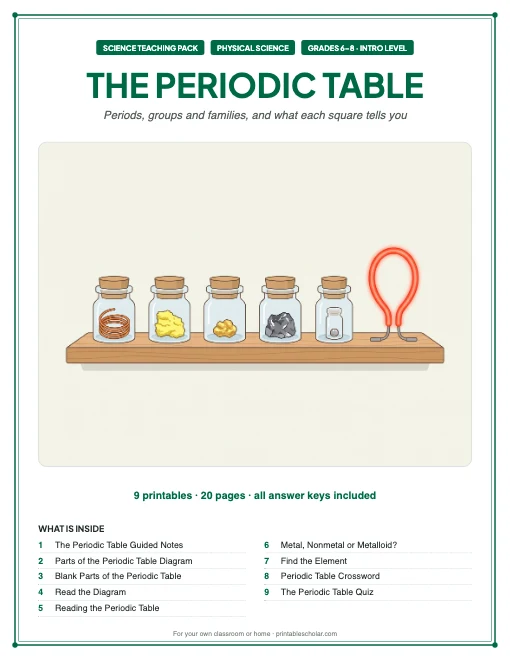
The Periodic Table teaching pack
Teaching the periodic table? Here is a ready-to-teach lesson. 26 slides and 9 printables that cover how the table is organized, what each square tells you, the element families and metals, nonmetals and metalloids, from the guided notes to the quiz. Present the slides while students fill in the guided notes, then use the worksheets, crossword and quiz, with every answer key.
Free on this page: the diagram and the blank one to label, marked Download below. The whole pack is $7: 20 pages in one print-ready file, the 26 lesson slides, the practice sheets, the crossword, the quiz and every answer key.
OnlineThe pack also comes as an online lesson for Google Classroom: every part on screen for students, plus a self-grading Google Forms quiz.
GameMake the first 20 elements with the free Atom Builder: add protons and the element changes, and each one lights up its square on a mini table.
GamePractice with the free Periodic Table Quiz and the First 20 Elements Quiz: we name a part, students tap it, with a score and time at the end.
One-time purchase. Instant download. Secure checkout by Stripe. Want to see a whole pack first? The Parts of an Atom pack is free.See all 18 packs in the bundle
- Cells
- Mitosis
- DNA
- Heredity and Punnett Squares
- Carbon Cycle and Greenhouse Effect
- The Nitrogen Cycle
- Excretory System
- Endocrine System
- Immune System
- Layers of the Skin
- Plate Tectonics and Earthquakes
- Life Cycle of a Star
- Parts of an Atom
- The Periodic Table (this pack)
- Physical and Chemical Changes
- Balancing Chemical Equations
- Waves and the Electromagnetic Spectrum
- Acids, Bases and the pH Scale
Teach the Periodic Table with 26 ready-made slides
Open the PowerPoint and teach: an opening question, the parts one at a time on the diagram, quick checks and an exit question. Students fill in the guided notes sheet as you go.
Every slide comes with teacher notes: what to say, what to ask, and sample answers.
The slides (PowerPoint and a PDF copy) and the guided notes sheet come with the pack.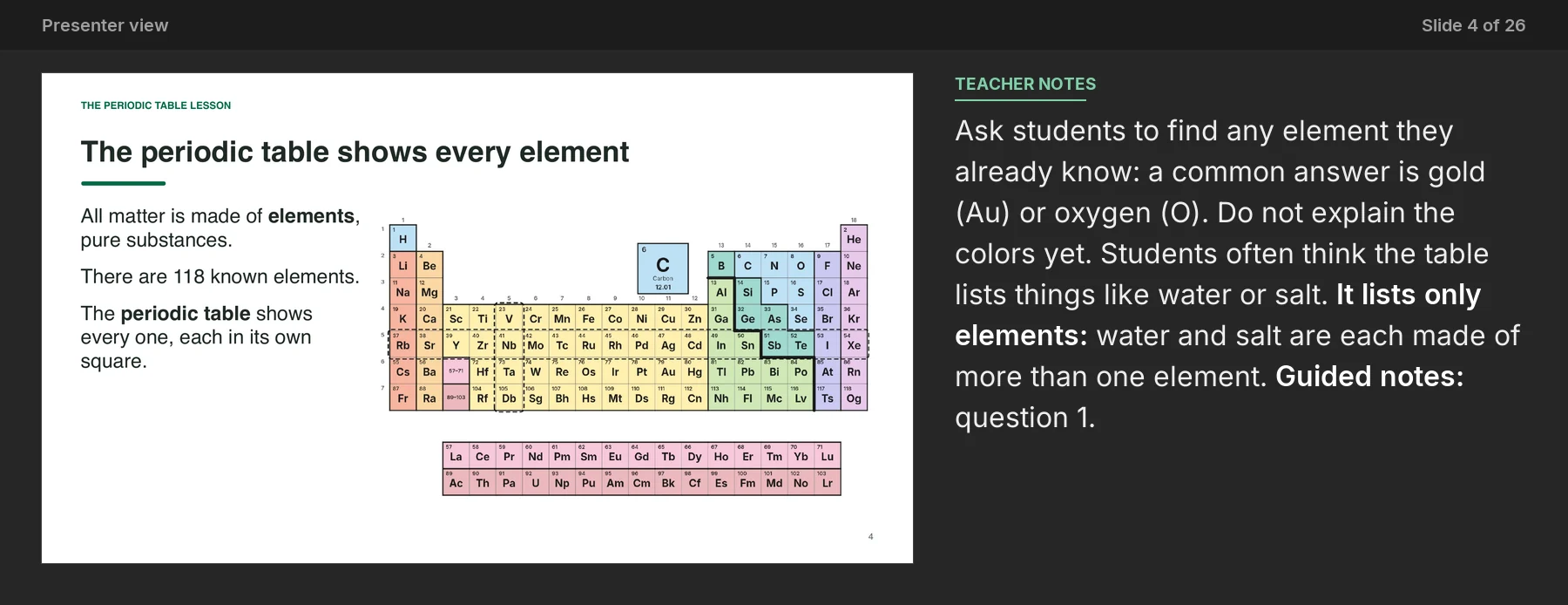
What is in the pack, in teaching order
 In the pack
1. TeachLesson Slides26 slides to present, with your notes for each one.In the $7 pack
 In the pack
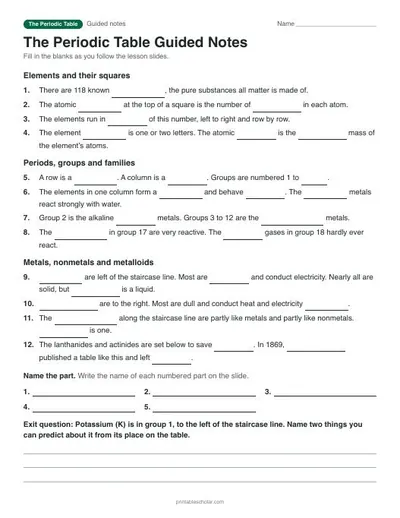
1. TeachThe Periodic Table Guided NotesStudents fill in the blanks as you present. With answer key.In the $7 pack
 Free
 Free
2. LabelBlank Parts of the Periodic TableStudents label 14 parts from a word bank.Download free PDF
 In the pack
3. ReasonRead the DiagramRead the periodic table picture: work out which metal reacts more strongly, whether two neighbors behave alike, and where a lettered element sits.In the $7 pack
 In the pack
4. ReadReading the Periodic TableA one-page text on how the periodic table is organized, what each square shows, the element families and metals, nonmetals and metalloids, with eight questions.In the $7 pack
 In the pack
5. SortMetal, Nonmetal or Metalloid?Read what ten real elements are like and sort each one as a metal, a nonmetal or a metalloid.In the $7 pack
 In the pack
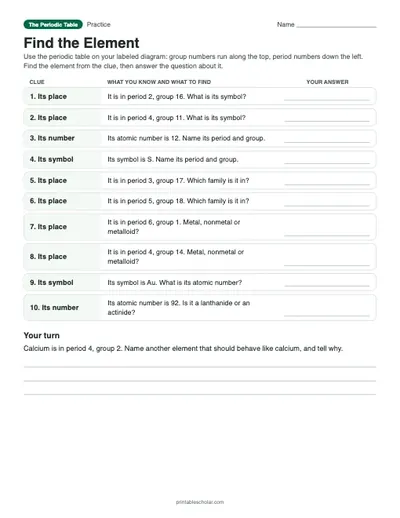
6. ApplyFind the ElementUse the period, group, symbol or atomic number to find ten elements on the table and tell something about each.In the $7 pack
 In the pack
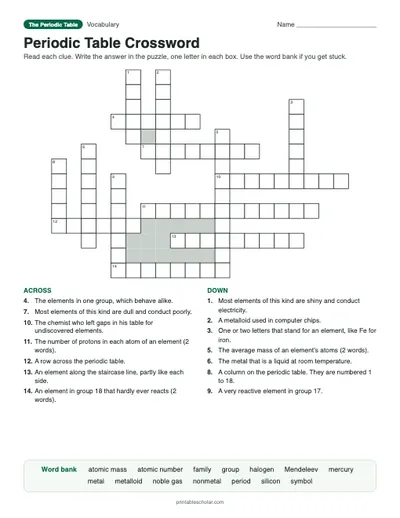
7. ReviewPeriodic Table CrosswordFourteen periodic table words with clues and a word bank.In the $7 pack
 In the pack
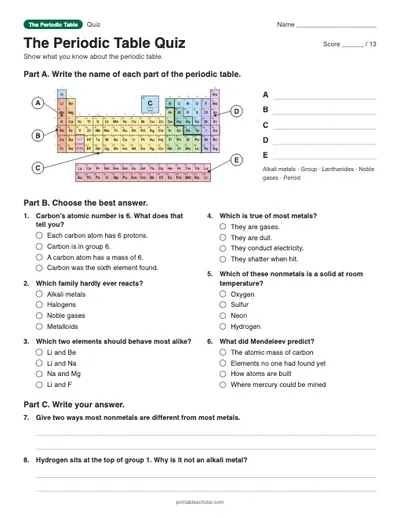
8. CheckThe Periodic Table QuizLabel five parts, six multiple choice and two written answers. Scored out of 13.In the $7 pack
Periodic Table worksheets, crossword and quiz
The Periodic Table teaching pack is 26 lesson slides (PowerPoint and PDF) and 9 printables with answer keys for grades 6 to 8 (introductory level), in the order you would teach them: the guided notes for the lesson slides, the labeled diagram and the blank one to label, then “Read the Diagram” (a worksheet), “Reading the Periodic Table” (a reading passage), “Metal, Nonmetal or Metalloid?” (a sorting table), “Find the Element” (a find-the-element table), a vocabulary crossword and a quiz.
The sheets are in a suggested teaching order: teach the lesson, have students label the blank diagram, then work through the practice sheets and finish with the quiz. Use them all over a week or pick the ones you need. The answer keys are together at the back.
The diagram and the blank one to label are free to download on this page. The other sheets come with the pack ($7), which is also in the Middle School Science bundle (grades 5 to 10).
About this periodic table
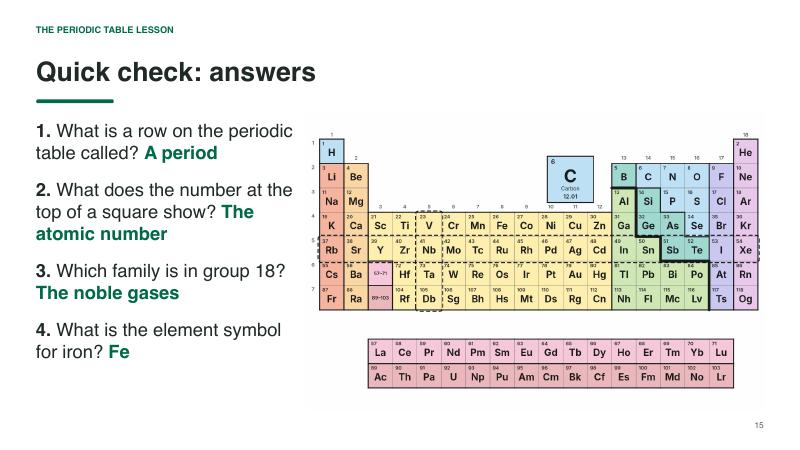
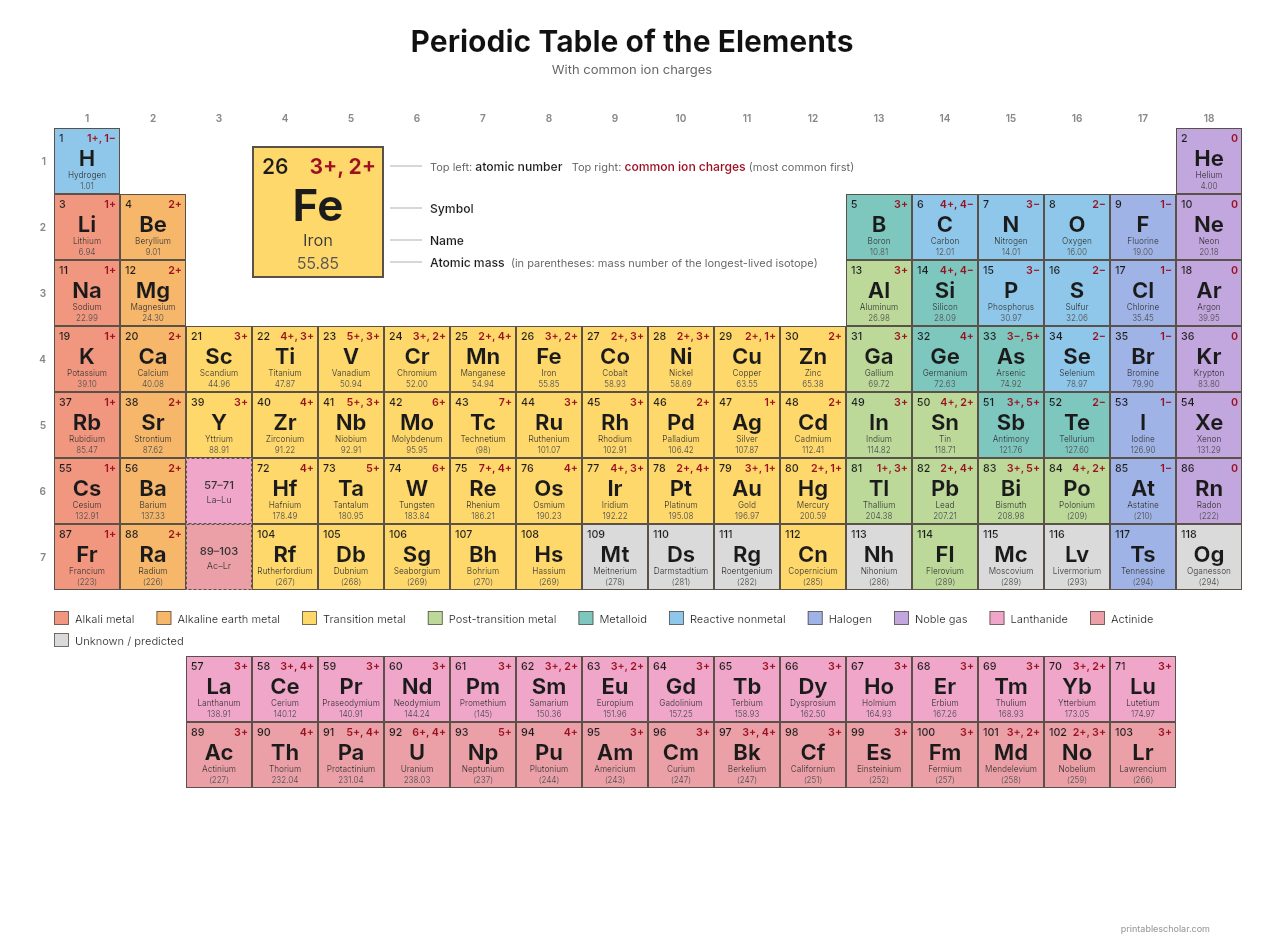
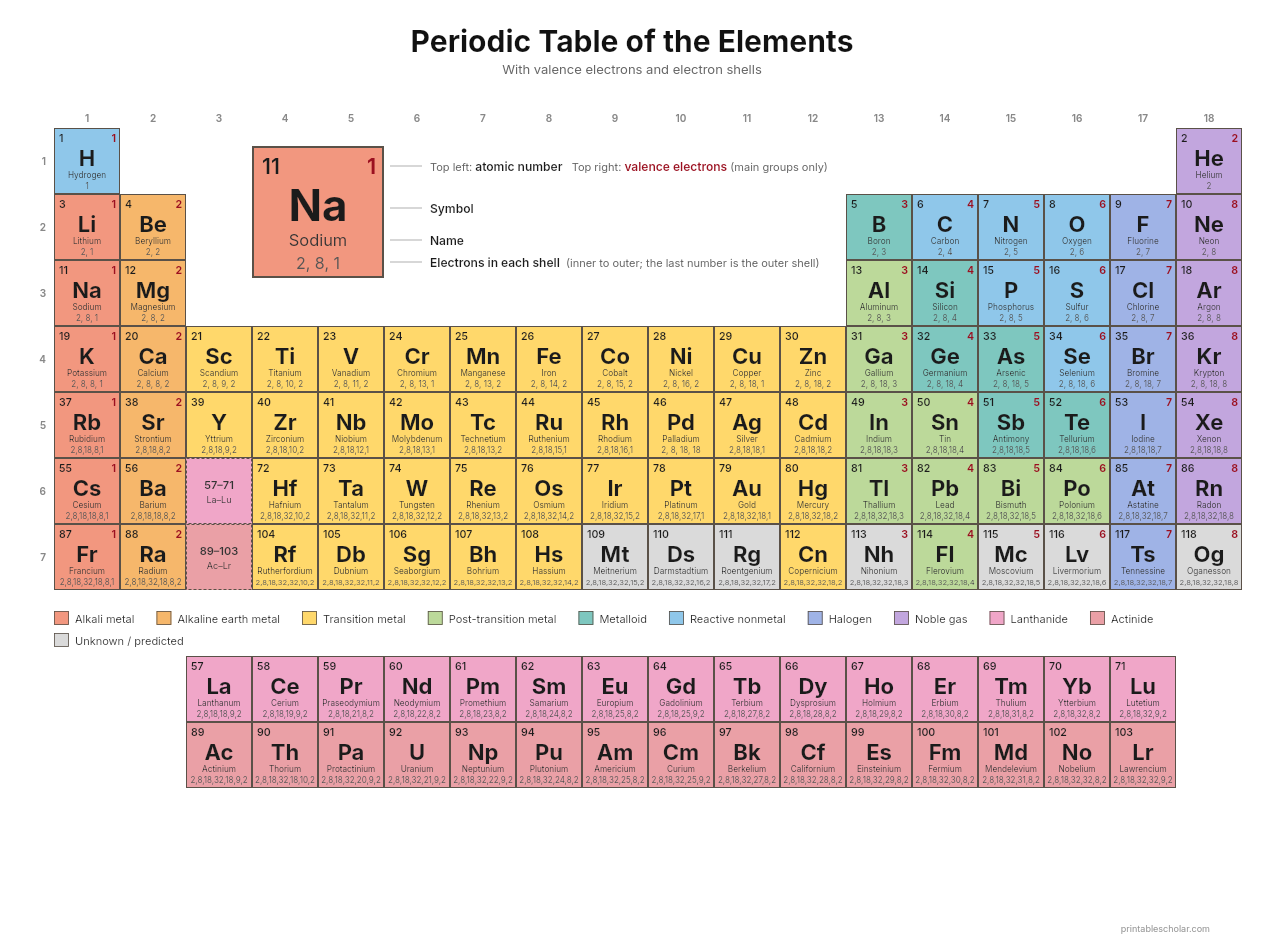
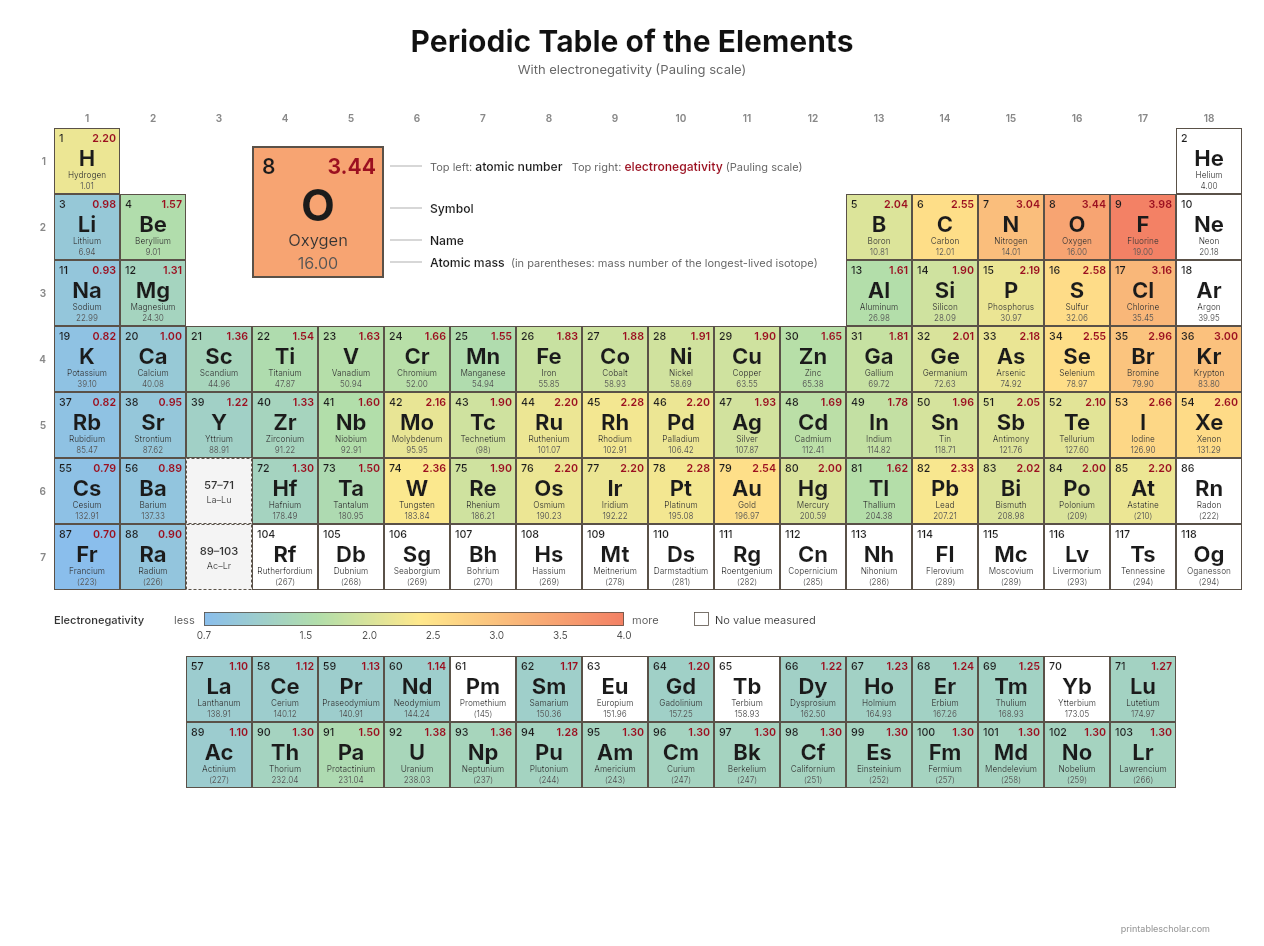
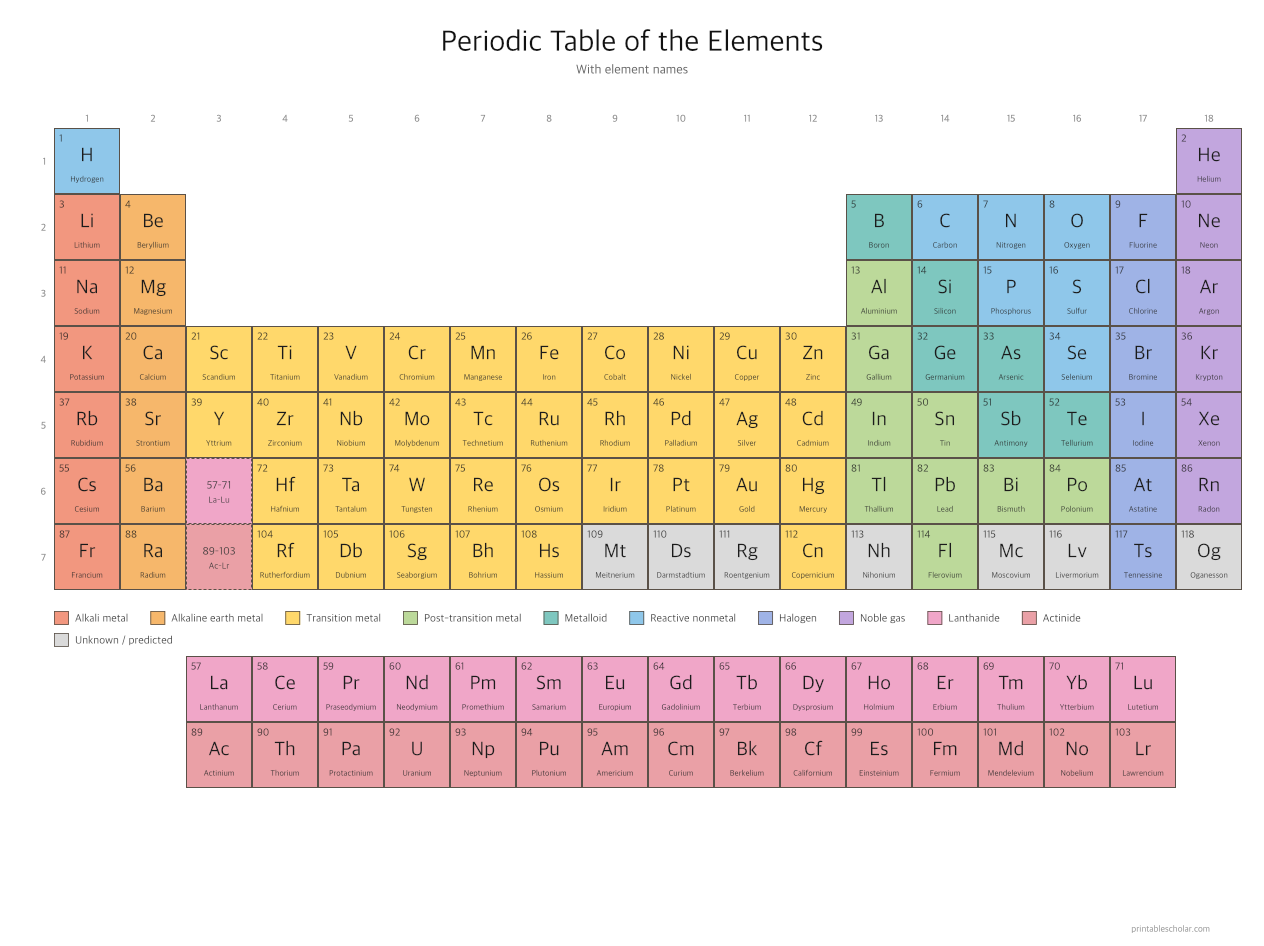
Free printable periodic table of the elements — color-coded, with names, symbols, atomic numbers and atomic masses. Download a high-resolution PDF or PNG sized for Letter paper. Every square is drawn from real element data — atomic number, symbol, name and atomic mass — rendered at high resolution so it stays crisp when you print it. There are 118 elements, laid out in the standard 18-column form with the lanthanide and actinide series shown below.
Elements are color-coded by category, and a legend printed on the table names every color so you can quickly tell metals, metalloids, nonmetals and noble gases apart.
How to read the periodic table
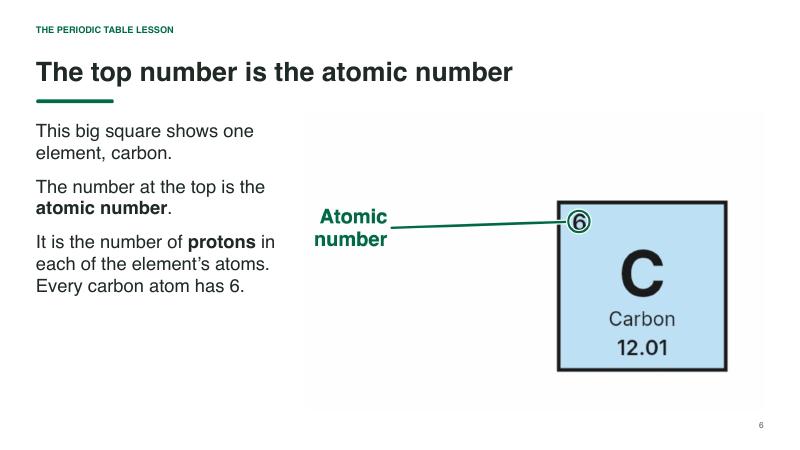
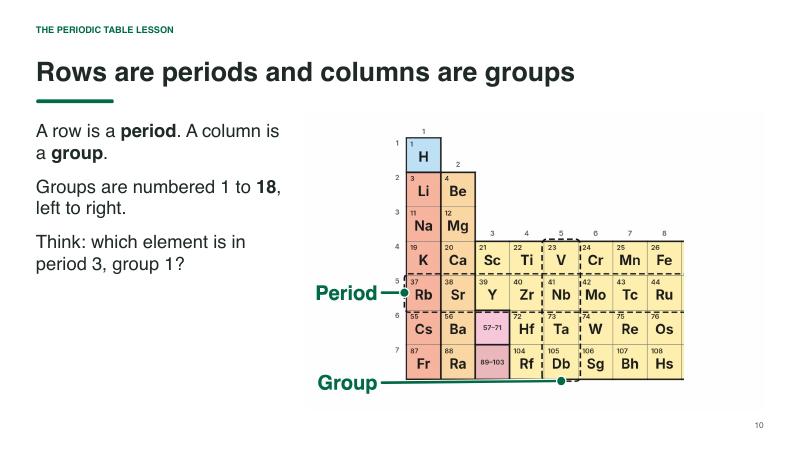
Each element occupies one square showing four things: the atomic number (how many protons the atom has), the element's symbol (one or two letters), its name, and its atomic mass (the average mass of one atom). The columns are called groups — elements in the same group share similar chemical behavior — and the rows are called periods. Reading left to right, top to bottom, follows increasing atomic number.
Element categories
Elements fall into families with shared properties. From the reactive metals on the left to the stable gases on the right, here is what each color group means:
- Alkali metals. Group 1 (except hydrogen) — soft, silvery, highly reactive metals such as lithium and sodium.
- Alkaline earth metals. Group 2 — reactive metals such as magnesium and calcium.
- Transition metals. Groups 3–12 — the large central block, including iron, copper, silver and gold.
- Post-transition metals. Softer metals to the right of the transition block, such as aluminum, tin and lead.
- Metalloids. Elements with properties between metals and nonmetals, such as boron and silicon.
- Reactive nonmetals. Elements essential to life, including carbon, nitrogen, oxygen and sulfur.
- Halogens. Group 17 — very reactive nonmetals such as fluorine, chlorine and iodine.
- Noble gases. Group 18 — stable, largely unreactive gases such as helium, neon and argon.
- Lanthanides. The upper series (57–71), the rare-earth elements.
- Actinides. The lower series (89–103), including uranium and plutonium.
How to print
Choose Download PDF for a ready-to-print file that automatically fits US Letter paper (8.5 × 11") in landscape orientation, or Download PNG for the high-resolution image. For the sharpest wall poster, print the PDF at 100% scale (not "fit to page shrink") on the largest paper your printer supports.
Other versions
More chemistry printables
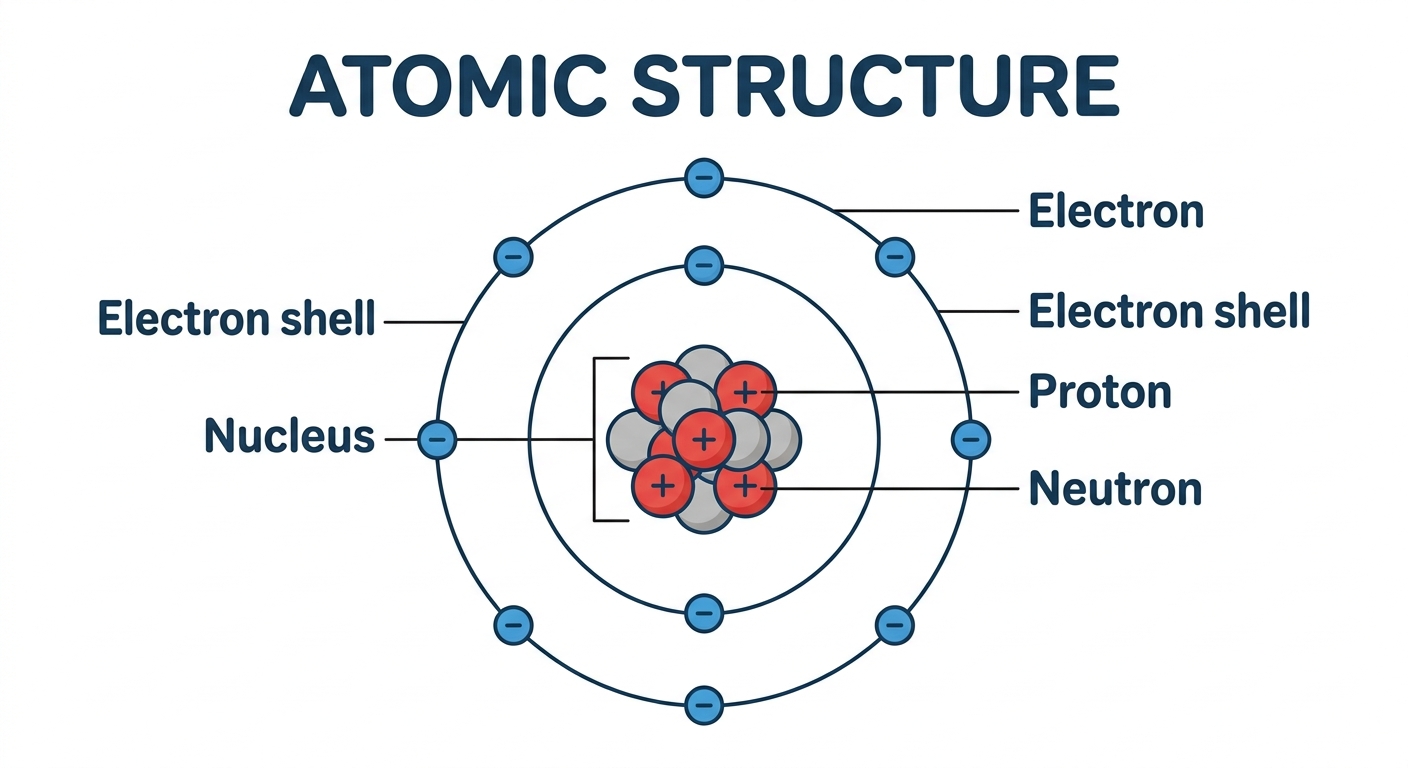
Teaching atoms? The free Parts of an Atom teaching pack has lesson slides and 8 printables with answer keys. See all science printables
Frequently asked questions
What is the periodic table?
The periodic table organizes all 118 known chemical elements by their atomic number and chemical properties. The rows are called periods and the columns are called groups; elements in the same group behave in similar ways.
How do I read the periodic table?
Each square shows the element's atomic number (the number of protons in its nucleus), its one- or two-letter symbol, its name, and its atomic mass (the average mass of one atom). Reading left to right and top to bottom follows increasing atomic number.
What do the colors mean?
Each color marks an element category — alkali metals, transition metals, noble gases, and so on. The legend printed on the table explains every color.
What paper size should I print this on?
This table is sized for standard US Letter paper (8.5 × 11 inches) in landscape orientation. Click "Download PDF" for a print-ready file that fits the page automatically, or "Download PNG" for the high-resolution image.
How many elements are on the periodic table?
There are 118 confirmed elements, from hydrogen (atomic number 1) to oganesson (atomic number 118).
Are there Periodic Table worksheets to go with the diagram?
Yes. The Periodic Table teaching pack, for grades 6 to 8 (introductory level), has 26 lesson slides and 9 printables with answer keys: the guided notes for the lesson slides, the labeled diagram and the blank one to label, then “Read the Diagram” (a worksheet), “Reading the Periodic Table” (a reading passage), “Metal, Nonmetal or Metalloid?” (a sorting table), “Find the Element” (a find-the-element table), a vocabulary crossword and a quiz. The diagram and the blank one to label are free to download on this page. The other sheets come with the pack ($7), which is also in the Middle School Science bundle (grades 5 to 10).