 Printable Scholar
Atom Builder
Build an atom from protons, neutrons and electrons and see what element you made.
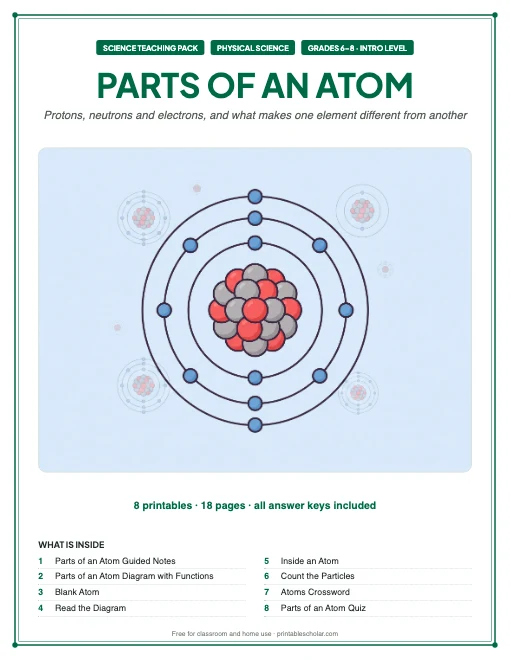 Free teaching pack · Grades 6–8Teaching atoms? Get the Parts of an Atom teaching pack free →Lesson slides and 8 printables with answer keys, sent free by email: protons, neutrons and electrons, and what makes one element different from another.
 Teaching pack · Grades 6–8 · $7Next up: the Periodic Table teaching pack →Lesson slides, guided notes and 9 printables, with every answer key.
How to play
Tap the proton, neutron or electron bin to add one to the atom, or drag one onto it. Tap a particle on the atom to take it off, or drag it out of the dark box. The card shows what you built: the element, its atomic number and mass number, its charge, and whether the nucleus is stable. An unstable nucleus wobbles, and after a few seconds it decays into a different atom, just like real atoms do (only much faster). Every element you make lights up its square on the table. Undo takes back your last change, even a decay, and Start over brings back carbon.
Things to try
- Turn carbon into nitrogen. What changed, and what stayed the same?
- Make carbon-14 and watch what it turns into.
- Find the only stable atom with no neutrons at all.
- Make an oxygen ion with a charge of −2, then a sodium ion with a charge of +1.
- Add neutrons to helium one at a time. How many can it hold before it starts to fall apart?
- Build neon with its rings full. Why is the next element (sodium) the start of a new ring?
- Make all three isotopes of hydrogen: hydrogen-1, deuterium and tritium. Which one decays?
- Make beryllium-8 and see what it splits into.
- Fill in all 20 squares of the table.
Teaching atoms?
The Parts of an Atom teaching pack is free by email: lesson slides, a labeled atom diagram, practice sheets and every answer key for grades 6 to 8. Use this game as the warm-up or the hands-on part. The atom diagram and the printable periodic table are free, and the first 20 elements quiz tests the symbols.
Questions
What are protons, neutrons and electrons?
They are the three particles that make up an atom. Protons have a positive charge and neutrons have no charge, and together they make the nucleus in the middle. Electrons have a negative charge and move around the nucleus in shells.
What decides which element an atom is?
Only the number of protons. One proton is always hydrogen, six is always carbon and eight is always oxygen. This number is the atomic number. Adding neutrons or electrons changes the atom, but it stays the same element.
What is the mass number?
The mass number is the number of protons plus the number of neutrons. Carbon with 6 protons and 6 neutrons is carbon-12, and carbon with 6 protons and 8 neutrons is carbon-14. Electrons are so light that they are not counted.
What is an isotope?
Isotopes are atoms of the same element with different numbers of neutrons. Carbon-12, carbon-13 and carbon-14 are all carbon, because they all have 6 protons, but they have 6, 7 and 8 neutrons.
What is an ion?
An ion is an atom with more or fewer electrons than protons, so it has a charge. Take an electron away and the atom becomes a positive ion (like Na⁺). Add one and it becomes a negative ion (like Cl⁻). An atom with the same number of protons and electrons is neutral.
Why do some atoms decay?
A nucleus needs the right mix of protons and neutrons to hold together. With too many or too few neutrons it is unstable, and sooner or later it changes: a neutron can turn into a proton (shooting out an electron), a proton can turn into a neutron, or the nucleus can throw out a particle. When the number of protons changes, the atom becomes a different element. Carbon-14 decays into nitrogen-14 this way.
What is a half-life?
The half-life is the time it takes for half of a pile of unstable atoms to decay. Carbon-14’s half-life is about 5,700 years, which is why it is used to date old bones and wood. In the game decay is sped up to a few seconds, and the card shows the real half-life.
How many electrons go in each shell?
In the simple shell model used in middle school, the first shell holds 2 electrons, the second holds 8 and the third holds 8, and then the fourth shell starts. That works for the first 20 elements, hydrogen to calcium, which is what this game builds.
Where do the stable and unstable atoms come from?
From the real table of known nuclei kept by the International Atomic Energy Agency (IAEA). Every half-life and every kind of decay in the game is the real one.
Is it really free?
Yes. No sign-up, no ads. Your atom and the elements you have made are saved on this device.