 Printable Scholar
Balancing Chemical Equations Worksheet and Diagram
Free printable balancing chemical equations diagram and worksheet for grades 8-10: reactants and products, the yields arrow, subscripts and coefficients, and atom counts that show hydrogen and oxygen making water, before and after balancing, with a blank diagram to label. PDF for Letter paper.
Part of the Balancing Chemical Equations teaching pack for grades 8 to 10: 31 lesson slides and 12 printables with answer keys. The diagram and the blank one to label are free, and so is one worksheet: “Balancing Equations Practice”.
Teaching ideas for Balancing Chemical Equations
Pick the ideas that suit your class, then follow the plan or use the sheets in any order.
- Rebuild the molecules. Groups use a molecular model kit, or white and red clay balls with toothpicks. They build two H₂ and one O₂, then pull them apart and rebuild them into two H₂O with nothing left over.
- Act it out. Six students hold H or O cards and link arms as two H₂ and one O₂. They regroup as two water molecules. Count the people before and after: nobody appeared or disappeared.
- Weigh a sealed bag. Weigh a zip bag holding a little vinegar with a spoon of baking soda kept apart. Seal it, mix, and weigh again: about the same. Repeat in an open cup and the mass drops as gas escapes.
A plan for the week
| Day 1 | Open with one of the ideas above. Teach the lesson with the slides while students fill in the guided notes. Teach the parts of an equation from the labeled diagram, then students label the blank one. | Lesson slides (PowerPoint) (in the pack) Balancing Chemical Equations Guided Notes (in the pack) Balancing Chemical Equations Diagram Blank Balancing Equations Diagram |
| Day 2 | Students work out what the picture shows on “Read the Diagram”: why the oxygen count gets a cross, what the coefficient makes two of and why hydrogen needs a 2 as well. Then they read “How to Balance a Chemical Equation” and answer the questions. | Read the Diagram (in the pack) How to Balance a Chemical Equation (in the pack) |
| Day 3 | Students count atoms in formulas on “Count the Atoms,” then balance six equations with atom tables on “Balancing Equations Practice.” | Count the Atoms (in the pack) Balancing Equations Practice |
| Day 4 | Students balance harder equations on “Balancing Equations: Level 2,” spot the mistakes on “Balanced or Not?” and turn reactions in words into equations on “Word Equations.” | Balancing Equations: Level 2 (in the pack) Balanced or Not? (in the pack) Word Equations (in the pack) |
| Day 5 | Review with the crossword, then give the quiz. | Balancing Equations Crossword (in the pack) Balancing Equations Quiz (in the pack) |
The sheets marked “in the pack” are in the Balancing Chemical Equations teaching pack below.
NGSS standards
- Aligned to MS-PS1-5: Develop and use a model to describe how the total number of atoms does not change in a chemical reaction and thus mass is conserved.
- Supports HS-PS1-7: Use mathematical representations to support the claim that atoms, and therefore mass, are conserved during a chemical reaction.
Balancing Chemical Equations teaching pack
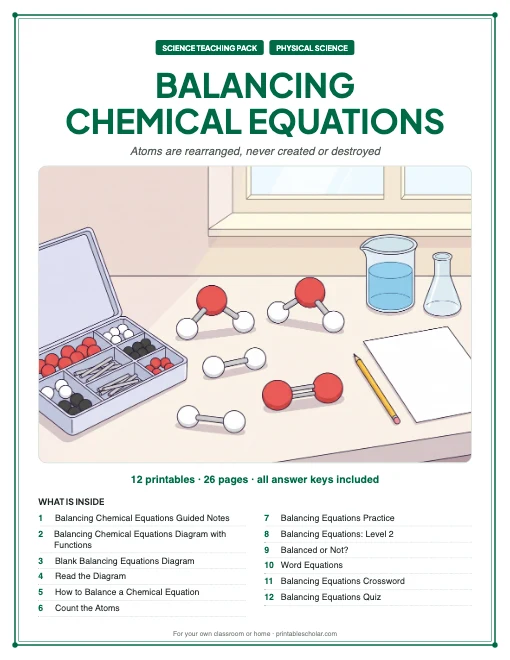
A ready-to-teach lesson: 31 slides and 12 printables. Present the slides while students fill in the guided notes, then use the worksheets, crossword and quiz, with every answer key.
Teaching how to balance chemical equations? This pack has ready-made lesson slides and 11 printables that take students from counting atoms to balancing combustion and word equations, in teaching order, with every answer key worked out and checked.
Free on this page: 3 of the 12 printables, marked Download below. The whole pack is $7: 26 pages in one print-ready file, the 31 lesson slides, the practice sheets, the crossword, the quiz and every answer key.
OnlineThe pack also comes as an online lesson for Google Classroom: every part on screen for students, plus a self-grading Google Forms quiz.
GameBalance equations online with the free Balancing Equations game: students change the numbers in front and watch the atoms appear on each side until a scale for every element levels, across 24 real reactions.
One-time purchase. Instant download. Secure checkout by Stripe. Want to see a whole pack first? The Parts of an Atom pack is free.See all 18 packs in the bundle
- Cells
- Mitosis
- DNA
- Heredity and Punnett Squares
- Carbon Cycle and Greenhouse Effect
- The Nitrogen Cycle
- Excretory System
- Endocrine System
- Immune System
- Layers of the Skin
- Plate Tectonics and Earthquakes
- Life Cycle of a Star
- Parts of an Atom
- The Periodic Table
- Physical and Chemical Changes
- Balancing Chemical Equations (this pack)
- Waves and the Electromagnetic Spectrum
- Acids, Bases and the pH Scale
Teach Balancing Chemical Equations with 31 ready-made slides
Open the PowerPoint and teach: an opening question, the parts one at a time on the diagram, quick checks and an exit question. Students fill in the guided notes sheet as you go.
Every slide comes with teacher notes: what to say, what to ask, and sample answers.
The slides (PowerPoint and a PDF copy) and the guided notes sheet come with the pack.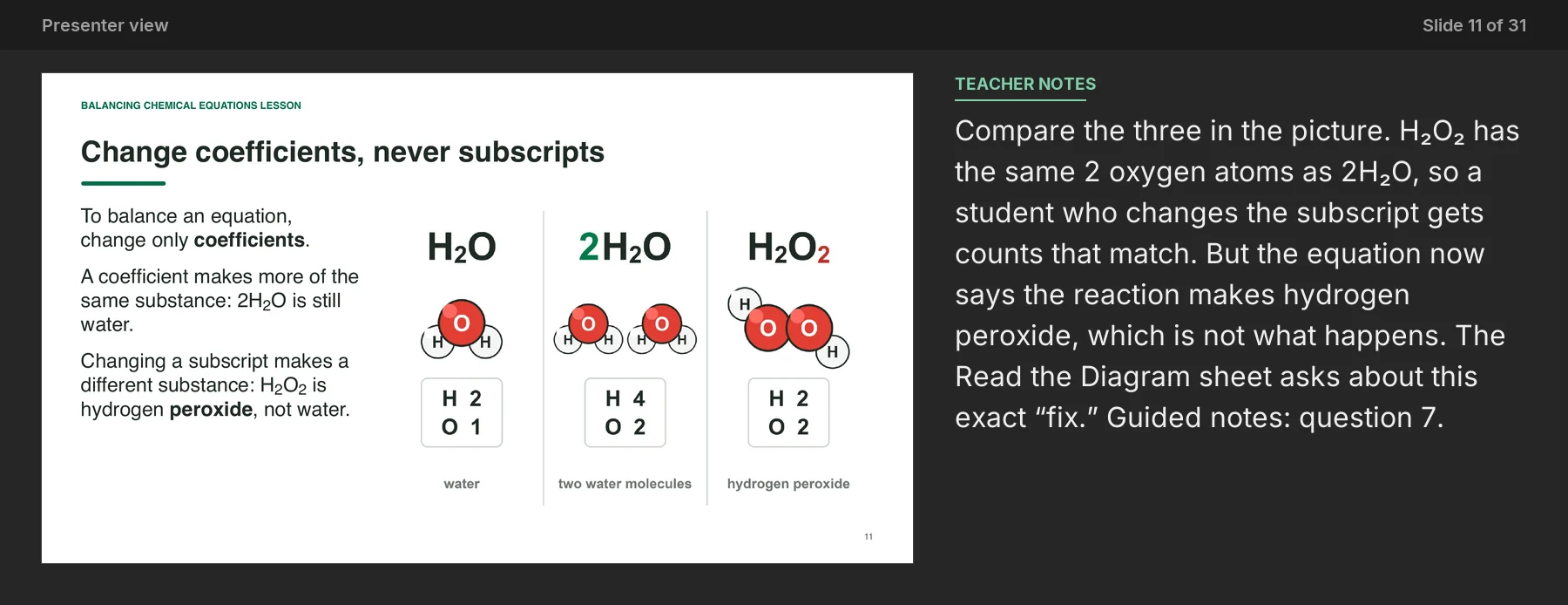
What is in the pack, in teaching order
 In the pack
1. TeachLesson Slides31 slides to present, with your notes for each one.In the $7 pack
 In the pack
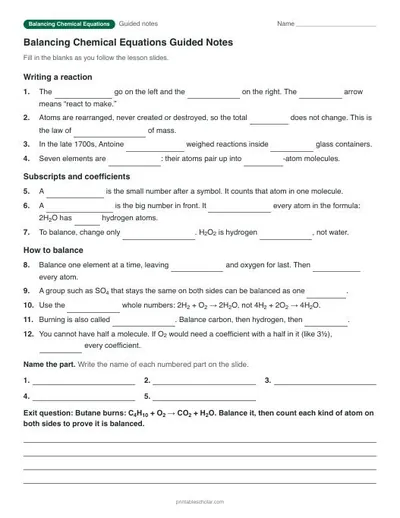
1. TeachBalancing Chemical Equations Guided NotesStudents fill in the blanks as you present. With answer key.In the $7 pack
 Free
 Free
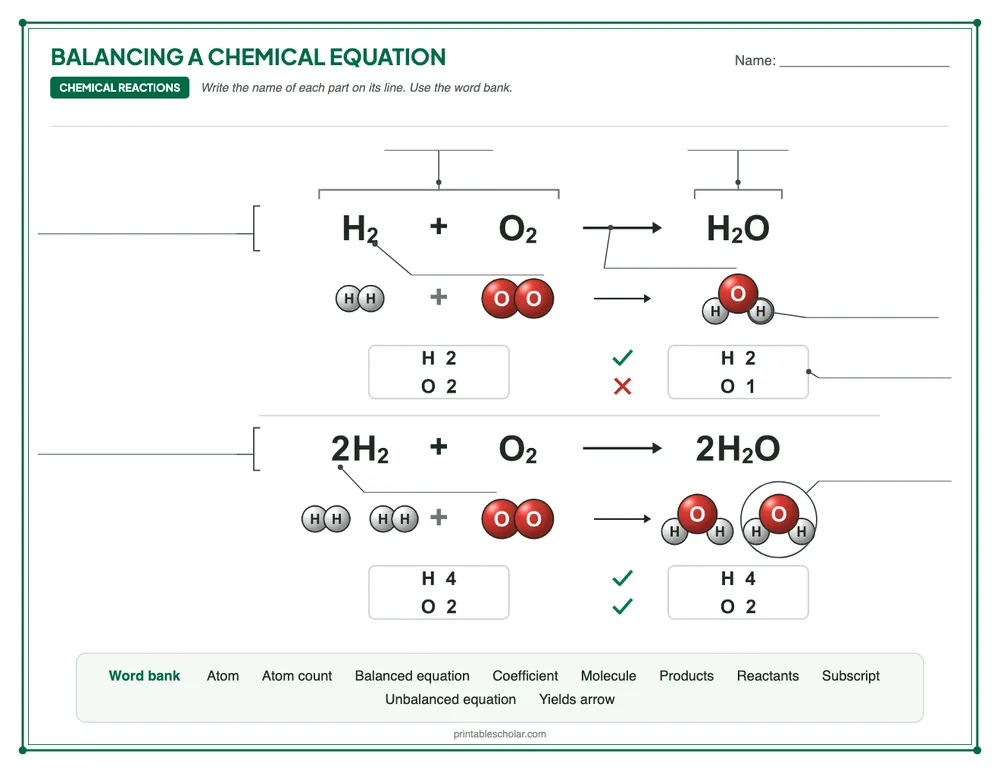
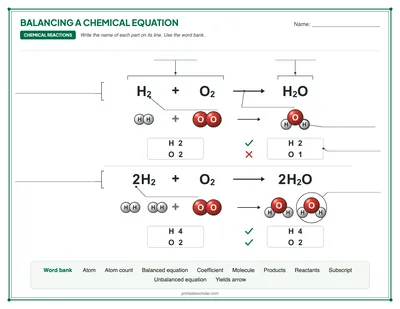
2. LabelBlank Balancing Equations DiagramStudents label 10 parts from a word bank.Download free PDF
 In the pack
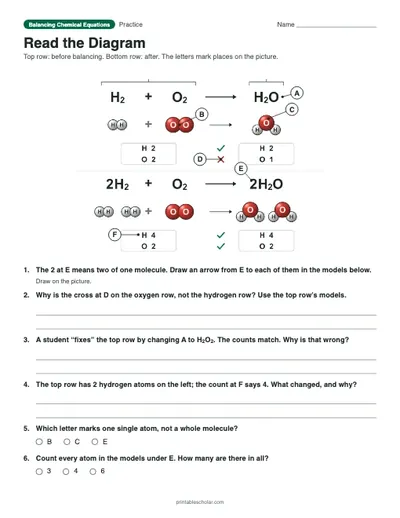
3. ReasonRead the DiagramRead the two equations in the picture: show what a coefficient makes two of, explain the cross on the oxygen row and why changing a subscript is the wrong fix.In the $7 pack
 In the pack
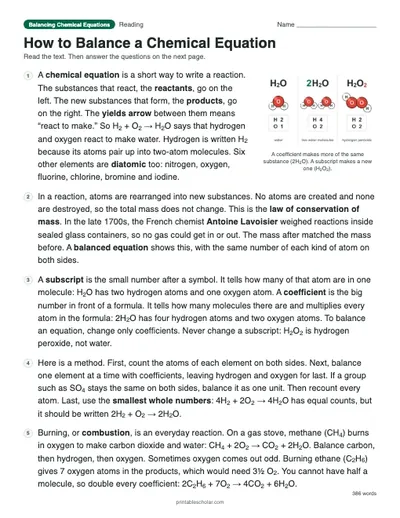
4. ReadHow to Balance a Chemical EquationA one-page text on reactants and products, conservation of mass, subscripts and coefficients, a step-by-step balancing method and burning methane, with eight questions.In the $7 pack
 In the pack
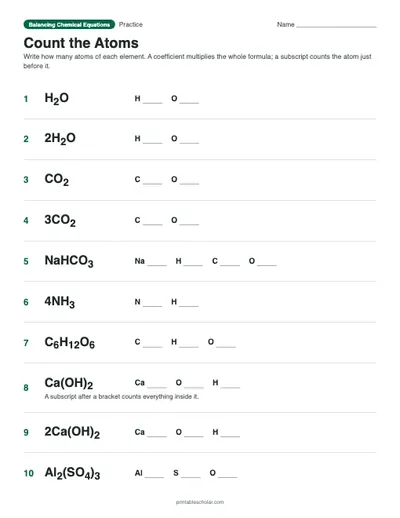
5. PracticeCount the AtomsCount the atoms of each element in ten formulas, with coefficients, subscripts and brackets.In the $7 pack
 Free
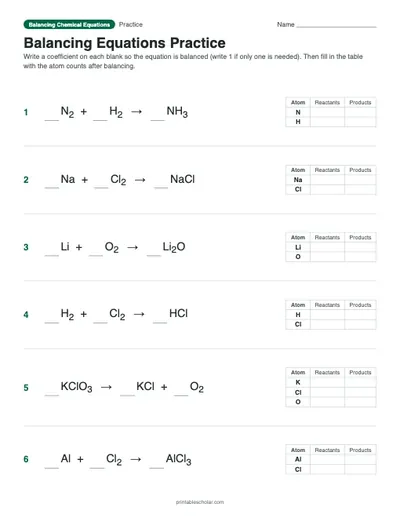
5. PracticeBalancing Equations PracticeSix equations to balance, each with an atom count table to fill in.Download free PDF
 In the pack
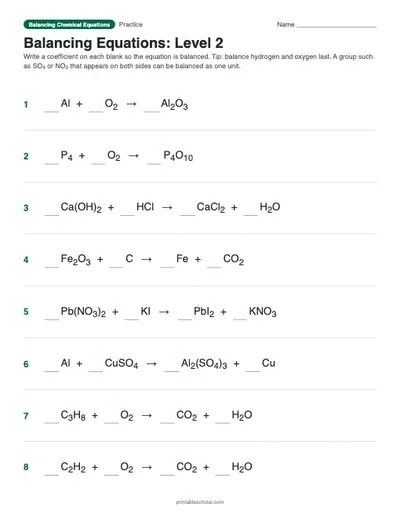
5. PracticeBalancing Equations: Level 2Eight harder equations to balance, with room to tally atoms: combustion, metals and groups in brackets.In the $7 pack
 In the pack
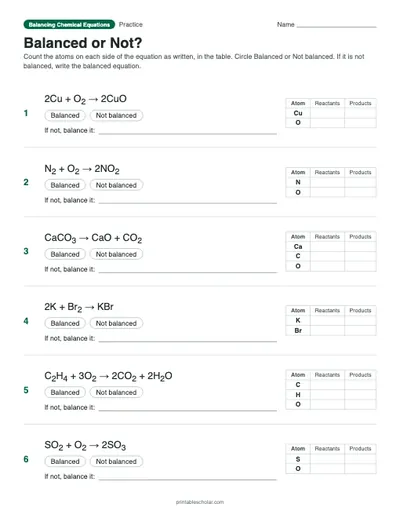
6. ApplyBalanced or Not?Six equations with coefficients already written: count both sides, decide if each is balanced, and fix the ones that are not.In the $7 pack
 In the pack
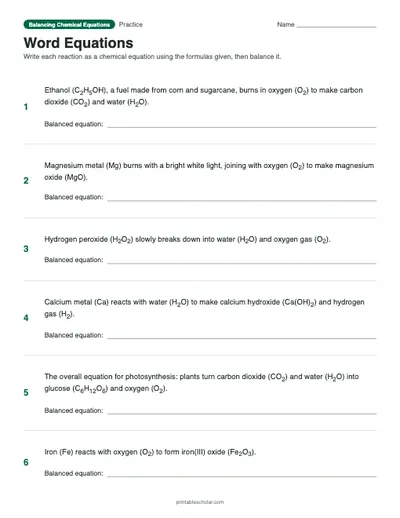
6. ApplyWord EquationsSix real reactions in words, with the formulas given: write each one as an equation and balance it.In the $7 pack
 In the pack
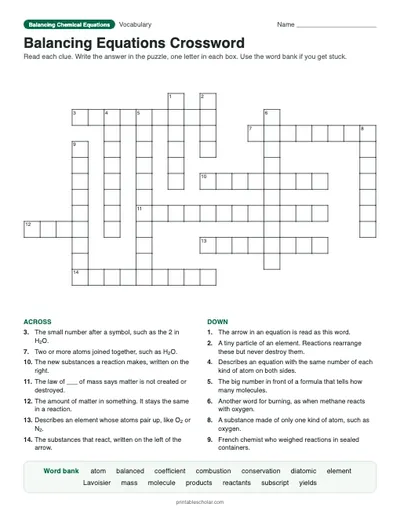
7. ReviewBalancing Equations CrosswordFourteen balancing equations words with clues and a word bank.In the $7 pack
 In the pack
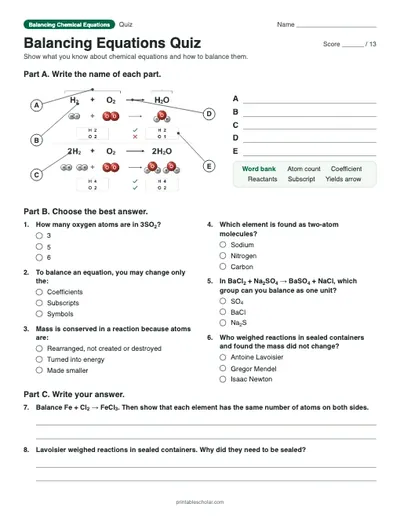
8. CheckBalancing Equations QuizName five parts of a chemical equation, six multiple choice and two written answers. Scored out of 13.In the $7 pack
Balancing Chemical Equations worksheets, crossword and quiz
The Balancing Chemical Equations teaching pack is 31 lesson slides (PowerPoint and PDF) and 12 printables with answer keys for grades 8 to 10, in the order you would teach them: the guided notes for the lesson slides, the labeled diagram and the blank one to label, then “Read the Diagram” (a worksheet), “How to Balance a Chemical Equation” (a reading passage), “Count the Atoms” (a worksheet), “Balancing Equations Practice” (a worksheet), “Balancing Equations: Level 2” (a worksheet), “Balanced or Not?” (a worksheet), “Word Equations” (a worksheet), a vocabulary crossword and a quiz.
The sheets are in teaching order: teach the lesson, label the blank diagram, work through the practice sheets, then give the quiz. Answer keys are at the back.
The diagram and the blank one to label are free to download on this page, and so is one worksheet: “Balancing Equations Practice”. The other sheets come with the pack ($7), which is also in the Middle School Science bundle (grades 5 to 10).
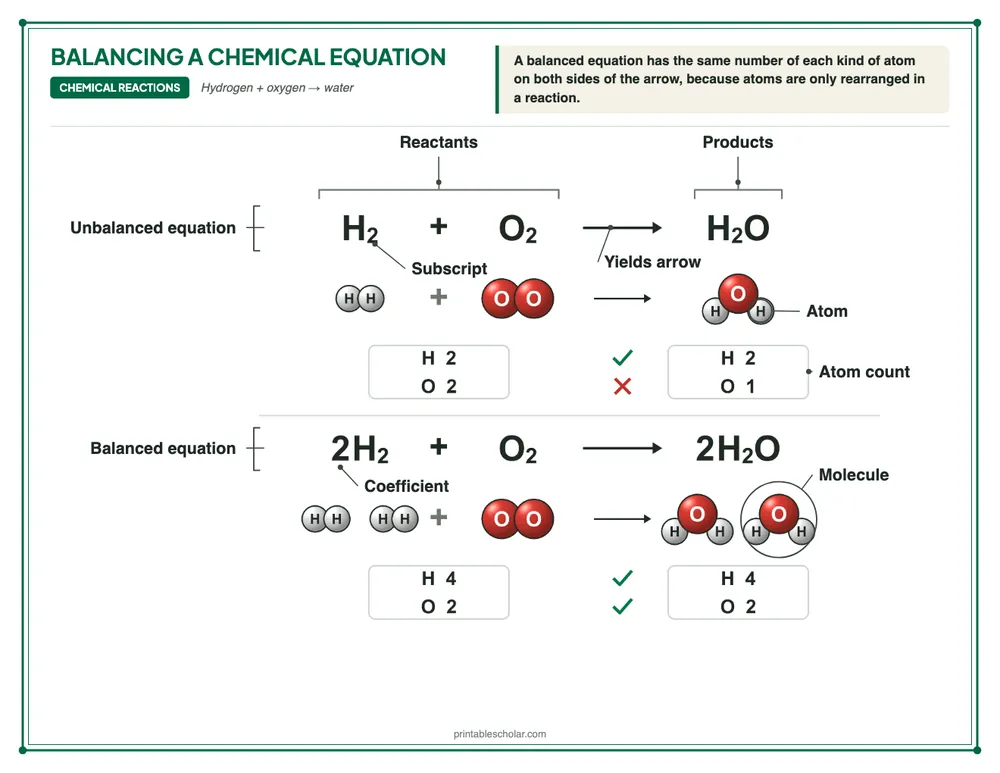
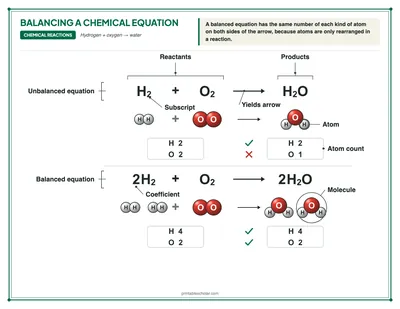
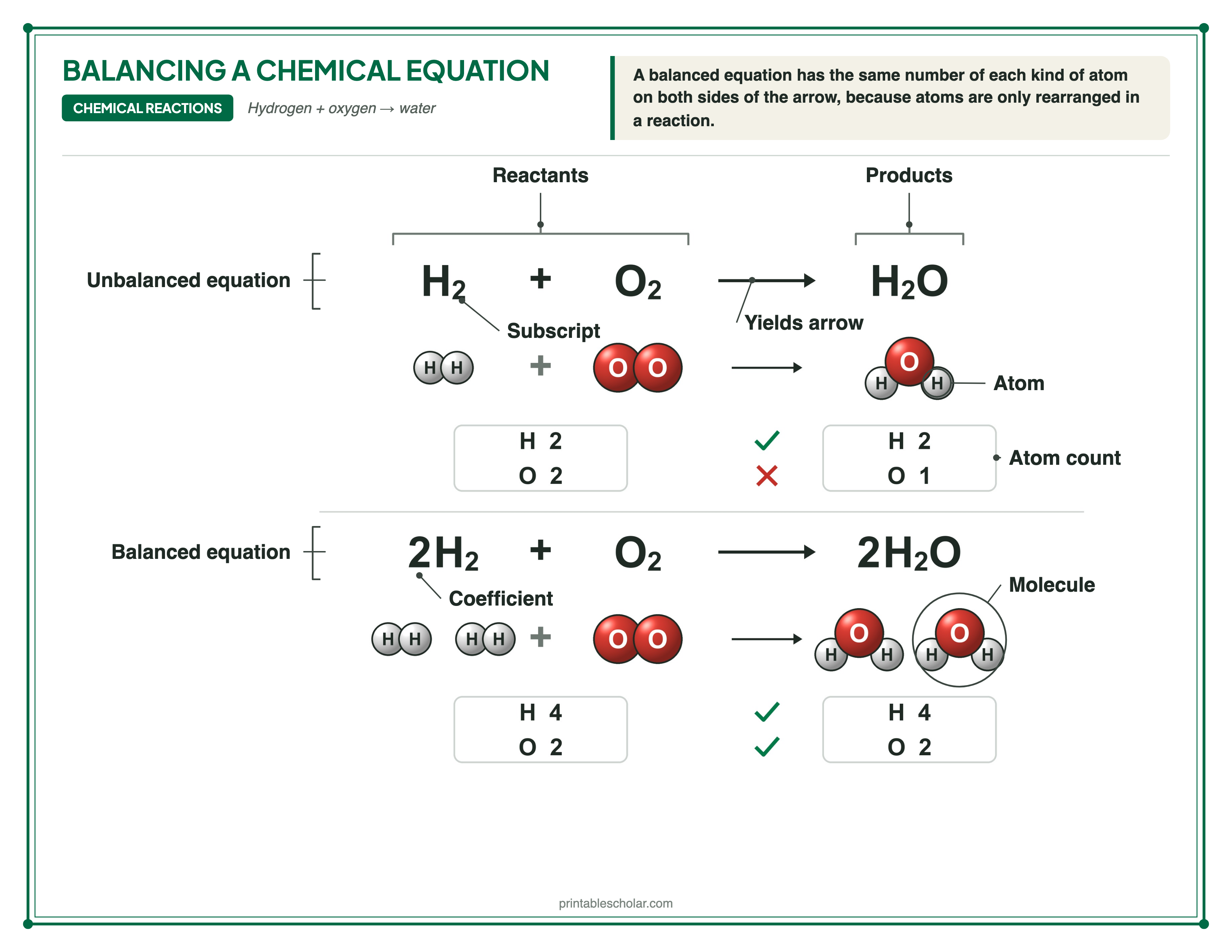
In a chemical reaction, atoms are rearranged into new substances. No atoms are created and none are destroyed, so the total mass stays the same: the law of conservation of mass. In the late 1700s the French chemist Antoine Lavoisier showed this by weighing reactions in sealed glass vessels, so that no gas could get in or out. A chemical equation has to show the same thing, so a balanced equation has the same number of each kind of atom on both sides of the arrow. The top row of the diagram, H₂ + O₂ → H₂O, is not balanced: there are two oxygen atoms in the reactants but only one in the product. You cannot fix it by changing H₂O to H₂O₂, because the subscripts are part of the formula, and H₂O₂ is hydrogen peroxide, not water. Instead you write coefficients in front of the formulas. A 2 in front of H₂O balances the oxygen but makes four hydrogen atoms, so H₂ needs a 2 as well: 2H₂ + O₂ → 2H₂O. Count the atoms again and every element matches. To balance any equation, count the atoms of each element, balance one element at a time, leave hydrogen and oxygen for last, recount, and use the smallest whole numbers.
The parts of a chemical equation
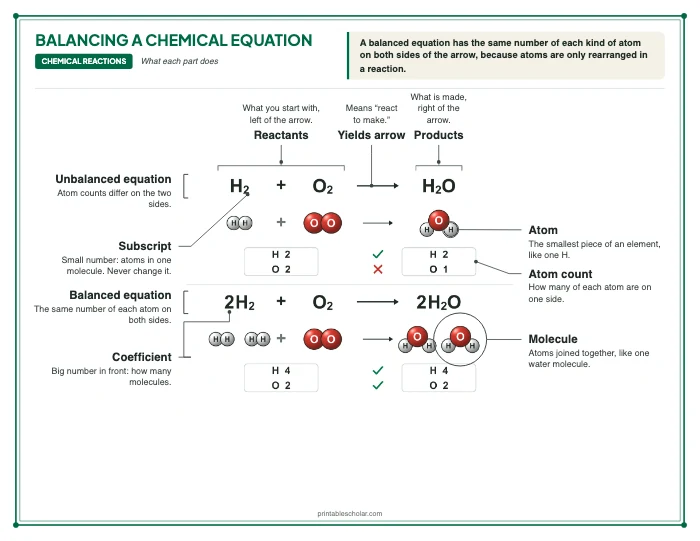
A chemical equation is balanced when it has the same number of each kind of atom on both sides of the arrow. This diagram shows hydrogen and oxygen making water twice: first unbalanced, then balanced by adding coefficients, with ball models and atom counts that show why. Here is what happens at each labeled part of the diagram:
| Part | What it does | Why it matters |
|---|---|---|
| Reactants | The substances that react, written on the left of the arrow. Here, hydrogen (H₂) and oxygen (O₂). | Reactants are joined with plus signs. Their atoms are not lost in the reaction; they are taken apart and joined again in new ways to make the products. Hydrogen and oxygen are written H₂ and O₂ because both are diatomic: their atoms pair up into two-atom molecules. |
| Products | The new substances the reaction makes, written on the right of the arrow. Here, water (H₂O). | A product has new properties: hydrogen and oxygen are gases, but water is a liquid at room temperature. The products contain exactly the same atoms as the reactants, only arranged differently. |
| Unbalanced equation | H₂ + O₂ → H₂O shows the right substances, but the atoms do not match: 2 oxygen atoms on the left, 1 on the right. | Written with formulas but no coefficients, it is called a skeleton equation. It names the reactants and products correctly but suggests that an oxygen atom disappears, which cannot happen. The atom counts show the problem: hydrogen matches (2 and 2) but oxygen does not (2 and 1). |
| Balanced equation | 2H₂ + O₂ → 2H₂O has the same number of each kind of atom on both sides: 4 hydrogen and 2 oxygen. | Balancing changed only the coefficients, never the formulas. Two hydrogen molecules and one oxygen molecule make two water molecules. The coefficients are the smallest whole numbers that work: 4H₂ + 2O₂ → 4H₂O also has equal counts, but it is not written that way. |
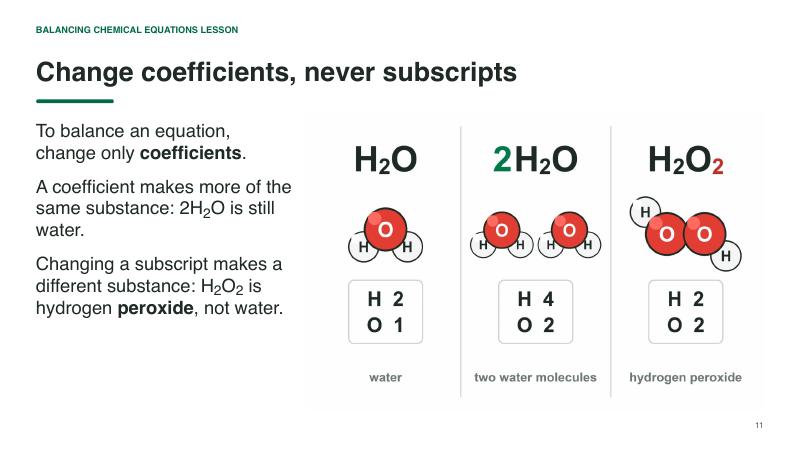
| Subscript | The small number after a symbol. It tells how many of that atom are in one molecule: H₂ has 2 hydrogen atoms. | Subscripts are part of a substance’s formula, so they never change when you balance. H₂O is water; H₂O₂ is hydrogen peroxide, a different substance. When there is no subscript, there is one atom: the O in H₂O means one oxygen atom. |
| Yields arrow | The arrow between reactants and products. It is read “yields” or “react to make.” | The arrow points from the reactants to the products. It is not an equals sign: the substances on the two sides are different, even though the atoms are the same. |
| Atom | The smallest particle of an element. Each ball in the models is one atom: white for hydrogen, red for oxygen. | Atoms are what get counted when you balance an equation. In a chemical reaction they are rearranged, but each atom stays the same element: no atom is created, destroyed or turned into another kind. |
| Atom count | How many atoms of each element are on each side. A tick means the two sides match; a cross means they do not. | To count, multiply each subscript by the coefficient in front of the formula, then add up all the formulas on that side. In the top row oxygen gets a cross (2 and 1). In the bottom row every element gets a tick: 4 hydrogen and 2 oxygen on each side. |
| Coefficient | The big number in front of a formula. It tells how many molecules there are: 2H₂ means two hydrogen molecules. | A coefficient multiplies every atom in the formula: 2H₂O has 4 hydrogen atoms and 2 oxygen atoms. Coefficients are the only numbers you change to balance an equation. A coefficient of 1 is not written. |
| Molecule | Two or more atoms joined together. Each water molecule here is one oxygen atom joined to two hydrogen atoms. | The particle models show every molecule in the equation, so you can count the atoms with your finger. In the balanced row there are two water molecules, because the coefficient in front of H₂O is 2. |
How to print
Choose Download PDF for a ready-to-print file that fits US Letter paper (8.5 × 11") in landscape, or Download PNG for the high-resolution image.
Frequently asked questions
How do you balance a chemical equation?
Write the correct formulas for the reactants and products first. Count the atoms of each element on both sides. Then put coefficients (whole numbers) in front of formulas to balance one element at a time, leaving hydrogen and oxygen until last. Recount every atom, and check that the coefficients are the smallest whole numbers that work.
What is the difference between a coefficient and a subscript?
A subscript is the small number after a symbol and tells how many of that atom are in one molecule: H₂O has 2 hydrogen atoms. A coefficient is the big number in front of a formula and tells how many molecules there are: 2H₂O is two water molecules, with 4 hydrogen atoms and 2 oxygen atoms in all.
Why can’t you change subscripts to balance an equation?
Changing a subscript changes the substance. H₂O is water, but H₂O₂ is hydrogen peroxide. Balancing has to describe the real reaction, so only the coefficients, the number of each molecule, can change.
Why must chemical equations be balanced?
Because of the law of conservation of mass: in a chemical reaction atoms are rearranged, not created or destroyed, so the total mass stays the same. A balanced equation shows this, with the same number of each kind of atom before and after the reaction.
What is the law of conservation of mass?
Matter is not created or destroyed in a chemical reaction, so the mass of the products equals the mass of the reactants. In the late 1700s the French chemist Antoine Lavoisier showed this by weighing reactions in sealed glass vessels, so no gas could get in or out. If a gas escapes from an open container, the scale shows less mass, but the atoms still exist in the air.
What are reactants and products?
Reactants are the substances you start with, written on the left of the arrow. Products are the new substances that form, written on the right. In 2H₂ + O₂ → 2H₂O, hydrogen and oxygen are the reactants and water is the product.
What does the arrow in a chemical equation mean?
The arrow means “yields” or “react to make.” It points from the reactants to the products. It is not an equals sign, because the substances on each side are different, even though the atoms are the same.
How do you balance a combustion equation?
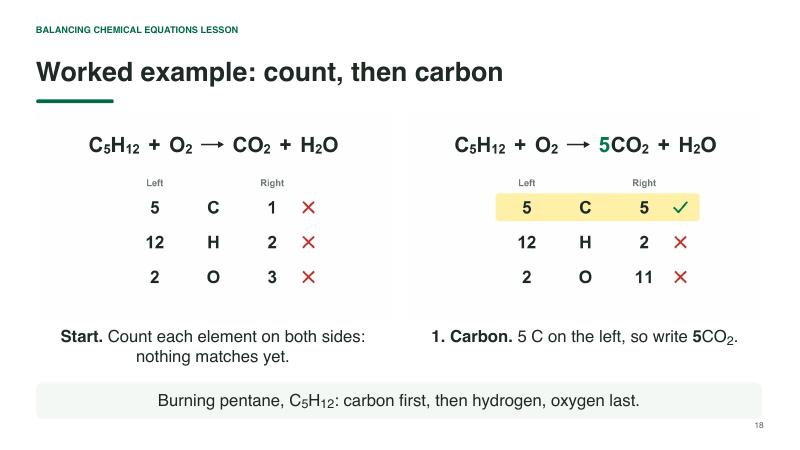
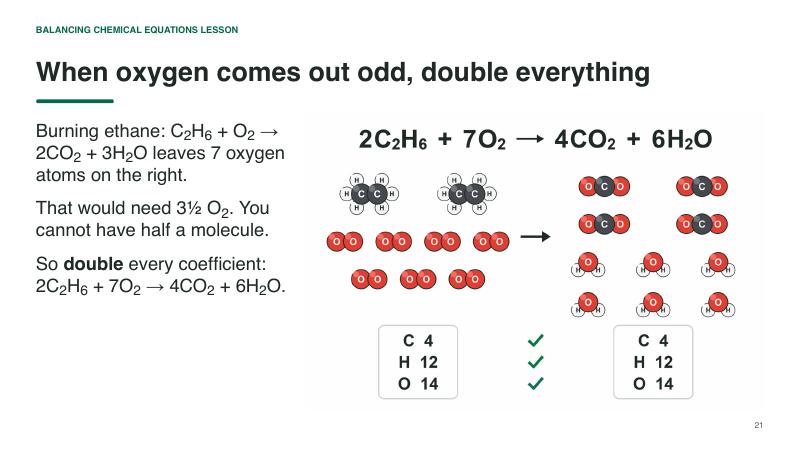
In the burning of a fuel such as methane (CH₄), balance carbon first, then hydrogen, and oxygen last, because oxygen appears in both products: CH₄ + 2O₂ → CO₂ + 2H₂O. If oxygen needs a half (C₂H₆ would need 3½ O₂), double every coefficient: 2C₂H₆ + 7O₂ → 4CO₂ + 6H₂O.
What paper size should I print this on?
The diagram is sized for standard US Letter paper (8.5 × 11") in landscape orientation. Use "Download PDF" for a print-ready file that fits the page automatically.
Are there Balancing Chemical Equations worksheets to go with the diagram?
Yes. The Balancing Chemical Equations teaching pack, for grades 8 to 10, has 31 lesson slides and 12 printables with answer keys: the guided notes for the lesson slides, the labeled diagram and the blank one to label, then “Read the Diagram” (a worksheet), “How to Balance a Chemical Equation” (a reading passage), “Count the Atoms” (a worksheet), “Balancing Equations Practice” (a worksheet), “Balancing Equations: Level 2” (a worksheet), “Balanced or Not?” (a worksheet), “Word Equations” (a worksheet), a vocabulary crossword and a quiz. The diagram and the blank one to label are free to download on this page, and so is one worksheet: “Balancing Equations Practice”. The other sheets come with the pack ($7), which is also in the Middle School Science bundle (grades 5 to 10).
Related: The atoms being counted are explained in the atomic structure diagram and listed on the periodic table; how to tell a chemical change from a physical one is in the physical and chemical changes diagram.