Endocrine System Diagram
Free printable endocrine system diagram — a labeled illustration showing the body's hormone-producing glands including the pituitary, thyroid, adrenal glands, pancreas and more. Download a high-resolution PDF or PNG for Letter paper.
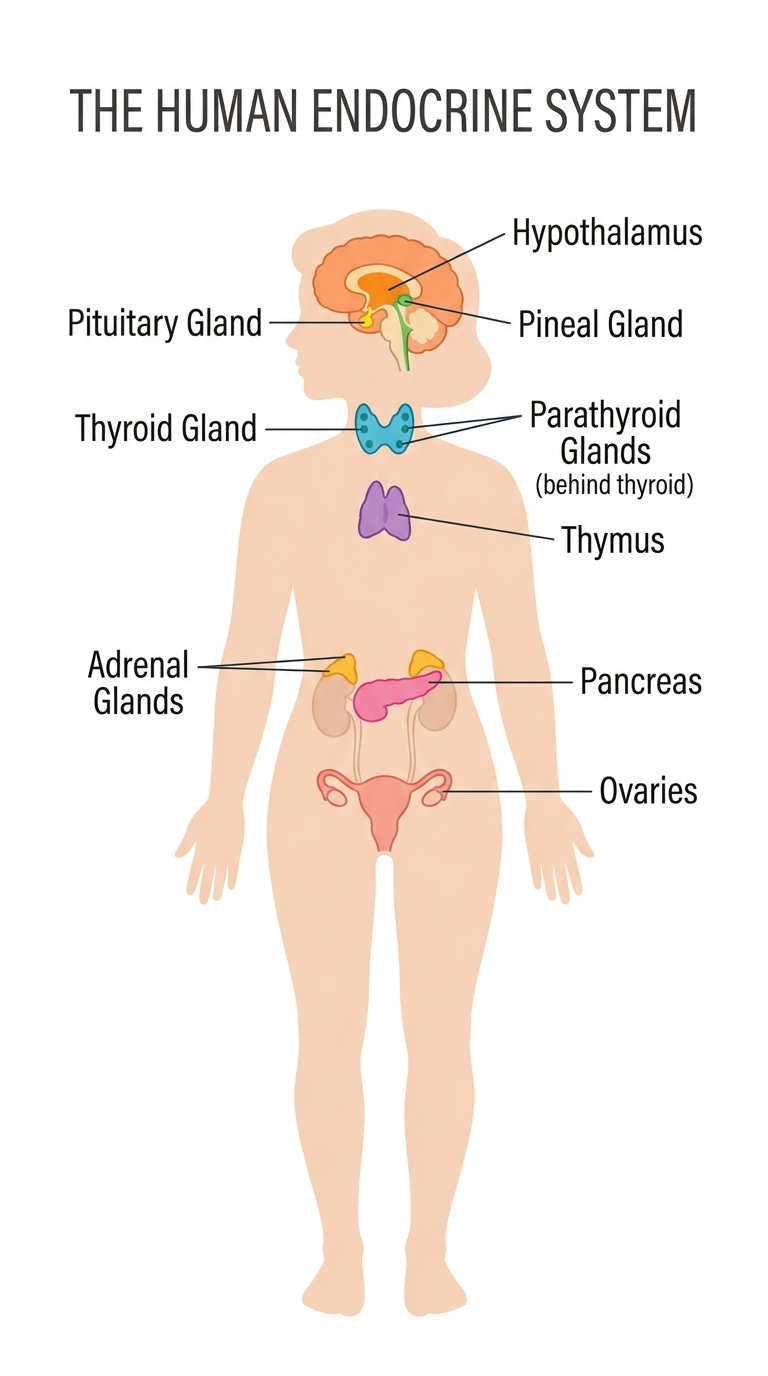

The glands of the endocrine system
The endocrine system is a network of glands that release hormones directly into the bloodstream to regulate growth, metabolism, mood, and many other body functions. Here is what happens at each labeled part of the diagram:
| Gland | What it does | Why it matters |
|---|---|---|
| Hypothalamus | The master regulator in the brain — it links the nervous system to the endocrine system. | Sitting at the base of the brain about the size of an almond, the hypothalamus monitors the body's internal conditions (temperature, hunger, thirst, stress) and sends chemical signals to the pituitary gland to trigger hormone releases throughout the body. It is effectively the translator between the brain's electrical signals and the body's chemical signalling system. |
| Pituitary Gland | The "master gland" — it controls many other endocrine glands by releasing hormones that trigger them. | No bigger than a pea, the pituitary gland hangs from the base of the brain and releases at least eight hormones. Some act directly on the body (like growth hormone and oxytocin); others act as messengers that tell the thyroid, adrenal glands, or reproductive organs to release their own hormones. Removing or damaging the pituitary affects nearly every other endocrine gland in a cascade. |
| Pineal Gland | Produces melatonin, the hormone that regulates sleep-wake cycles. | Deep inside the brain, this tiny gland responds to light signals relayed from the eyes and produces more melatonin in the dark, signalling to the body that it is night and time to sleep. Bright screens before bed suppress melatonin production, shifting the sleep signal later — one reason devices are associated with difficulty falling asleep. |
| Thyroid Gland | Produces hormones that control the rate of metabolism throughout the body. | Wrapped around the trachea in the neck, the butterfly-shaped thyroid produces thyroxine, which acts like a throttle for every cell in the body — setting the rate at which cells use energy. An overactive thyroid revs the body up (causing weight loss, rapid heartbeat, anxiety); an underactive one slows everything down (causing fatigue, weight gain, cold intolerance). Iodine in the diet is essential for making thyroid hormone, which is why table salt is routinely iodized. |
| Parathyroid Glands | Four tiny glands behind the thyroid that regulate calcium levels in the blood. | Despite sitting right behind the thyroid, the parathyroid glands have a completely different function: they monitor blood calcium and release parathyroid hormone to pull calcium from bones into the blood when levels drop. Calcium is critical for muscle contraction and nerve signalling, so these four glands — each about the size of a grain of rice — quietly prevent muscle cramps and nerve problems around the clock. |
| Thymus | Trains immune cells (T-cells) in childhood; shrinks in adulthood. | The thymus sits in the upper chest behind the sternum and is largest during childhood, when it is busy maturing T-lymphocytes — the white blood cells that become the immune system's targeted attackers. By puberty it begins to shrink and is largely replaced by fat by adulthood, but the T-cells it trained continue protecting the body for a lifetime. |
| Adrenal Glands | Sit on top of the kidneys and produce adrenaline and cortisol for the stress response. | Each adrenal gland has two distinct layers with completely different functions: the inner medulla releases adrenaline (epinephrine) for immediate "fight or flight" responses, while the outer cortex releases cortisol and other steroids for longer-term stress regulation. The surge of strength, tunnel vision, and racing heart you feel in a sudden emergency is adrenaline hitting your muscles and heart within seconds of a stressful event. |
| Pancreas | Produces insulin and glucagon to regulate blood sugar levels. | The pancreas has two jobs: producing digestive enzymes (its exocrine role) and releasing hormones into the blood (its endocrine role). Insulin lowers blood sugar by helping cells absorb glucose; glucagon raises it by triggering the liver to release stored glucose. In type 1 diabetes, the cells that produce insulin are destroyed by the immune system — patients must inject insulin externally because without it, blood sugar rises to dangerous levels. |
| Ovaries | Produce oestrogen and progesterone, which regulate the reproductive cycle and development. | The ovaries do two jobs: releasing eggs for potential fertilisation and producing the hormones oestrogen and progesterone. Oestrogen drives the development of female secondary sex characteristics during puberty and regulates the monthly reproductive cycle. At menopause, when the ovaries stop producing significant oestrogen, the hormonal shift affects bone density, body temperature regulation, and mood — reflecting just how widely oestrogen acts across the body. |
Companion worksheet
A free fill-in worksheet with an answer key, built from the labels above — students match each gland to its description, then answer a couple of short questions. Great for a quick check after using the diagram.
How to print
Choose Download PDF for a ready-to-print file that fits US Letter paper (8.5 × 11") in portrait, or Download PNG for the high-resolution image.
Frequently asked questions
What does the endocrine system do?
It produces and releases hormones — chemical messengers that travel through the bloodstream to control growth, metabolism, mood, reproduction, and many other body functions.
What is the difference between the endocrine and nervous systems?
The nervous system sends fast electrical signals; the endocrine system sends slower chemical signals (hormones) that have broader, longer-lasting effects.
What paper size should I print this on?
The diagram is sized for standard US Letter paper (8.5 × 11") in portrait orientation. Use "Download PDF" for a print-ready file that fits the page automatically.