DNA Structure
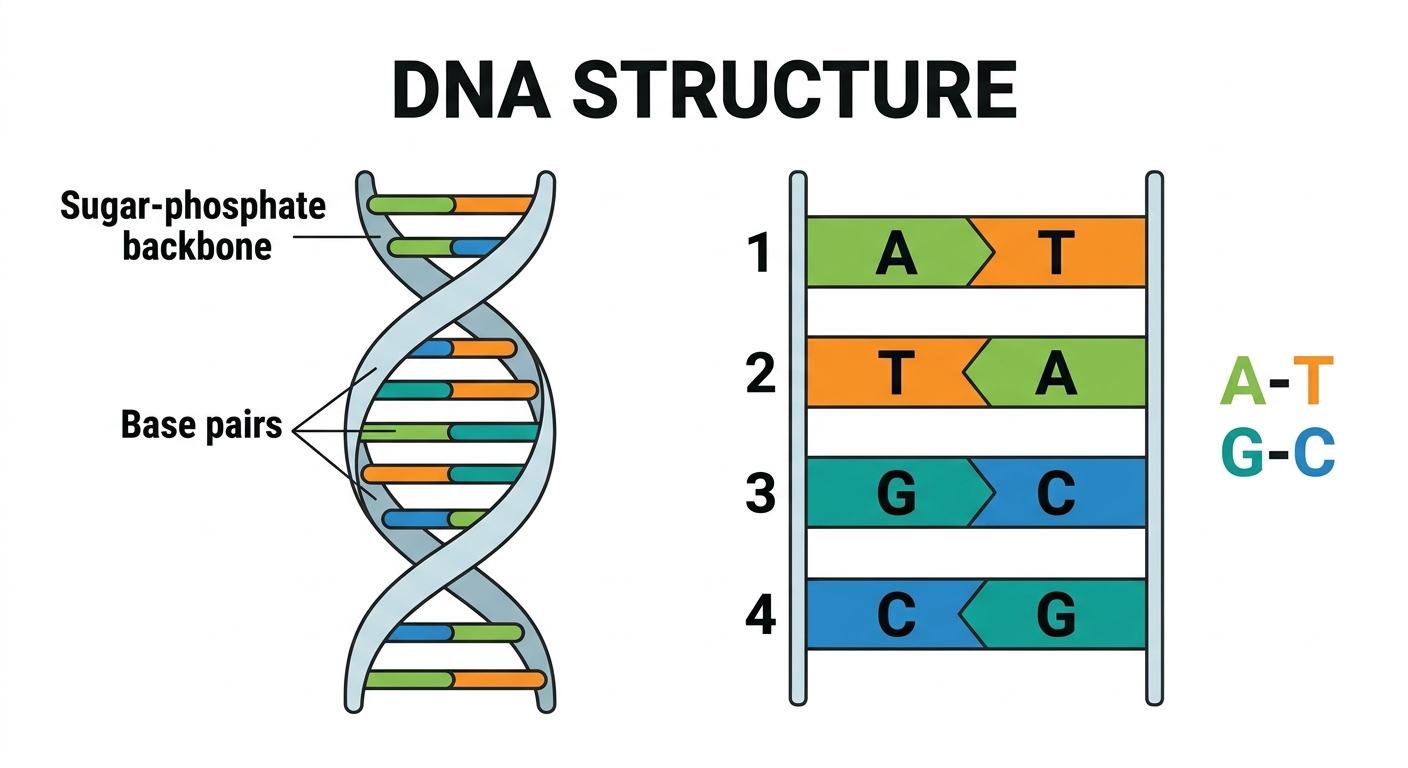
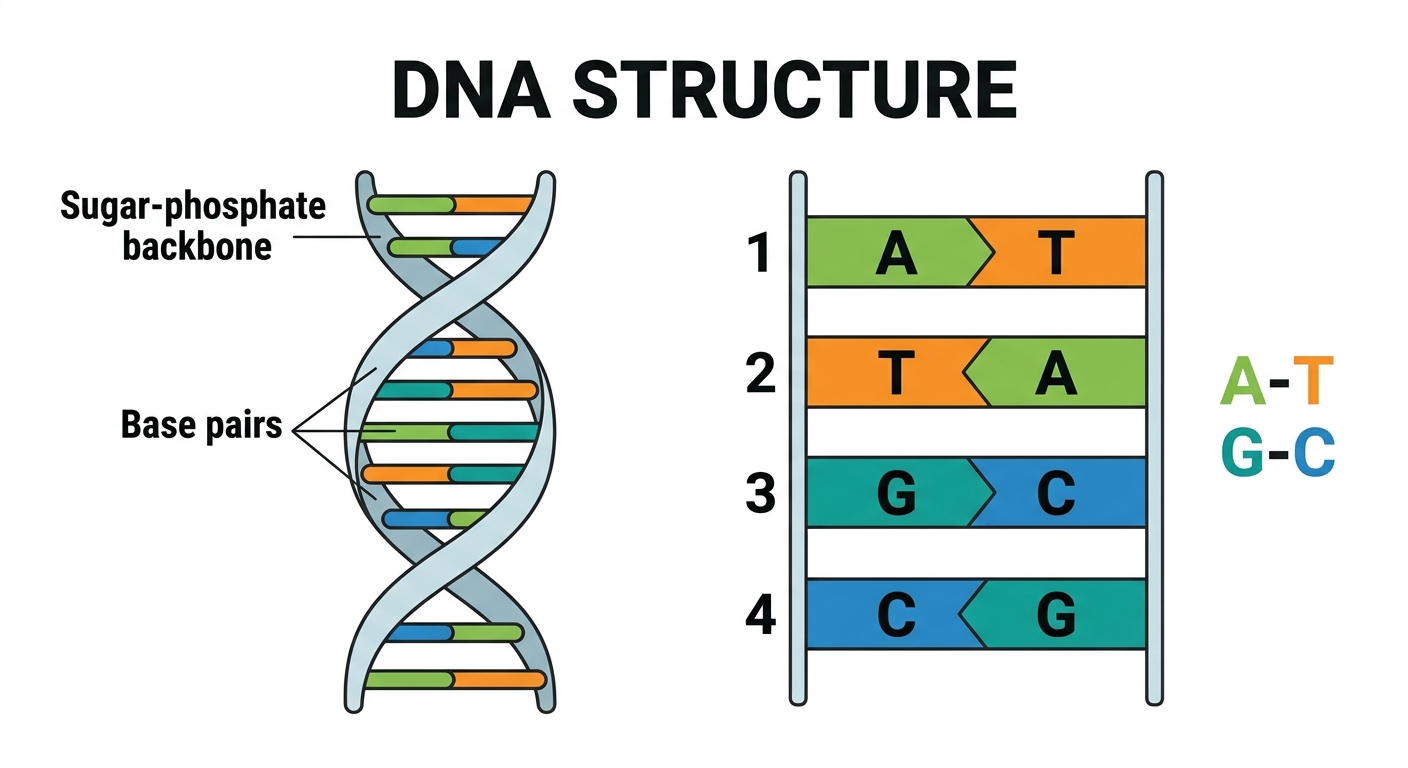
Free printable DNA structure diagram — the double helix, sugar-phosphate backbone and base pairs (A-T and G-C), all labeled. Download a high-resolution PDF or PNG for Letter paper.
DNA is a molecule — a tiny structure made of atoms bonded together — and inside almost every cell in your body, you have about two meters of it coiled up tighter than a ball of yarn. That molecule contains the instructions for everything: your eye color, how tall you grow, how your heart beats. Think of it like a biological recipe book written in a four-letter alphabet, one that has been copied and passed down from parent to child for billions of years. Understanding DNA's shape is the key to understanding how those instructions stay intact and get read correctly.
The parts of a DNA molecule
DNA is the molecule that carries the instructions for building and running a living thing. It is shaped like a twisted ladder called a double helix. Here is what happens at each labeled part of the diagram:
| Part | What it does | Why it matters |
|---|---|---|
| Double helix | The twisted-ladder shape of a DNA molecule. | The twisted shape isn't just decorative — it makes DNA incredibly compact, letting two meters of genetic code fit inside a cell nucleus smaller than a grain of sand. The coiling also protects the fragile instruction sequences on the inside, shielding them like a spiral-bound cover around a notebook. |
| Sugar-phosphate backbone | The two long strands that form the sides of the ladder. | These two strands are the structural skeleton that holds everything in place. Without a stable backbone, the base pairs carrying your genetic code would drift apart and the instructions would fall to pieces. |
| Base pairs | The rungs of the ladder, each made of two bases joined in the middle. | Each rung is one letter in the genetic alphabet, and the order of those letters spells out every instruction your cells ever follow. A single wrong base pair in the wrong place can cause a gene to malfunction — which is why cells have repair machinery that checks the rungs millions of times a day. |
| A pairs with T | Adenine always pairs with Thymine. | This strict pairing rule is what makes copying DNA reliable. When a cell divides, each strand serves as a template, and because A can only bond with T, the copy comes out accurate almost every single time across all three billion base pairs in your genome. |
| G pairs with C | Guanine always pairs with Cytosine. | Guanine and Cytosine form three hydrogen bonds instead of two, making G-C pairs slightly stronger than A-T pairs. Regions of DNA packed with G-C pairs tend to be more stable — useful in places where the instructions are especially critical and can't afford to unravel. |
Companion worksheet
A free fill-in worksheet with an answer key, built from the labels above — students match each part to its description, then answer a couple of short questions. Great for a quick check after using the diagram.
How to print
Choose Download PDF for a ready-to-print file that fits US Letter paper (8.5 × 11") in landscape, or Download PNG for the high-resolution image.
Frequently asked questions
What are the base pairs in DNA?
Adenine (A) always pairs with Thymine (T), and Guanine (G) always pairs with Cytosine (C). These pairs form the rungs of the DNA ladder.
What is the shape of DNA?
DNA is shaped like a twisted ladder called a double helix.
What paper size should I print this on?
The diagram is sized for standard US Letter paper (8.5 × 11") in landscape orientation. Use "Download PDF" for a print-ready file that fits the page automatically.