 Printable Scholar
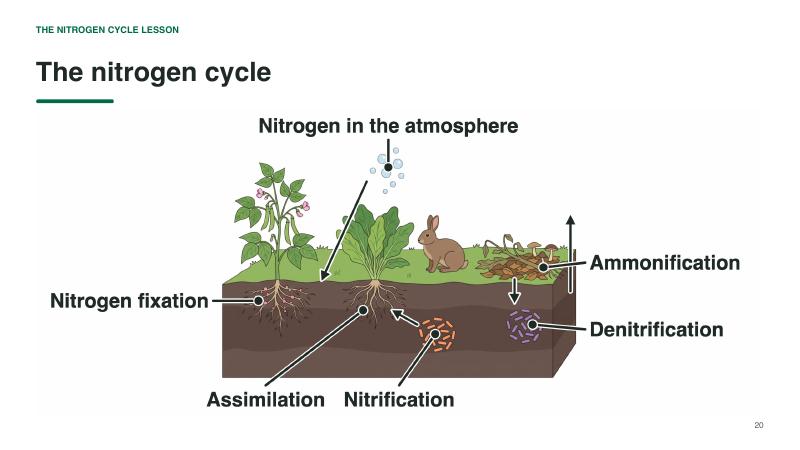
Nitrogen Cycle Diagram
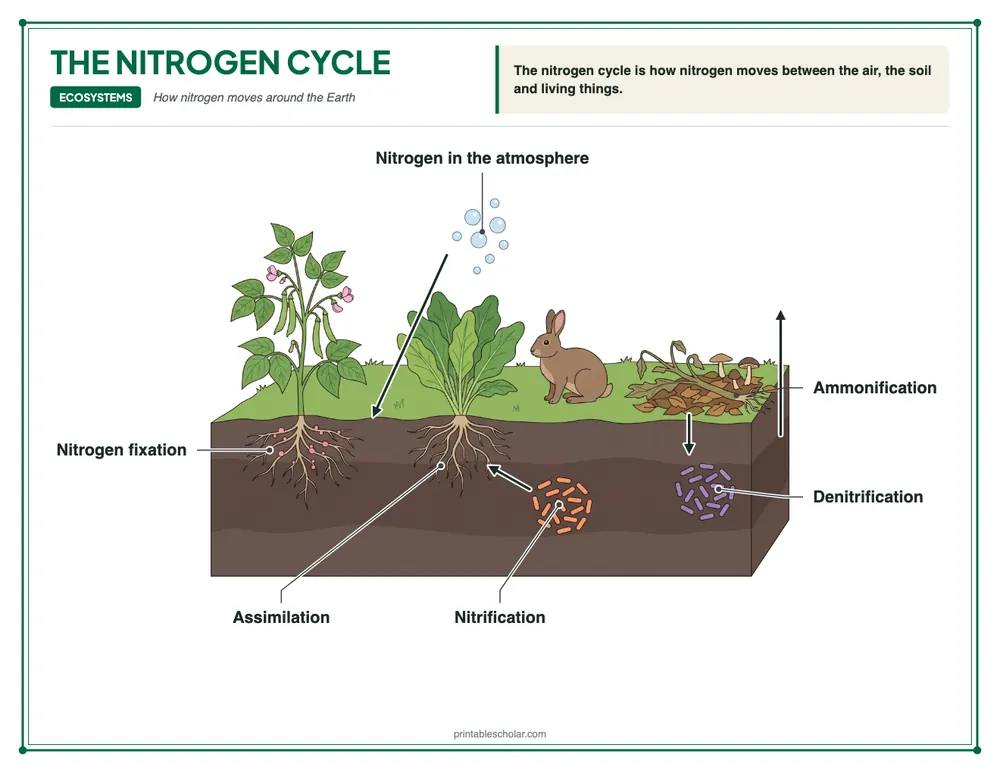
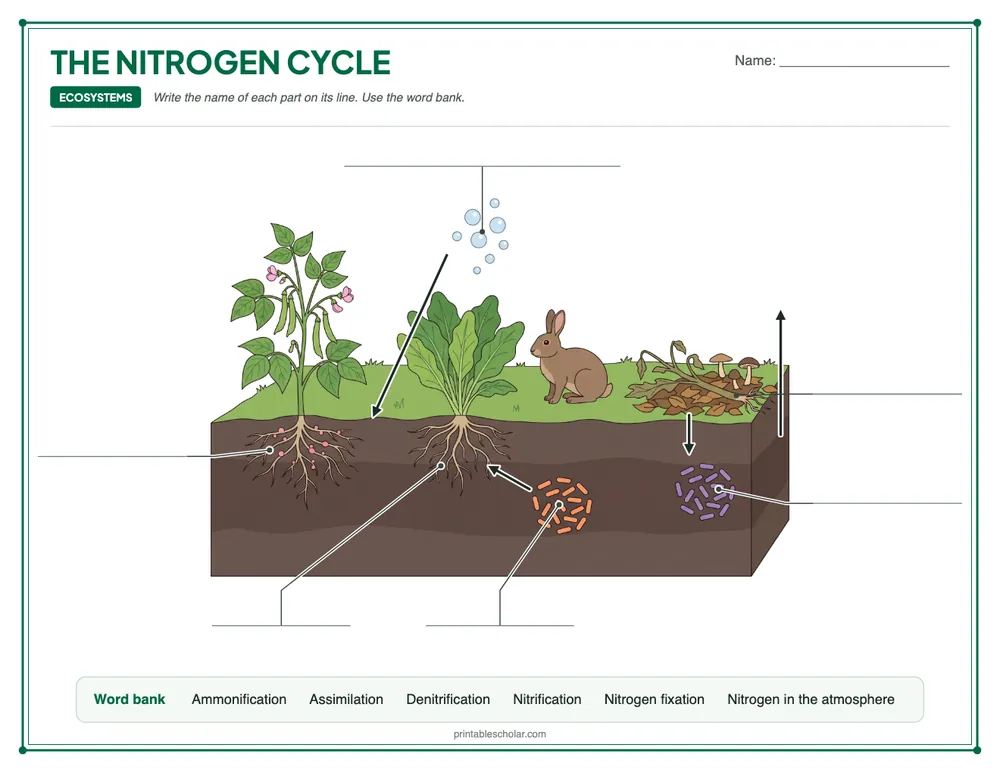
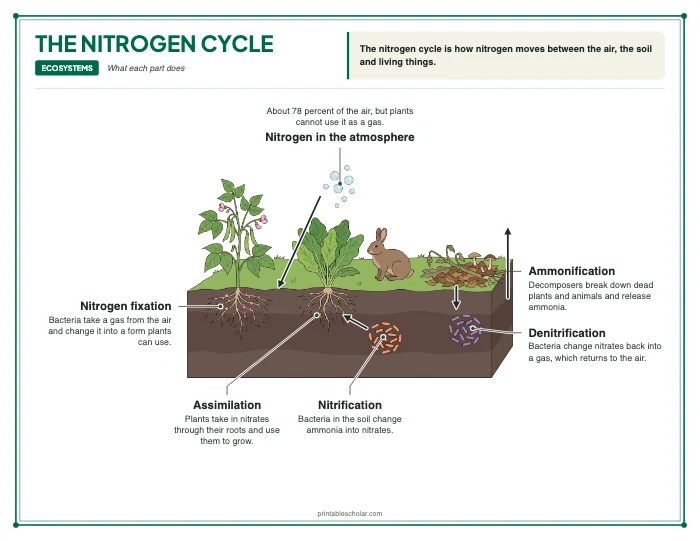
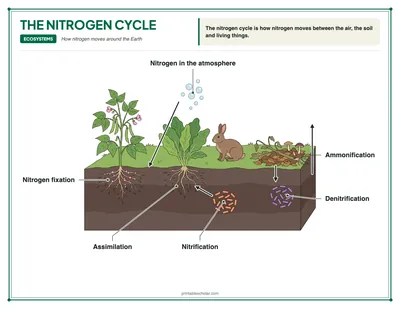
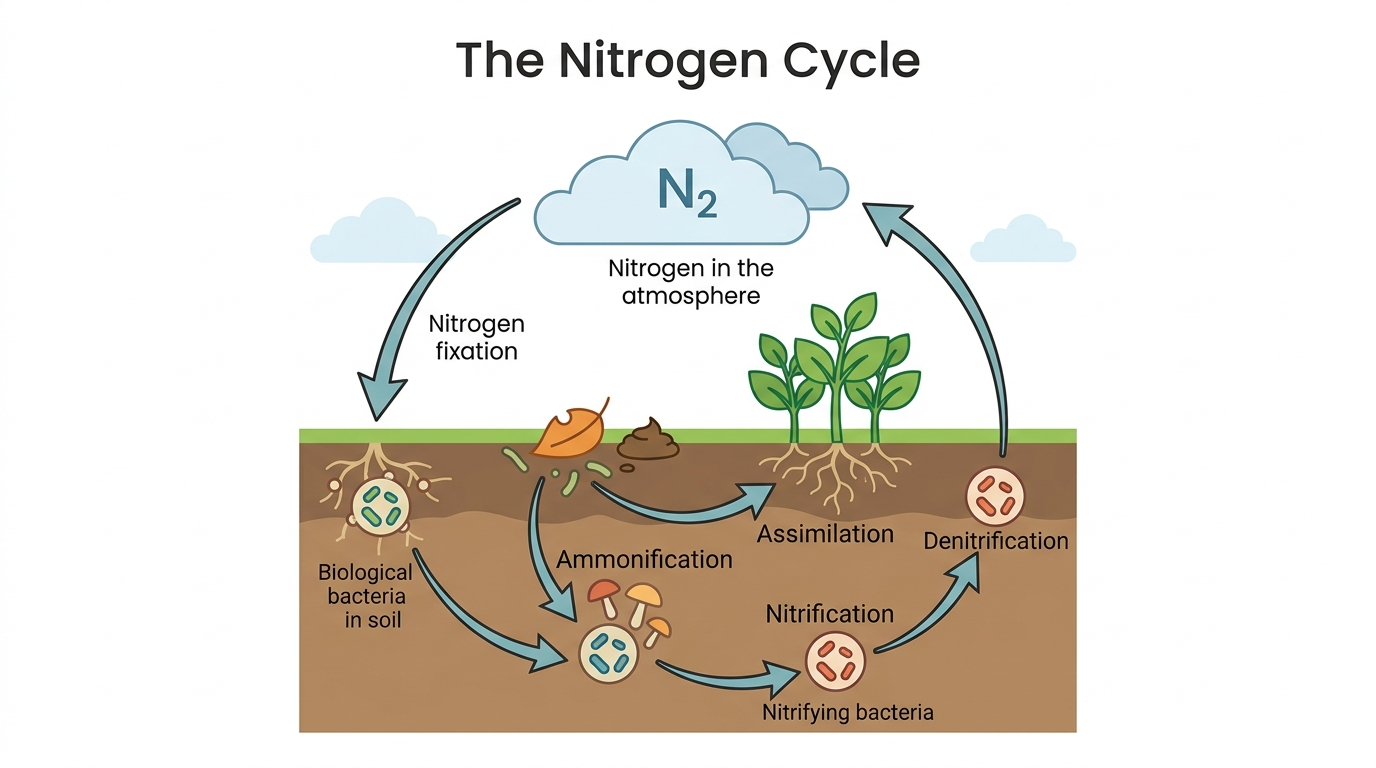
Free printable nitrogen cycle diagram — a labeled illustration showing nitrogen fixation, nitrification, assimilation, ammonification and denitrification. Download PDF or PNG for Letter paper.
Part of the The Nitrogen Cycle teaching pack for grades 6 to 8 (introductory level): 25 lesson slides and 8 printables with answer keys. The diagram and the blank one to label are free.
Teaching ideas for The Nitrogen Cycle
Pick the ideas that suit your class, then follow the plan or use the sheets in any order.
- Dig up clover. Pull up a clover plant, roots and all, and rinse the roots. With a hand lens, students look for the small bumps where the helpful bacteria live.
- Act out the cycle. Students stand as the air, soil bacteria, a plant, an animal and decomposers. Pass a ball as a nitrogen atom and name each step from the diagram.
- Sort the legumes. Bring in dried beans, peas and lentils along with rice, corn and sunflower seeds. Students sort out the legumes and say why farmers plant them.
- Read the label. Bring in an empty fertilizer bag or a plant food label. Students find nitrogen on it and say which step of the cycle it helps along.
A plan for the week
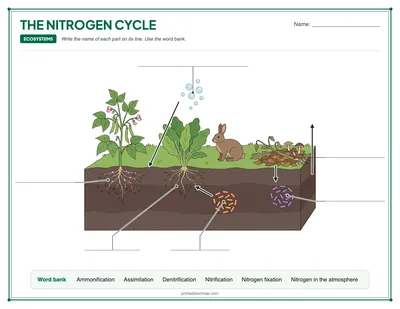
| Day 1 | Open with one of the ideas above. Teach the lesson with the slides while students fill in the guided notes. Then students label the blank diagram. | Lesson slides (PowerPoint) (in the pack) The Nitrogen Cycle Guided Notes (in the pack) Nitrogen Cycle Diagram Blank Nitrogen Cycle |
| Day 2 | On “Read the Diagram,” students trace nitrogen through the soil on the picture and work out where it comes from and goes. | Read the Diagram (in the pack) |
| Day 3 | Read “Nitrogen on the Move” and answer the questions. | Nitrogen on the Move (in the pack) |
| Day 4 | Put the steps of “The Path of a Nitrogen Atom” in order and answer the questions. | The Path of a Nitrogen Atom (in the pack) |
| Day 5 | Review with the crossword, then give the quiz. | Nitrogen Cycle Crossword (in the pack) Nitrogen Cycle Quiz (in the pack) |
The sheets marked “in the pack” are in the The Nitrogen Cycle teaching pack below.
NGSS standards
- Supports MS-LS2-3: Develop a model to describe the cycling of matter and flow of energy among living and nonliving parts of an ecosystem.
The Nitrogen Cycle teaching pack
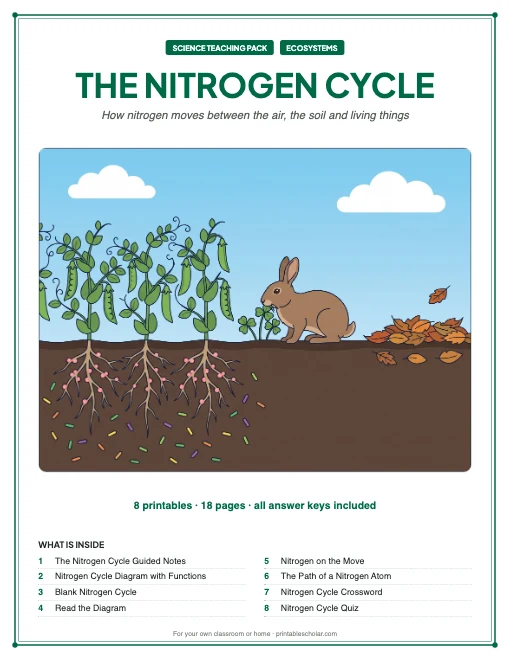
Teaching the nitrogen cycle? Here is a ready-to-teach lesson. 25 slides and 8 printables that cover the whole topic, from the guided notes to the quiz. Present the slides while students fill in the guided notes, then use the worksheets, crossword and quiz, with every answer key.
Free on this page: the diagram and the blank one to label, marked Download below. The whole pack is $7: 18 pages in one print-ready file, the 25 lesson slides, the practice sheets, the crossword, the quiz and every answer key.
OnlineThe pack also comes as an online lesson for Google Classroom: every part on screen for students, plus a self-grading Google Forms quiz.
One-time purchase. Instant download. Secure checkout by Stripe. Want to see a whole pack first? The Cells pack is free.See all 18 packs in the bundle
- Cells
- Mitosis
- DNA
- Heredity and Punnett Squares
- Carbon Cycle and Greenhouse Effect
- The Nitrogen Cycle (this pack)
- Excretory System
- Endocrine System
- Immune System
- Layers of the Skin
- Plate Tectonics and Earthquakes
- Life Cycle of a Star
- Parts of an Atom
- The Periodic Table
- Physical and Chemical Changes
- Balancing Chemical Equations
- Waves and the Electromagnetic Spectrum
- Acids, Bases and the pH Scale
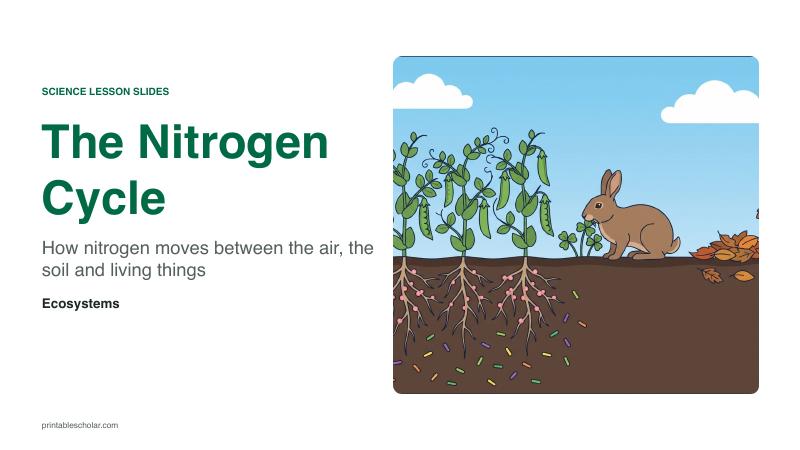
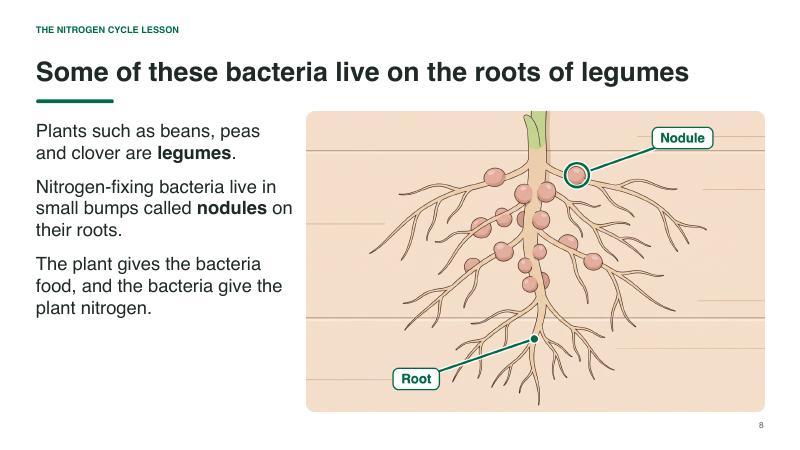
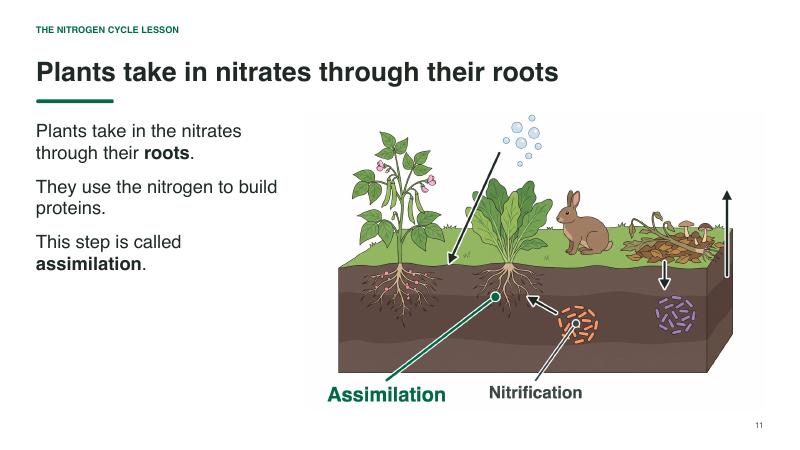
Teach the Nitrogen Cycle with 25 ready-made slides
Open the PowerPoint and teach: an opening question, the parts one at a time on the diagram, quick checks and an exit question. Students fill in the guided notes sheet as you go.
Every slide comes with teacher notes: what to say, what to ask, and sample answers.
The slides (PowerPoint and a PDF copy) and the guided notes sheet come with the pack.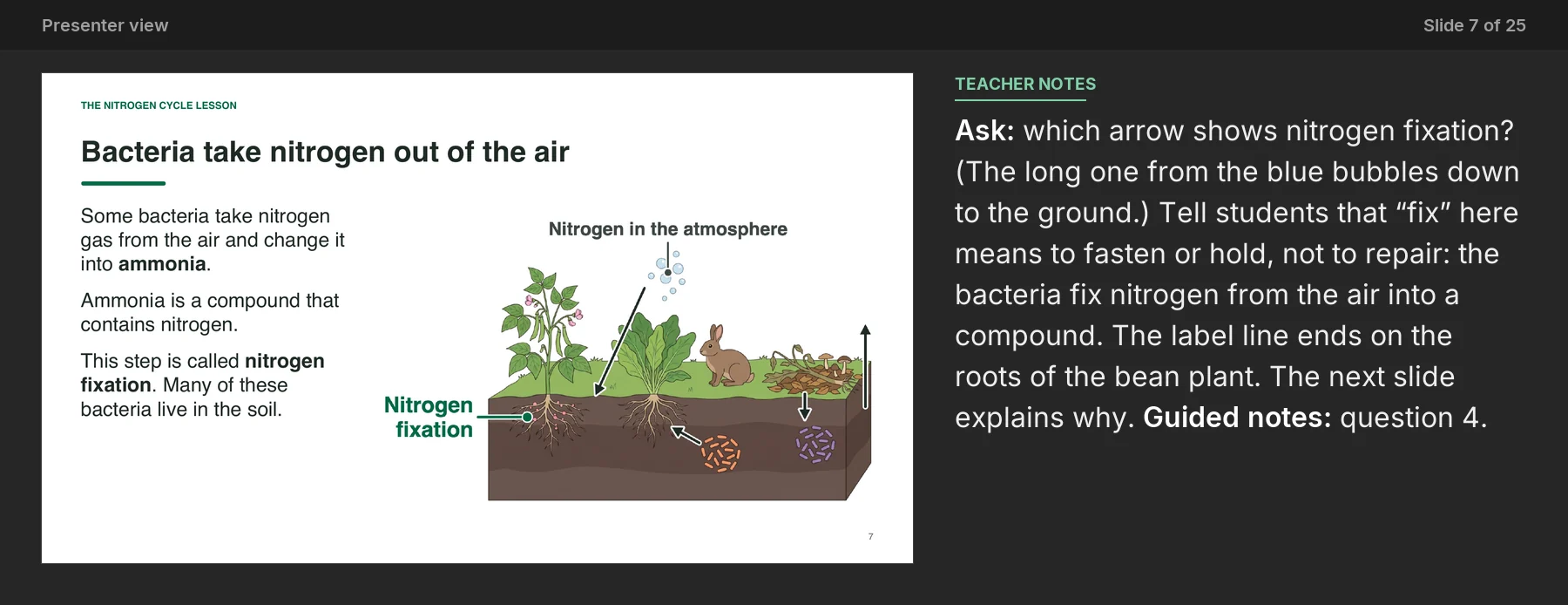
What is in the pack, in teaching order
 In the pack
1. TeachLesson Slides25 slides to present, with your notes for each one.In the $7 pack
 In the pack
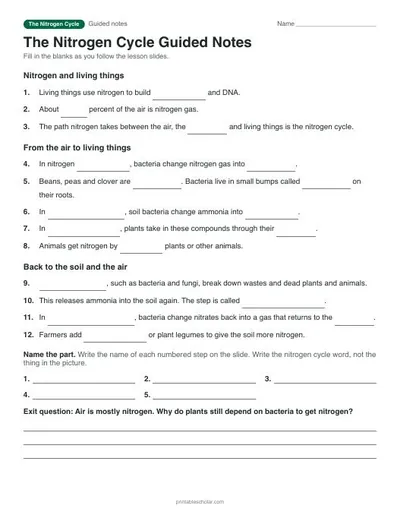
1. TeachThe Nitrogen Cycle Guided NotesStudents fill in the blanks as you present. With answer key.In the $7 pack
 Free
 Free
 In the pack
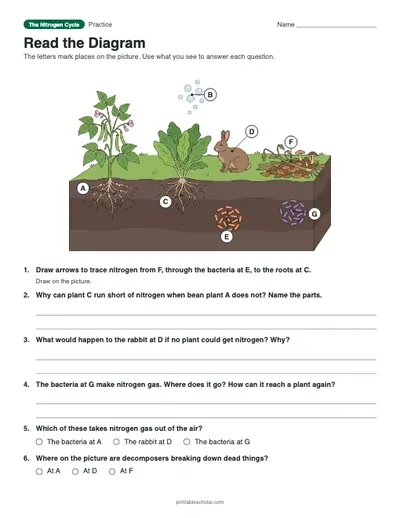
3. ReasonRead the DiagramRead the nitrogen cycle picture: trace nitrogen from a dead plant to a living one, and work out why one plant runs short of nitrogen and the other does not.In the $7 pack
 In the pack
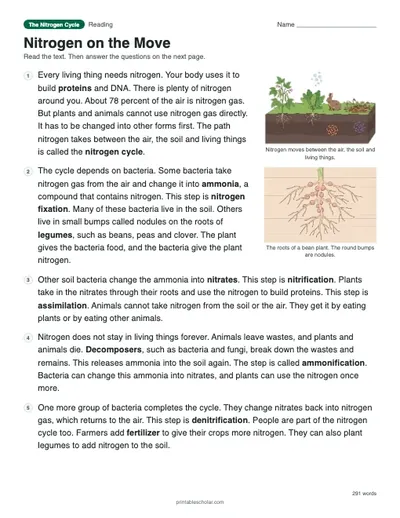
4. ReadNitrogen on the MoveA one-page text on how nitrogen moves between the air, the soil and living things, with eight questions.In the $7 pack
 In the pack
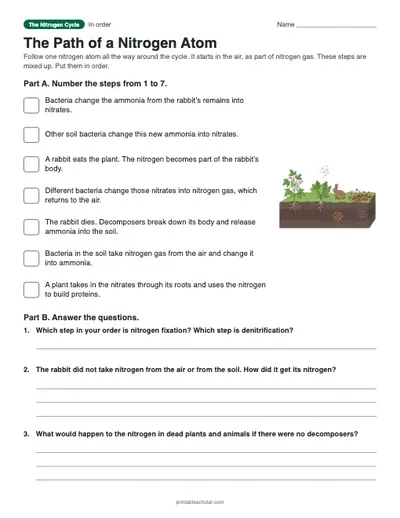
5. OrderThe Path of a Nitrogen AtomPut seven steps in order to follow one nitrogen atom around the cycle, then answer three questions.In the $7 pack
 In the pack
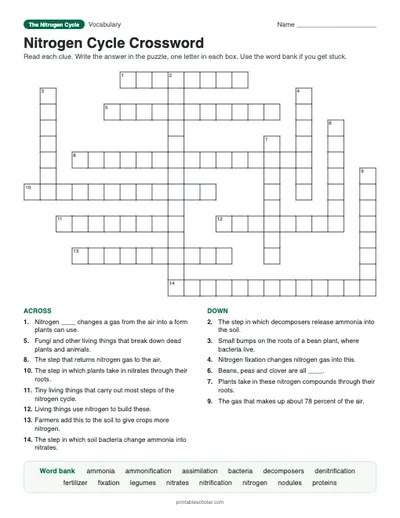
6. ReviewNitrogen Cycle CrosswordFourteen nitrogen cycle words with clues and a word bank.In the $7 pack
 In the pack
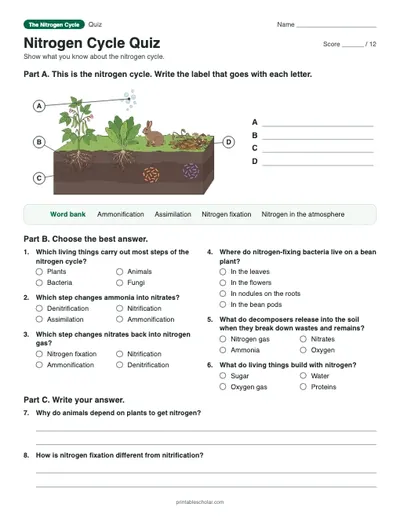
7. CheckNitrogen Cycle QuizLabel four parts, six multiple choice and two written answers. Scored out of 12.In the $7 pack
Nitrogen Cycle worksheets, crossword and quiz
The Nitrogen Cycle teaching pack is 25 lesson slides (PowerPoint and PDF) and 8 printables with answer keys for grades 6 to 8 (introductory level), in the order you would teach them: the guided notes for the lesson slides, the labeled diagram and the blank one to label, then “Read the Diagram” (a worksheet), “Nitrogen on the Move” (a reading passage), “The Path of a Nitrogen Atom” (an ordering worksheet), a vocabulary crossword and a quiz.
The sheets are in a suggested teaching order: teach the lesson, have students label the blank diagram, then work through the practice sheets and finish with the quiz. Use them all over a week or pick the ones you need. The answer keys are together at the back.
The diagram and the blank one to label are free to download on this page. The other sheets come with the pack ($7), which is also in the Middle School Science bundle (grades 5 to 10).
How nitrogen moves through the cycle
The nitrogen cycle is how nitrogen moves between the air, the soil and living things. Here is what happens at each labeled part of the diagram:
| Process | What it does | Why it matters |
|---|---|---|
| Nitrogen in the atmosphere | About 78% of the air is nitrogen gas, which most living things can't use directly. | |
| Nitrogen fixation | Bacteria turn nitrogen gas from the air into forms plants can use. | Farmers have known for centuries that planting beans or clover can restore a worn-out field — they just didn't know why. The reason is fixation: nitrogen-fixing bacteria living on the roots of those plants are quietly converting useless air into the fertilizer the soil desperately needs. |
| Nitrification | Bacteria change ammonia in the soil into nitrates. | Plants can absorb ammonia only in tiny amounts, but nitrates dissolve easily in water and travel straight up through roots — nitrifying bacteria perform the conversion that makes nitrogen actually accessible at scale. Skip this step and most plants would starve even in nitrogen-rich soil. |
| Assimilation | Plants absorb nitrogen through their roots to grow. | Every gram of protein in the food you eat — the chicken, the beans, the cheese — was built by a plant that first pulled nitrogen from the soil through its roots. Without assimilation, nitrogen would cycle through the ground but never enter the food chain. |
| Ammonification | Decomposers break down dead matter, releasing nitrogen back into the soil. | When a leaf falls or an animal dies, the nitrogen locked inside those proteins would be lost forever if decomposers didn't break it back down. Decomposition is nature's recycling program, and without it the soil would slowly go bankrupt. |
| Denitrification | Bacteria return nitrogen gas to the air, completing the cycle. | If nitrogen only ever moved from the air into the soil and stayed there, it would build up as toxic levels of nitrates — poisoning waterways and eventually killing the organisms the cycle is meant to support. Denitrifying bacteria act as a pressure-release valve, returning gas to the atmosphere and keeping the whole system in balance. |
How to print
Choose Download PDF for a ready-to-print file that fits US Letter paper (8.5 × 11") in landscape, or Download PNG for the high-resolution image.
Frequently asked questions
What is the nitrogen cycle?
The nitrogen cycle is the way nitrogen moves in a loop between the air, the soil and living things, through processes carried out mostly by bacteria.
Why do living things need nitrogen?
Nitrogen is used to build proteins and DNA, which every living thing needs to grow.
What paper size should I print this on?
The diagram is sized for standard US Letter paper (8.5 × 11") in landscape orientation. Use "Download PDF" for a print-ready file that fits the page automatically.
Are there Nitrogen Cycle worksheets to go with the diagram?
Yes. The Nitrogen Cycle teaching pack, for grades 6 to 8 (introductory level), has 25 lesson slides and 8 printables with answer keys: the guided notes for the lesson slides, the labeled diagram and the blank one to label, then “Read the Diagram” (a worksheet), “Nitrogen on the Move” (a reading passage), “The Path of a Nitrogen Atom” (an ordering worksheet), a vocabulary crossword and a quiz. The diagram and the blank one to label are free to download on this page. The other sheets come with the pack ($7), which is also in the Middle School Science bundle (grades 5 to 10).