French Revolution Timeline
The French Revolution overthrew the monarchy and transformed France, spreading ideas of liberty and equality that changed politics across Europe and the world.
In 1789, France was in crisis. The government was bankrupt, the harvest had failed, and bread prices were so high that ordinary people were going hungry while the nobility paid little in taxes. When King Louis XVI called a meeting of representatives to solve the financial crisis, it quickly got out of control. Within weeks, ordinary citizens had declared themselves a National Assembly with the right to govern France. The storming of the Bastille prison on July 14 became the revolution's symbol. Over the next ten years, France lurched from hope to terror and back — executing the king, unleashing the Reign of Terror, and finally ending with a general named Napoleon seizing power in 1799.
- 1789
The Estates-General Meets
King Louis XVI calls the Estates-General — France's parliament of clergy, nobility, and commoners — for the first time since 1614.
Why it mattered: France faced bankruptcy and a starving population; the meeting was the last attempt to solve the crisis within the old order — it quickly spiraled out of royal control.
- 1789
The National Assembly
The commoners' representatives, locked out by the king, declare themselves the National Assembly and vow to write a new constitution.
Why it mattered: It was a revolutionary act — ordinary citizens claiming the right to govern France rather than be governed. The old order had cracked.
- 1789
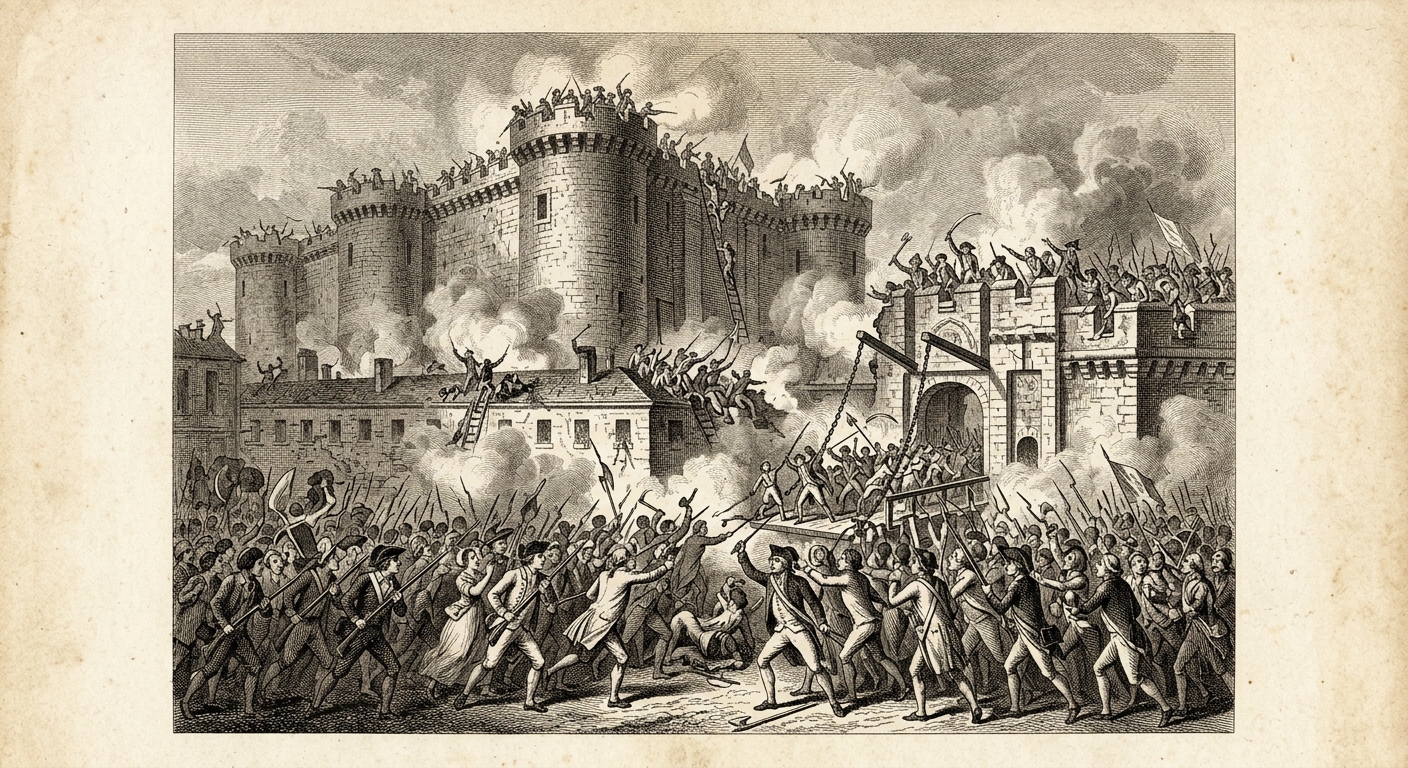
Storming of the Bastille
On July 14, a Paris crowd storms the Bastille prison — a hated symbol of royal tyranny — and releases its prisoners.
Why it mattered: The fall of the Bastille became the symbol of the Revolution. France still celebrates July 14 as Bastille Day.
- 1789
Declaration of the Rights of Man
The National Assembly adopts a declaration proclaiming that all men are born free and equal with rights to liberty, property, and security.
Why it mattered: Inspired by the American Declaration of Independence, it articulated the Revolution's ideals and influenced human rights documents around the world for generations.
- 1792
France Goes to War
France declares war on Austria and Prussia; a mob storms the royal palace and King Louis XVI is arrested.
Why it mattered: The war radicalized the Revolution — moderate voices lost control as the crisis deepened, setting the stage for the most violent phase.
- 1793
The Reign of Terror
Radical leader Maximilien Robespierre leads the Committee of Public Safety, executing thousands accused of being enemies of the Revolution.
Why it mattered: About 17,000 people were officially executed — including King Louis XVI and Marie Antoinette — showing how a revolution built on liberty could turn into tyranny.
- 1794
The Terror Ends
Members of the National Convention, fearing they were next, arrest and execute Robespierre, ending the Reign of Terror.
Why it mattered: The Revolution pulled back from extremism, but France remained unstable — governments rose and fell as the country struggled to find a stable new order.
- 1795
The Directory
A five-man committee called the Directory takes power, attempting to bring stability to post-Terror France.
Why it mattered: The Directory was corrupt and ineffective — France still faced war, inflation, and unrest. The stage was set for a military strongman to take over.
- 1798
Napoleon's Campaigns
General Napoleon Bonaparte wins a series of spectacular military victories in Italy and Egypt, making him the most famous man in France.
Why it mattered: Napoleon's military fame and political skill positioned him perfectly to step into the power vacuum left by the Directory's failures.
- 1799
Napoleon's Coup
Napoleon seizes power in a coup on November 9, ending the Revolution.
Why it mattered: Napoleon ended the Revolution's political chaos but preserved many of its reforms — and then spread its ideas of legal equality and nationalism across Europe through his conquests.
French Revolution Quiz
Check what you learned — read on screen, or use the Printable quiz button above for a worksheet version with an answer key.
What event is the symbol of the French Revolution's beginning?
- A) The adoption of the Declaration of the Rights of Man
- B) The storming of the Bastille prison on July 14, 1789
- C) The execution of King Louis XVI
- D) Napoleon's coup in 1799
What did the Third Estate declare itself in 1789?
- A) The Committee of Public Safety
- B) The Directory
- C) The National Assembly, claiming the right to write a new constitution for France
- D) The Revolutionary Guard
What did the Declaration of the Rights of Man proclaim?
- A) That France would become a republic immediately
- B) That the king had final authority over the constitution
- C) That all men are born free and equal with rights to liberty and security
- D) That France would declare war on all monarchies
What was the Reign of Terror?
- A) A period when the king's army attacked revolutionary mobs
- B) A period of mass executions led by Robespierre targeting suspected enemies of the Revolution
- C) The period of war with Austria and Prussia
- D) Napoleon's violent seizure of power
Who was Robespierre?
- A) The king who was guillotined in 1793
- B) A radical leader who led the Reign of Terror and was later executed himself
- C) A general who took power in 1799
- D) The founder of the Directory
How did the Reign of Terror end?
- A) Napoleon overthrew Robespierre
- B) Members of the National Convention arrested and executed Robespierre
- C) The king was restored to power
- D) Austria and Prussia invaded Paris
What were the main ideals of the French Revolution?
- A) Monarchy, order, and religious tradition
- B) Liberty, equality, and brotherhood — and the idea that government should serve the people
- C) Military strength, empire, and nationalism
- D) Democracy only for the educated classes
How did the French Revolution end?
- A) With the restoration of the king
- B) With a permanent democratic republic
- C) With Napoleon Bonaparte seizing power in a coup on November 9, 1799
- D) With a peace treaty signed with Austria
Show answer key
1. B · 2. C · 3. C · 4. B · 5. B · 6. B · 7. B · 8. C
Related timelines
 Renaissance Timeline — The Renaissance was a rebirth of art, learning, and science in Europe, beginning in Italy and spreading across the continent — bridging the Middle Ages and the modern world. Open →
 Industrial Revolution Timeline — The Industrial Revolution transformed the world from a farming society to a factory society, beginning in Britain and spreading across Europe and America. Open →
How to print
Choose Download PDF for a ready-to-print timeline that fits US Letter paper (8.5 × 11"). The blank fill-in version keeps the dates and gives students empty lines to write each event — great for review and quizzes.
Frequently asked questions
What caused the French Revolution?
France faced a combination of crises: the government was bankrupt after years of expensive wars, the harvest had failed and bread prices were soaring, and ordinary people had no real voice in government while the nobility paid little in taxes. When King Louis XVI called the Estates-General to fix the financial crisis, it triggered a broader revolution that overthrew the old order entirely.
What were the main ideas of the French Revolution?
The Revolution was built on the ideals of liberty, equality, and brotherhood. It challenged the divine right of kings, abolished feudalism, and declared that government should serve the people. These ideas, spread across Europe by Napoleon's conquests, influenced reform movements and revolutions for generations and are still central to modern democratic thought.
What paper size should I print this on?
The timeline is sized for standard US Letter paper (8.5 × 11 in.). The Download PDF button gives you a print-ready file that fits the page automatically.