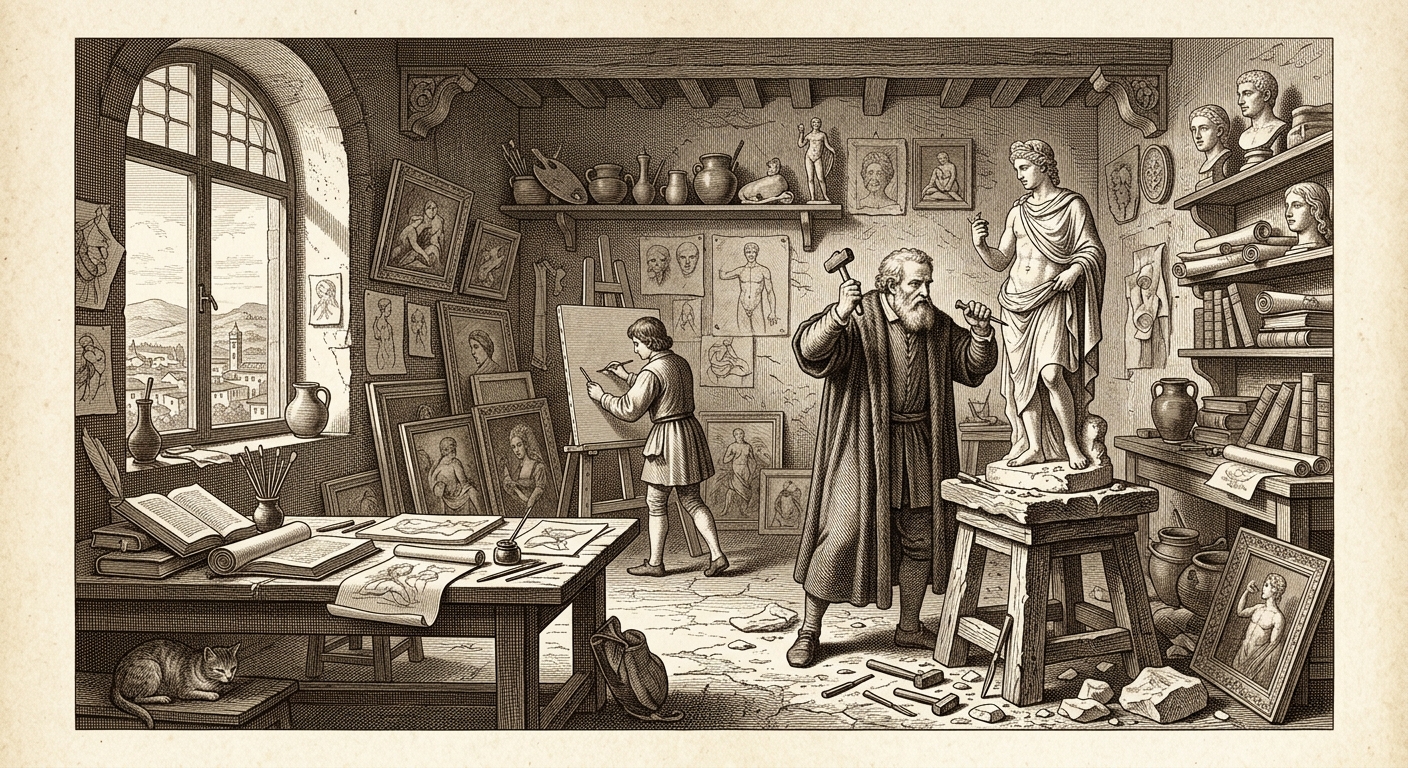
Renaissance Timeline
The Renaissance was a rebirth of art, learning, and science in Europe, beginning in Italy and spreading across the continent — bridging the Middle Ages and the modern world.
The word Renaissance means rebirth in French — and that is exactly what it was. Beginning in the wealthy city-states of northern Italy around 1300, artists, writers, and scholars rediscovered the literature and art of ancient Greece and Rome and began to see the world in a new way. Instead of focusing only on God and the afterlife, they became interested in the human experience — in beauty, knowledge, and the capacity of individual people to create great things. This new way of thinking spread from Florence to the rest of Europe, producing some of the greatest art, literature, and scientific ideas in human history, from Leonardo's notebooks to Shakespeare's plays to Copernicus's discovery that the Earth orbits the Sun.
- ~1300
Early Renaissance in Italy
In the wealthy city-states of northern Italy — Florence, Venice, and Siena — a revival of interest in ancient Greek and Roman culture begins to reshape art and learning.
Why it mattered: Italy's wealth from trade, its proximity to classical ruins, and its competitive city-states created perfect conditions for an explosion of creativity.
- 1304–74
Petrarch — Father of Humanism
Italian poet Petrarch revives interest in classical Roman literature and champions the study of human experience over purely religious scholarship.
Why it mattered: Petrarch's humanism — the belief that studying the humanities was essential to a full life — became the intellectual foundation of the Renaissance.
- ~1420s
Brunelleschi and Linear Perspective
Florentine architect Filippo Brunelleschi discovers the rules of linear perspective, allowing painters to represent depth on a flat surface.
Why it mattered: Linear perspective transformed art — suddenly painters could create a believable three-dimensional world, revolutionizing how Europeans depicted reality.
- 1434
The Medici Dominate Florence
Cosimo de' Medici and his banking family take control of Florence and become the leading patrons of Renaissance art and learning.
Why it mattered: The Medici bankrolled the Renaissance — funding Botticelli, Michelangelo, and Leonardo da Vinci, making Florence the artistic capital of Europe.
- 1455
Gutenberg Prints the Bible
Johannes Gutenberg produces the first book printed with movable type — making books far faster and cheaper to produce.
Why it mattered: The printing press spread Renaissance ideas across Europe faster than manuscripts ever could, putting books in the hands of a much wider audience.
- ~1495–1519
Leonardo da Vinci
Leonardo paints the Last Supper and the Mona Lisa, and fills thousands of notebook pages with scientific observations and inventive designs.
Why it mattered: Leonardo embodied the Renaissance ideal of the universal person — equally brilliant as painter, scientist, architect, and engineer.
- 1508–12
Michelangelo's Sistine Chapel
Michelangelo spends four years on his back painting the ceiling of the Sistine Chapel in the Vatican.
Why it mattered: The Sistine Chapel ceiling is one of the greatest achievements in Western art — it combined classical ideals of human beauty with Christian themes in a work still visited by millions.
- 1517
The Reformation Begins
Martin Luther posts his 95 Theses criticizing the Catholic Church; the printing press spreads his arguments across Europe within weeks.
Why it mattered: The Reformation fractured Western Christianity — and the intellectual questioning it unleashed deepened the Renaissance's challenge to traditional authority.
- 1543
Copernicus and the Solar System
Nicolaus Copernicus publishes his theory that the Earth orbits the Sun — not the other way around.
Why it mattered: Copernicus launched the Scientific Revolution, a fundamental shift in how Europeans understood the natural world — built on the Renaissance spirit of observation over tradition.
- ~1590–1613
Shakespeare
English playwright William Shakespeare writes Hamlet, Othello, King Lear, and dozens of other plays and sonnets in London.
Why it mattered: Shakespeare brought the Renaissance's rich exploration of human nature to the stage — his works are still performed more than any other playwright's, four centuries later.
Renaissance Quiz
Check what you learned — read on screen, or use the Printable quiz button above for a worksheet version with an answer key.
Where did the Renaissance begin?
- A) In Germany, with the printing press
- B) In France, at the royal court
- C) In the wealthy city-states of northern Italy, especially Florence
- D) In England, with Shakespeare's plays
What was humanism?
- A) A religious movement that rejected the Church
- B) An intellectual movement that emphasized classical texts and the study of human experience
- C) A style of painting using linear perspective
- D) The belief that science could replace religion
What did linear perspective allow artists to do?
- A) Paint religious scenes with greater emotional power
- B) Represent depth and three-dimensional space convincingly on a flat surface
- C) Use oil-based paint to create richer colors than before
- D) Print books using movable type
Who were the Medici?
- A) A Florentine banking family who became the leading patrons of Renaissance art
- B) A group of scientists who launched the Scientific Revolution
- C) The artists who painted the Sistine Chapel
- D) The inventors of the Gutenberg printing press
What was Leonardo da Vinci famous for?
- A) Painting the Sistine Chapel ceiling
- B) Being equally brilliant as a painter, scientist, and engineer
- C) Writing the 95 Theses that began the Reformation
- D) Discovering the rules of linear perspective
What did Michelangelo paint between 1508 and 1512?
- A) The Mona Lisa
- B) The Last Supper
- C) The ceiling of the Sistine Chapel
- D) The School of Athens fresco
How did the printing press help spread the Renaissance?
- A) It allowed artists to copy classical statues more accurately
- B) It made books faster and cheaper to produce, spreading Renaissance ideas to a much wider audience
- C) It helped Copernicus prove the Earth orbited the Sun
- D) It funded the Medici banking family's art patronage
What did Copernicus propose in 1543?
- A) That the Earth was round, not flat
- B) That all humans share common ancestors
- C) That the Earth orbits the Sun, not the other way around
- D) That the Catholic Church needed reform
Show answer key
1. C · 2. B · 3. B · 4. A · 5. B · 6. C · 7. B · 8. C
Related timelines
 Middle Ages Timeline — The Middle Ages lasted roughly a thousand years after the fall of Rome, shaped by feudalism, the Catholic Church, crusades, and plagues — ending on the eve of the Renaissance. Open →
 Age of Exploration Timeline — The Age of Exploration was the period when European sailors mapped the world, opening sea routes to Asia, reaching the Americas, and beginning a new era of global trade — and colonization. Open →
How to print
Choose Download PDF for a ready-to-print timeline that fits US Letter paper (8.5 × 11"). The blank fill-in version keeps the dates and gives students empty lines to write each event — great for review and quizzes.
Frequently asked questions
What was the Renaissance?
The Renaissance (French for rebirth) was a cultural and intellectual movement that began in Italy around 1300 and spread across Europe by 1600. It was characterized by a revival of interest in classical Greek and Roman culture, a new focus on human experience and individual achievement, and an explosion of art, literature, architecture, and science. It marked the transition from the medieval world to the modern world.
What is the Renaissance known for?
The Renaissance produced some of the world's most enduring works of art and thought: Leonardo da Vinci's Mona Lisa, Michelangelo's Sistine Chapel and David, Shakespeare's plays, Machiavelli's political writing, and Copernicus's discovery that the Earth orbits the Sun. It also saw the invention of the printing press, which spread these ideas across Europe and made knowledge widely accessible for the first time.
What paper size should I print this on?
The timeline is sized for standard US Letter paper (8.5 × 11 in.). The Download PDF button gives you a print-ready file that fits the page automatically.