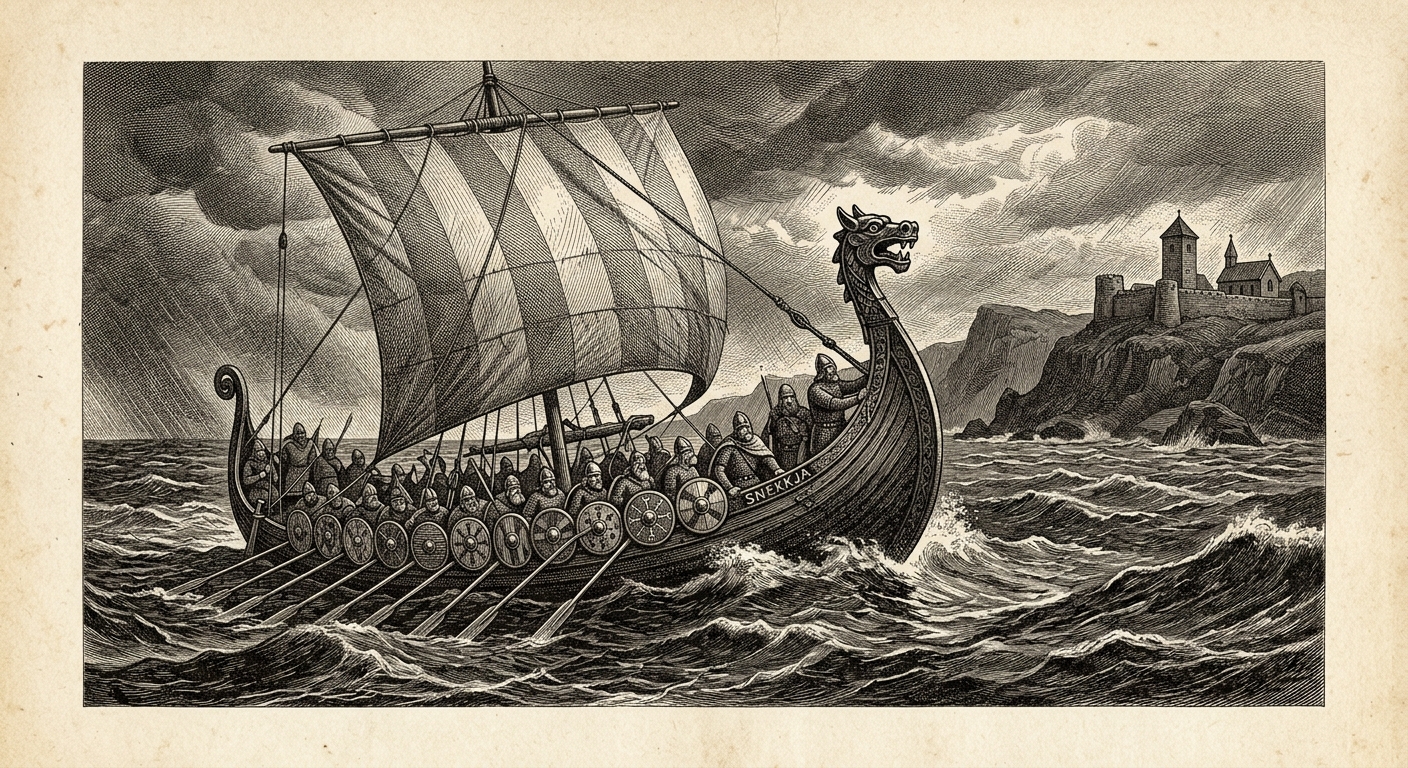
Viking Age Timeline
The Viking Age was a period of Norse exploration, trade, and raiding that transformed medieval Europe — sending Scandinavian warriors and settlers as far as North America in the west and Central Asia in the east.
The Viking Age began with a shock. In 793 CE, Norse warriors appeared without warning at the monastery of Lindisfarne off the northeast coast of England — looting the church, killing the monks, and vanishing back to sea. For the Christian kingdoms of Europe, it felt like the end of the world. But the Vikings were not merely raiders. They were traders, explorers, settlers, and state-builders on a scale that has few parallels in history. Norse longships crossed the open Atlantic to Iceland, Greenland, and — five centuries before Columbus — the coast of North America. Viking traders paddled Russia's rivers to reach Constantinople and Baghdad. Norse settlers founded Dublin, discovered Iceland, and gave their name to Normandy. When the Viking age ended in 1066, it ended with a Viking descendant — William the Conqueror — seizing the throne of England at the Battle of Hastings. The impact of those 270 years is still visible in English words, Irish cities, Russian history, and the DNA of millions of people across the Northern Hemisphere.
- 793
Raid on Lindisfarne
Norse warriors attack the monastery of Lindisfarne off the northeast coast of England — looting its treasures, killing monks, and disappearing by sea — in the first recorded Viking raid in history.
Why it mattered: The Lindisfarne raid shocked Christian Europe and announced that a new force had arrived — the speed, ruthlessness, and seamanship of the Norse raiders gave them an advantage that no coastal monastery or settlement could easily defend against.
- 800s
Vikings Expand in All Directions
Over the 9th century, Norse raiders and traders spread across Europe simultaneously — raiding the coasts of France, Ireland, and Spain; establishing trade routes deep into Russia; settling the Faroe Islands; and appearing as far south as the Mediterranean.
Why it mattered: The speed and reach of Viking expansion transformed the political map of Europe — every coastal kingdom from Ireland to the Byzantine Empire had to respond to the Norse presence, through tribute, alliances, or military reorganization.
- 840s–860s
Dublin and Kievan Rus Founded
Norse settlers establish a permanent base at Dublin (841), which grows into one of medieval Europe's most important trading ports; Varangian (eastern Viking) traders establish control over river trade routes through what is now Russia, helping found the city of Kyiv.
Why it mattered: Dublin and Kievan Rus show the Vikings as builders, not just raiders — Dublin became the center of Irish commerce for centuries, and the Varangian trade network connecting Scandinavia to Constantinople and Baghdad moved enormous quantities of silver, furs, and slaves.
- 874
Settlement of Iceland
Large-scale Norse settlement of Iceland begins; by 930 CE, settlers establish the Althing — a national assembly of chieftains held every summer — one of the world's oldest parliaments.
Why it mattered: Iceland's Althing is remarkable evidence of Norse political sophistication — a society of settlers with no king established one of history's earliest representative assemblies, creating a legal and political order through agreement rather than conquest.
- 911
Rollo Founds Normandy
The Viking leader Rollo negotiates a treaty with the King of France, receiving the territory around Rouen in exchange for defending it from further Norse raids; he becomes the first Duke of Normandy.
Why it mattered: Normandy's founding shows how Viking settlements transformed from raids into permanent political entities — within a few generations, the descendants of Norse raiders had become French-speaking Christian knights, and their leader William would conquer England in 1066.
- c. 1000
Leif Erikson Reaches North America
Norse explorer Leif Erikson sails from Greenland and establishes a settlement at L'Anse aux Meadows in Newfoundland, Canada — the first confirmed European presence in the Americas, roughly 500 years before Columbus.
Why it mattered: L'Anse aux Meadows (confirmed by archaeology in 1960) proved that Europeans reached the Americas in the Viking Age — though the Norse settlements did not last, the discovery reframes the 'discovery of America' as part of a much longer and more complex story.
- 1013–16
Vikings Conquer England
Danish King Sweyn Forkbeard conquers England in 1013; his son Cnut becomes King of England in 1016, then also rules Denmark and Norway — assembling a North Sea empire that unites Scandinavia and England under one ruler.
Why it mattered: Cnut's North Sea Empire was the Viking Age's political high point — a Scandinavian king ruling England, Denmark, and Norway simultaneously, demonstrating that Norse power had evolved from seaborne raiding into dynastic statecraft.
- 1066
Norman Conquest Ends the Viking Age
At the Battle of Hastings on October 14, 1066, William the Conqueror — Duke of Normandy and a direct descendant of the Viking Rollo — defeats King Harold of England and seizes the throne, transforming English language, law, and culture.
Why it mattered: The Norman Conquest is simultaneously the end of the Viking Age and its greatest legacy — the conqueror of England was a Viking descendant, and the French-Norse hybrid culture his army brought transformed the English language and political system for centuries.
Viking Age Quiz
Check what you learned — read on screen, or use the Printable quiz button above for a worksheet version with an answer key.
What event is traditionally considered the start of the Viking Age?
- A) The settlement of Iceland by Norse colonists around 874 CE
- B) The founding of the city of Dublin as a Norse trading post
- C) The Norse raid on the monastery of Lindisfarne in 793 CE
- D) The death of Charlemagne, which weakened European defenses against Norse raiders
What was the Althing, established in Iceland around 930 CE?
- A) A Viking war council that planned raids on the coasts of France and England
- B) One of the world's oldest parliaments — a national assembly of Icelandic chieftains that governed the island
- C) A Norse religious ceremony held at midsummer to honor the gods Odin and Thor
- D) The name for the longship fleet that Leif Erikson used to reach North America
Who was Rollo, and what did he establish in 911?
- A) A Norwegian explorer who founded the settlement at L'Anse aux Meadows in Newfoundland
- B) A Viking trader who established the river trade routes connecting Scandinavia to Constantinople
- C) A Norse leader who received land from the King of France, founding the Duchy of Normandy
- D) A Danish king who conquered England in 1013 and united Scandinavia under one rule
What did Leif Erikson discover around 1000 CE?
- A) A sea route from Scandinavia to Constantinople through the rivers of eastern Europe
- B) The island of Iceland, which Norse settlers then colonized over the following decades
- C) A settlement at L'Anse aux Meadows in Newfoundland — the first confirmed European presence in the Americas
- D) A passage through the Arctic Ocean connecting the Atlantic to the Pacific
Who was King Cnut, and what made his reign significant?
- A) The last Viking king of Norway, who was defeated by English forces and ended the Viking Age
- B) A Danish king who assembled a North Sea empire ruling England, Denmark, and Norway simultaneously
- C) A Norse explorer who led the expedition that established the settlement at L'Anse aux Meadows
- D) The Viking leader who founded Kievan Rus after controlling the river trade routes through eastern Europe
How were Vikings different from the popular image of purely destructive raiders?
- A) Vikings were actually peaceful farmers who only raided other Scandinavian settlements
- B) While they did raid, Vikings were also traders, explorers, settlers, and state-builders who founded cities and trade networks across Europe and beyond
- C) Vikings were primarily Christian missionaries who used the threat of force to convert European pagans
- D) Vikings were sophisticated naval builders whose ship designs were adopted by all European kingdoms
How did the Norman Conquest of 1066 connect to the Vikings?
- A) William the Conqueror recruited Viking mercenaries from Scandinavia to supplement his Norman army
- B) The Normans who invaded England were themselves descended from Vikings — Rollo's descendants had settled in Normandy 150 years earlier
- C) Harald Hardrada's Viking army weakened King Harold's forces before William's invasion at Hastings
- D) The Vikings had previously conquered England under Cnut, making English resistance to Norman rule much weaker
What long-term legacies did the Viking Age leave in European history?
- A) The Vikings introduced Christianity to northern Europe, converting Scandinavia from paganism
- B) Viking raids caused such devastation that European populations declined dramatically throughout the 9th century
- C) The Viking Age left permanent marks in English vocabulary, Irish cities like Dublin, Russian history, and the Norman transformation of English culture after 1066
- D) The Vikings established a unified Scandinavian kingdom that still governs the Nordic countries today
Show answer key
1. C · 2. B · 3. C · 4. C · 5. B · 6. B · 7. B · 8. C
Related timelines
 Middle Ages Timeline — The Middle Ages lasted roughly a thousand years after the fall of Rome, shaped by feudalism, the Catholic Church, crusades, and plagues — ending on the eve of the Renaissance. Open →
 Age of Exploration Timeline — The Age of Exploration was the period when European sailors mapped the world, opening sea routes to Asia, reaching the Americas, and beginning a new era of global trade — and colonization. Open →
How to print
Choose Download PDF for a ready-to-print timeline that fits US Letter paper (8.5 × 11"). The blank fill-in version keeps the dates and gives students empty lines to write each event — great for review and quizzes.
Frequently asked questions
Did Vikings really wear horned helmets?
No — horned helmets are a myth. Actual Viking helmets found by archaeologists are simple iron or leather caps, sometimes with a nose guard, but no horns. The horned helmet image comes from 19th-century Romantic art and opera costumes, not from historical evidence. Vikings did sometimes use horned helmets in religious ceremonies, but not in battle, where horns would be a dangerous liability. The Gjermundbu helmet, the only complete Viking Age helmet ever found, has no horns whatsoever.
How far did Vikings actually travel?
The Viking reach was extraordinary. Norse traders and settlers reached Iceland (874), Greenland (985), and North America (c. 1000) to the west. To the east, Varangian traders paddled Russia's rivers to reach Constantinople (Istanbul) and Baghdad, trading furs, amber, and slaves for silver coins. In the south, Norse raiders reached Spain, Portugal, Morocco, and Italy. Viking mercenaries served as the elite bodyguard of Byzantine emperors in Constantinople. A few individual Norse travelers may even have reached the Middle East. The Viking world was genuinely global for its time.
What paper size should I print this on?
The timeline is sized for standard US Letter paper (8.5 × 11 in.). The Download PDF button gives you a print-ready file that fits the page automatically.