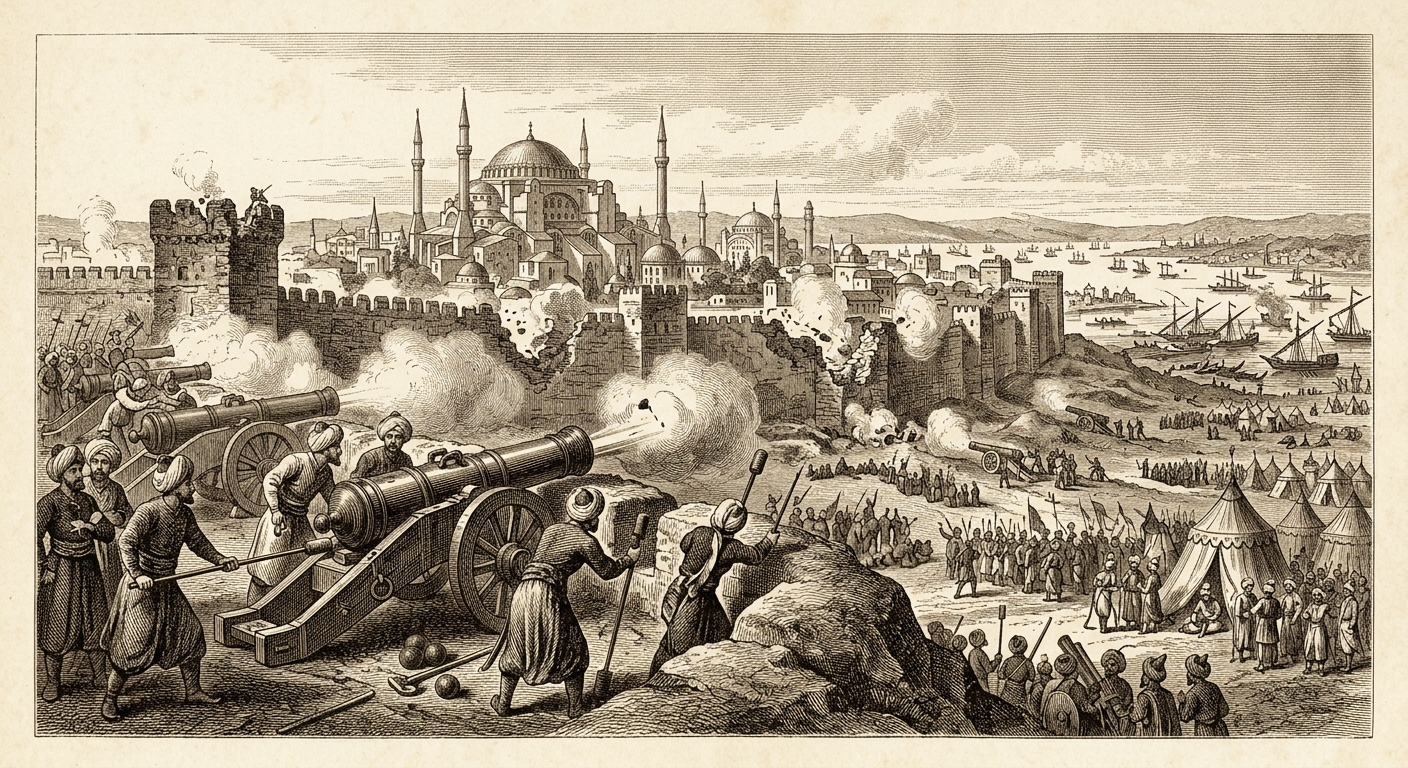
Ottoman Empire Timeline
The Ottoman Empire was one of history's greatest empires — a Turkish state that grew from a small principality in Anatolia into a civilization spanning three continents, lasting more than 600 years before collapsing after World War I.
The Ottoman Empire began as a small warrior state on the frontier of the Byzantine Empire — just a few thousand soldiers loyal to a chieftain named Osman. Over the next 600 years, his descendants built one of the greatest empires the world has ever seen. At its height under Suleiman the Magnificent, the empire stretched from Hungary in the west to Persia in the east, from Egypt in the south to the Black Sea in the north. It was a center of law, art, and scholarship, and its capital Constantinople was one of the world's great cities. But like all empires, it rose, peaked, and declined. By the 1800s Europeans called it the 'Sick Man of Europe.' Its collapse after World War I created the modern map of the Middle East — borders still debated today.
- c. 1299
Osman I Founds the Dynasty
A Turkish warrior named Osman I establishes a small principality in northwestern Anatolia and begins raiding the weakening Byzantine Empire.
Why it mattered: Osman's small state was the seed from which one of history's great empires grew — his successors would expand it into a civilization covering three continents at its height.
- 1453
Fall of Constantinople
Ottoman Sultan Mehmed II captures Constantinople — capital of the Byzantine Empire for over a thousand years — using massive cannons that breach its legendary walls; he renames it Istanbul.
Why it mattered: The fall of Constantinople ended the Byzantine Empire and transformed trade routes between Europe and Asia, helping push European explorers to find sea routes to Asia — directly contributing to the Age of Exploration.
- 1520–66
Suleiman the Magnificent
Suleiman I rules at the height of Ottoman power — the empire stretches from Hungary to Baghdad; law, architecture, and the arts flourish; the Ottoman navy dominates the Mediterranean.
Why it mattered: Suleiman's reign was the Ottoman golden age — the empire was larger and more powerful than any in Europe, and became a center of scholarship, art, and law that rivaled Renaissance Europe.
- 1571
Battle of Lepanto
A coalition of European Christian powers defeats the Ottoman navy off the coast of Greece — the first major Ottoman military defeat in over a century.
Why it mattered: Lepanto shattered the myth of Ottoman naval invincibility, though the Ottomans quickly rebuilt their fleet; it marked the beginning of a slow shift in the balance of power between the Ottoman Empire and Europe.
- 1683
Failed Siege of Vienna
Ottoman forces surround Vienna in their deepest push into Europe, but are defeated by a combined Polish-Habsburg army — marking the high-water mark of Ottoman expansion westward.
Why it mattered: Vienna was the turning point: after 1683, the Ottomans were steadily pushed back in Europe, beginning the long decline that would last until the empire's end in 1922.
- 1800s
The 'Sick Man of Europe'
The Ottoman Empire loses territory in a series of wars and nationalist rebellions; European powers call it the 'Sick Man of Europe' and compete to control its declining lands.
Why it mattered: Ottoman decline created a dangerous power vacuum — each European power maneuvering for Ottoman territory contributed directly to the instability that caused World War I.
- 1914–18
World War I
The Ottomans enter World War I allied with Germany and Austria-Hungary; they fight on multiple fronts and commit genocide against Armenian Christians; they lose the war and their Arab territories are divided by the victorious Allies.
Why it mattered: World War I destroyed the Ottoman Empire — the Arab lands were split between Britain and France, creating borders whose legitimacy is disputed to this day, while the heartland of Anatolia faced occupation.
- 1922–23
Republic of Turkey Founded
The Ottoman sultanate is abolished in 1922; Mustafa Kemal (Atatürk) then leads a successful war of independence and proclaims the modern secular Republic of Turkey in 1923.
Why it mattered: The Ottoman Empire — lasting over 600 years — was replaced by a modern nation-state; its collapse also created the modern map of the Middle East, drawn by European powers with consequences felt to this day.
Ottoman Empire Quiz
Check what you learned — read on screen, or use the Printable quiz button above for a worksheet version with an answer key.
Who founded the Ottoman dynasty around 1299?
- A) Suleiman the Magnificent
- B) Sultan Mehmed II
- C) Osman I, a Turkish warrior chieftain in Anatolia
- D) Saladin, the Kurdish general who recaptured Jerusalem
What happened when Mehmed II captured Constantinople in 1453?
- A) He converted it to a Christian capital and renamed it Rome
- B) He destroyed the city and moved the capital to Ankara
- C) He ended the Byzantine Empire and renamed the city Istanbul, making it the Ottoman capital
- D) He signed a peace treaty with Byzantine Emperor Constantine XI
Why is Suleiman called 'the Magnificent'?
- A) He conquered all of Europe and Asia in a single military campaign
- B) He ruled during the Ottoman golden age, when the empire reached its greatest size and cultural achievement
- C) He was the first Ottoman sultan to convert to Christianity
- D) He built the Hagia Sophia church in Constantinople
What was the significance of the Battle of Lepanto in 1571?
- A) It was the battle where Suleiman the Magnificent died
- B) A European coalition defeated the Ottoman navy for the first time in over a century, challenging Ottoman sea power
- C) The Ottomans captured Vienna, their deepest advance into Europe
- D) The Ottoman Empire and Spain signed a peace treaty ending decades of conflict
What happened at the Siege of Vienna in 1683?
- A) Ottoman forces captured Vienna and expanded deep into western Europe
- B) The Ottoman navy destroyed the Habsburg fleet in the Danube River
- C) Ottoman forces were defeated, marking the turning point and the beginning of Ottoman retreat in Europe
- D) Austria signed a peace treaty giving the Ottomans control of Hungary
Why did Europeans call the Ottoman Empire the 'Sick Man of Europe' in the 1800s?
- A) Because plague epidemics kept reducing the Ottoman population
- B) Because the empire was losing territory, facing nationalist revolts, and struggling economically
- C) Because the Ottoman sultan had become mentally ill
- D) Because the empire refused to trade with European nations
What happened to Ottoman territories after World War I?
- A) The Ottomans kept all their territories because they had not started the war
- B) The Ottoman Empire expanded into Europe as a reward for helping the Allies
- C) The Arab lands were divided between Britain and France, and Anatolia was occupied — leading to Turkish independence under Atatürk
- D) The League of Nations declared the Ottoman territories an international zone
What did Atatürk establish in 1922–23?
- A) The Kingdom of Arabia, carved out of the former Ottoman Arab provinces
- B) The modern secular Republic of Turkey, replacing the Ottoman sultanate
- C) A new Ottoman Empire with a constitutional monarchy
- D) The League of Arab States, uniting all former Ottoman Arab territories
Show answer key
1. C · 2. C · 3. B · 4. B · 5. C · 6. B · 7. C · 8. B
Related timelines
 World War I Timeline — World War I was a global war fought mainly in Europe from 1914 to 1918. The United States stayed neutral for three years before entering on the Allied side in 1917. Open →
 Age of Exploration Timeline — The Age of Exploration was the period when European sailors mapped the world, opening sea routes to Asia, reaching the Americas, and beginning a new era of global trade — and colonization. Open →
How to print
Choose Download PDF for a ready-to-print timeline that fits US Letter paper (8.5 × 11"). The blank fill-in version keeps the dates and gives students empty lines to write each event — great for review and quizzes.
Frequently asked questions
How long did the Ottoman Empire last?
The Ottoman Empire lasted from approximately 1299, when Osman I established his principality, to 1922, when the sultanate was abolished and the Republic of Turkey was proclaimed — over 620 years. At its height in the 16th and 17th centuries under Suleiman the Magnificent, it was one of the largest and most powerful empires in the world, controlling territory across three continents: southeastern Europe, western Asia, and northern Africa.
How did the Ottoman Empire affect the modern Middle East?
The Ottoman Empire's collapse after World War I directly created the modern map of the Middle East. Britain and France divided the Ottoman Arab territories between themselves under the Sykes-Picot Agreement, drawing borders that created the modern states of Iraq, Syria, Lebanon, Palestine/Israel, and Jordan. These borders often cut across ethnic, religious, and tribal lines without regard for local populations, creating tensions and conflicts that continue today. The Ottoman period also shaped the religious, cultural, and legal traditions of the entire region.
What paper size should I print this on?
The timeline is sized for standard US Letter paper (8.5 × 11 in.). The Download PDF button gives you a print-ready file that fits the page automatically.